
Short answer: Ludwigia hyssopifolia, called linear-leaf water primrose or seedbox, is an upright annual of wet ground with narrow lance-shaped leaves, 3- to 4-angled stems and tiny yellow flowers with four petals only 2–3 mm long. It is not the aggressive floating water primrose that chokes lakes in Europe and the western US; that is L. grandiflora or L. hexapetala, which has five or six petals the size of a coin. Where L. hyssopifolia causes real losses is lowland rice in South and Southeast Asia, where the International Rice Research Institute lists it among its “dirty dozen” weeds. One plant can shed around 250,000 seeds, but those seeds need light: burying them 1 cm (0.4 in) deep or flooding the field early stops most seedlings from coming up.
How to identify Ludwigia hyssopifolia
The IRRI Rice Knowledge Bank and the Flora of China describe the plant consistently:
- Habit: an erect annual, usually 15–150 cm (6 in to 5 ft) tall. Occasionally to 3 m and woody at the base; young growth finely hairy.
- Stems: branched, green or purplish, often 3- or 4-angled. Stems standing in water grow white, spongy breathing roots (pneumatophores).
- Leaves: alternate, lance-shaped to linear-lanceolate, 2–9 cm long and 0.5–2 cm wide, narrowing to a short stalk and a pointed tip.
- Flowers: single, stalkless, in the leaf axils. There are 4 green sepals 2–4 mm long and 4 yellow petals 2–3 mm long that fade to orange-yellow, plus 8 stamens.
- Fruit: a slender, finely hairy, almost cylindrical capsule 1.5–3 cm long and about 1 mm thick, slightly swollen in its upper part.
- Seeds: two kinds. The upper, swollen part of the capsule holds loose pale seeds 0.3–0.5 mm long. The lower part holds larger brown seeds, 0.7–0.9 mm, each set in a cube of corky tissue. This mix is the most reliable feature.
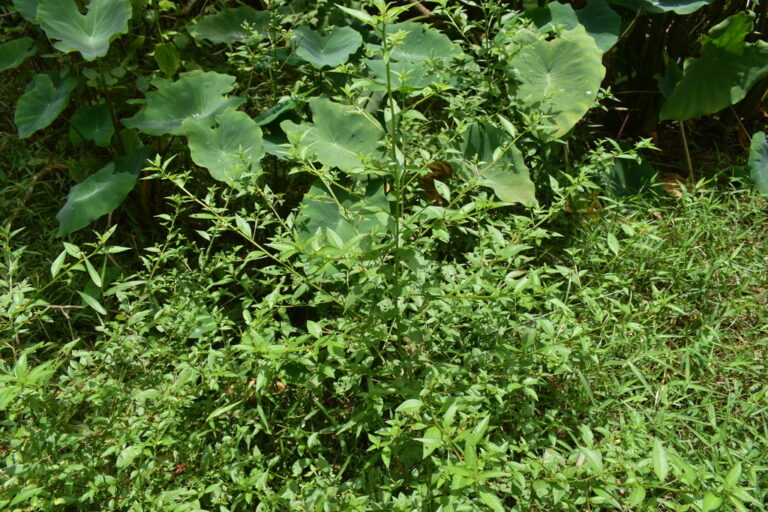
Note that “seedbox” is also the name of L. alternifolia, a native North American wetland plant with larger flowers and a squat, cube-shaped capsule. In North America, a plant with square pods is almost certainly that native.
Look-alikes: which water primrose do you have?
Flower size and petal count separate most species. The table uses the Flora of China key to Ludwigia with the USGS fact sheets for Peruvian primrose-willow and six-petal water primrose.
| Species | Growth form | Petals | Capsule | Where it matters |
|---|---|---|---|---|
| L. hyssopifolia | Erect annual, 0.15–1.5 m; angled stems | 4, yellow, 2–3 mm | Slender, 1.5–3 cm × ~1 mm, swollen near the top; two seed types | Lowland rice, ditches and pond margins in the tropics |
| L. octovalvis (primrose willow) | Robust perennial to 4 m, often hairy and woody at the base | 4, yellow, 6–17 mm | 1.7–4.5 cm × 2–8 mm, with 8 darker ribs | Pantropical wetlands and rice; much bigger flowers |
| L. adscendens (water primrose) | Creeping or floating perennial, rooting at nodes, with clusters of white spindle-shaped floats 1–3 cm long | 5, creamy white with a yellow base, 9–18 mm | 1.2–2.7 cm × 3–4 mm, on a stalk 1.5–5.5 cm long | Flooded paddies and tank edges in Asia |
| L. peruviana (Peruvian primrose-willow) | Shrubby, hairy perennial, 1–4 m | 4 (rarely 5), yellow, 1–3 cm | Short, stout, four-angled, 1–3 cm | Non-native in Florida and other south-eastern US wetlands |
| L. grandiflora / L. hexapetala | Perennial with floating runners forming mats plus upright flowering stems | 5 (sometimes 6), bright yellow, 1–2 cm | 1–2.5 cm × 3–4 mm, hairy | Regulated invasive in the EU and UK; listed noxious weed in California |
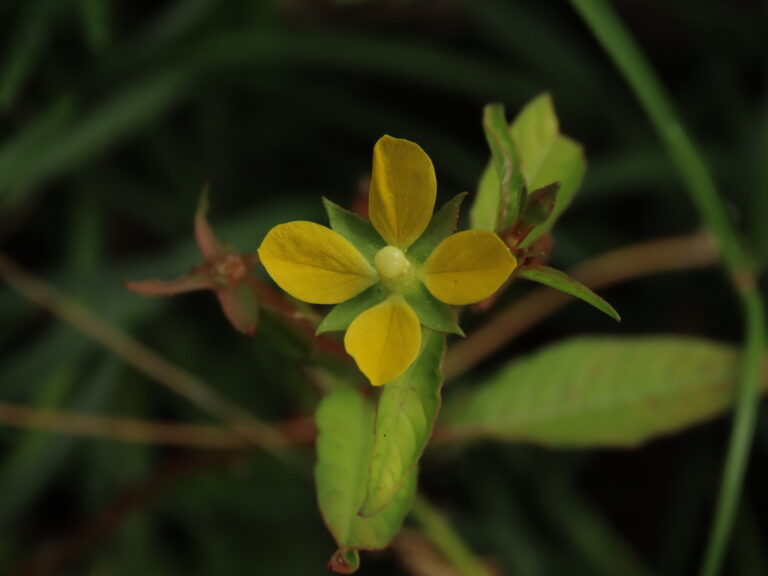
Two other small-flowered species can confuse matters in Asia. L. prostrata and L. perennis have as many stamens as sepals, usually 4 (L. hyssopifolia has 8), and their seeds are all loose rather than of two kinds.
Where it grows
This is a pantropical weed of uncertain origin. The Pacific Island Ecosystems at Risk (PIER) profile quotes floras that record it from Africa, India, Sri Lanka, southern China, Malesia, Micronesia and northern Australia, with more recent populations in Fiji and Samoa. IRRI adds most rice-growing countries of South and Southeast Asia, parts of West Africa, and Colombia and Suriname. Claims that it is an American plant spreading outward are not supported by these sources.
Its habitat is open, wet, often disturbed ground: rice fields, shallow pools, ditches, canal banks and stream edges, on heavy clay as well as sand.
Seed biology: why it is hard to get rid of
According to IRRI, a single plant can produce about 250,000 seeds, released gradually. They float for up to 16 days, so irrigation water carries them between fields, and germinate anywhere between 10 and 40 °C (50–104 °F).
The weak points are light and water. In trials at IRRI, Chauhan and Johnson (Crop Protection, 2009) found that germination was strongly stimulated by light and that no seedlings emerged from seed buried 1 cm or deeper. Flooding to 2 cm (under an inch) for 4 days out of 7 reduced emergence by more than 71% and seedling dry weight by 97%. Flooding to 10 cm did not suppress the weed when it was delayed until 21 days after sowing. In a later IRRI screenhouse study published in Frontiers in Plant Science (2018), keeping 2 or 5 cm of water on the soil cut its emergence by 89–95%.
Impact in rice
IRRI rates L. hyssopifolia a serious weed of lowland rice on clay-loam and clay soils. It is worst in direct-seeded rice, where crop and weed emerge together with no standing water, and it competes mainly for light. When grown under a rice canopy, the plants in a Weed Science study by Chauhan, Pame and Johnson (2011) moved 82% of their leaf weight into the upper half of the plant, compared with 25% for plants grown alone. The same authors conclude that dense rice stands can still hold it back.
How to control it in rice
- Prepare the land to bury the seed. Puddling or tillage that leaves the seed 1 cm or more deep stops germination.
- Flood early, not late. A shallow 2–5 cm (1–2 in) water layer put on soon after sowing or transplanting does most of the work. Flooding started three weeks after sowing comes too late. In dry-seeded rice, flooding also slows crop emergence, so check that your variety tolerates early flooding.
- Grow a dense, even crop. Uniform stands and closer spacing shade the weed, which is its main weakness.
- Hand-weed before seed set. IRRI names hand weeding and tillage as the usual controls. Weed in the first few weeks, before capsules form, and carry any podded plants out of the field.
- Herbicides, where registered. IRRI lists MCPA and 2,4-D as post-emergence options, plus quinclorac + bensulfuron and molinate + 2,4-D. Registrations differ by country, so use only products registered for rice where you farm and follow the label.
Control in garden ponds, ditches and wet borders
In a garden, L. hyssopifolia is an annual, so the aim is simply to stop it seeding.
- Pull plants, roots included, as soon as you recognise them; they come out easily from soft mud.
- If capsules have formed, snip them into a bag first. Do not put seeding plants on an open compost heap. Our guide to disposing of invasive plants safely covers bagging and drying.
- Keep exposed mud covered, with mulch, planting or standing water, because the seed needs light to germinate. Check pond margins for seedlings whenever the water level drops in summer.
- Avoid herbicide in or beside water unless the product is labelled for aquatic use. Many places also require a permit for that.
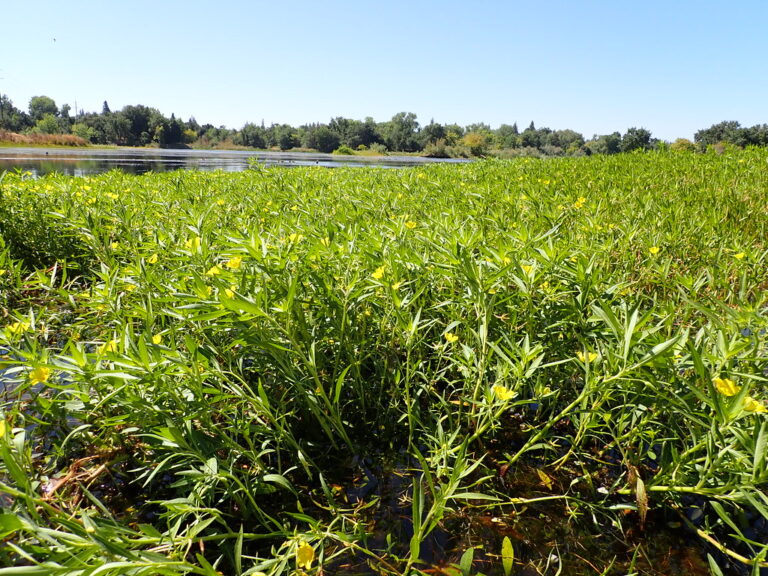
If your pond plant has large five- or six-petalled flowers and runners across the water, treat it as L. grandiflora or L. hexapetala. The California Invasive Plant Council rates it High impact: its mats block water flow, crowd out native plants and reduce habitat for waterbirds and fish, and fragments caught on boats start new colonies. The EPPO Global Database shows L. grandiflora listed as an invasive alien species of EU concern since 2016 and regulated in the UK, so it may not be sold or planted there. Report it to your local invasive-species authority. Like water hyacinth or water lettuce, it needs containment, not casual pulling.
Traditional uses
The Useful Tropical Plants database, drawing on Plant Resources of South-East Asia and Flora Malesiana, records folk uses of the plant for diarrhoea, dysentery and enteritis, a poultice for boils and pimples, a leaf decoction for fever, and a black dye made from the whole plant. Laboratory and animal studies have tested extracts, but there is no clinical evidence of safety or benefit in people, and plants from rice fields and ditches may carry herbicide residues. Do not use it as a remedy without advice from a qualified health professional.
Related guides: Tiger Foot Morning Glory (Ipomoea pes-tigridis): Identification and Control
Plant uses are described here as background only. Nothing on this page is medical advice, and no wild plant should be eaten or used as a remedy based on a website. See our disclaimer.
Sources
- IRRI Rice Knowledge Bank – Ludwigia hyssopifolia fact sheet
- Flora of China – Ludwigia hyssopifolia and key to Ludwigia
- Chauhan & Johnson (2009), Crop Protection – emergence and growth as affected by light, burial depth and water management
- Chauhan, Pame & Johnson (2011), Weed Science – compensatory growth of ludwigia in direct-seeded rice
- Chamara et al. (2018), Frontiers in Plant Science – sowing and flooding depth in dry-seeded rice
- Pacific Island Ecosystems at Risk – Ludwigia hyssopifolia
- USGS Nonindigenous Aquatic Species – Ludwigia hexapetala and Ludwigia peruviana
- California Invasive Plant Council – Ludwigia hexapetala profile
- EPPO Global Database – Ludwigia grandiflora categorization
- Useful Tropical Plants – Ludwigia hyssopifolia