
Short answer: Caesar weed (Urena lobata, also called Congo jute, aramina or cadillo) is a hibiscus-family shrub with rough, shallowly lobed leaves, small pink flowers about 2–3 cm (1 in) across and round burs covered in hooked bristles. It is listed as a Category I invasive in Florida, is on Hawaii’s noxious weed list and is a serious weed across the Pacific. Pull or dig young plants before the burs form, and spray larger stands with a broadleaf herbicide such as triclopyr or 2,4-D. The same plant was once a commercial fibre crop, and its leaves and roots have a long list of folk-medicine uses that have not been confirmed in people.
What Caesar weed is
Urena lobata belongs to the mallow family (Malvaceae), the same family as cotton, okra and hibiscus. It grows as an annual or short-lived perennial shrub. Weedy plants are usually 0.5–2.5 m (1.5–8 ft) tall and branch from low down. Plants grown for fibre are taller and less branched, up to 5 m (16 ft), according to the PROTA (Plant Resources of Tropical Africa) account. UF/IFAS notes that it can reach 2–7 ft in its first year and up to 10 ft (3 m) eventually.
Its origin is uncertain. Tropical Asia, where its closest relatives grow, and Africa are the usual candidates. It has spread through the tropics and subtropics for at least three centuries. It needs warmth and does best at average temperatures of 21–27 °C (70–81 °F). Frost kills it, so it is a weed of Florida, the Caribbean, Hawaii, the Pacific islands, Africa and tropical Asia, not of cool-temperate gardens.
How to identify Caesar weed
Three features together identify it: the leaves, the flowers and the burs.
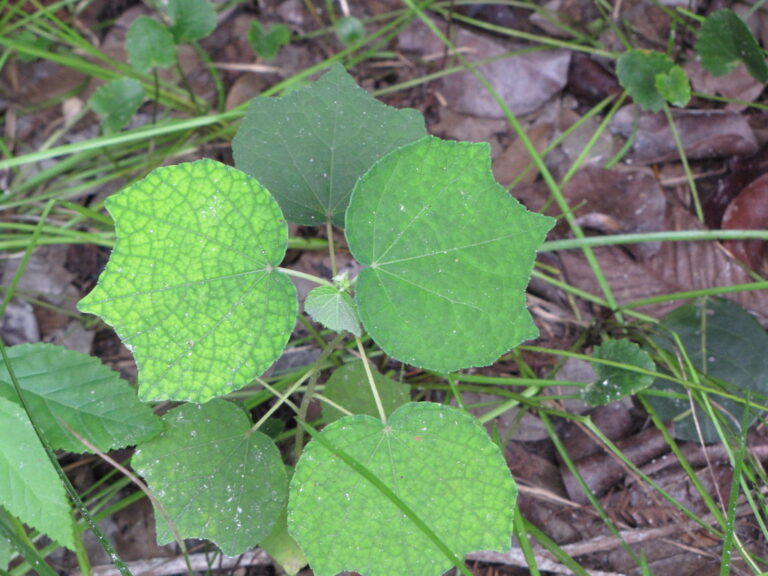
- Leaves: alternate on the stem, broadly ovate to roundish, usually with 3–5 shallow, angular lobes, so they look a little like a small maple leaf. The upper surface feels rough like fine sandpaper, and the underside is greyish because of dense star-shaped hairs. Leaf size varies a lot, from about 1 to 12 cm (0.5–5 in).
- A small gland under the leaf: turn a leaf over and look at the base of the main veins. You will find one to three small slit-like nectaries. Ants often visit them. This detail separates Urena from its close relative Pavonia.
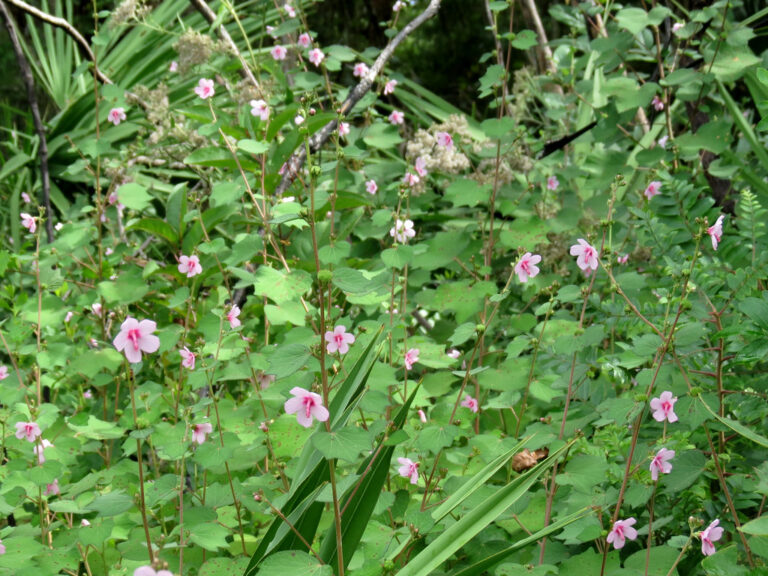
- Flowers: single or in small clusters where the leaf joins the stem. Each has five pink petals, darker toward the centre, and a central column of stamens like a hibiscus. They open early in the morning and wither by about noon.
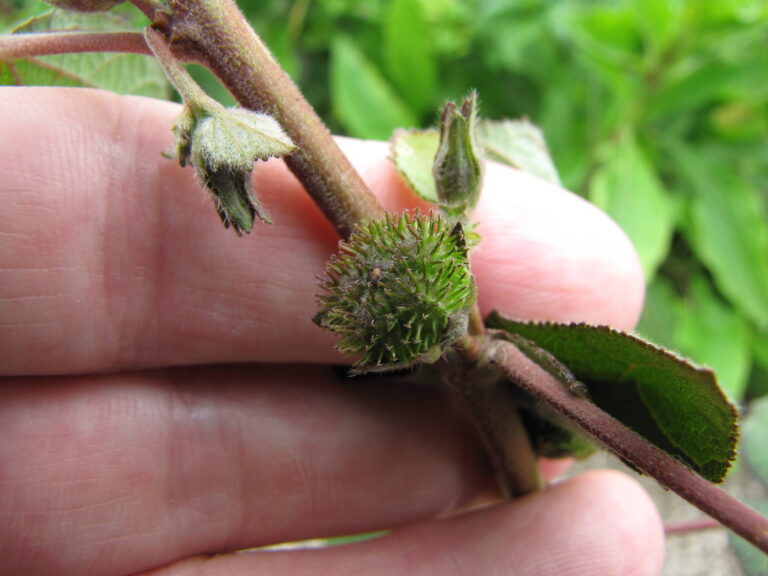
- Fruit (burs): a flattened round capsule 6–10 mm (about 1/4–3/8 in) wide that breaks into five wedge-shaped segments. Each segment holds one seed and is covered in barbed bristles that grip fur, socks and trouser legs.
Caesar weed look-alikes
Several mallow-family plants grow in the same places. This table covers the ones people mix up most often.
| Plant | Flowers | Fruit | Leaf clue |
|---|---|---|---|
| Caesar weed (Urena lobata) | Pink, 2–3 cm, darker centre | Round bur of 5 segments covered in hooked bristles | Shallow angular lobes, rough on top; nectary slit under the midrib |
| Pavonia species | Pink, white or yellow, hibiscus-like | Segments with bristles that are not barbed, or with 3 hairy awns | Usually no nectary under the leaf |
| Sida / fanpetals (Sida species) | Yellow to orange, small | Dry segments, often with two short points, no hooked bur | Leaves usually toothed but not lobed |
| Hibiscus and rose-mallows | Usually much larger | Smooth or hairy capsule that splits open, no hooks | Smoother leaves, no sandpaper feel |
| Jute (Corchorus species) | Small, yellow | Long pod or round capsule, no hooks | Narrow, toothed, unlobed leaves |
If the plant has pink flowers and its burs cling to your clothes, it is almost certainly Caesar weed.
Where it is invasive
Florida. Caesar weed is on the Florida Invasive Species Council’s 2023 list (formerly the FLEPPC list) as Category I, the highest tier, for the northern, central and southern regions of the state. Category I means it is changing native plant communities, not just spreading. It first went on the list in 1995 as Category II. UF/IFAS describes it as widespread through the peninsula and spreading into the Panhandle. It invades pastures, plantations, hardwood hammocks, forests and coastal sites, and it tolerates salt spray and fairly wet soils. The Florida Natural Areas Inventory dates the earliest Florida specimen to 1877 and notes that cattle spread it by carrying burs and disturbing the soil.
Hawaii and the Pacific. The Pacific Island Ecosystems at Risk (PIER) database records it as naturalised in low, disturbed areas of Hawaii and on the State noxious weed list. In Fiji it is described as “a pernicious weed abundantly naturalized in gardens, canefields, pastures, clearings, and grassland” and is a declared noxious weed there. PIER also lists it as introduced and invasive in American Samoa, Guam, French Polynesia and the Galápagos.
Elsewhere. Across tropical Africa and Asia it is a common weed of roadsides, fallow land, riverbanks and especially pastures. Many people there also value it as a useful plant.
How it spreads
It spreads almost entirely by seed, and the burs do the travelling. Each fruit breaks into five one-seeded segments that stick to animal coats and clothing. In a 1999 article, botanist Daniel Austin pointed out that people are among its best carriers, because the fruits cling to clothes. Hikers carry it along trails, and cattle carry it across pastures.
The seed coat is hard. According to PROTA, seed that is still inside its husk can go on germinating over about two and a half months, so one flush of seedlings is rarely the last. In warm climates plants flower over a long season, and one stem can carry buds, flowers and ripe burs at the same time.
How to control Caesar weed
The goal is to stop seed production. Every plant that sets burs adds to next year’s seedlings.
- Pull seedlings and young plants. Before the stems turn woody, the taproot (usually 20–25 cm, or 8–10 in) comes out fairly easily from moist soil. Wear gloves, because the stems and leaves are covered in rough hairs. UF/IFAS lists hand-pulling as the first step for seedlings and young plants.
- Remove plants that are flowering or carrying burs. Cut off the fruiting tops into a bag first, then dig out the plant. Check your socks, trouser cuffs and any pet that has been in the patch. Do not compost the burs. Bag them and put them in the trash, as described in our guide on how to dispose of invasive plants safely.
- Shade and mulch the ground. Caesar weed seedlings need open, sunny, disturbed soil. A 2–3 in (5–7 cm) layer of mulch or a dense groundcover cuts down germination. See our tips on keeping weeds from coming up through mulch.
- Spray larger infestations. For foliar sprays, UF/IFAS lists 1% 2,4-D, 1% triclopyr ester, 1% fluroxypyr or 0.15% aminopyralid products. The Florida Natural Areas Inventory adds glyphosate (3–5%), triclopyr (2–3%), imazapic and imazapyr. A two-year University of Florida field trial published in Weed Technology tested triclopyr ester, aminopyralid, 2,4-D amine, aminocyclopyrachlor and triclopyr plus fluroxypyr. Most treatments gave at least 90% control 30 days after spraying, and all reached 100% by 60 days.
- Follow up. Walk the area every few weeks during the warm season and pull new seedlings before they flower. Expect to keep doing this for more than one year.
Which herbicide for a home garden? In lawns and beds, a selective broadleaf product containing 2,4-D or triclopyr, applied as a spot spray, is the practical choice. Imazapyr, aminopyralid and aminocyclopyrachlor are pasture and natural-area products, not garden products. Imazapyr stays active in the soil and can injure nearby trees. Aminopyralid residues can pass through manure and compost and damage vegetables later. Always read and follow the label for your site. Do not eat or feed to animals any plant material that has been sprayed.
Congo jute: the fibre use
Caesar weed’s other common names come from its history as a fibre plant. The inner bark (bast) of the stem yields a fibre that people have long used for string, rope, fishing nets and coarse cloth. In the early 20th century it was grown commercially as a substitute for jute. In the 1999 article cited above, Daniel Austin notes that the fibre trade “reached a peak between 1900 and World War II”. The name Congo jute comes from its importance in what is now the Democratic Republic of the Congo. In the fibre trade it was also sold as aramina, and by the 1970s Brazil produced most of the world’s supply.
The PROTA account gives these details about the fibre:
- Fresh stems yield about 5–6% retted fibre, which is fine, soft, lustrous and creamy white to pale yellow.
- It can be spun on jute machinery without changes. It was used for sacks, carpets, cordage and upholstery, often blended with jute.
- It is not as strong as jute, and it loses strength when wet, so rope made from it is less suitable for wet conditions.
- In the 1970s world output was estimated at about 38,000 tonnes a year, roughly 70% from Brazil and 20% from the DR Congo. Production then fell sharply as synthetic fibres took over.
Researchers have recently looked at the fibre again as a reinforcement for bio-based composite materials. A 2025 review in Bioresource Technology Reports describes the fibres as promising but points out gaps in knowledge about their long-term durability and how well they bond with plastics. For a gardener, none of this changes the advice. Where Caesar weed is invasive, remove it rather than growing it for fibre.
Food and traditional medicine
According to PROTA, the young shoots and leaves are eaten as a cooked vegetable in parts of Africa, and the seeds are sometimes boiled into soups. Livestock graze the foliage. The seed oil contains cyclopropenoid fatty acids (malvalic and sterculic acid), the same group found in cottonseed oil. That is one reason not to treat the seeds as a staple food.
The recorded folk uses are numerous and vary by region. Decoctions of the root or leaves have been used for fever, coughs, diarrhoea, indigestion and rheumatism. Leaf poultices and bark scrapings have been applied to wounds. In several regions the leaves have also been used to bring on labour. A 2026 review in Vegetos and an earlier 2017 review in the International Journal of Medicine summarise the laboratory work. Extracts have shown antioxidant, anti-inflammatory, antibacterial, antidiabetic and antidiarrhoeal activity, and also antifertility effects, in test tubes and in rats, mice and rabbits. These results are early-stage and do not show that the plant is safe or effective as a treatment for people.
Safety: do not use Caesar weed as a medicine in place of medical care. Avoid it completely if you are pregnant, trying to conceive or breastfeeding, because of its traditional use to induce labour and the antifertility effects seen in animal studies. The hairs and burs can irritate the skin. Never eat plants from roadsides, or plants that may have been sprayed. Talk to a doctor or pharmacist before trying any herbal preparation, especially if you take medicines for diabetes or blood pressure.
For another weedy plant with a long record in folk medicine, see our page on the touch-me-not plant (Mimosa pudica). For an ornamental shrub that has also turned invasive in warm regions, see whether lantana is invasive.
Plant uses are described here as background only. Nothing on this page is medical advice, and no wild plant should be eaten or used as a remedy based on a website. See our disclaimer.
Frequently asked questions
Is Caesar weed poisonous to touch?
It is not known to be poisonous to touch. The stiff hairs on the leaves and the hooked burs can scratch and irritate the skin, so wear gloves and long sleeves when removing it.
Does Caesar weed fix nitrogen?
No. It is a mallow, not a legume, and it has no nitrogen-fixing root nodules. PROTA notes that it takes up a lot of nutrients, so it depletes soil rather than enriching it.
When does Caesar weed flower?
Long days delay flowering, according to PROTA. In subtropical areas such as Florida most flowers and burs therefore appear from late summer onward. Near the equator it can flower almost all year.
Related guides: Desmodium triflorum (Three-Flower Beggarweed): Identification, Lawn Control and Uses
Sources
- UF/IFAS Center for Aquatic and Invasive Plants – Urena lobata
- Florida Invasive Species Council – 2023 List of Invasive Plant Species
- Florida Natural Areas Inventory – Urena lobata
- Pacific Island Ecosystems at Risk (PIER) – Urena lobata
- Dias et al. (2019), Weed Technology – Cadillo (Urena lobata) control with POST herbicides
- PROTA / Pl@ntUse – Urena lobata
- Austin (1999), Wildland Weeds – Caesar’s weed: an invasive exotic, or a Florida native?
- Huyen et al. (2026), Vegetos – Urena lobata: traditional use, phytochemistry and pharmacology
- Islam & Uddin (2017), International Journal of Medicine – A revision on Urena lobata
- Bioresource Technology Reports (2025) – Review of invasive Urena lobata fibers and their composites