
Short answer: grass spiders (funnel weavers in the genus Agelenopsis) are not dangerous. They are fast, shy and almost never bite; when one does, extension entomologists describe local pain, redness and itching that clears in 1 to 10 days, with no serious cases on record. The sudden flush of flat, funnel-shaped webs across a lawn in August to October happens because the spiders have just reached adult size and morning dew makes their webs visible. They eat lawn insects and die at the first hard frost, so leave them in the grass. Control is worth doing only when they keep wandering indoors, and the fix is sealing entry points and tidying the ground next to the house, not spraying the lawn.
What a grass spider looks like
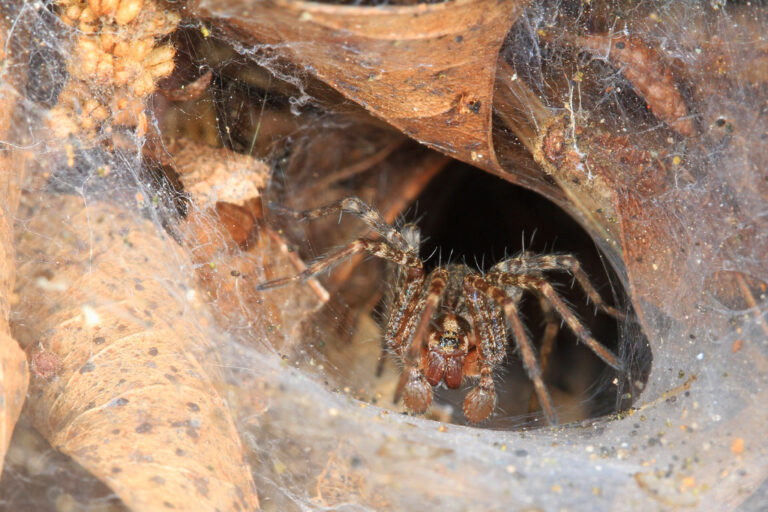
Grass spiders belong to the family Agelenidae. About 111 agelenid species live in North America, and the ones people notice in lawns are mostly Agelenopsis species such as A. pennsylvanica, according to Ohio State University Extension. Three field marks identify the genus:
- Two dark stripes down the head. The carapace is yellow-brown with a pair of darker lengthwise bands; the abdomen is darker with a lighter central band, per Penn State Extension. The Missouri Department of Conservation describes the abdominal pattern as a reddish-brown zigzag stripe with a cream border on each side.
- Long “tail” spinnerets. The hind spinnerets stick out well past the end of the abdomen like a short pair of tails.
- Banded legs. The legs are ringed, darker towards the tip of each segment.
Adult females are 10 to 20 mm (0.4 to 0.8 in) long in the body and males 9 to 18 mm. The web is the other giveaway: a flat horizontal sheet, sometimes up to 3 ft (90 cm) wide, with a silk funnel leading down into the grass, a shrub or a wall crack. The sheet is not sticky. Insects tripped by the fine threads above it are slowed down, and the spider rushes out, bites, and drags the meal into the tunnel.
Grass spider or something else?
Most worried questions about “big brown spiders in the lawn” come down to one of four animals.
| Spider | Web | Key field marks | Medical significance |
|---|---|---|---|
| Grass spider (Agelenopsis spp.) | Flat sheet with a funnel, low in grass, hedges, window wells | Two dark head stripes, long spinnerets, banded legs, eight eyes of similar size | None; rare bites are mild and local |
| Wolf spider (Lycosidae) | None; hunts on foot | Stockier, two large forward-facing eyes, short spinnerets; female carries the egg sac, then the spiderlings | None of importance |
| Hobo spider (Eratigena agrestis) | Funnel web at ground level near foundations and woodpiles; mainly Pacific Northwest | Also a funnel weaver, but legs plain brown with no dark bands | Once blamed for necrotic wounds; claim discredited |
| Brown recluse (Loxosceles reclusa) | Untidy silk in hidden dry places, never a sheet in open grass | Uniform tan with no stripes or bands, violin mark, only six eyes in three pairs | Medically significant, but range limited to the central US |
The hobo spider mix-up
Hobo spiders are funnel weavers too, and in Washington, Oregon, Idaho and Utah they are the funnel weaver most likely to wander indoors. For years they were blamed for slow-healing skin ulcers; Colorado State University Extension states that those claims were “thoroughly discredited” and that the hobo spider “is now considered to be harmless to humans in North America, as throughout its range”; the wounds once blamed on it were traced to bacterial infections. Utah State University Extension adds that the CDC does not list it among spiders toxic to humans and describes the bite as mild pain and redness. A funnel weaver with clearly banded legs is not a hobo spider in any case.
Ruling out a brown recluse
The brown recluse can cause a necrotic wound, but it lives in the central Midwest and South, roughly Nebraska south to Texas and east to southern Ohio and north-central Georgia, according to UC Riverside’s spider research group. Outside that area it is exceedingly rare, and it never builds sheet webs in open lawn. A spider with head stripes, banded legs, long spinnerets and eight eyes is not a recluse. Poison Control notes that infections and other insect bites are routinely mistaken for recluse bites; for a worsening wound, call 1-800-222-1222 (US) for free advice at any hour.
Do grass spiders bite, and does it matter?
Rarely, and no. Penn State Extension calls them “extremely fast and shy”; disturbed, they shoot down the funnel or out of a rear exit. Bites happen when a spider is pressed against skin, usually in a shoe or glove. The documented result is pain, swelling, redness and itching lasting one to ten days, with no serious health consequences reported. Wash it with soap and water and treat it like any insect bite. In North America the only spiders whose venom is a real medical concern are the widows (Latrodectus) and the recluses (Loxosceles); a striped funnel weaver is neither.
Why they are useful in a lawn
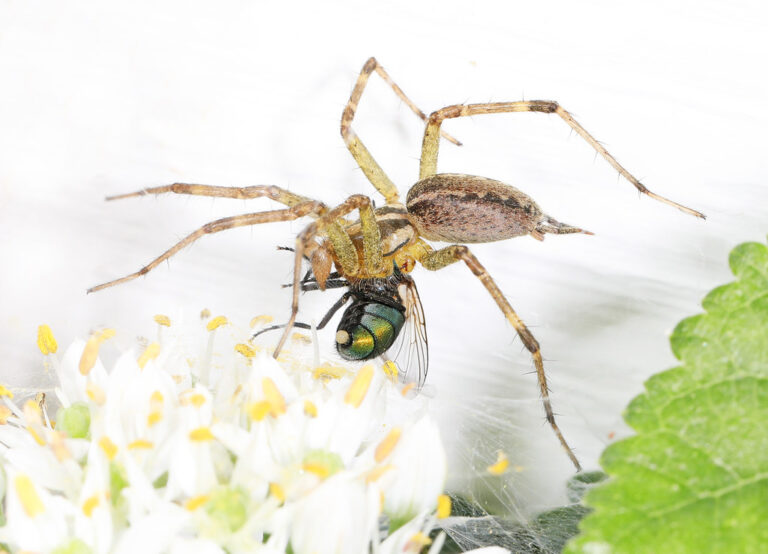
Missouri’s field guide lists beetles, moths and small butterflies as prey; University of Minnesota Extension points to aphids and flies. Ohio State files funnel weavers under “natural enemies” because, as generalist predators, they are part of the complex that keeps pest numbers down. To be honest about the limits: nobody has measured how much a lawn’s grass spiders reduce chinch bugs, sod webworms or armyworms, so do not expect them to replace scouting. What they provide is free, constant, low-level predation on whatever crosses the turf. The webs sit a few inches above the blades and do the grass no harm.
Why the webs appear all at once in late summer
The spiders were there all season; you just could not see them. Agelenopsis has a one-year life cycle. Eggs laid in a white, lens-shaped sac in late summer or fall overwinter, spiderlings hatch in spring, and the young spend the growing season growing on small webs tucked into the sward. By August the adults are full size and spinning sheets that span a couple of feet. Males then leave their webs to search for females from August to October, which is why more spiders turn up on patios and in garages in autumn. Females guard their egg sacs until the first hard frost kills them; adults do not survive winter. Add cool, still nights and heavy dew, and every sheet lights up for an hour after sunrise. Nothing has infested the lawn; the same population has simply become visible.
Thick, thatchy turf and dense ground covers such as ivy, pachysandra and periwinkle carry the most webs because they offer the most anchor points. If you have been meaning to thin out grass that has grown too dense, you will notice fewer webs afterwards as a side effect.
When control is reasonable
- They keep coming indoors. Agelenopsis wanders into houses in autumn but, per Colorado State Extension, does not establish inside buildings and dies out by winter. Its relatives the barn funnel weaver (Tegenaria domestica) and the hobo spider do settle in basements and garages.
- Webs where you do not want them. Window wells, porch corners, a play area, a hedge by the front door.
How to reduce grass spiders around the house
The methods that work remove shelter and stop entry, and they are the same steps that keep out clover mites and other autumn wanderers.
- Mow regularly and keep the strip next to the house short. Sheet webs need standing vegetation to span. Keep the last 18 in (45 cm) along the foundation trimmed or in gravel.
- Dethatch if the thatch layer is over about 1/2 in (1.3 cm). Whether dethatching helps your lawn depends on grass type and season, so treat it as a lawn-health decision that happens to remove spider habitat.
- Clear debris. Move woodpiles, stacked pots and rock piles away from the foundation; rake leaf litter out of window wells and from under shrubs.
- Trim plants back from the walls so spiders have to cross bare ground to reach the house.
- Seal entry points. Utah State Extension’s checklist: replace worn door sweeps, add weather stripping, and caulk foundation cracks and gaps around pipes. Funnel weavers climb poorly on smooth surfaces, which is why they end up in bathtubs; a tight door sweep stops most of them.
- Move outdoor lighting. Lights draw the moths and flies that spiders eat. UC IPM recommends keeping fixtures off the structure and away from windows and doors.
- Indoors, vacuum and use sticky traps. Vacuuming works because spiders’ soft bodies rarely survive it; empty the canister outside. Glue boards along baseboards, two per room from August to October, catch wandering males and show where they enter.
Why not just spray the lawn?
Because it does not work and it costs you the benefit. UC IPM’s position is that insecticides “will not provide long-term control and should not generally be used against spiders outdoors”. A spider in a silk tunnel under the sheet is shielded from a surface spray, turf residues break down in days, and new spiders walk in from next door. What a broadcast pyrethroid does reliably kill is the insects the spiders were eating, plus the predatory beetles and parasitic wasps doing the same job, leaving the lawn more dependent on the next spray. The one chemical measure extension services accept is targeted: a dust in a crawl space or a perimeter band on the foundation in late spring, for houses with a persistent indoor funnel weaver problem. Follow the label and keep it off the lawn.
What not to do
- Do not sweep the lawn of webs every morning (they rebuild overnight) or read a September spider count as a pest outbreak; it means the spiders matured on schedule.
- Do not diagnose a sore as a spider bite unless you saw the spider bite you. If you itch after time on the lawn and cannot find a culprit, chiggers and mites are more likely than any spider.
When to expect results
Sealing and tidying around the foundation cuts indoor wanderers within a week or two, and the indoor season ends on its own once the first hard frost kills the outdoor adults, typically October or November across most of the US and Canada. Lawn webs keep appearing until then and vanish over winter. Next summer the new generation will be back at about the same level, because the eggs overwintered in the turf. That is normal; a lawn with grass spiders has enough insect life to feed them.
Sources
- Penn State Extension – Grass Spiders
- Ohio State University Extension (Ohioline) – Ohio’s Natural Enemies: Funnel Weaver Spiders
- Colorado State University Extension – Colorado Arachnids of Interest: Funnel Weaver Spiders
- University of Minnesota Extension – Fall’s hidden architects: funnel weavers in Minnesota gardens
- Missouri Department of Conservation – Grass Spiders
- Utah State University Extension – Hobo Spiders
- UC Riverside – Myth of the Brown Recluse: Fact, Fear, and Loathing
- Poison Control (America’s Poison Centers) – Brown recluse spider bites
- UC IPM – Pest Notes: Spiders