
Short answer: dethatching helps only when you actually have a thatch problem, and most lawns do not. Cut a small wedge of turf and measure the brown, spongy layer between the green blades and the soil: under 1/2 inch (1.3 cm) is normal and even useful, over 1/2 inch is worth acting on, and over 1 inch (2.5 cm) usually means dethatching alone will not fix it. Thatch builds fast in Kentucky bluegrass, creeping bentgrass, bermuda, zoysia and St. Augustine, and almost never in tall fescue or perennial ryegrass. Even when thatch is thick, most extension services now recommend core aeration first, because it is less destructive and it fixes the cause. Save the vertical mower for the real cases, run it in the right season for your grass, and expect a rough-looking lawn for two to four weeks afterwards.
What thatch is (and what it is not)
Thatch is the tightly interwoven layer of living and dead stems, crowns, roots, rhizomes and stolons that sits between the green leaves and the soil surface, as University of Minnesota Extension describes it. It forms when the lawn produces this tough, slow-rotting tissue faster than soil microbes can break it down.
Grass clippings are not the cause. Purdue Extension puts it plainly: clippings are mostly water and break down too quickly to contribute. Bagging them just throws away nitrogen. What drives thatch is anything that speeds up stem growth or slows decomposition: heavy nitrogen (more than 1 lb per 1,000 sq ft per application, according to Texas A&M AgriLife Extension), overwatering, compacted or waterlogged soil, acidic soil, and routine pesticide use that knocks back the earthworms and microbes doing the digesting.
A thin layer is useful: up to about 1/2 inch cushions the surface and insulates crowns. Problems start when roots grow in the thatch instead of the soil: the lawn dries out fast, fertilizer and water sit above the root zone, and disease fungi and insects have somewhere to live.
How to measure it: the wedge test
NDSU Extension describes it as cutting a slice of pie: push a trowel or knife straight down about 2 inches (5 cm) into the soil, lever out the wedge, and look at the side. Press the brown mat between the green blades and the dark soil lightly and measure it. Check three or four spots; thatch is usually thickest in shady, wet or heavily fertilized areas.
| Compressed thatch depth | What it means | What to do |
|---|---|---|
| Under 1/2 in (1.3 cm) | Normal, beneficial | Nothing. Keep mowing regularly and do not overfeed. |
| 1/2 to 3/4 in (1.3 to 2 cm) | Borderline | Core aerate this season; light topdressing; fix the cause. Dethatch only if the lawn is clearly suffering. |
| 3/4 to 1 in (2 to 2.5 cm) | Excessive | Vertical mow in the right season, then aerate, overseed and feed. |
| Over 1 in (2.5 cm) | Severe | Purdue and Kentucky both say dethatching alone is unlikely to fix this; expect repeat treatments over two seasons or renovation with a sod cutter. |
The thresholds shift a little by grass. Clemson HGIC uses 1/2 inch for bermudagrass but tolerates up to 1 inch on zoysiagrass, which naturally carries a thicker mat, and the North Carolina and Texas St. Augustine calendars use 3/4 inch.
Which grasses build thatch, and which do not
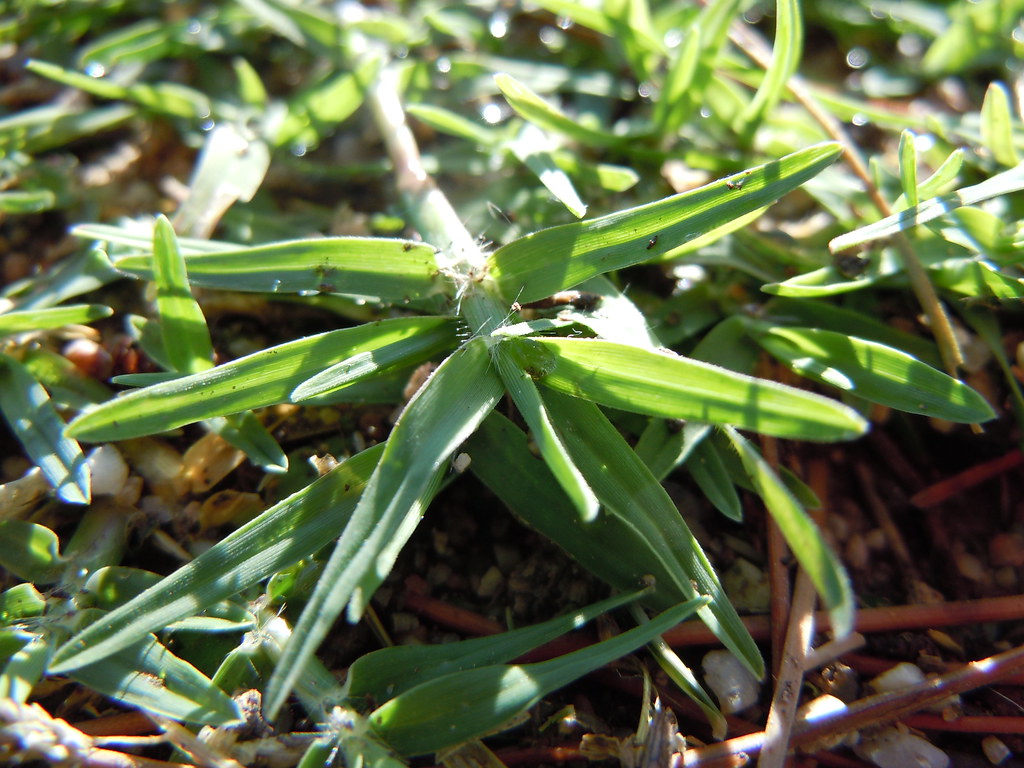
Thatch is mostly stems. Grasses that spread by rhizomes and stolons build it; bunch grasses that spread only by tillering rarely do. SDSU Extension ranks the cool-season lawn grasses from least to most prone as tall fescue, perennial ryegrass, fine fescues, Kentucky bluegrass, then creeping bentgrass.
| Grass | Growth habit | Thatch tendency |
|---|---|---|
| Kentucky bluegrass | Rhizomes | High |
| Creeping bentgrass | Stolons | Very high |
| Hybrid bermudagrass | Rhizomes and stolons | High |
| Zoysiagrass | Rhizomes and stolons; tough, slow-rotting tissue | High; recovers slowly |
| St. Augustinegrass | Thick stolons | Moderate to high when overfed; tolerates one pass only |
| Fine fescues | Some rhizomes | Moderate |
| Tall fescue | Bunch | Low |
| Perennial ryegrass | Bunch | Low |
If you are not sure which grass you have, see our lawn grass comparison. A spongy tall fescue lawn is far more likely to be overwatered or mossy than thatchy.
Pros and cons of dethatching
| Pros | Cons |
|---|---|
| Removes a thick mat in one afternoon; water, fertilizer and seed reach the soil again | Very stressful for the turf; the lawn looks torn up for two to four weeks |
| Improves seed-to-soil contact, so it pairs well with overseeding | Does nothing about the cause; thatch comes back unless feeding, watering or compaction are corrected |
| Reduces the moist layer where fungal diseases and some insects live | Opens the canopy to weeds; disturbing the soil also breaks a pre-emergent herbicide barrier |
| Cheap to rent and simple to run on a small to medium lawn | Done in the wrong season, or on the wrong grass, it can thin or kill the lawn |
Why extension services usually prefer core aeration
Illinois Extension says thatch can be torn out with a dethatcher or vertical mower but will most likely return unless the cause is corrected, and recommends core aeration followed by a thin topdressing instead. Purdue calls core aerification the less destructive option. The University of Kentucky explains why it works: the hollow tines pull out plugs of soil, the plugs crumble back into the thatch layer, and that soil brings microbes, moisture and a less acidic environment into the mat so it rots down on its own, while the holes also relieve compaction and let water in.
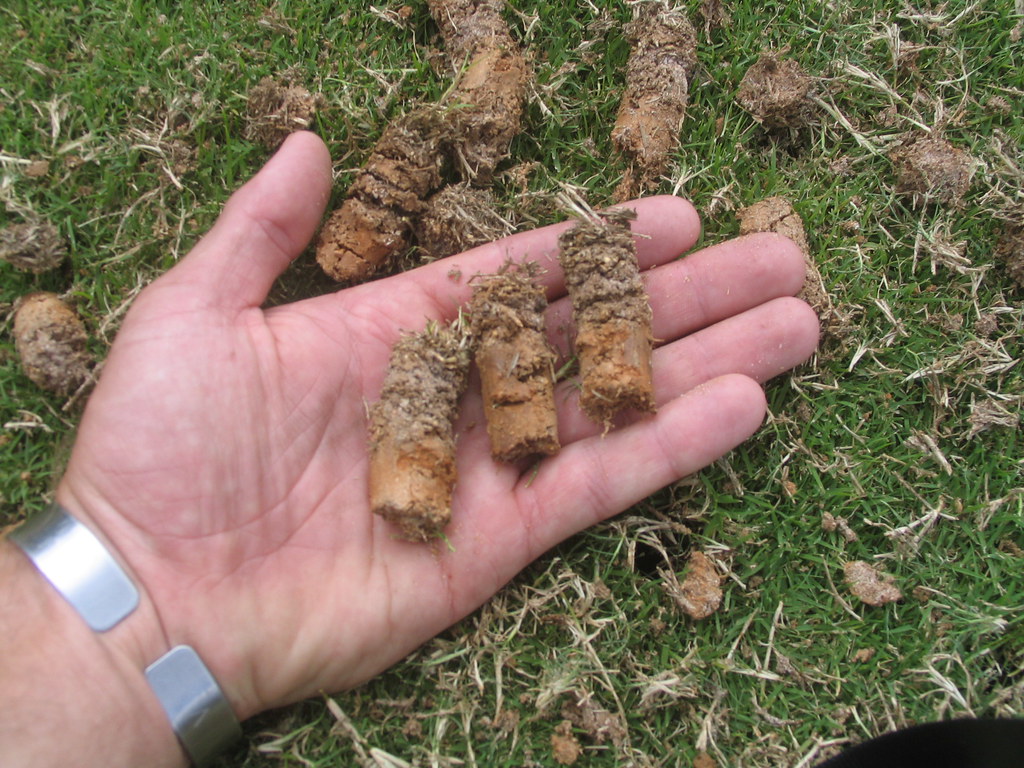
A proper job is not a light pass. Illinois suggests two trips, the second at right angles to the first, for 15 to 20 holes per square foot; Purdue and Kentucky aim for 20 to 40 holes, with 1/2 to 1 inch tines reaching 2 to 3 inches (5 to 8 cm) deep. Leave the cores on the surface to melt back in with rain, or drag them in with the back of a rake. Follow with 1/8 to 1/4 inch (3 to 6 mm) of screened topsoil or compost, which Illinois recommends and Texas A&M caps at 1/8 inch per application. Soil moisture decides how deep the tines go; see our guide to aerating after rain.
Vertical mowing is the right tool when the mat is already 3/4 inch or more, when roots are visibly growing in the thatch rather than the soil, or when you need clean seed-to-soil contact for a heavy overseed. In those cases do both: dethatch, then aerate, then seed.
Timing by grass type
Dethatch when the grass is entering its strongest growth, never when it is heading into heat or dormancy; a thinned lawn has to fill back in before weeds do.
| Grass | Best window | Avoid | Source |
|---|---|---|---|
| Kentucky bluegrass, fine fescue, bentgrass (cool-season) | Late August to early October; second choice is April to late May | Summer | Minnesota, Illinois, Purdue, SDSU |
| Tall fescue, perennial ryegrass | Rarely needed; if so, early fall | Summer | Purdue, Kentucky |
| Bermudagrass | After the last frost as the lawn greens up, through early to mid-summer | Late summer and fall (no time to recover before dormancy) | Clemson, Kentucky |
| Zoysiagrass | Late spring to early summer when fully green and growing | Fall; Kentucky advises against dethatching zoysia at all because it recovers so slowly | Purdue, Clemson |
| St. Augustinegrass | April to August while actively growing | Fall; multiple passes at any time | NC State, Texas A&M, Clemson |
Fall suits cool-season lawns because weed pressure is low and the grass grows vigorously for another six to eight weeks; a spring dethatch opens the canopy just as crabgrass germinates. If you have applied a pre-emergent, Clemson warns that cultivation breaks the barrier, so dethatch before the application or postpone it until just before the next one.
How to dethatch, step by step
- Mow low the day before. Drop the mower one or two notches below normal (NC State Extension suggests 2 1/2 inches for St. Augustine) and bag the clippings so the blades can reach the mat.
- Water lightly the day before so the soil is moist but firm; wet soil tears out crowns.
- Choose the right machine. For anything over a few hundred square feet, rent a vertical mower (also called a verticutter or dethatcher) with fixed steel knives or flail blades. Purdue and Kentucky both say to avoid flexible spring-tine attachments and blade-on-a-mower gadgets; they scratch the surface without cutting the mat. Our power raking article explains the difference between a power rake and a verticutter and when each is appropriate.
- Set blade spacing and depth. Clemson’s calendar specifies 2 or 3 inch (5 to 7.5 cm) blade spacing for bermuda and zoysia, set about 1/4 inch (6 mm) deep, and warns that a power rake with 1 inch spacing can cause severe injury. Use 3 inch spacing on St. Augustine. Set the depth so the blades just nick the soil surface, which Texas A&M says is needed to cut through the whole thatch layer.
- Make your passes. On bluegrass or bermuda with more than 1/2 inch of thatch, Kentucky recommends two or three passes in different directions. On St. Augustine and centipede, Clemson HGIC is emphatic: one direction only, because multiple passes can kill the lawn.
- Clean up. Rake or bag-mow the debris. Kentucky notes that several garbage bags or a full pickup load can come off a small lawn. It composts well.
- Aerate, seed, feed, water. See below.
On a lawn of a few hundred square feet a hand thatching rake is enough and costs less than one rental. Above that, rental yards hire out walk-behind verticutters and core aerators by the half day or day; one will do a typical suburban lawn in a morning. Lawn services price by the square foot, and a dethatch, aerate and overseed package is usually better value than dethatching alone.
Aftercare: the part that decides whether it worked
- Overseed cool-season lawns straight away. The exposed soil is a perfect seedbed, and if you do not fill it, weeds will. Stay at the low end of the bag’s overseeding rate; more is not better, as our post on too much grass seed explains. Warm-season lawns refill from stolons and rarely need seed.
- Fertilize lightly. Minnesota recommends 1/2 to 3/4 lb of nitrogen per 1,000 sq ft (about 2.5 to 3.5 g per sq m) after vertical mowing; Clemson suggests about 1 lb per 1,000 sq ft a week later, with less than half of it quick-release. Do not go heavier; excess nitrogen is what built the thatch.
- Water like a new seeding: keep the top inch moist for two to three weeks, then taper back to deep, infrequent watering.
- Expect recovery in a few weeks under good growing conditions, according to NDSU. If the lawn is still thin at six weeks, the machine was probably set too deep.
What goes wrong
- Dethatching a lawn that did not need it. A spongy feel or some brown at the base of the blades is not a diagnosis; the wedge test is.
- Wrong season. Bermuda in September or bluegrass in July has no growth left to recover with.
- Blades set too deep or spaced too tightly. The machine pulls up crowns and stolons instead of dead material. If you are lifting green plants with roots attached, stop and raise the blades.
- Skipping aftercare. Bare soil without seed, water and a light feed becomes a weed nursery within weeks.
- Repeating it every year while the cause continues. If you still apply more than 1 lb of nitrogen per 1,000 sq ft at a time, water daily, or spray insecticide on a schedule, the mat will be back. Correct those, keep soil pH from drifting acidic (Kentucky puts the best range for the decomposing microbes at 6.0 to 8.0), and mow often enough that you never remove more than a third of the blade.
Related guides: Why Is My Grass Lying Flat? Causes and How to Make It Stand Up Again · Mulching Grass Clippings: Pros, Cons and When You Should Bag Instead
Sources
- University of Minnesota Extension – How to control thatch in your lawn
- Purdue Extension – Thatch (AY-8-W)
- Illinois Extension – Managing Thatch in Lawns
- NDSU Extension – Do You Have a Thatch Problem?
- SDSU Extension – Understanding Thatch in Turf
- University of Kentucky – Thatch and Aeration (AGR-54)
- Texas A&M AgriLife Extension – Thatch Management for Home Lawns
- Clemson HGIC – Controlling Thatch in Lawns
- Clemson HGIC – Bermudagrass Yearly Maintenance Program
- NC State Extension – St. Augustinegrass Lawn Maintenance Calendar