
Short answer: too much grass seed does not give you a thicker lawn. It gives you a crowded stand of thin, slow-maturing seedlings that shade each other, stay wet longer and are far more likely to collapse from damping-off (Pythium or Rhizoctonia). The target is only about 7 to 14 established plants per square inch, according to UMass Extension, and a normal seeding rate already delivers several times that many seeds. If the seed is still dry on the surface, rake it out to spread it. If it has already germinated into a dense mat, leave it alone, back off the watering, mow it when it reaches 3 to 4 inches (8 to 10 cm) and let the seedlings thin themselves. Do not add more seed, fertilizer or water to “help” it.
What happens when you put down too much grass seed
The recommended rate per 1,000 sq ft (93 m²) is set so that, after normal losses, enough seedlings survive to knit into a dense turf. Double or triple it and five things change.
- Seedling competition. Crowded seedlings grow tall and spindly instead of tillering, and the stand stays juvenile for weeks longer. UMass Extension says sowing above the recommended rate “will result in a stand containing a high number of small, young, immature (juvenile) plants” that are slow to develop into the mature plants that tolerate heat, drought, cold and wear.
- Damping-off disease. This is the big one. Dense stands hold moisture at soil level, and the water-mould Pythium (warm weather) or the fungus Rhizoctonia (cool weather) rots the young stems. NC State Extension states it plainly: high seeding rates encourage damping-off “by producing dense populations of seedlings that mature more slowly and remain wet for extended periods of time.” Affected seedlings look limp and twisted, turn dark and greasy, then disintegrate and leave bare soil. UC IPM adds that the disease occurs from 50 to 100°F (10 to 38°C) but is most common above 70°F (21°C), and names sowing above the recommended rate, with excess moisture, as a main trigger.
- Uneven, patchy results. Over-application is never even. You get a thick mat where the spreader overlapped or the bag tipped, and that mat is the first part to die back, so the lawn ends up patchier than if you had seeded lightly.
- Weak plants going into their first stress period. A stand that is still juvenile at the first hard frost or in July heat loses far more plants than one that matured on schedule.
- Wasted money. At 2 lb of Kentucky bluegrass per 1,000 sq ft, with roughly 2.2 million seeds per pound (the UMass figure), you are already sowing about 30 seeds per square inch to end up with 7 to 14 plants. Every extra pound is seed that germinates and then dies.
Recommended seeding rates by species
The rates below are compiled from Cornell University, Penn State Extension, the NC State Extension Gardener Handbook and Nebraska Extension; where they differ slightly, the range covers them. Overseeding an existing lawn uses roughly half the new-lawn rate because established grass already occupies most of the space. Check the rate on your own bag, because blends and coated seed change the numbers.
| Grass | New lawn (lb/1,000 sq ft) | New lawn (g/m²) | Overseeding (lb/1,000 sq ft) | Overseeding (g/m²) |
|---|---|---|---|---|
| Kentucky bluegrass | 1–3 | 5–15 | 1–2 | 5–10 |
| Perennial ryegrass | 4–8 | 20–39 | 2–4 | 10–20 |
| Tall fescue (turf-type) | 6–8 | 29–39 | 3–4 | 15–20 |
| Fine fescues (red, chewings, hard) | 4–5 | 20–24 | 2–3 | 10–15 |
| Bermudagrass (common, hulled) | 1–2 | 5–10 | 0.5–1 | 2.5–5 |
| Zoysiagrass (seeded types) | 1–2 | 5–10 | 0.5–1 | 2.5–5 |
| Centipedegrass | 0.25–0.5 | 1–2.5 | 0.25 | 1 |
| Bahiagrass | 5 | 24 | 2–3 | 10–15 |
The rates differ so much because seed size differs. A pound of Kentucky bluegrass holds around 1.5 to 2.2 million seeds; a pound of perennial ryegrass or tall fescue holds only about 225,000 to 250,000, according to the Cornell and UMass figures. That is why 2 lb of bluegrass is a full rate while 2 lb of tall fescue is a light overseed. The most common way people over-apply is using a ryegrass or fescue rate for a bluegrass-heavy mix, or reading the new-lawn number when they are only overseeding.
How to tell if you have over-applied
Before germination (days 0 to 7 for ryegrass, 0 to 21 for bluegrass), look at the soil surface:
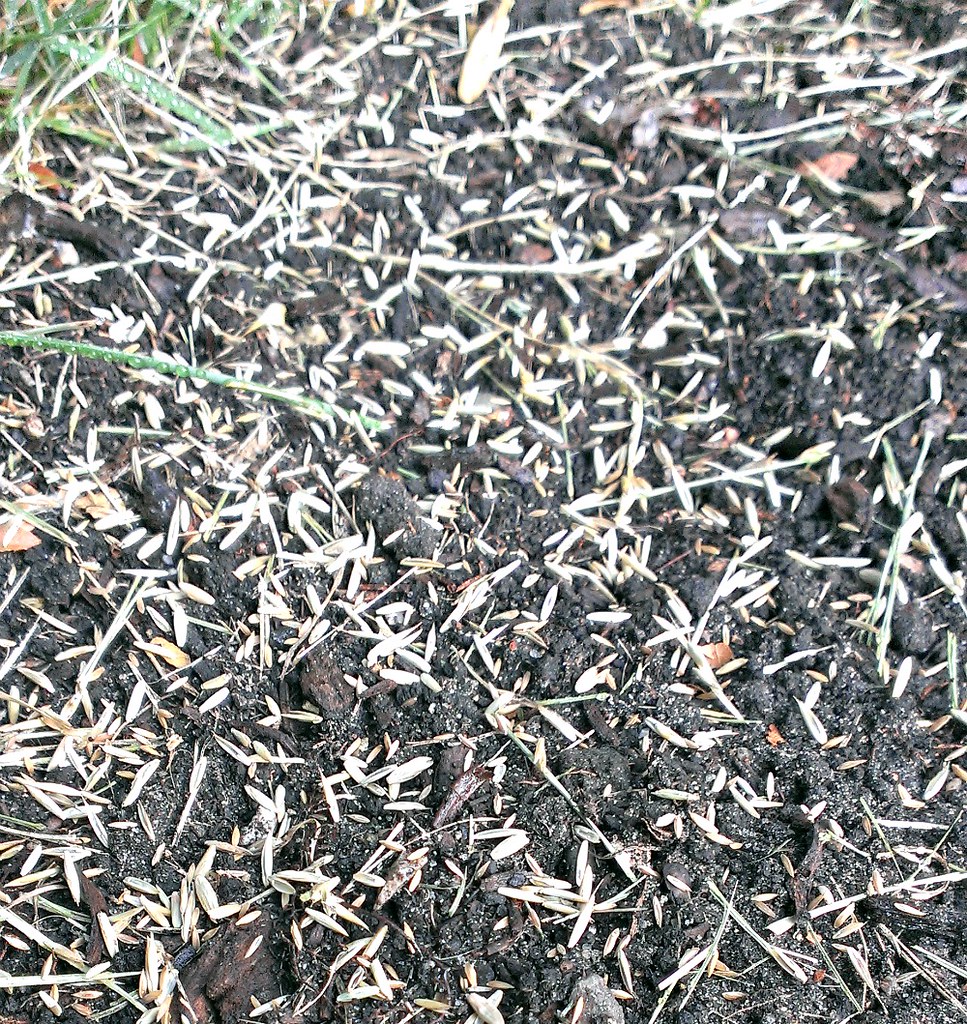
- At a correct rate, seed is visible but you can see soil between the seeds, roughly like coarse pepper on a plate. Cornell’s lawn guide gives rates of 1 to 10 lb per 1,000 sq ft depending on species, and none of them covers the soil.
- If the seed forms a continuous layer, piles up in drifts, or sits two or three seeds deep, you have over-applied. Seed lying on seed is not touching soil and will either fail to germinate or germinate and dry out.
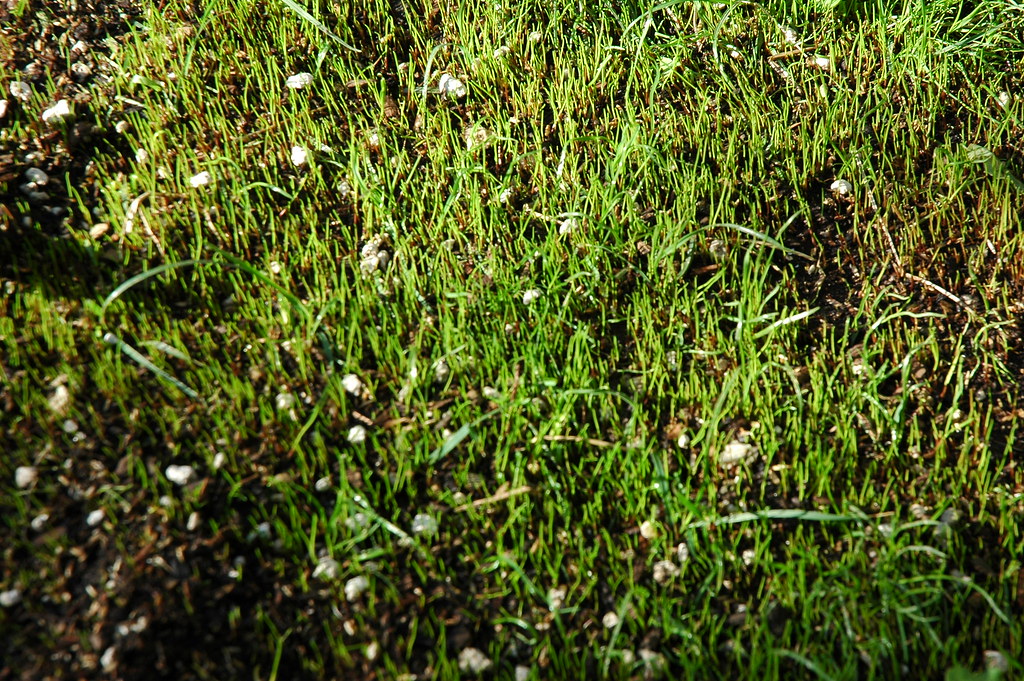
After germination, the signs are a dense, felt-like mat that is still wet late in the morning when normally seeded areas have dried; seedlings that are tall, pale and floppy rather than short and stiff; and patches that suddenly wilt, turn dark and slimy and vanish over two or three days. That last one is damping-off, and it almost always starts in the thickest areas.
What to do now
If the seed is still dry on the surface
- Do not water yet. Dry seed can be moved; wet seed sticks and starts germinating within a day or two.
- Rake it out. Use a leaf rake held lightly and pull seed from the thick areas onto the thin ones, working in two directions, until you have the pepper-on-a-plate look.
- Scoop up obvious piles and keep the seed in a paper bag somewhere cool and dry for patching later.
- Rake the seed in lightly. Cornell recommends covering seed no more than 1/16 to 1/8 inch (1.5 to 3 mm) deep and rolling with a half-full roller for seed-to-soil contact. On bare ground, our guide to preparing soil for grass seed covers the seedbed steps in order.
- Then water lightly two or three times a day, just enough to keep the top 1.5 inches (4 cm) moist, as NC State advises for new seedlings.
If the seed has already germinated
- Leave the seedlings alone. Pulling or heavy raking rips out the good with the bad because the roots are shallow and tangled. Most of the thinning happens on its own.
- Cut back the water. The mat holds moisture, so move from two or three light waterings a day to once a day as soon as the seedlings are up, then to every second or third day. NC State’s damping-off guidance is to reduce irrigation gradually so the leaves dry completely between waterings. Water in the early morning, never in the evening.
- Do not add nitrogen to push growth. Excess nitrogen makes damping-off worse. A phosphorus-containing starter at seeding is fine (Penn State suggests 0.5 to 1 lb N per 1,000 sq ft), but skip any follow-up feeding for now.
- Thin only mats that are clearly dying. If a patch is collapsing from damping-off, a light pass with a leaf rake on a dry surface opens the mat, lets air in and can save the survivors at the edges.
- Mow as soon as the grass reaches 3 to 4 inches (8 to 10 cm). Cornell suggests waiting until the grass is at least 4 inches tall; NC State says to mow when it is 50 percent taller than the height you want to keep. Sharp blade, no more than one third off, seedlings dry. Mowing is the most effective way to thin an over-seeded stand because it favours seedlings that are tillering over the tall, weak ones.
- Feed lightly at 4 to 6 weeks. After two or three mowings, apply no more than 0.5 lb of actual nitrogen per 1,000 sq ft (2.4 g N/m²), the limit NC State gives for follow-up nitrogen on young turf; its lawn handbook puts the first regular fertilization at six to eight weeks after emergence.
Should you reseed the thin spots?
Usually not straight away. Over-seeded stands look thick at three weeks and thin at eight weeks as the weak seedlings die, which tempts people into a second round of heavy seeding and the same disease cycle. Wait until the surviving grass has been mowed at least three times. If bare patches larger than your hand remain, patch them at the overseeding rate in the table, not the new-lawn rate, and rake the seed into the soil. If the bare patches follow the pattern of your spreader passes, the problem is the spreader, and the fix is calibration.
If the thin spots are full of weeds rather than bare, deal with those first. Our decision guide on whether to kill weeds before overseeding explains which weeds matter and how long to wait after a herbicide before seeding.
How to calibrate a spreader so it does not happen again
Almost every case of too much grass seed comes from guessing a spreader setting, or using the bag’s setting for a different spreader model. The method below is adapted from Clemson Cooperative Extension and takes about 15 minutes.
- Find the effective width. Run a rotary (broadcast) spreader over a hard surface and measure how far seed lands at reasonable density on each side, not the furthest single seed. Small seed like bluegrass throws much narrower than fertilizer. A drop spreader’s width is the width of the hopper.
- Mark a test strip. A 10 ft (3 m) swath over 100 ft (30 m) is 1,000 sq ft; a 5 ft drop spreader over 200 ft is the same.
- Weigh the seed in. Put a known weight, say 5 lb (2.3 kg), in the hopper. A kitchen scale works.
- Walk the strip at your normal pace, closing the hopper at the end.
- Weigh what is left. The difference is your rate per 1,000 sq ft. Adjust the setting and repeat until it matches the target.
- Apply in two passes. Set the spreader to half the target rate and cover the area twice at right angles. Penn State notes that seeding in two directions gives fewer skips and a more uniform result, and Clemson recommends the same perpendicular passes. Any error in the setting is halved.
For a small patch, skip the spreader. Weigh out the seed for the area (about 0.6 oz or 16 g of tall fescue for a 3 ft by 3 ft patch at 4 lb/1,000 sq ft), mix it with a can of dry sand or screened compost, and scatter it by hand. The filler shows you where you have been.
Common mistakes that make it worse
- Adding more seed at week two because the stand looks thin. Bluegrass takes 14 to 21 days just to emerge.
- Watering more because the seedlings look stressed. Limp, dark seedlings in a wet mat are diseased, not thirsty.
- Heavy straw on top of heavy seed. Straw helps at 80 to 100 lb per 1,000 sq ft (Penn State’s figure), thin enough to see soil through. A thick layer keeps a dense stand wet and shaded.
- Skipping the first mow because the grass looks too young. At 4 inches and dry, it is ready.
- A high-nitrogen lawn feed to green it up. Starter at seeding, then nothing for four to six weeks.
When to expect results
An over-seeded stand managed this way usually looks worse at four to six weeks than a correctly seeded one, as the weak seedlings die and leave small gaps, then catches up by the end of the season as the survivors tiller. Bluegrass and other spreading grasses fill gaps on their own; bunch grasses such as tall fescue and perennial ryegrass do not, so patch remaining bare spots at the overseeding rate the following spring or fall. Cornell’s sports-field guidance gives 9 to 12 months for a bluegrass stand to be fully usable, 9 months for tall fescue and under 3 months for perennial ryegrass; an over-seeded stand sits at the slow end of those ranges.
Getting the seedbed right matters as much as the rate: see how to prepare soil for grass seed, seeding into compacted soil and protecting new seed from birds.
Sources
- UMass Extension – Seeding Rate Considerations
- NC State Extension – Damping Off in Turf
- UC IPM – Seed Rot and Damping-Off in Turfgrass
- Cornell University Sports Field Management – Seeding Rates
- Cornell Turfgrass Program – Starting Fresh: Plant
- Penn State Extension – Lawn Establishment
- NC State Extension Gardener Handbook – Chapter 9: Lawns
- Nebraska Extension Turfgrass Science – Overseeding in the Fall
- Clemson Cooperative Extension – Calibrating Spreaders