
Short answer: it depends on which weeds you have. If your lawn is full of dandelions, clover, plantain or other broadleaf weeds, seed first and spray later – about four to six weeks after the new grass comes up. If the problem is crabgrass or other summer annuals and you are seeding in late summer or fall, don’t bother killing them at all; mow them short, seed into them, and let the first frost finish the job. Only if you are fighting perennial grassy weeds such as bermudagrass, quackgrass or nimblewill should you kill first and seed later, and that usually means a longer project than one weekend.
Where this applies: the months in this guide are for cool-season lawns (fescue, bluegrass, ryegrass) in temperate climates such as the northern US, Canada, the UK and Europe. Warm-season lawns (bermuda, zoysia, St. Augustine) are seeded or repaired in late spring and early summer instead, and in the Southern Hemisphere every date shifts by about six months. Herbicide rules also differ by country, so check what is registered where you live.
That is the same three-way split the turf specialists at Purdue University use, and the reasoning behind it is worth understanding, because it also tells you which weed killers are safe to use around new seed and how long to wait after the ones that are not. (Purdue’s original note is here.)
Why the order matters
Two things are going on at the same time when you overseed a weedy lawn: a competition for light and water between tiny grass seedlings and established weeds, and a chemistry problem with whatever you sprayed to control those weeds.
The competition is less dramatic than most people fear. A grass seedling in its first three or four weeks has a root only a few centimetres deep and needs the top inch of soil to stay moist. A dandelion rosette sitting flat on the ground barely shades it; a knee-high stand of crabgrass or a mat of ground ivy does. So the question is not “are there weeds?” but “are the weeds tall or dense enough to shade the seedlings, and will they still be alive in six weeks?”
The chemistry problem is the one that actually ruins overseeding jobs. Most lawn weed killers stay active in the soil for weeks, and grass seed is just as sensitive to them as the weeds are:
- The common three-way broadleaf products (2,4-D + MCPP + dicamba, sold as Trimec, Weed-B-Gon and many store brands) carry the instruction “do not reseed treated areas for 3 to 4 weeks after use”, according to the Alabama Extension home-lawn herbicide guide.
- Pre-emergent crabgrass preventers are far worse: pendimethalin labels say no reseeding for 4 months, dithiopyr for 10 weeks. They work by stopping every germinating seed, and grass seed is a seed.
- Glyphosate (Roundup and generics) is the mild one. It does not act through the soil, and most lawn labels allow seeding within about a week. University of Missouri horticulturist David Trinklein still suggests allowing “at least two weeks” so the weeds are fully dead before you tear up the area.
Add those waiting periods to the calendar and the decision often makes itself. In the northern United States the best seeding window for cool-season grasses is roughly mid-August to mid-September, and Penn State advises not seeding later than mid-October. If it is already late September and you spray a three-way herbicide today, the soil is not safe for seed until late October, which is too late for a good stand.
The decision guide, by weed type
1. Mostly broadleaf weeds (dandelion, clover, plantain, chickweed): seed first
Mow low, seed, and leave the weeds alone until the new grass has been mowed two or three times. Then treat the broadleaf weeds with a normal lawn herbicide in October, when perennial weeds are actively moving sugars to their roots and take herbicide down with them. Purdue’s guidance is to wait until the seedlings have been “mowed at least three times” before using broadleaf herbicides; Alabama Extension puts the same rule as “mowed three or four times”. Either way, a late-August seeding is ready for an October spray.
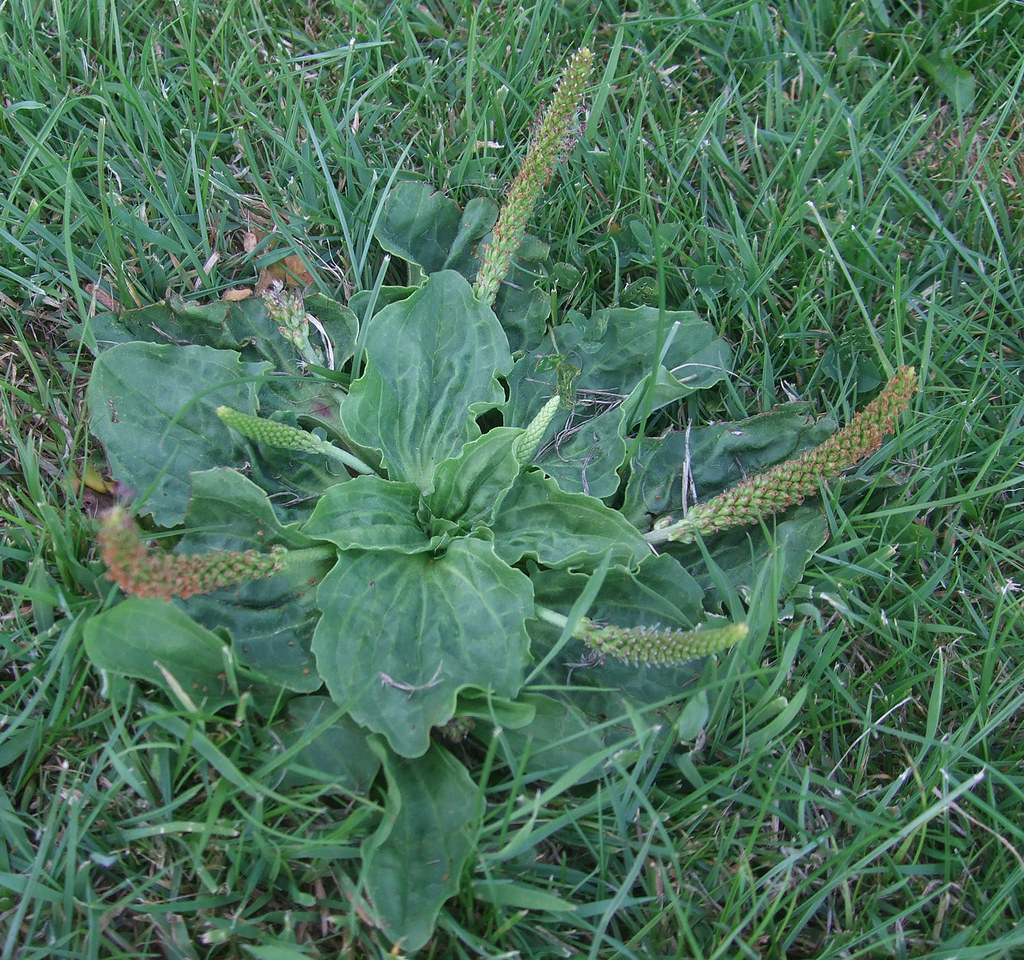
If the broadleaf weeds are so thick that they form a canopy, or you simply cannot stand looking at them, there is a shortcut: a few active ingredients are labelled for use right around seeding. Purdue lists Tenacity (mesotrione), Pylex (topramezone), SquareOne (quinclorac + carfentrazone) and Drive (quinclorac) as products after which you can “spray weeds now, seed tomorrow”. Quicksilver (carfentrazone) can be used on newly seeded turf. These are not the products in the weed-and-feed aisle, so read the label twice.
2. Crabgrass and other summer annuals: ignore them
Crabgrass, goosegrass, foxtail and spurge are annuals. They will die at the first hard frost whether you spray them or not, and in fall they have stopped spreading. Killing them in September buys you nothing except a bare patch and a herbicide waiting period. Mow the lawn short, bag the clippings so you are not spreading crabgrass seed, and seed straight into it. Where the dead crabgrass leaves gaps in November, the new grass will fill them next spring. If you want to know what you are looking at, our crabgrass identification guide shows the growth habit that gives it away.
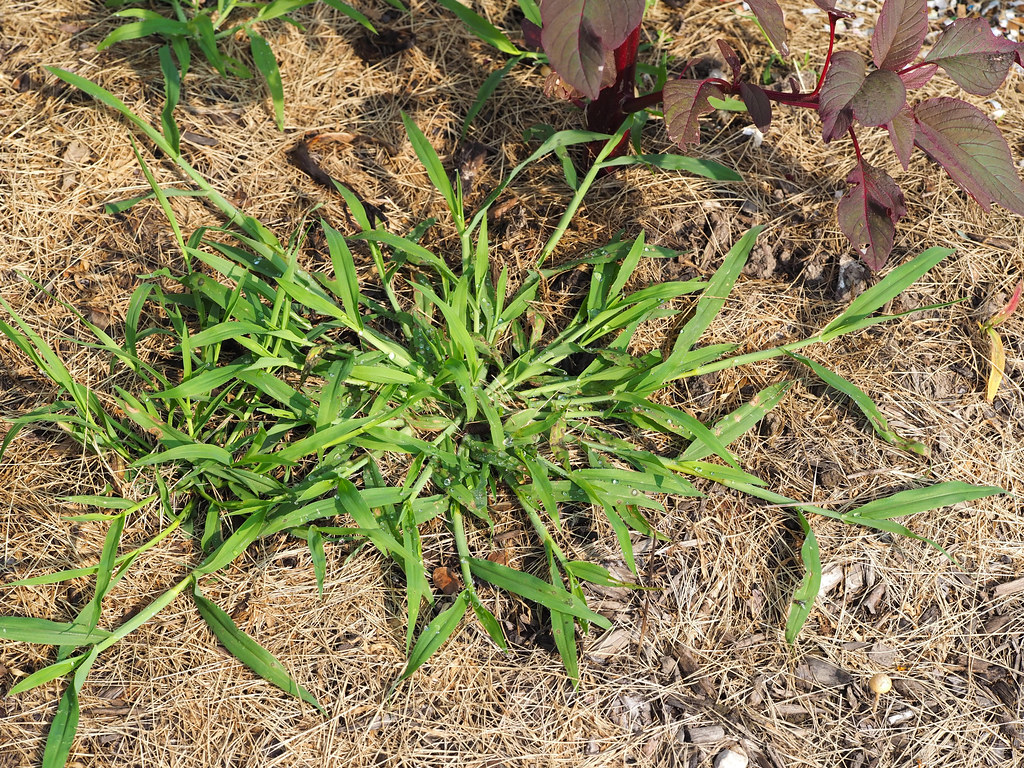
The one thing crabgrass leaves behind is seed. Next spring you will need a pre-emergent, and the label rule applies in reverse: Purdue advises delaying pre-emergent crabgrass control “until the new seedlings have been mowed four to eight times” (the exception is siduron, sold as Tupersan, which can go down at seeding). Prodiamine (Barricade) requires 60 days after seeding or the second mowing, whichever is longer.
3. Perennial grassy weeds: kill first, and plan for a long job
Bermudagrass creeping into a fescue lawn, quackgrass and tall fescue clumps in a bluegrass lawn cannot be sprayed out of new grass later, because there is no selective herbicide that removes one of these grasses from another. (Nimblewill is the main exception: Iowa State Extension reports that repeated mesotrione sprays can take it out of cool-season lawns, and mesotrione is one of the few herbicides that can be used at seeding.) For the others, the sound approach is to kill the patch completely with glyphosate before you seed. One application is rarely enough. Purdue recommends at least two applications spaced “at least three weeks” apart and says three or more may be needed; Kentucky Extension gives the same “2 to 3 applications 2 to 3 weeks apart” for bermudagrass. Count it out and you are six to nine weeks from the first spray to seeding, which pushes most northern lawns past the fall window.
Two ways out of that trap: start the glyphosate program in July so the ground is ready in early September, or kill the weeds this fall and use dormant seeding, spreading seed on bare, frozen ground between late November and March so it germinates the moment the soil warms. Purdue’s Indiana guidance puts that window between Thanksgiving and March. The other option is spring seeding, which works but forces the seedlings to grow up alongside next year’s crabgrass.
4. Nutsedge: a sedge, not a grass, so it has selective options
Yellow and purple nutsedge look grassy but are sedges (triangular stems, shiny leaves), and unlike the grasses above they can be controlled selectively in an established lawn. Purdue Extension recommends products containing halosulfuron or sulfentrazone, applied in late spring or early summer while the plants are young and before they start making tubers, with a repeat six to ten weeks later if they regrow, and warns that it takes two to three years of control to deplete the tubers in the soil.
So you do not need to kill a whole patch of lawn for nutsedge. If you are overseeding in late summer or fall, treat the nutsedge in early summer, keep the lawn thick, and check the product label for how long to wait between the herbicide and seeding (it differs by product and by grass type). Spraying glyphosate on nutsedge is a last resort for a patch that is mostly sedge, and even then the tubers usually send up new shoots.
Herbicide waiting periods around seeding
The figures below come from product labels as summarised by Purdue and Alabama Extension. Labels change and vary by brand, so the label in your hand always wins.
| Product type (examples) | Before seeding | After seeding |
|---|---|---|
| Glyphosate (Roundup, generics) | Label often allows about 7 days; extension advice is to allow 2 weeks | Not used on new lawns (kills everything) |
| Three-way broadleaf (2,4-D + MCPP + dicamba) | Do not reseed for 3–4 weeks | After the new grass has been mowed 3–4 times |
| Triclopyr-based broadleaf products | Typically 3–4 weeks (check label) | After 3–4 mowings |
| Quinclorac (Drive) | 7 days before seeding on any cool-season grass | Any time on tall fescue; 28 days after emergence on bluegrass, ryegrass, bentgrass |
| Mesotrione (Tenacity) | Can be applied at seeding (caution with fine fescue) | Second application 4–6 weeks later if needed |
| Carfentrazone (Quicksilver) | No restriction | Labelled for newly seeded turf |
| Siduron (Tupersan) pre-emergent | Can be applied at seeding | Any time after germination |
| Prodiamine (Barricade) pre-emergent | Do not seed for months (label) | 60 days after seeding or after 2nd mowing, whichever is longer |
| Dithiopyr (Dimension) pre-emergent | Do not seed for 10 weeks | After the 3rd mowing |
| Pendimethalin (Pendulum, many weed-and-feeds) | Do not reseed for 4 months | After the turf has filled in and at least 4 mowings |
How to overseed a weedy lawn so the grass wins
Whichever scenario you are in, the seedlings win or lose on seed-to-soil contact and moisture, not on how many weeds you removed. The routine below follows Purdue’s renovation bulletin.
- Mow to 1–1.5 inches and bag the clippings. This is the one step that neutralises weed competition: a scalped dandelion or crabgrass plant cannot shade anything.
- Open the soil. Core aerate to at least 20–40 holes per square foot, making several passes, or run a dethatcher or slit seeder. Seed that sits on top of thatch or compacted soil dries out and dies; our guide to preparing compacted soil for seed covers the tools.
- Seed at the right rate. Purdue’s figures: 2 lb per 1,000 sq ft for a pure Kentucky bluegrass mix, 4 lb for a bluegrass–ryegrass blend, and 6–8 lb for turf-type tall fescue. More is not better; crowded seedlings starve each other, as we explain in what happens when you put down too much grass seed.
- Feed lightly. A starter fertilizer supplying about 1.5 lb of P2O5 per 1,000 sq ft, unless a soil test or local phosphorus rules say otherwise. Keep the nitrogen for later: once the new grass has been mowed two or three times and frost is approaching, a winterizer application finishes the season.
- Water little and often. Keep the top inch damp with two to four light waterings a day until germination, then water deeper and less often to push roots down.
- Keep mowing the old lawn. Mow whenever the existing grass and weeds get tall enough to shade the seedlings; start cutting the new grass when it reaches about 2–3 inches. This matters more than most people think, and Kentucky Extension calls it out specifically.
- Spray the survivors in October or next spring, after the three-mowing rule is satisfied. Winter annuals such as henbit, chickweed and annual bluegrass germinate in the same fall weather as your grass seed, so expect a few of them in the thin spots; they are easy to control once the new grass is established, and many die back on their own, as we discuss in do weeds die in the winter?
A note from the agronomist’s side
Weed scientists talk about a “critical period of competition”: the stretch of a crop’s life when weeds actually cost yield, which is usually the first third of the season. A lawn seedling is a crop like any other. What hurts it is shade and dry surface soil during its first month, not the mere presence of a weed. That is why the low mow, the aeration and the watering schedule do more for a weedy overseeding than any herbicide, and why the herbicide should wait until the seedlings are strong enough to be mowed three times. The approach that fails most often is the reverse: a heavy weed-and-feed application in September followed by seed a week later, which kills the seed and leaves the lawn thinner than before.
Frequently asked questions
Can I overseed without killing the weeds first?
Yes, if the weeds are broadleaf perennials or summer annuals. Mow them very short, seed into them, and treat the broadleaf weeds after the new grass has been mowed three times. Only perennial grassy weeds need to be killed before seeding.
How long after weed killer can I plant grass seed?
Glyphosate: about one to two weeks. Three-way broadleaf herbicides: three to four weeks. Pre-emergent crabgrass preventers: 10 weeks to 4 months depending on the active ingredient. The label for your product is the final word.
Can I put pre-emergent down when I overseed?
Not the usual ones. Prodiamine, dithiopyr and pendimethalin stop grass seed as effectively as crabgrass seed. The exceptions labelled for use at seeding are siduron (Tupersan) and mesotrione (Tenacity).
Will new grass choke out the weeds by itself?
A dense lawn prevents new weeds from establishing, but it does not remove a mature dandelion or a bermudagrass patch. Think of overseeding as prevention for next year and herbicide (or hand-pulling) as the treatment for this year’s weeds.
Sources
- Patton, A. (2014). Plant turf seed or control weeds first? Purdue Turfgrass Science.
- Reicher, Z. (2006). Herbicide delays after seeding. Purdue Turfgrass Science.
- Purdue Extension. Lawn improvement programs (AY-20-W).
- Alabama Cooperative Extension System. Home lawns: chemical weed control recommendations (IPM-0590).
- Rutgers Center for Turfgrass Science. Weed control in spring seedings.
- Penn State Extension. Lawn management through the seasons.
- Trinklein, D., University of Missouri. Fall lawn renovation.
- Heisdorffer, A. M., University of Kentucky Cooperative Extension. Renovating an existing lawn.