
Short answer: sensitive plant (Mimosa pudica) is easy to grow from seed once you get past its hard seed coat. Nick each seed or pour hot water over them and soak overnight, sow about 3 mm (1/8 in) deep in a free-draining, loam-based mix, and keep the pot at 18 to 24°C (64 to 75°F); seedlings appear in one to four weeks. Grow it in the brightest spot you have, keep the compost moist but never soggy, feed lightly in summer, and keep it above about 13°C (55°F) in winter. Because it is an invasive weed in warm climates, grow it in a pot and remove the flower heads before they turn into bristly seed pods.
This is the practical growing guide. For how the leaf folding works, how to identify the plant in the wild, its weed status and what studies found about its traditional uses, see our reference page on Mimosa pudica (touch-me-not).
Before you start: where it is safe to grow
In cool climates such as the UK, Canada and most of the northern US, sensitive plant is a windowsill or greenhouse plant that dies at the first frost if left outside. The Royal Horticultural Society rates it H1b: it can stand outdoors in summer but needs a heated space in winter.
In frost-free climates it is a different story. It is a serious weed across the tropics, the UF/IFAS invasive plant assessment rates it high risk and not recommended anywhere in Florida, and the Hawaii weed risk assessment lists it as high risk, noting that one plant can produce 600 to 700 seeds a year that stay alive in soil for decades. If you live in south Florida, Hawaii, northern Australia, the Pacific islands or anywhere similar, grow it only indoors or in a container on a hard surface, and never let it set seed. Check local rules before buying seed.
Step 1: break the seed coat (scarification)
Like many legumes, sensitive plant has “physical dormancy”: a waterproof seed coat that stops water getting in. Seed sown straight from the packet often sits for weeks and only a few come up. A 2022 study in PeerJ by Tang and colleagues found that intact seeds hardly germinated at all at normal temperatures, while seeds nicked with a blade germinated at more than 89 percent, and seeds dipped in 80°C (176°F) water for 10 minutes reached about 86 percent. Longer or hotter soaks killed more seed.
Pick one method:
| Method | How to do it at home | Notes |
|---|---|---|
| Nicking (most reliable) | Hold the seed with tweezers and clip a tiny corner off with nail clippers, or rub one edge on fine sandpaper until a paler layer shows. Avoid the small scar where the seed was attached. | Best for a few seeds. Then soak for a few hours. |
| Hot water | Boil a kettle, let it stand a couple of minutes (roughly 80°C / 176°F), pour it over the seeds in a cup, and leave them to cool and soak overnight. | Good for a whole packet. Do not keep them in boiling water. |
| Plain soaking | Soak overnight in warm water, as the RHS and BBC Gardeners’ World suggest. | Works for some seeds; Gardeners’ World expects seedlings in 21 to 30 days. |
After soaking, seeds that have swollen to about twice their size have taken up water and are ready to sow. Seeds that are still small and hard can be nicked and soaked again.
Step 2: sow and germinate
- When: spring is best, so seedlings grow on into long, bright days. Indoors under lights you can sow at any time.
- Mix: use a peat-free seed compost or a loam-based mix (the RHS and Gardeners’ World both suggest loam-based compost such as John Innes No. 2 for growing on), with a handful of perlite or grit for drainage.
- Depth: press the seeds in and cover them with about 3 mm (1/8 in) of compost or vermiculite. Water from below or with a fine mist.
- Warmth: keep the pot at 18 to 24°C (64 to 75°F), the RHS range. A heat mat or a warm spot away from direct sun works well. Cover with a clear lid or bag to hold humidity, and remove it once seedlings appear.
- Light: as soon as the seedlings are up, move them to bright light or a few centimetres under an LED grow light, or they stretch and flop.
- Prick out: when the first feathery true leaves have formed, move each seedling into its own 7 to 9 cm (3 to 3.5 in) pot. Handle it by a seed leaf, not the stem.

Step 3: light, temperature and humidity
- Light: full sun to light shade. On a windowsill, a south, east or west window is best. Under glass in hot summer weather, the RHS advises some protection from the fiercest sun. In poor light the stems grow long and weak, flowering stops, and the leaves respond sluggishly.
- Temperature: Gardeners’ World recommends not less than 18°C (64°F) for good growth; the RHS says winter temperatures must not fall below 13°C (55°F). Yellowing leaves are often the first sign the plant is too cold.
- Humidity: it likes moist air. Stand the pot on a tray of damp pebbles and keep it away from radiators and air-conditioning vents. Dry air invites red spider mite.
- Summer outdoors: in cool climates you can put it outside in a sheltered, sunny spot once nights stay above about 15°C (59°F). Bring it back in before autumn chills.
Step 4: soil, watering and feeding
Pot on into a 12 to 15 cm (5 to 6 in) pot with drainage holes as the roots fill each pot; a mature plant rarely needs more. The RHS gives an ultimate size of 10 to 50 cm tall and up to 1 m across, reached in one to two years.
- Water when the top 1 to 2 cm (about half an inch) of compost feels dry, then water thoroughly and let the excess drain away. Never leave the pot standing in water. In winter, water sparingly.
- Feed with a balanced liquid fertiliser once a month in spring and summer, as the RHS suggests, at the rate on the label or weaker. As a legume it can make some of its own nitrogen, so heavy feeding just produces soft, floppy growth.
- Repot in spring if roots are circling the bottom of the pot.
Step 5: pruning, flowers and seed pods
The RHS says no pruning is required, but a light trim keeps a pot plant tidy. Pinch out the growing tips of young plants to make them branch, and cut back long, straggly stems by a third in spring. Wear gloves: the stems carry small, sharp prickles.
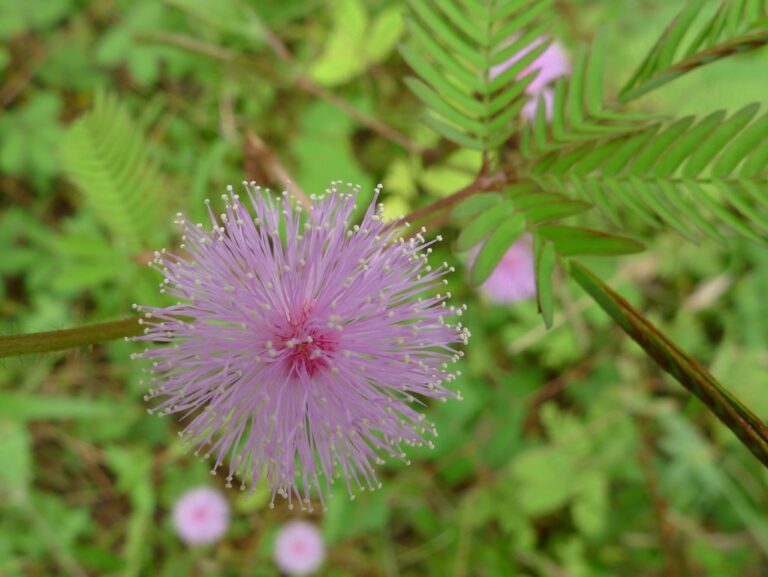
From early summer the plant produces fluffy pink ball-shaped flowers. Each flower head can become a cluster of flat, bristly pods, and each pod segment holds a seed that clings to clothes and fur, according to the Pacific Pests, Pathogens and Weeds fact sheet. This is the moment that matters for containment.
How to keep it from escaping
- Deadhead. Snip off each flower head as it fades, before the green pod cluster forms. If you want seed for next year, let one or two heads ripen and cover them with a small organza bag so no pods drop.
- Keep it off bare soil. In warm climates, keep the pot on a patio, balcony or indoors, not sunk into a bed where fallen seed can germinate.
- Bin the leftovers. Put pods, prunings with seed and old plants in the rubbish, not the compost heap; our guide on disposing of invasive plants covers the safer options.
- Do not share seed with gardeners in frost-free regions or post it to places where it is regulated.
- Replace rather than keep. Older plants get woody and leggy. Many growers take a few softwood cuttings in early summer (the RHS suggests using bottom heat) or simply sow fresh seed each spring.
Touching the leaves without wearing the plant out
Every fold forces the plant to pump ions and water back into its hinge cells before the leaf can reopen, which takes several minutes and costs energy it would otherwise use for growth. An occasional touch does no harm. Constant poking, especially in poor light, leaves a plant with drooping, closed leaves for much of the day. Plants also get used to repeated harmless disturbance: in an Oecologia study by Gagliano and colleagues, plants that were dropped repeatedly stopped folding; the effect was strongest in low light and could last for a month. Leaves also close every evening and in the cold, so a plant that is shut at night or in a chilly room is behaving normally.
Is sensitive plant safe with pets and children?
The main risk for children is the prickles on the stems and pods, so show them how to touch the leaves with one finger and keep them from pulling at the stems or putting seeds or pods in their mouths. The plant contains mimosine, which the Pacific Pests fact sheet notes can harm the thyroid of cattle that graze it. There is no reliable data on how much a cat or dog would need to eat to be harmed, so keep the pot out of reach of pets that chew plants, and call your vet or an animal poison line if a pet eats a significant amount. The plant has no proven medicinal use in people, and it should not be eaten or used as a home remedy, particularly in pregnancy.
Common problems
| What you see | Likely cause | What to do |
|---|---|---|
| Leaves stay closed during the day | Too cold, too dark, too much touching, or the roots are waterlogged or bone dry | Move to a warmer, brighter spot, water correctly, and leave it alone for a day |
| Yellow leaves | Cold, overwatering or a pot that does not drain | Keep above 18°C (64°F) and let the top of the compost dry between waterings |
| Long, floppy stems, no flowers | Not enough light, or too much fertiliser | Give more light or a grow light, feed less, pinch back |
| Fine webbing, pale speckled leaflets | Red spider mite in dry air | Raise humidity, rinse the foliage, isolate the plant; use insecticidal soap if needed |
| Seeds never came up | Hard seed coat not broken, or compost too cold | Nick or hot-water treat the seed and keep it at 18 to 24°C (64 to 75°F) |
For identification, how the leaf-folding works and where the plant becomes a weed, see our full guide to Mimosa pudica (touch-me-not). Other wild plants with traditional uses are collected in our useful weeds section, including Euphorbia hirta.
Sources
- Royal Horticultural Society – Mimosa pudica (sensitive plant) plant details
- BBC Gardeners’ World – How to grow and care for sensitive plant
- Tang et al. (2022), PeerJ – Methods of breaking physical dormancy in seeds of the invasive weed Mimosa pudica
- UF/IFAS – Assessment of non-native plants in Florida: Mimosa pudica
- Plant Pono (Hawaii) – Mimosa pudica high-risk assessment
- Pacific Pests, Pathogens and Weeds – Sensitive plant (464)
- Gagliano et al. (2014), Oecologia – Experience teaches plants to learn faster and forget slower