
Short answer: Mimosa pudica, the sensitive plant or touch-me-not, is a low, prickly legume from tropical America whose feathery leaves fold up within about a second of being touched. The fold happens because small hinge organs called pulvini fire an electrical signal, lose potassium and chloride ions, and let water rush out of their motor cells. The same plant that children love to poke is a serious weed of crops, pastures and lawns across the tropics, carries the livestock toxin mimosine, and sheds around 700 bristly seeds a year that can stay alive in soil for decades. It has a long record in folk medicine, but no clinical trials in people.
This page is the reference: how to recognise it, what the leaf movement actually is, where it is a weed, what the studies on its traditional uses found, and how to get rid of it. If you want to grow one on purpose, see our separate guide on how to grow sensitive plant from seed and keep it contained.
Names you will see it under
Common English names include sensitive plant, touch-me-not, shame plant, humble plant, sleepy plant and shy plant. Across its introduced range it has many local names: makahiya in Tagalog, lajwanti or chhui-mui in Hindi, lojjaboti in Bengali, putri malu or semalu in Malay, and dormidera or moriviví in Spanish-speaking tropical America. Do not confuse it with the garden balsams and jewelweeds (Impatiens), which are also called touch-me-not because their ripe seed capsules burst when touched. Their leaves do not move.
How to identify Mimosa pudica
These features separate it from its larger relatives; measurements are from the EAFRINET weed key and the Pacific Pests, Pathogens and Weeds fact sheet.
- Habit: a sprawling or creeping perennial, often behaving as an annual in cooler places, usually under 50 cm (20 in) tall but spreading wider.
- Stems: brown to purplish, woody at the base with age, hairy, and armed with short, sharp, slightly hooked prickles a few millimetres long.
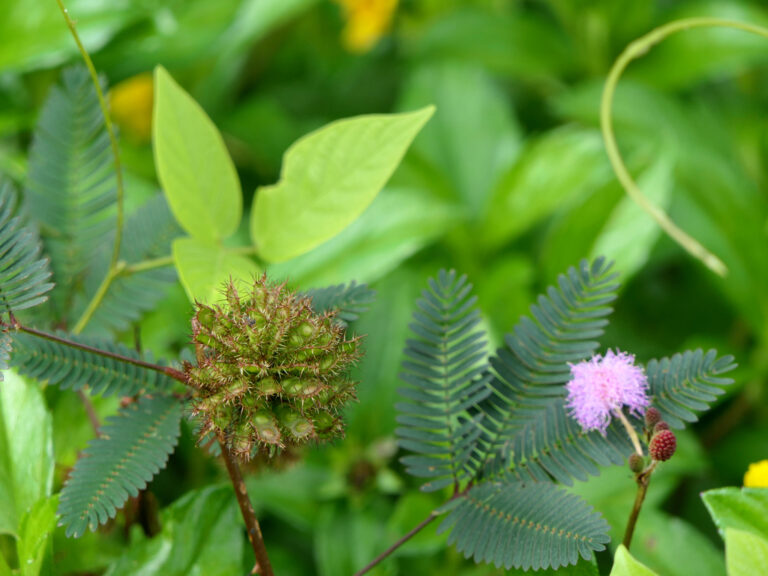
- Leaves: twice-divided (bipinnate), with one or two pairs of feathery segments held close together like the fingers of a hand. Each segment carries about 10 to 26 pairs of narrow leaflets 6 to 15 mm long, with bristly edges. The leaves fold when touched and at night.
- Flowers: fluffy pink to lilac balls about 1 cm (0.4 in) across on bristly stalks from the leaf axils. The fluff is the stamens; each tiny flower has four of them.
- Pods: flat, 1 to 2 cm long, in tight clusters, with bristles along the edges. They break into two to four one-seeded segments that stick to fur, feathers, socks and trouser legs.
- Roots: a long, tough taproot, which is why established plants snap off rather than pull out.
Look-alikes
| Plant | Growth form | Pods | Why it matters |
|---|---|---|---|
| Sensitive plant (Mimosa pudica) | Low, spreading, few leaf segments held finger-like | 1–2.5 cm, 1–6 seeds | Lawn, garden and crop weed |
| Giant sensitive plant (Mimosa diplotricha) | Upright or scrambling shrub, climbs over other plants | 1–3.5 cm, 3–5 seeds | Scrambles over and smothers crops and pasture |
| Giant mimosa (Mimosa pigra) | Large thorny shrub, many leaf segments | 3–8 cm, 14–26 seeds | A major wetland invader; report it where it is a declared weed |
| Jewelweed, balsam (Impatiens) | Soft, fleshy, no prickles, simple leaves | Explosive capsules | Shares the name touch-me-not only |
The first three rows follow the EAFRINET key. A “sensitive plant” that is knee-high, climbing, or has pods longer than your thumb needs a proper identification.
Why the leaves close when you touch them
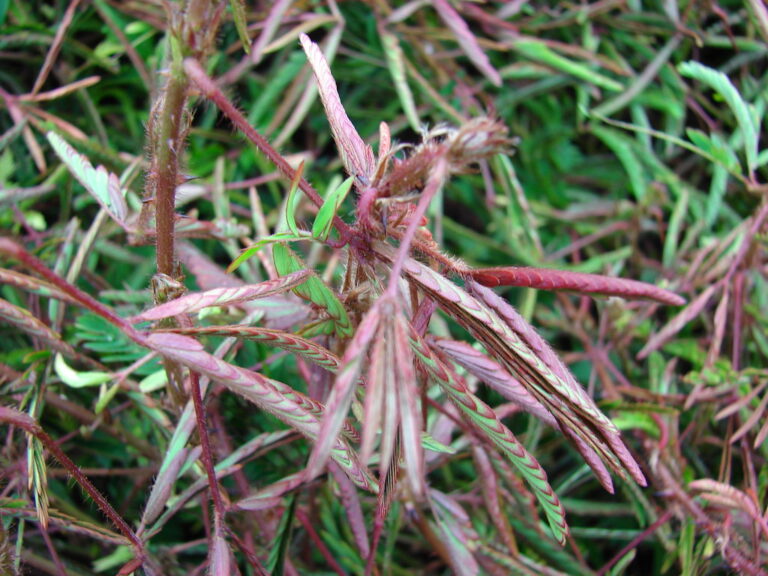
The movement is called seismonasty: plumbing driven by electricity. According to a 2020 review by Hagihara and Toyota in Plants (PubMed Central), the plant has three sets of motor organs called pulvini: one at the base of each leaflet, one where each feathery segment meets the leaf stalk, and a large one where the leaf stalk meets the stem.
- Signal. A touch opens ion channels and triggers an action potential, a wave of electrical depolarisation not unlike a nerve impulse. Researchers have closed leaflets simply by applying 1.3 to 1.5 volts to a pulvinus, as reported in Volkov and colleagues in Plant, Cell & Environment.
- Ion flood. Calcium rises inside the motor cells, and potassium and chloride ions pour out of the cells on one side of the pulvinus. Part of that calcium is thought to come from a special tannin-filled vacuole that stores it.
- Water loss. Water follows the ions out through aquaporin water channels, so the cells on that side go limp while the cells on the other side stay firm. The joint bends and the leaflets fold together or the whole leaf drops.
- Reset. Proton pumps slowly pull the ions back in, water returns, and the leaf reopens over the following minutes. Reopening is the energy-hungry part of the cycle.
High-speed X-ray imaging published in Scientific Reports showed that the whole bend takes about one second, one of the fastest water-driven movements in any multicellular plant, with the upper and lower skin of the pulvinus stretching and wrinkling as it flexes.
Touch versus wounding, and why it bothers
A light touch produces a local action potential, so only the touched leaflets fold. Crushing or burning a leaf produces a slower “variation potential” that spreads through the plant, folding leaves some distance away. In a 2022 study in Nature Communications, the same research group tracked calcium and electrical waves moving at roughly 4 to 6 mm per second. They then made plants that could not move, either by blocking calcium signalling or by using CRISPR-Cas9 to knock out the genes needed to build pulvini. Grasshoppers ate about twice as much of the immobile plants (30.7 percent of leaf area versus 15.3 percent in normal plants). Folding is an anti-herbivore defence.
Night closing and “learning”
The leaves also fold every evening, a separate slow movement (nyctinasty) run by the plant’s internal clock through the same pulvini. Repeated harmless touching also makes the plant respond less: in an Oecologia study by Gagliano and colleagues, potted plants dropped repeatedly stopped folding, the effect was stronger in plants kept in low light, where every fold is expensive, and some plants still showed it a month later.
Where it is a weed
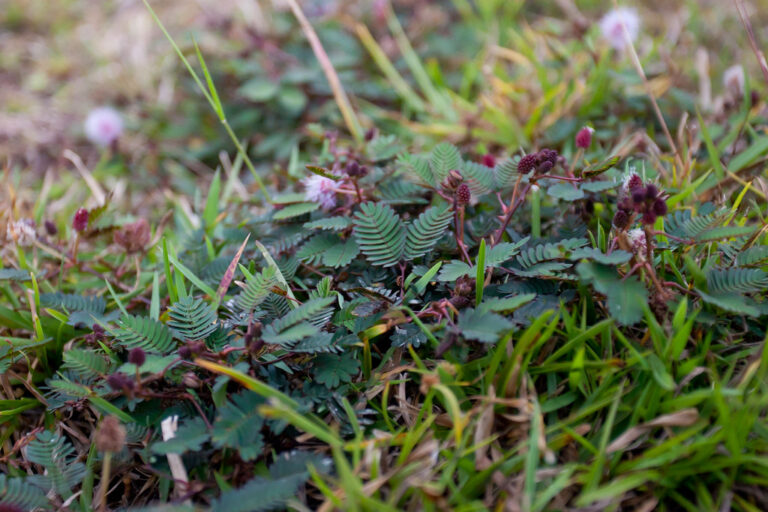
Sensitive plant is native to Central and South America and now grows across the tropics and subtropics. The IUCN Global Invasive Species Database lists it in more than 50 countries and describes it in croplands, orchards, pastures, mowed areas, roadsides and construction sites, favouring disturbed, low-nutrient soil where competition is thin.
- Pacific islands: the Pacific Pests fact sheet ranks it among the ten worst weeds in American Samoa, French Polynesia, Guam, the Solomon Islands and Tonga. It is a serious weed of cotton, maize, pineapple, sorghum, soybean, sugarcane, tea, tomatoes and upland rice, and tolerates enough shade to invade banana, citrus, coconut, coffee, oil palm, papaya and rubber plantations.
- Hawaii: recorded as naturalised by 1864 and widespread within seven years; the Hawaii weed risk assessment (Plant Pono) rates it high risk.
- Florida: the UF/IFAS invasive plant assessment gives it a high invasion risk in north, central and south Florida and does not recommend planting it.
- Australia: included in weed guides for south-east Queensland and northern New South Wales, and several herbicides are registered against it (see control below).
In pastures the prickly mats keep cattle off the grass underneath, dead mats are a fire hazard, and hand-weeding without gloves leaves painful sores.
Is it toxic? Mimosine, livestock and people
The plant contains mimosine, the same amino acid that limits the feeding value of leucaena. The Pacific Pests fact sheet explains that rumen bacteria convert mimosine to a compound that interferes with thyroid function in cattle and causes hair loss; in Australia, Fiji, Papua New Guinea and elsewhere the problem was solved by dosing herds with a rumen bacterium that breaks the toxin down. The Hawaii risk assessment lists mimosine as a reason not to rely on the plant as fodder. Sheep graze it readily.
For people, the main everyday hazard is the prickles. There is no good human toxicity data, and the 2023 review by Adurosakin and colleagues (below) notes that no clinical trials or quality-control studies exist. Animal studies in the 2012 Pharmacognosy Reviews overview report antifertility effects, so it should not be taken in pregnancy or when trying to conceive.
Traditional uses and what the research found
Few weeds have a longer medicinal résumé. The leaves and roots have been used in South and Southeast Asia, Africa and tropical America for dysentery and diarrhoea, piles, urinary complaints, sinus trouble, skin problems and wounds, and in Mesoamerica for anxiety and sleeplessness.
| Traditional use | What studies have tested | Level of evidence |
|---|---|---|
| Wounds, skin infections | Antibacterial and wound-healing activity of extracts | Laboratory and animal studies only |
| Dysentery, intestinal worms | Antimicrobial and anthelmintic (anti-worm) activity of extracts | Laboratory and animal studies |
| Anxiety, insomnia, depression | Anxiolytic and antidepressant-like behaviour in rodents | Animal studies; reviewed in the Mayan-medicine overview in Journal of Ethnopharmacology |
| Diabetes, liver complaints | Lower blood glucose in diabetic rats; liver protection against chemical injury | Animal studies |
| Snakebite | Antivenom activity of extracts in test systems | Laboratory studies |
The broadest recent summary, Adurosakin and colleagues in Pharmacological Research – Modern Chinese Medicine (2023), lists antioxidant polyphenols (gallic acid, quercetin, rutin, apigenin), sterols and L-mimosine among the compounds, and concludes that clinical trials and quality-control work are needed before any safe, effective dose can be named. None has been done. In other words, the traditional uses are well documented, the laboratory results are interesting, and there is no evidence yet that any preparation works or is safe in people.
Beyond medicine, the seed coat produces a mucilage that is being studied as a pharmaceutical binder and gel, according to a 2024 review in the International Journal of Biological Macromolecules. The plant also fixes nitrogen, has been used as a cover crop, and bees collect its pollen.
Safety: do not use sensitive plant as a remedy on your own. It contains mimosine, has antifertility effects in animals, and has never been tested in human trials. Avoid it completely in pregnancy and breastfeeding, keep it away from children, and talk to a doctor before taking any herbal product.
Plant uses are described here as background only. Nothing on this page is medical advice, and no wild plant should be eaten or used as a remedy based on a website. See our disclaimer.
How to control sensitive plant
The goal is to stop seed. A plant that flowers for a few weeks can leave enough seed to keep a patch going for years, because the hard-coated seed survives long burial; the Hawaii assessment cites viability of up to 44 years.
- Catch it young. Hoe or dig seedlings and young plants before the first flower heads appear. Wear leather gloves. Lever older, woody plants out with a narrow spade rather than pulling.
- Bag seed heads. If pods have formed, clip them into a bag first, then dig. Do not compost plants with pods; follow our notes on disposing of invasive plants without spreading them.
- Clean up after yourself. Brush down socks, boots, pets and mower decks, and avoid moving soil or gravel from infested ground.
- Thicken the turf or cover the soil. In lawns the plant exploits thin, low-fertility grass. Feed and overseed so the grass closes the gaps. In beds, a thick mulch stops seedlings.
- Use a herbicide on larger infestations. Glyphosate sprayed onto the foliage is the most widely used option for non-lawn areas. In Australia, products registered for sensitive plant include fluroxypyr, dicamba, picloram plus triclopyr, MCPA plus terbutryn, and hexazinone plus diuron. In lawns, a selective broadleaf herbicide containing dicamba, triclopyr or fluroxypyr is the usual choice, but check that the label lists your grass type. The GISD notes that thorough wetting of all leaves is essential; spray when leaves are open, not after you have brushed past them.
- Do not burn or overgraze. Fire alone tends to increase density because it stimulates the seed bank. Overgrazing opens the pasture and favours it.
- Follow up. Expect seedlings from the seed bank for several seasons. Check every few weeks in warm, wet weather.
Biological control has worked against the giant sensitive plant, Mimosa diplotricha, in parts of the Pacific, but no agent is in use against M. pudica. For a comparable story of an attractive plant that became a problem, see whether lantana is invasive.
Related guides: Parthenium Weed (Carrot Grass, Congress Grass): Identification, Health Risks and Control · Acmella uliginosa (Marsh Para Cress): Identification, Uses and Safety · Desmodium triflorum (Three-Flower Beggarweed): Identification, Lawn Control and Uses
Sources
- Hagihara & Toyota (2020), Plants – Mechanical signaling in the sensitive plant Mimosa pudica L.
- Hagihara et al. (2022), Nature Communications – Calcium-mediated rapid movements defend against herbivorous insects in Mimosa pudica
- Song, Yeom & Lee (2014), Scientific Reports – Real-time imaging of pulvinus bending in Mimosa pudica
- Volkov et al. (2010), Plant, Cell & Environment – Electrical and mechanical stimulation of plant movements
- Gagliano et al. (2014), Oecologia – Experience teaches plants to learn faster and forget slower
- Pacific Pests, Pathogens and Weeds – Sensitive plant (464)
- EAFRINET – Mimosa pudica (common sensitive plant) fact sheet
- IUCN Global Invasive Species Database – Mimosa pudica
- Plant Pono (Hawaii) – Mimosa pudica high-risk assessment and UF/IFAS – Assessment of non-native plants: Mimosa pudica
- Adurosakin et al. (2023) – Ethnomedicinal uses, phytochemistry, pharmacological activities and toxicological effects of Mimosa pudica and Ahmad et al. (2012), Pharmacognosy Reviews – Mimosa pudica L. (Laajvanti): an overview