
Short answer: Euphorbia hirta, known as asthma plant, garden spurge, hairy spurge or tawa-tawa, is a small, hairy, reddish-stemmed spurge. You can recognise it by the dense round heads of tiny greenish flowers, 0.2–0.4 in (5–10 mm) across, that sit in the leaf joints. It is a common weed of warm-climate lawns, beds and paving cracks. One plant can shed thousands of seeds within 6–10 weeks of germinating. Pull it before it flowers, wearing gloves because the milky sap irritates skin and eyes. Use a pre-emergent herbicide before soil warms past about 60 °F (15 °C) to stop the next flush. It has a long history in folk medicine for asthma, coughs and diarrhoea, but the evidence comes almost entirely from laboratory and animal work, and the plant is not safe to self-treat with.
What asthma plant is
Euphorbia hirta (older name Chamaesyce hirta) belongs to the spurge family, Euphorbiaceae. Like almost every Euphorbia, it bleeds white, milky latex when a stem or leaf is broken. It is an annual or short-lived perennial with a taproot. Its stems usually grow upright to sprawling, about 4–20 in (10–50 cm) long.
It probably originated in tropical America. The Flora of North America describes it as “probably native to at least central Mexico” and treats it as introduced in the southern United States. It now grows throughout the tropics and subtropics of Africa, Asia, Australia and the Pacific. In warm regions it flowers all year. Where winters bring frost it behaves as a summer annual and comes back each year from seed.
Its common names come from its uses and appearance. “Asthma plant” and “asthma weed” refer to its traditional respiratory use. “Hairy spurge” and “garden spurge” describe it as a weed. “Tawa-tawa” is its Tagalog name in the Philippines, and “pillpod spurge” refers to the small round seed capsules.
How to identify Euphorbia hirta
According to UF/IFAS Extension and the NC State Extension Plant Toolbox, look for these features:
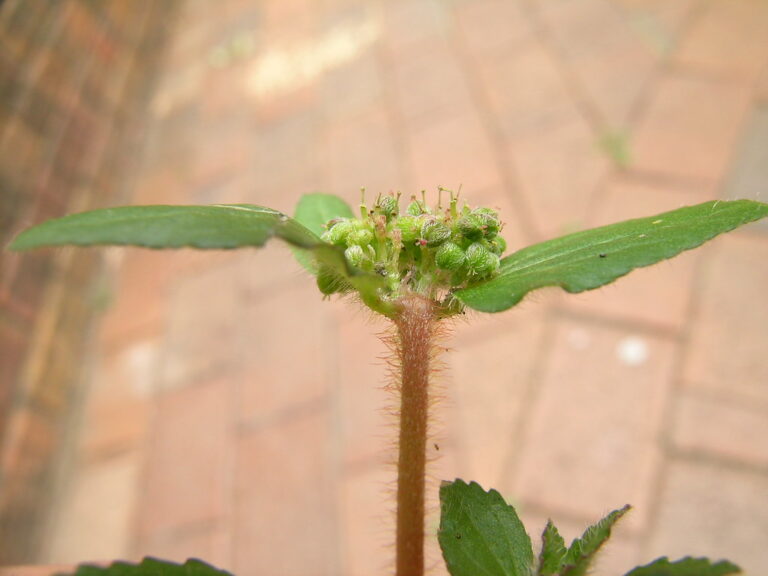
- Stems: reddish-purple and covered in long, spreading yellowish to brown hairs. The hairs are easy to see against the light.
- Leaves: in opposite pairs, oval to lance-shaped, about 0.5–1.5 in (1–4 cm) long, finely toothed, and lopsided at the base. They are often dark green with a reddish-purple blotch in the middle, and paler underneath.
- Flowers: there are no petals. Tiny flower structures (cyathia) are packed into dense, ball-shaped clusters 0.2–0.4 in (5–10 mm) across on short stalks in the leaf joints. They are green, tan or pinkish. These round heads are the most reliable way to tell this plant from other weedy spurges.
- Fruit and seed: a small hairy three-lobed capsule about 1–1.5 mm across. Each holds tiny, four-angled, reddish-brown seeds.
Asthma plant vs other spurges
Several small spurges grow in the same lawns and paving cracks, and they are often confused. The chemical control is similar for all of them, but identification matters if you want to use the plant or keep it away from children and pets.
| Species | Growth habit | Hairs | Leaves | Flowers |
|---|---|---|---|---|
| Asthma plant / garden spurge (E. hirta) | Upright to sprawling, 4–20 in (10–50 cm) | Long, spreading, yellowish to brown hairs on stems | 0.5–1.5 in, toothed, lopsided base, often a red blotch | Dense round heads 5–10 mm across on short stalks |
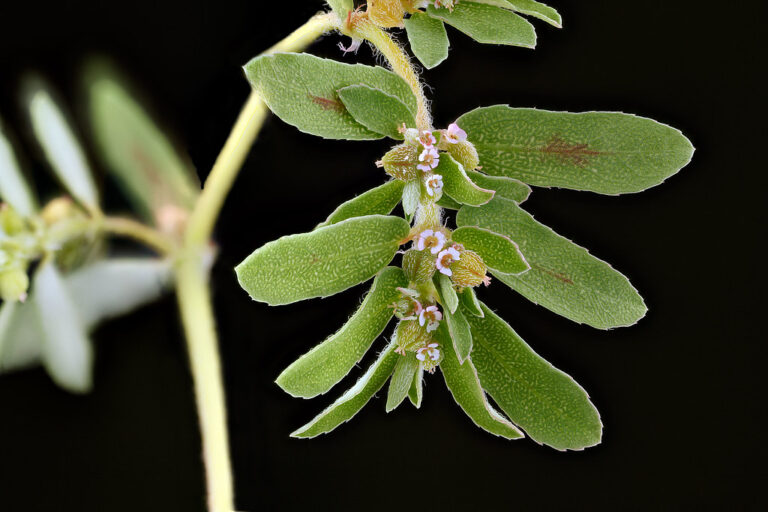
| Spotted spurge (E. maculata) | Flat mat hugging the ground | Hairy stems; capsules hairy all over | Small, about 1/2–3/4 in, usually with a reddish central spot | Tiny, single or few along the stems, not in balls |
| Prostrate or ground spurge (E. prostrata) | Flat mat | Capsule hairs mostly along the ridges | Small, never with a central spot | Tiny, scattered along the stems |
| Graceful spurge (E. hypericifolia) | Upright, 6–20 in (15–50 cm) | None: stems, leaves and capsules are hairless | Oblong, 0.4–1.4 in (1–3.5 cm), toothed | Clustered, but on a smooth, hairless plant |
Sources for the table: UC IPM for spotted and ground spurge, Penn State Extension for spotted spurge leaf size, and the Flora of North America for graceful spurge. UF/IFAS adds that spotted spurge leaves are “much rounder” and about half the size of garden spurge leaves.
A quick field check: if the plant is hairy and has round, button-like flower heads, it is E. hirta. If it lies flat with small spotted leaves and no flower balls, it is spotted spurge. If it looks like E. hirta but is completely smooth, it is graceful spurge.
The milky sap: skin and eye irritation
All parts of the plant contain milky latex. The NC State Extension Plant Toolbox lists all parts as toxic because of diterpene esters. These can cause mild to severe skin rashes and eye damage. If the plant is chewed, it can blister the lips and mouth. NC State rates the overall severity as low. Sap in the eye is the bigger risk. It is easy to rub your eye after weeding without thinking.
- Wear gloves when pulling spurge, and wash your hands before touching your face.
- If sap gets in an eye, rinse it with plenty of clean running water for several minutes and get medical advice if pain or blurred vision continues.
- Keep children and pets from chewing the plant. If a pet has eaten some and is drooling or pawing at its mouth, call your vet or a poison helpline.
Why it is a problem weed in lawns and gardens
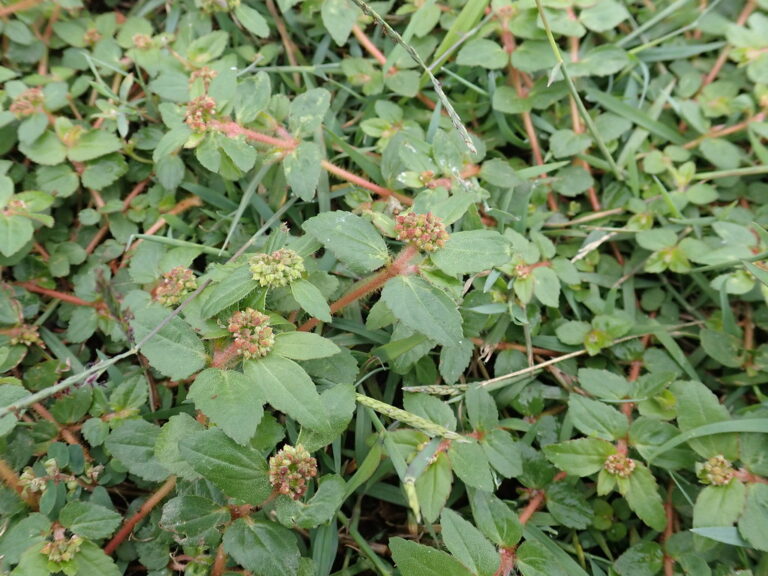
Garden spurge grows fast and seeds early. According to UF/IFAS, it can start producing seed 6–8 weeks after germinating. One plant can release several thousand seeds over 8–10 weeks. The seeds have no dormancy, so they can germinate as soon as they land. They need light, and they germinate best at 75–85 °F (24–29 °C), with some germination whenever it is above 60 °F (15 °C). That is why it shows up in sunny, thin patches of lawn, bare soil in beds, gravel, pavers and the edges of containers. Nursery pots are another common way it arrives.
In a thick, healthy lawn it has a hard time establishing. It takes over where turf is thin from drought, compaction or low mowing. If spurge keeps coming back in the same spot, look first at why the grass is thin there. Our guide to why grass won’t grow covers the usual causes.
How to control garden spurge
- Hand-pull early and often. Pull plants while they are small and before the flower heads turn brown and shed seed. UF/IFAS recommends weeding every 2–4 weeks in the growing season, because a missed plant can seed in under two months. Pull slowly from the base when the soil is moist. UC IPM warns that spurge stems often snap off above the root and the plant regrows. Wear gloves.
- Mulch bare soil. Seeds need light to germinate, so 2–3 in (5–7.5 cm) of bark or wood-chip mulch in beds stops most of them. UC IPM notes that coarse mulch needs 3–4 in to work. See our guide on stopping weeds in mulch beds.
- Use a pre-emergent in late winter or spring. Pre-emergents stop seedlings but do not affect plants that are already growing. UC IPM advises applying before the soil at 1 in (2.5 cm) deep passes 55–60 °F (13–16 °C). Penn State Extension lists dithiopyr, pendimethalin, prodiamine and isoxaben for lawns. For home beds UC IPM also names oryzalin and trifluralin. Because spurge germinates all summer, a split application or a longer-lasting product may be needed where summers are long. The timing is similar to crabgrass prevention; see our crabgrass guide. Do not apply a pre-emergent where you plan to seed grass.
- Spot-spray plants already growing in lawns. Penn State Extension reports good control of spurges with lawn broadleaf herbicides that combine 2,4-D, dicamba, MCPP (mecoprop) and/or fluroxypyr. Spray young plants on a warm day when they are growing actively, and follow the label for your grass type.
- In gravel, paving and bare ground, a contact herbicide such as diquat or glufosinate kills the top growth. UF/IFAS rates both as highly effective when coverage is thorough. Pulling or scraping works just as well on small patches. For more on these areas, see killing weeds in rock gardens and gravel.
Common mistakes: pulling plants that are already carrying ripe capsules (shake them into a bag, not onto the soil); relying on a single spring pre-emergent in a long, hot summer; and hoeing without mulching afterwards, which exposes more seed to light. Expect results over one or two seasons, not one weekend. The seed bank drops quickly once no new plants are allowed to set seed.
Traditional uses and what studies show
Asthma plant has a long record in folk medicine across South and Southeast Asia, Africa and tropical America. A 2010 review in Pharmacognosy Reviews lists these traditional uses:
- gut complaints (diarrhoea, dysentery, intestinal worms)
- respiratory complaints (asthma, bronchitis, coughs and hay fever)
- conjunctivitis and eye sores (the latex applied near the eyelid)
- skin conditions, boils (leaf poultices) and a gargle for thrush
The same review summarises the laboratory findings. Extracts showed antidiarrhoeal effects in mice, anti-inflammatory effects in a mouse model, a diuretic effect in rats, and antibacterial, antifungal, antiamoebic and antimalarial activity in the test tube. The “anti-asthmatic” action is described as a relaxing effect on the bronchial tubes together with “a depressant action on respiration”. That second part is a warning sign, not a benefit. The review also reports that an extract sharply reduced sperm count and motility in male rats. These are extract experiments in animals and cell cultures. They do not show that home preparations are safe or effective.
Dengue. In the Philippines, tawa-tawa decoction is widely used as a folk remedy to raise platelet counts in dengue fever. A 2018 systematic review in the Journal of Tropical Medicine screened over 860 records. It found only eight relevant papers, and only one of them was a human study. The authors concluded that the number of studies was inadequate and called for well-controlled clinical trials. That one human study followed 125 dengue patients but had no control group. The rise in platelet count it reported was not statistically significant. Dengue can become dangerous quickly. It needs medical monitoring, not home treatment.
Safety line: do not use asthma plant to treat asthma or any other condition in place of prescribed medicine. An asthma attack needs proper medical treatment. Avoid all use in pregnancy, while breastfeeding, in children, and if you are trying to conceive. Anyone allergic to latex or to other spurges should also avoid it. Keep the sap away from your eyes. Never use plants from sprayed lawns or roadsides. Talk to a doctor or pharmacist before taking any herbal product, especially if you take other medicines.
For another common weed with a long folk-medicine history, see our page on Caesar weed (Urena lobata).
Plant uses are described here as background only. Nothing on this page is medical advice, and no wild plant should be eaten or used as a remedy based on a website. See our disclaimer.
Frequently asked questions
Is Euphorbia hirta the same as spotted spurge?
No. Both are weedy spurges with milky sap, but spotted spurge (E. maculata) lies flat in a mat and has small spotted leaves with scattered tiny flowers. E. hirta is more upright, very hairy, and carries its flowers in dense round heads.
Is asthma plant poisonous to dogs and cats?
The sap irritates skin and the mouth, so a pet that chews it may drool, paw at its mouth or vomit. NC State rates the severity as low, but call your vet if symptoms appear or if a large amount was eaten.
Will vinegar or boiling water kill it?
They burn the top growth of small seedlings, but older plants often regrow from the root, and neither method stops new seedlings. See what horticultural vinegar really does. Pulling plus mulch or a pre-emergent works better.
Related guides: How to Get Rid of Spurge in Lawns, Garden Beds and Sidewalk Cracks · Tiger Foot Morning Glory (Ipomoea pes-tigridis): Identification and Control · Parthenium Weed (Carrot Grass, Congress Grass): Identification, Health Risks and Control
Sources
- UF/IFAS Extension – Biology and Management of Garden Spurge (Euphorbia hirta) in Ornamental Crop Production
- NC State Extension Gardener Plant Toolbox – Euphorbia hirta
- UC Statewide IPM Program – Spotted Spurge and Other Spurges
- Penn State Extension – Lawn and Turfgrass Weeds: Spotted Spurge
- Flora of North America – Euphorbia hirta and Euphorbia hypericifolia
- Kumar et al. (2010), Pharmacognosy Reviews – Euphorbia hirta: its chemistry, traditional and medicinal uses, and pharmacological activities
- Perera et al. (2018), Journal of Tropical Medicine – Potential use of Euphorbia hirta for dengue: a systematic review
- Mir et al. (2012), J Ayub Med Coll Abbottabad – Herbal water of Euphorbia hirta in dengue patients