
Short answer: power raking is worth doing only when you have a real thatch layer to remove, roughly 1/2 inch (1.3 cm) or more between the soil and the green grass, or a mat of dead winter debris that a leaf rake will not lift. A power rake uses spinning spring tines or loose flail blades that comb thatch out of the surface; a dethatcher (vertical mower or verticutter) uses fixed vertical knives that slice into the soil, so it removes more but also does more damage. Both must be run while the grass is growing fast and has at least a month of good weather ahead to recover: late August to early October for cool-season lawns, late spring to early summer for bermuda and zoysia. On a thin, drought-stressed or newly seeded lawn, or one with less than 1/2 inch of thatch, power raking hurts more than it helps and core aeration is the better tool.
Power rake, dethatcher, verticutter: what the words mean
Rental yards use these names loosely. The machines differ in what spins under the deck and how deep it goes.
- Power rake: a walk-behind machine with a horizontal reel carrying spring-steel tines or swinging flail blades. The tines comb loose thatch, dead stems and matted debris to the surface. Manufacturer guidance is that the flails should remove the thatch but “should not make contact with the soil”, according to the Billy Goat power rake FAQ. Small electric “dethatchers” sold for home use are usually spring-tine power rakes.
- Dethatcher / vertical mower / verticutter: a heavier machine with straight, fixed steel blades set vertically on a roller. Clemson Extension describes the right tool as one with “revolving, straight fixed blades with adjustable spacing and depth”, set so the blades cut “at least 1/2 inch into the soil”, according to Clemson HGIC. It removes dense thatch that a power rake only scratches, and opens grooves that seed falls into.
- Core aerator: a different job. Hollow tines pull soil plugs “1/4 to 3/4 inch in diameter and 2 to 12 inches in depth”, ideally 15 to 30 cores per square foot, which relieves compaction and helps microbes break thatch down, according to K-State Turfgrass.
K-State groups both machines as mechanical dethatchers that “use a series of spinning vertical blades or spring teeth”. The practical difference is intensity: a power rake is the light treatment, a verticutter the heavy one.
First, check whether you have a thatch problem at all
Thatch is the brown, spongy layer of dead stems, crowns and roots between the soil and the green blades. Grass clippings do not cause it; they are about 90 percent water and break down quickly, according to the K-State publication MF2131. Heavy nitrogen, frequent shallow watering, compacted soil and thatch-prone grasses (Kentucky bluegrass, bermuda, zoysia) are the real causes.
To measure it, cut a wedge of turf 2 inches (5 cm) deep with a knife. If the layer between soil and green tissue is 1/2 inch or less, no action is needed, according to UMN Extension. Oklahoma State sets a tighter limit for cool-season grasses, saying thatch under fescue, bluegrass and ryegrass “should not exceed 1/3 inch thick”, while warm-season lawns can carry up to 1/2 inch, according to Oklahoma State Extension.
K-State’s MF2131 gives a useful schedule based on the measurement:
| Thatch depth | What to do |
|---|---|
| 0 to 1/4 in (0 to 0.6 cm) | Nothing. A thin layer insulates the soil and cushions wear. |
| 1/4 to 1/2 in (0.6 to 1.3 cm) | Dethatch (power rake is enough) every two years, or core aerate yearly instead. |
| 1/2 to 1 in (1.3 to 2.5 cm) | Dethatch once a year; a vertical mower does this better than a power rake. |
| 1 to 1 1/2 in (2.5 to 3.8 cm) | Dethatch twice a year, during the growing season only. |
| Over 1 1/2 in (3.8 cm) | Remove the turf and replant. Most of the roots are in the thatch, and stripping it would take the lawn with it. |
When power raking helps
- Thatch of 1/4 to 3/4 inch on a healthy, dense lawn. The tines lift the loose layer without cutting the crowns.
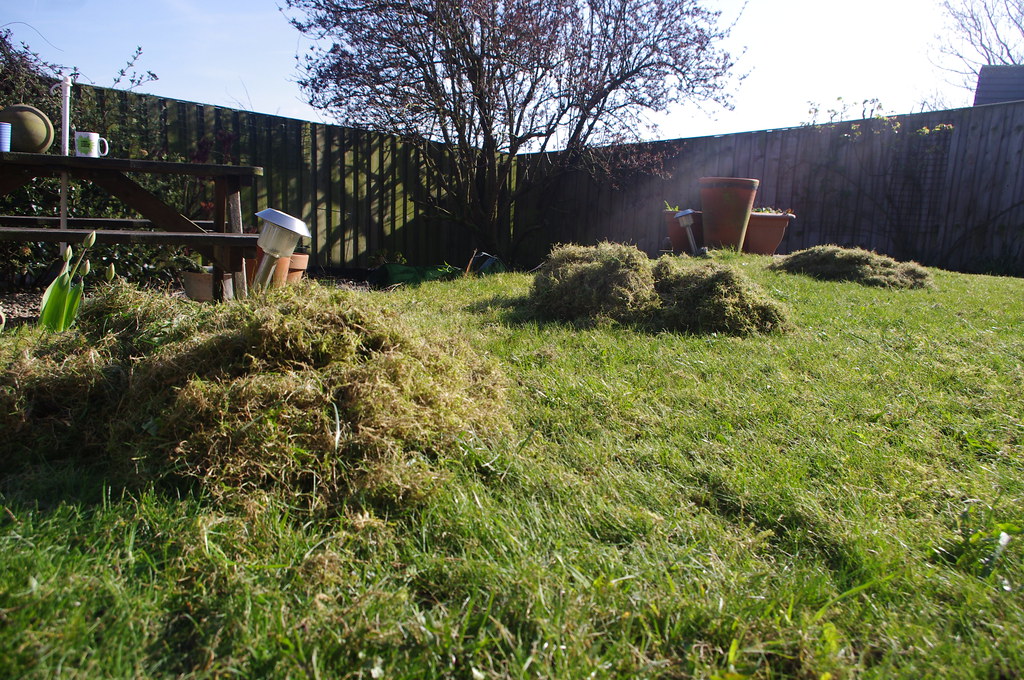
- Matted dead grass after winter. Snow mold and winter debris on bluegrass lawns are why power raking is a spring ritual in northern and mountain states. A light spring-tine pass lifts the mat so light and air reach the crowns. Keep it shallow; the soil is soft and growth has barely started.
- Preparing a thin lawn for overseeding. Seed needs to touch soil. Colorado State recommends a power rake “set deep enough to expose the soil”, run “in two different directions” before seeding, because grass germinates better “in aerification holes or slits made by the power rake”, according to CSU Extension. If weeds are part of why the lawn is thin, see our guide to killing weeds before overseeding first.
- Getting water, lime or a pre-emergent through a spongy surface. Thatch dries out fast, is hard to rewet, and ties up pesticides before they reach the soil.
When power raking hurts
- Heat or drought. Every extension source above says to avoid hot, dry periods. Opening a fescue canopy in July exposes crowns when the grass cannot regrow. Manufacturer guidance is that “at least 30 days of growing season should be available following power raking.”
- Thin, weak or newly seeded lawns. A power rake removes some live grass with the thatch. On a sparse lawn nothing is left to fill in, and you have made a seedbed for crabgrass. Missouri Extension warns that “weak zoysia lawns with heavy thatch (1 inch or more) may not fully recover in one year from intense mechanical dethatching”, according to MU Extension.
- Lawns rooted in thatch. K-State cautions that when most rooting is in thick thatch, “a great deal of live turf can be pulled out by a mechanical dethatcher”. Check the wedge before you rent anything.
- Bermuda, zoysia, St. Augustine and centipede set too deep or run too often. These grasses spread by surface stolons, and aggressive tines rip them up. Clemson advises vertical mowing centipede and St. Augustine “in one direction only, since multiple passes can injure or kill the lawn.”
- Warm-season grass in early spring. K-State says bermuda and zoysia “should not be verticut in April” because opening the turf then exposes new growth to late frost.
- Wet soil. In saturated ground, tines pull whole plants out by the roots. Aim for moist, not muddy, the same rule as for aerating after rain applies here.
Power rake vs dethatcher vs core aerator
| Power rake (spring tine / flail) | Dethatcher / verticutter (fixed blades) | Core aerator | |
|---|---|---|---|
| What it does | Combs loose thatch, dead grass and debris out of the canopy | Slices vertically through thatch and into the top of the soil | Pulls out soil plugs; relieves compaction, speeds thatch decay |
| Working depth | Tines just brushing the soil surface | Blades cutting into the top 1/2 in (1.3 cm) of soil | 2 to 3 in (5 to 8 cm) plugs, about 3/4 in wide |
| Best for thatch of | Under about 1/2 in | 1/2 to 1 1/2 in | Any depth as prevention; mild layers as treatment |
| Stress on the lawn | Moderate | Moderate to heavy | Least (MU Extension: coring “causes less lawn stress than dethatching with a power rake or vertical mower”) |
| Debris to remove | Several bags per 1,000 sq ft | Often a trailer load on a thick lawn | Plugs can be left to dry and crumble |
| Seedbed for overseeding | Fair | Good (grooves hold seed) | Good (holes hold seed) |
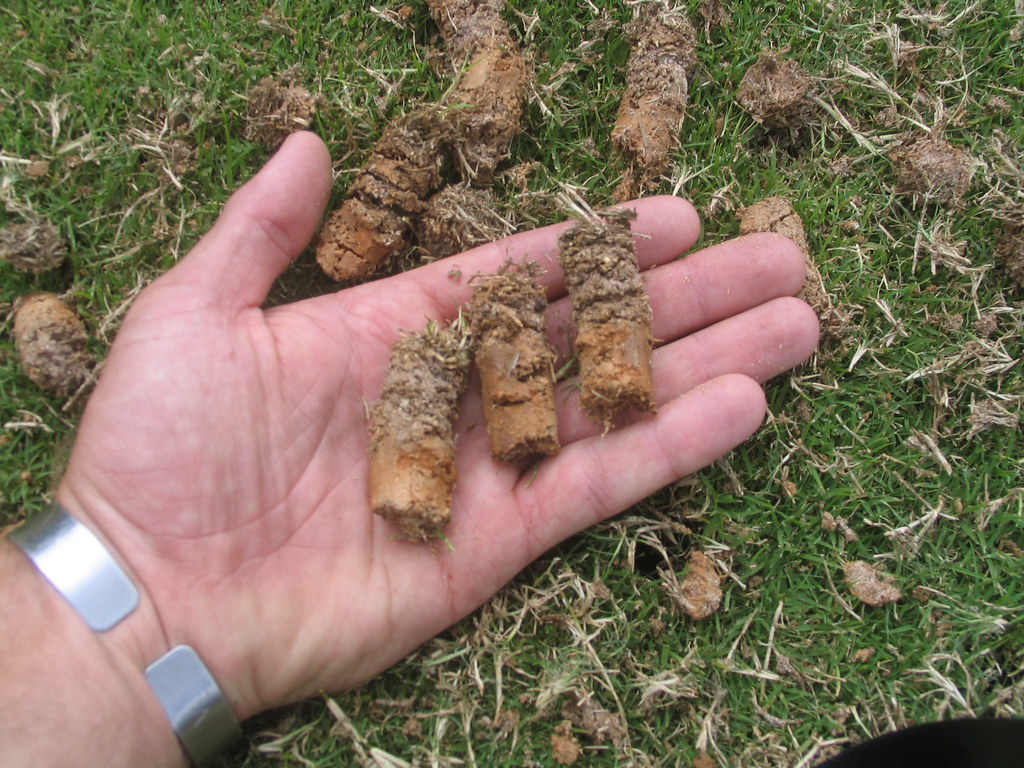
Choosing between a power rake and a core aerator on a lawn with under 1/2 inch of thatch, take the aerator. K-State describes crumbling the dried cores back over the surface so soil microbes mix into the thatch, which is the slow, low-damage way to keep it in check.
Timing by grass type
| Grass | Best window | Notes |
|---|---|---|
| Kentucky bluegrass, tall fescue, perennial ryegrass, fine fescue | Late August to early October (northern US, Canada, UK); early spring is second choice | UMN and K-State both prefer late summer/early fall. If you must do it in April, apply a pre-emergent within a few days, since raking breaks any barrier already down. |
| Bermudagrass | Late May to June, once fully green and growing hard | MU: “Mid-June is preferred for zoysiagrass and bermudagrass, but only when lawns are actively growing.” Oklahoma State instead lists February to March, before green-up. Either way, not April and not late summer. |
| Zoysiagrass | Late spring to early summer | Slow to recover. Use flat steel blades, not wire tines (K-State). |
| St. Augustine, centipede | Late spring to early summer | One pass only, 2 to 3 in blade spacing (Clemson). Often better to core aerate instead. |
How to power rake a lawn: settings and passes
- Mow low first. Drop the mower one or two notches below normal (about 1.5 to 2 in, 4 to 5 cm, for cool-season grass; 1 in for bermuda) and bag the clippings so the tines reach the thatch.
- Water a day or two ahead if the soil is dry. You want it “moist, but not too wet” (Billy Goat).
- Mark sprinkler heads, shallow cables and surface roots.
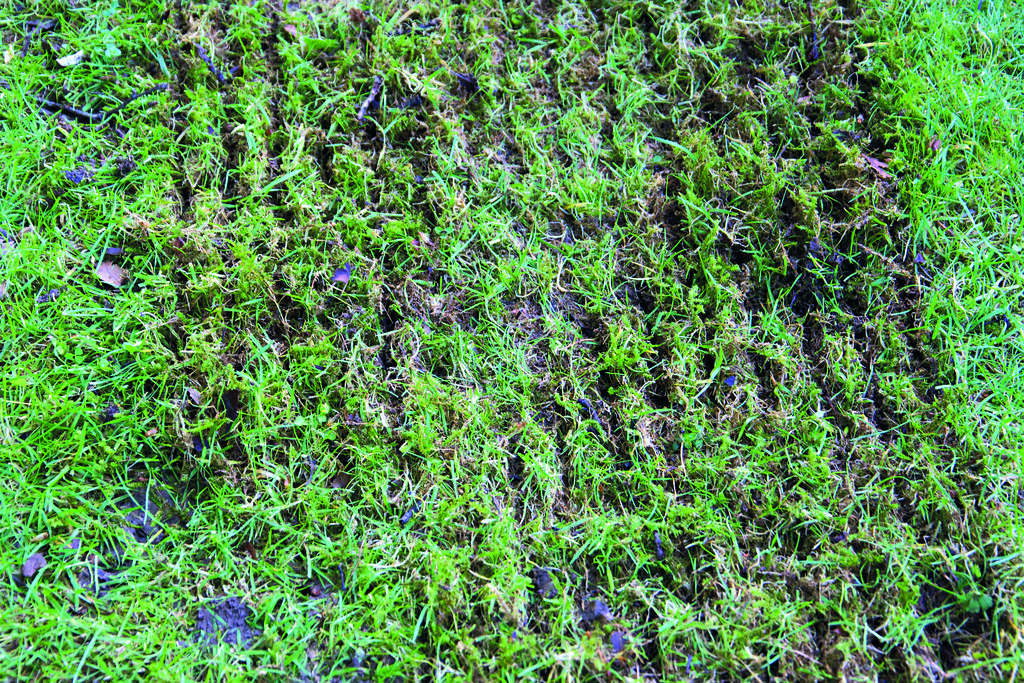
- Set the depth on a test strip. Lower the reel until the tines just touch the soil and pull up brown fibre with only a little green. UMN’s rule for vertical mowers is to set them “so the tines bring a small amount of soil to the surface with the thatch debris.” If green is piling up faster than brown, you are too deep.
- Blade spacing on a verticutter: 1 to 2 in for bermuda, zoysia, bluegrass and fine fescue; 2 to 3 in for St. Augustine and centipede (Clemson). K-State’s general figure is 2 inches or more.
- Work in one direction, overlapping each pass by a few inches. On cool-season lawns, or bermuda and zoysia with heavy thatch, make a second pass at 45 to 90 degrees. One pass only on St. Augustine and centipede.
- Rake or vacuum up everything. Left in place the debris smothers the grass you just exposed. It composts well.
Aftercare: the part most people skip
- Overseed straight away on cool-season lawns in late summer or early fall. The exposed soil and grooves are the best seedbed you will get; firm the seed in with a roller or a light pass with the rake set high.
- Feed lightly. UMN suggests “1/2 to 3/4 pounds actual nitrogen per thousand square feet” (about 25 to 35 g N per 100 m²) to speed recovery; Clemson allows up to 1 lb N per 1,000 sq ft a week after vertical mowing warm-season grass. No more than that; heavy nitrogen causes thatch.
- Water lightly every day for a week or two so disturbed crowns and new seed do not dry out, then return to deep, infrequent watering.
- Pre-emergent timing. After spring power raking, apply the crabgrass pre-emergent within a few days. If you are seeding, use a seeding-safe product (mesotrione or siduron on cool-season lawns) or wait until the new grass has been mowed two or three times.
- Expect the lawn to look worse for two to four weeks. Recovery takes about a month of active growth on bluegrass and fescue, longer on zoysia.
Rent, buy or hire it out
A gas power rake or verticutter rents by the half-day or day, and a typical suburban lawn takes a morning including clean-up. Electric dethatchers cost about the same as one or two rentals; they suit light spring clean-up on a small lawn but lack the weight for real verticutting. A tow-behind tine dethatcher gives the same light treatment in a wider swath. Since the machine time is short and disposal is the tedious part, hiring a service makes sense mainly if you cannot haul away several bags or a trailer of debris.
Common mistakes
- Power raking every spring because it is “what you do”. If the wedge test shows under 1/2 inch, you are stressing the lawn for nothing and opening it to weeds. Aerate instead.
- Setting the tines too deep. The green pile is your grass. Adjust up.
- Wrong season: summer heat, warm-season grass before full green-up, or cool-season grass in late fall with no growth left to heal.
- Leaving the debris on the lawn or skipping the follow-up seed and light feed.
- Treating the symptom only. Thatch returns if you keep over-fertilizing, watering little and often, and mowing high and rarely. Our posts on thinning out grass that is too thick and dethatching pros and cons cover the feeding side and the heavier machines.
Sources
- Kansas State University Turfgrass – Cultivation and Thatch Control
- K-State Research and Extension – MF2131 Thatch: A Hidden Lawn Concern
- University of Minnesota Extension – How to control thatch in your lawn
- University of Missouri Extension – Managing Thatch in Home Lawns (G6708)
- Oklahoma State University Extension – Thatch Management in Lawns
- Clemson HGIC – Controlling Thatch in Lawns
- Clemson HGIC – Turfgrass Cultivation
- Colorado State University Extension – Renovating the Home Lawn
- Billy Goat – Power Rake (Dethatcher) FAQ