
Short answer: you cannot stop a downpour, but you can make the seed hard to move. Rake the seed into the top 1/8 to 1/4 inch (3 to 6 mm) of soil, roll it lightly so it is pressed into firm contact, and cover it with clean straw at about one bale per 1,000 sq ft (so roughly half the soil still shows). On slopes, use a stapled erosion-control blanket instead of loose straw, and try to sow when the forecast gives the seed a few dry days to settle in. If a storm does wash seed away, wait until the soil has dried and the surviving seed has had time to sprout (3 to 5 days for ryegrass, 10 to 30 days for other species) before reseeding only the bare streaks.
What heavy rain actually does to new grass seed
Rain itself is not the enemy. Grass seed needs the top inch of soil kept constantly moist to germinate, and a gentle soaking does that better than a hose. The damage comes from water moving across the surface faster than the soil can absorb it. There are five separate problems, and they need different fixes:
- Washout. Loose seed on the surface floats and travels with runoff. You end up with bare stripes where water ran and thick clumps of seed where it stopped, usually in low spots, along edges and at the foot of a slope.
- Puddling and waterlogging. Seed sitting under standing water for a day or more runs short of oxygen. Germination slows, and seedlings that do emerge are weak.
- Burial or exposure. Splash and flowing water can bury seed too deep to emerge or strip the soil off it so it dries out afterwards. Iowa State recommends covering seed only 1/8 to 1/4 inch deep, so it does not take much soil movement to push it outside that range.
- Surface crusting. Hard rain breaks soil crumbs into fine particles; when the surface then dries quickly, those particles cement into a crust. University of Minnesota Extension explains that seedlings trapped under a crust keep elongating below it until they run out of stored energy. Tiny grass seeds have very little energy to spare.
- Damping-off. Constantly wet, crowded seedlings are the ideal target for seedling diseases. According to NC State Extension, Pythium causes most damping-off in warm weather and Rhizoctonia in cool weather; affected seedlings look wilted and twisted, then turn dark and greasy and collapse, leaving bare soil.

When new seed is most at risk
| Stage | Main risk from a downpour | How much protection it needs |
|---|---|---|
| Day 0 to 3: seed on or just under the surface, not yet swollen | Washout and burial | Highest. Straw or a blanket matters most now. |
| Germinating: seed split, short root only | Washout, crusting, drowning | High. A seedling with a 1 cm root anchors poorly. |
| Seedlings up to about 2 in (5 cm) | Damping-off in wet, crowded patches; erosion on slopes | Moderate. Let the surface dry between rains; do not add extra water. |
| Seedlings over 2 in (5 cm), rooted | Low, except on steep slopes | Normal care; Iowa State says this is the point to start watering less often but more deeply. |
How long the high-risk window lasts depends on the species. University of Minnesota turfgrass scientists note that perennial ryegrass usually germinates 3 to 5 days after planting, while the other species in a typical mix fill in over 10 to 30 days. A Kentucky bluegrass lawn is therefore exposed for weeks, not days.
How to protect grass seed before the rain arrives
- Sow in the right season, and watch the forecast. Seeding in the best window shortens the time seed sits exposed. Iowa State University Extension gives mid-August to mid-September as the best time for cool-season lawns in the Midwest, with early April to mid-May as a second choice. Within that window, pick a sowing day with a few dry or lightly showery days ahead rather than the day before a forecast storm.
- Grade out low spots and fix drainage first. Any hollow that holds a puddle will collect seed and drown it. Fill dips with soil, and make sure the surface slopes gently away from the house. If the soil is hard and water runs off rather than soaking in, loosen it first; our guides to preparing soil for grass seed and seeding compacted soil cover this.
- Work the seed in. Seed lying on top of the soil is the seed that floats away. After spreading, rake or drag lightly so most seed is covered by 1/8 to 1/4 inch of soil, then roll with a light, empty roller. Purdue Extension recommends rolling new seedings with a light roller to ensure seed-to-soil contact.
- Use the recommended seeding rate, not more. Extra seed does not buy insurance against rain. NC State notes that dense seedling stands from high seeding rates stay wet longer and mature more slowly, which invites damping-off. See what happens when you use too much grass seed.
- Mulch with straw. A light layer of clean straw (wheat, oat or rice straw, not hay, which carries weed seed) breaks the force of raindrops, slows runoff and keeps the surface from crusting. Iowa State suggests one bale per 1,000 sq ft, spread so that about half the soil is still visible. Construction-site guidance from the Kentucky Energy and Environment Cabinet uses a heavier 1.5 to 2.5 tons per acre (roughly 70 to 115 lb per 1,000 sq ft) with 80 to 90 percent ground cover; that heavier rate suits bare slopes, but on a flat lawn it can shade seedlings. It also hides seed from birds (see do birds eat grass seed). There is no need to remove the straw later; it breaks down and is mowed into the turf.
- Consider hydroseeding or a tackifier on hard-to-cover sites. Hydraulic mulch sprays seed, fibre mulch and a binder in one pass. Kentucky’s guidance points out that it must dry for at least 24 hours before rain, so it has to be scheduled against the forecast too.
- Do not fertilize heavily just before a storm. A starter fertilizer is useful, but a heavy rain soon after application carries it off the soil. NC State also warns that excess nitrogen increases damping-off; it suggests no more than 0.5 lb of readily available nitrogen per 1,000 sq ft at the first mowing.
Products sold as “seed mats” or grass-repair mixes with paper mulch work on the same principle as straw: the mulch holds moisture and shields the seed. They make sense for small patches; for a whole lawn, straw is far cheaper per square foot.
Slopes and banks: use a blanket, not loose straw
On any bank where water gathers speed, loose straw and seed will slide down together in the first storm. Iowa State calls erosion-control mats or blankets excellent options when sowing steep slopes. These are rolls of straw, coconut coir, jute or wood fibre held in a light net; you lay them over the seeded soil and pin them down.
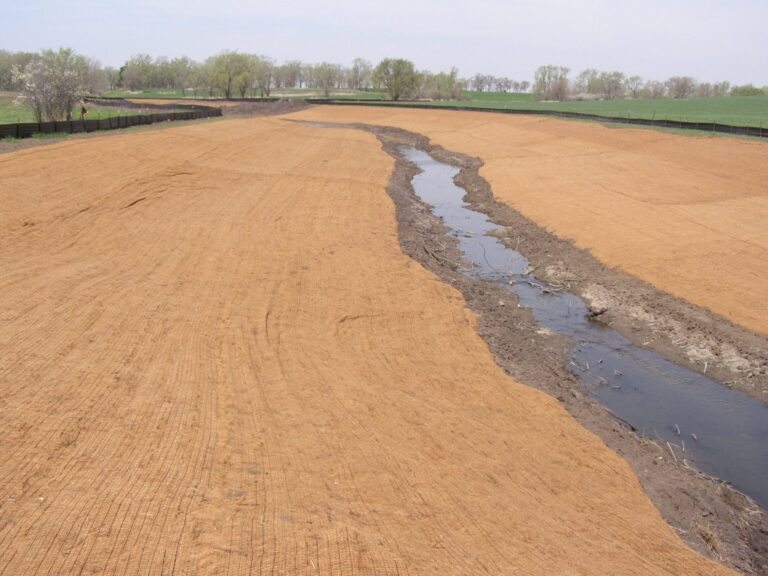
Installation details from the Kentucky erosion-control guide:
- Standard blankets are for slopes up to 3:1 (3 ft horizontal for every 1 ft of rise). Steeper than that, use a heavier turf reinforcement mat, or a tackifier to glue straw in place.
- Bury the top end of the blanket in a trench about 8 in (20 cm) deep so water cannot run underneath it.
- Overlap strips 6 to 8 in (15 to 20 cm) on the sides and ends, shingle-style, with the upper strip on top.
- Staple about every 12 in (30 cm) across the top and every 24 in (60 cm) along the sides and middle.
- Blankets degrade in 6 to 24 months depending on the material. If birds, hedgehogs or snakes visit the garden, choose a product with loose-weave natural-fibre netting rather than fixed plastic mesh, which can trap wildlife.
For a steep bank that keeps washing out, sod or a ground cover may be a better long-term answer than seed.
What to do after a heavy rain washes out your seed
- Stay off the soil until it is firm. Walking on saturated seedbeds leaves footprints that become puddles and compacts the surface. Wait until the soil no longer sticks to your boots.
- Look for the pattern. Bare streaks running downhill and a dense green fringe or a line of seed at the bottom mean washout. Uniformly sparse emergence across a level lawn more often means crusting, seed buried too deep, or seed that rotted in waterlogged spots.
- Break any crust gently. If the surface has dried to a hard skin, lightly scratch it with the back of a leaf rake or keep it softened with light sprinkling until the seedlings are through. Do not rake hard over germinating seed.
- Give the surviving seed time before you judge. Rain rarely removes all the seed, and much of what moved will still sprout where it landed. Use the germination times above: wait at least a week for ryegrass mixes and two to three weeks for bluegrass before deciding an area is bare.
- Reseed only what is bare, then protect it. Rough up the bare streaks lightly, sow them at the normal rate for that species, rake in, roll, and add straw. Areas that are thin rather than bare usually need about half the normal rate. Seed that piled up in thick clumps will produce an over-dense patch; thin it later rather than trying to rake wet seed around.
- Watch for damping-off in wet, crowded patches. Dark, greasy, collapsing seedlings in circles or low spots are the sign. Let the surface dry between waterings, skip extra nitrogen, and reseed those patches once the weather dries. NC State notes that fungicide seed treatments and seedbed fungicides exist, and that Pythium and Rhizoctonia need different products.
If rain keeps falling for days, skip your normal irrigation entirely; new seedings need moist soil, not saturated soil. Our article on overwatered lawns describes what too much water looks like in established grass too.
Common mistakes
| Mistake | Why it backfires |
|---|---|
| Leaving seed on the surface “because it needs light” | Most lawn grass seed does best lightly covered; surface seed is the first to wash away or dry out. |
| Covering with hay or grass clippings | Hay carries weed seed; clippings mat down, stay wet and can smother seedlings. |
| Straw so thick no soil shows on a flat lawn | Shades and delays seedlings; about half the soil should be visible. |
| Plastic sheeting over the seed | Overheats the seedbed and blocks air; water simply runs off the edges. |
| Doubling the seeding rate to allow for losses | Crowded seedlings stay wet and are more prone to damping-off. |
| Reseeding the day after the storm | The first sowing may still come up; you end up with patches that are too thick. |
Related guides: Bird Netting for Grass Seed: Does It Work and How to Use It Properly
Sources
- Iowa State University Extension – Seeding a New Lawn
- NC State Extension – Damping Off in Turf
- Kentucky Energy and Environment Cabinet – Protecting Soils with Mulch and Erosion Control Materials
- University of Minnesota Extension – Soil Crusting and Emergence Problems
- University of Minnesota Turfgrass Science – Seeding Your Lawn This Fall
- Purdue Extension – Lawn seeding (AY-20)