
Short answer: most lawns need little or no watering in winter; how much depends on which of three situations you are in. Where the ground freezes and cool-season grass (bluegrass, fescue, ryegrass) is dormant, do not water at all unless you live in a dry, windy climate with no snow cover; then give about 1/2 inch (1.3 cm) once or twice a month, at midday, only when the air is above 40°F (4°C) and the soil is not frozen. Where winters are mild and cool-season grass keeps growing slowly (Pacific Northwest, the UK, overseeded southern lawns), rain usually covers it; in a dry spell, 1/2 to 1 inch (1.3 to 2.5 cm) every 2 to 3 weeks is plenty. Where you have a dormant warm-season lawn (bermuda, zoysia, St. Augustine, centipede), apply 1/2 to 1 inch only after 3 to 4 weeks without rain, to keep the crowns from drying out. Never water in the evening or in the day or two before a hard freeze.
Why winter watering is a different job
In winter, growth slows or stops, evaporation is low, and in many regions rain or snow supplies more than the grass can use. The roots and crowns are not dead, though. Clemson Extension points out that roots are “still taking up water and nutrients for daily metabolic activity as well as for storage until spring”. If the soil around a dormant crown dries out completely, the crown dehydrates, and that is where winter watering earns its keep. Water applied at the wrong time does harm, though: it freezes on the surface or leaves the turf wet going into a night of hard frost. So the question is not “how often” in the abstract, but “which situation is my lawn in, and is the soil actually dry?”
Which of the three situations are you in?
Work out your case from the grass type and the climate, then use the matching row in the table. If you are not sure what you are growing, our lawn grass comparison shows how to tell bermuda, zoysia, St. Augustine and fescue apart.
| Situation | Typical places | Grass state in winter | How often to water | How much | Conditions |
|---|---|---|---|---|---|
| 1. Cold winters, cool-season grass | Northern US, Canada, mountain and plains states, inland Europe | Dormant; soil often frozen or under snow | Usually never. In dry, windy, snow-free areas: once or twice a month | About 1/2 inch (1.3 cm) | Air above 40°F (4°C), soil unfrozen, midday, no snow cover, no puddling |
| 2. Mild winters, cool-season grass still growing | Pacific Northwest, coastal California, UK and Ireland, southern lawns overseeded with ryegrass | Slow growth, still green | Only when rain fails for 2 to 3 weeks; overseeded ryegrass in a desert climate roughly weekly | 1/2 to 1 inch (1.3 to 2.5 cm) | Morning after frost has melted; skip if the soil is already wet |
| 3. Warm-season grass, dormant | Southern US, Texas, Southeast, Australia’s cooler south | Brown or tan, dormant | Only after 3 to 4 weeks without rain | 1/2 to 1 inch (1.3 to 2.5 cm) | A warm day, at least 24 to 48 hours before any forecast freeze |
Situation 1: cold regions with dormant cool-season grass
If your lawn spends the winter frozen or under snow, put the hose away. Frozen soil cannot take water in and snow melt supplies moisture as it thaws. The exception is the dry, windy, sunny winter of the Rockies, the High Plains and the intermountain West, where the soil thaws on warm afternoons and dormant grass still loses water to the wind. This is winter desiccation, and the extension services in those states treat it as a real problem.
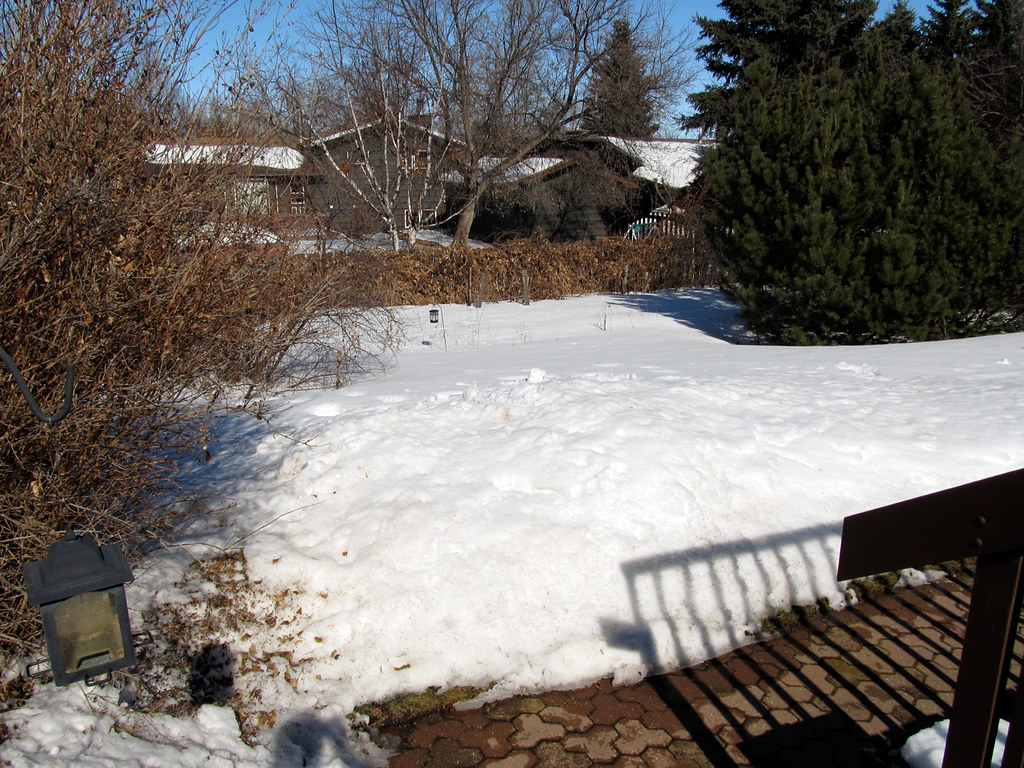
Colorado State University Extension advises watering “only when air temperatures are above 40 degrees F”, applying it “during midday, so it will have time to soak in before possible freezing at night”, and doing so “during extended dry periods without snow cover, about once or twice each month”. It singles out new lawns and lawns on south- or west-facing slopes or next to walls, which catch reflected heat and the low winter sun, as the ones most likely to be damaged. Nebraska Extension gives the same threshold of 40°F, notes that desiccation is “more problematic on sunny, dry, windy days when the air temperature is above freezing but the soil is dry or frozen”, and recommends a screwdriver test first: if a long screwdriver slides in easily, skip it; if it stops after the first inch or two, the soil is dry. Nebraska also suggests hand watering with a hose rather than recharging the sprinkler system.
A practical routine for these areas:
- Watch for two to three weeks with no rain or snow and repeated windy, sunny days.
- Pick a day above 40°F (4°C) with an unfrozen surface and no freeze forecast that night; water late morning to early afternoon.
- Do the screwdriver test. If it slides in, wait.
- Apply about 1/2 inch (1.3 cm) with a hose-end sprinkler, roughly 20 to 30 minutes. Stop if water pools, because pooled water becomes ice.
- Repeat no more than once or twice a month until spring green-up.
Situation 2: mild winters where cool-season grass keeps growing
In the Pacific Northwest, coastal California and most of the UK and Ireland, fescue, ryegrass and bent lawns stay green and grow slowly all winter, and winter is the wet season. The RHS notes that grass “continues to grow in temperatures above 7°C” (45°F), and its December advice is about the opposite problem: waterlogging after winter rain, relieved by spiking the lawn with a fork. You will rarely need to water between November and March. The exception is a settled dry spell of two or three weeks, most often in late winter, on sandy soil or a south-facing bank. Then 1/2 to 1 inch (1.3 to 2.5 cm) on a mild morning is enough, after a screwdriver test.
The one mild-winter lawn that needs regular water is a warm-season lawn overseeded with perennial ryegrass in the desert Southwest, where the rye is growing and there is almost no rain. The University of Arizona’s Phoenix lawn watering guide says established overseeded ryegrass should be watered every 3 to 7 days through winter, while a dormant, non-overseeded bermuda lawn “needs no supplemental watering”. If a screwdriver goes 6 inches (15 cm) into the soil and comes out damp, skip that watering.
Situation 3: dormant warm-season lawns
Bermuda, zoysia, St. Augustine and centipede turn brown after the first frosts and stop growing, but the crowns and stolons at the soil surface are alive. Clemson Extension explains that if there is not enough moisture in the soil “the crown can become dehydrated, and the metabolic processes stop. This is referred to as desiccation, and it can lead to winter kill”, and it adds that centipede and St. Augustine are more susceptible than bermuda or zoysia. Its advice is to “apply irrigation if there hasn’t been any rainfall in 3-4 weeks”; a companion Clemson factsheet puts the amount at 1 inch (2.5 cm) after three weeks with no rain, applied in the morning “once the frost is gone and the grass is dry”. In most of the Southeast winter rain covers this. The lawns that need the occasional soak are on sandy soil, in the drier parts of Texas and the Southwest, or newly laid.
In Florida, where growth slows but rarely stops, UF/IFAS Extension says a lawn “may only need watering every two to three weeks” in winter, with 1/2 to 3/4 inch (1.3 to 2 cm) per application, and only when the grass shows it: about half the blades folded lengthwise and blue-grey, and footprints that stay pressed into the lawn.
Clemson’s irrigation guidance adds that moist soil holds daytime warmth and releases it slowly overnight, so a lawn watered a day or two ahead of a cold snap is slightly better protected than a bone-dry one. The timing matters, as the freeze section below explains.
Newly seeded or sodded lawns going into winter
A lawn seeded in September or sodded in October has shallow roots and no reserves, and it is the case where winter watering matters most in every climate. Colorado State’s PlantTalk says sod planted late in the fall “must be irrigated during the winter to prevent drying since it has little time in the fall to develop a substantial root system”, which “may mean watering every 2-3 weeks during an especially dry winter”, and it warns to “apply only enough water so that puddling (and ice) does not form on the turf surface”. University of Georgia extension guidance for dormant warm-season sod laid in winter is to keep the top 1 to 2 inches (2.5 to 5 cm) of soil moist with no more than 3/4 to 1 inch of water a week from rain and irrigation combined, because unrooted sod can dry out in a single day. Kansas State turf specialists flag February and March as the months when desiccation of late-sown seedlings usually shows up, so keep checking young turf through late winter.
Winterizing the sprinkler system
Where the ground freezes, drain the irrigation system before the first hard freeze and do any winter watering by hand. Colorado State University Extension explains that water expands by about one-eleventh as it freezes, enough to split pipe, valves and heads. Gravity drains are unreliable because you cannot see whether the lines are empty; blowing the system out with compressed air is the only sure method. Keep the compressor between 40 and 80 psi (80 psi maximum for rigid PVC, 50 psi for polyethylene), and never blow air through a pressure vacuum breaker or reduced-pressure backflow device. In the northern US this is typically done in mid to late October. In the Deep South, where lines sit below the frost line, Clemson notes that draining the pipe is generally unnecessary, but any surface pump must be emptied. Run one last deep watering before you shut down so the lawn enters winter with a moist root zone.
Frost, freezes and watering
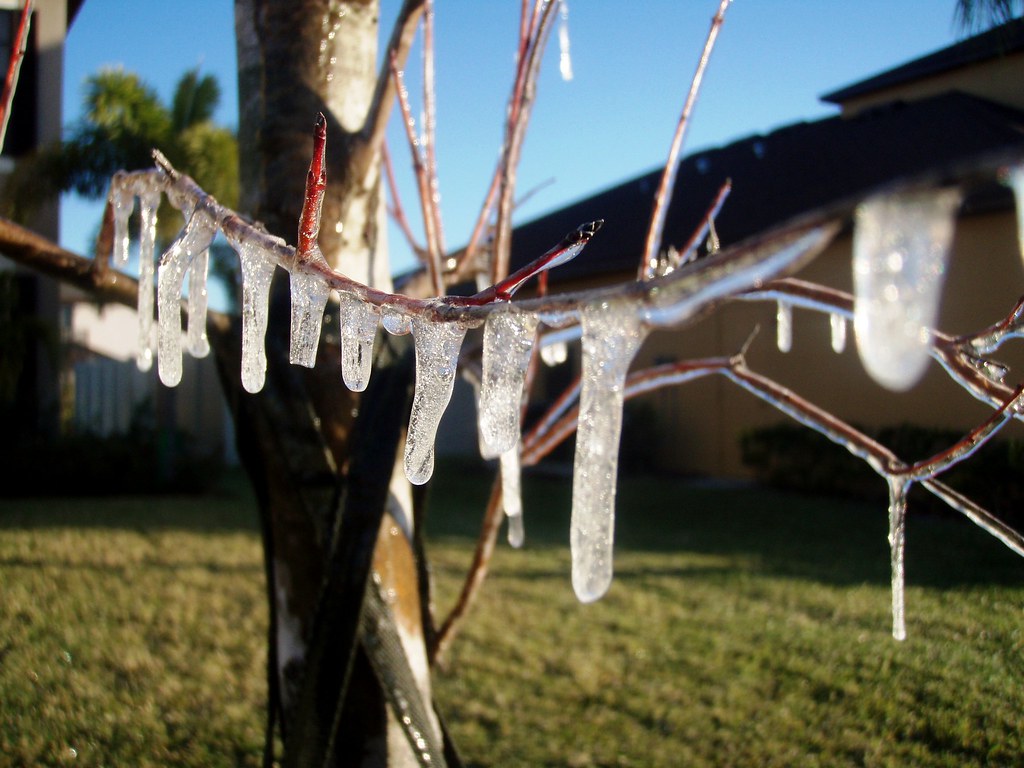
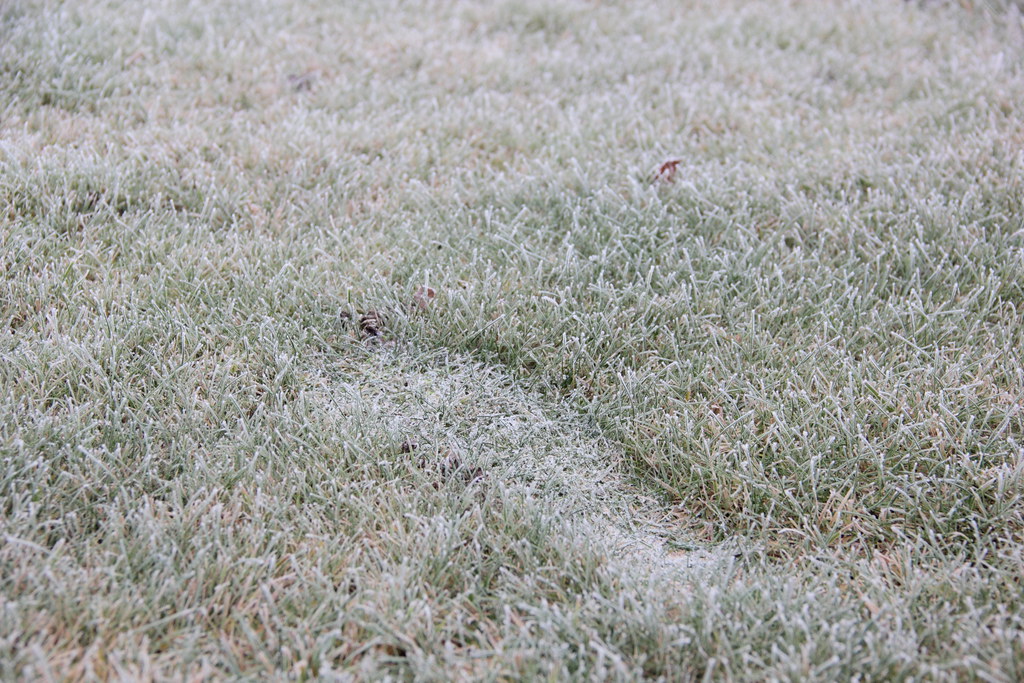
Frost on the grass is not a reason to water. Wait for it to melt, then decide based on the soil. The rule that matters is the one Clemson’s winter irrigation factsheet states plainly: “if the grass is watered and a freeze immediately follows, the grass can be severely damaged”. Water in the crowns freezes, and Colorado State warns that a solid ice layer lasting more than a month can suffocate or mat the grass. So water at least 24 to 48 hours ahead of a forecast freeze, never the evening before, and never while a freeze is under way. The RHS adds one more rule: keep off frosted grass, because the brittle blades break and footprints turn into brown tracks that last weeks. For the temperature thresholds themselves, see our post on the best temperature to water grass.
Signs the lawn is short of water in winter
- The screwdriver stops. A long screwdriver or soil probe that will not go past the first inch or two of unfrozen soil is the most reliable sign.
- Folded, blue-grey blades and lingering footprints on lawns that are still green (situations 2 and 3).
- Bleached patches on the windward side, south and west slopes and along pavements while sheltered areas look normal. This pattern points to desiccation rather than disease.
- Dormant turf that pulls up easily with brittle stolons and crowns that snap rather than bend.
- Slow, patchy green-up in spring, often the first sign a lawn dried out over winter. Our article on dormant versus dead grass shows how to check whether the crowns are alive.
Common mistakes
- Leaving the summer schedule running. Two or three waterings a week in winter keeps the soil saturated, starves roots of air and feeds fungal disease. If the lawn is spongy, yellow and growing mushrooms, read our guide to an overwatered lawn.
- Watering the evening before a hard freeze. Wet crowns freeze solid overnight. Water at midday, only when the next day or two are forecast clear of freezes.
- Watering during frost or on frozen soil. The water cannot infiltrate, so it pools and turns to ice.
- Watering on a fixed calendar. Once or twice a month is a ceiling for dry-climate dormant lawns, not a target. Check the soil first.
- Running the underground system in a freezing climate. Use a hose and a portable sprinkler, then drain the hose.
- Forgetting the new sod. Established lawns forgive a dry winter; sod laid in October does not.
When to expect a difference
Winter watering is insurance rather than a visible treatment. A dormant lawn will not green up because you watered it; what you are buying is an even, quick green-up in spring instead of thin, bleached patches on the exposed sides that take until early summer to fill. If you find desiccation damage in March or April, treat it like drought damage: rake out the dead material, keep the soil moist, and overseed the bare areas once soil temperatures suit the grass type.
Sources
- Colorado State University Extension – Fall and Winter Watering of Plants and Trees
- Nebraska Extension – Winter Watering
- Clemson HGIC – Winter Irrigation for Turfgrass Lawns
- Clemson HGIC – Watering Warm-Season Lawns During Winter
- Clemson HGIC – Landscape Irrigation Management Part 4: Winter Irrigation and Winterizing
- UF/IFAS Florida-Friendly Landscaping – Watering the Lawn in Winter
- University of Arizona AZMET – Phoenix Lawn Watering Guide
- Colorado State University PlantTalk – Fall Planting of Sod
- Colorado State University Extension – Preparing Your Sprinkler System for Winter
- Royal Horticultural Society – December Lawn Care