
Short answer: there is no air temperature that is too hot to water grass. Water on a 100°F (38°C) afternoon will not scorch the blades; it just wastes water, because midday losses to evaporation and wind are roughly double those of a pre-dawn run. The best temperature to water grass is simply the coolest part of the day, between about 4 and 9 am, giving the lawn 1 to 1.5 inches (2.5 to 4 cm) a week including rain. On the cold side, stop routine watering once the grass has gone dormant and the soil is freezing, and in winter only water dormant lawns on dry, snow-free days when the air is above 40°F (4°C) and the ground is not frozen.
Is any temperature too hot to water grass?
The idea that watering in hot sun burns grass comes from the belief that droplets act like tiny magnifying glasses. Extension horticulturists have looked for evidence and found none. A review by Washington State University Extension notes that hundreds of scientific publications on leaf scorch in crops, turf, shrubs and trees have not implicated midday irrigation once; the real causes are drought, salt build-up, wind, temperature extremes and poor root health. Its advice: any time a plant shows drought stress is the time to water it, whatever the clock says. Penn State Extension makes the same point and adds that a midday shower actually cools the foliage.
So if your lawn is wilting at 2 pm in a heat wave, water it. Brown, crispy patches after hot weather are drought or fertilizer burn, not droplet burn; our guide to how long burnt grass takes to grow back covers how to tell those apart.
Why the time of day matters more than the temperature
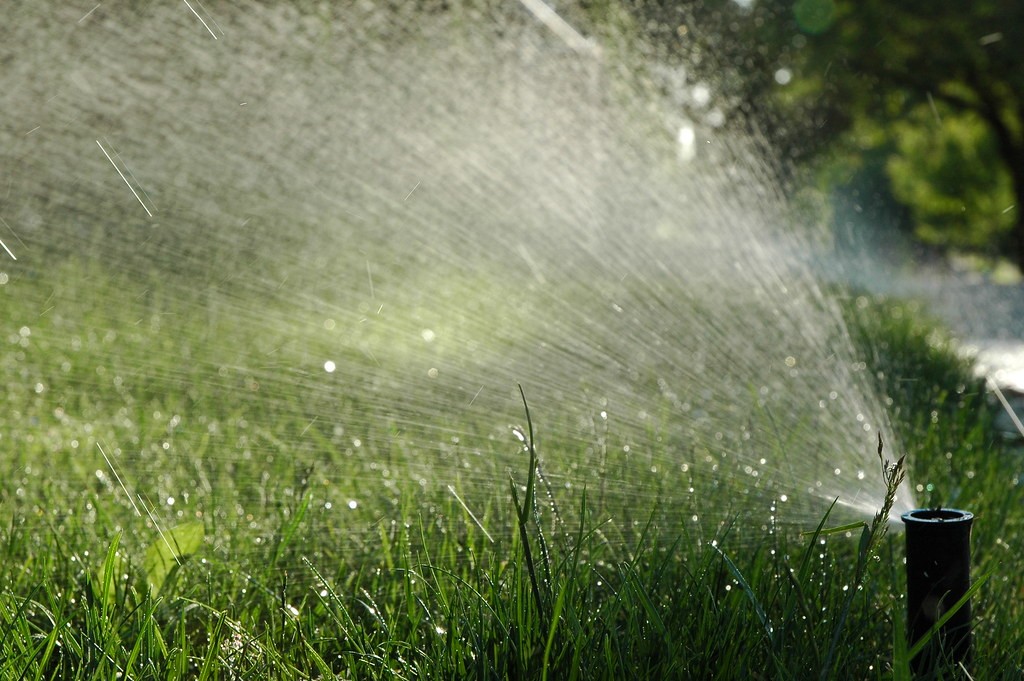
What temperature does change is how much of the water actually reaches the roots. University of Georgia Extension reports that research puts water losses from irrigation at night 50 percent below those from midday irrigation, because less is lost to evaporation. Purdue Extension ranks the windows like this:
| Time of day | What happens | Verdict |
|---|---|---|
| 4–8 am | Highest water pressure, little wind distortion, negligible evaporation; leaves dry soon after sunrise | Best |
| 8 am–noon | Slight evaporation, wind starting to pick up; municipal pressure may drop | Second best |
| Afternoon | A large share lost to evaporation, hard to wet the soil deeply. Does not burn the grass | Wasteful; use only for emergencies |
| Evening and night | Efficient for water, but leaves stay wet until morning, which favours brown patch, dollar spot and other fungal diseases | Avoid, especially in humid summer weather |
The evening problem is conditional. Purdue notes the disease risk falls if you water deeply and only when the lawn needs it, and NC State Extension calls 10 pm to 8 am the most efficient window, because the grass will be wet with dew overnight anyway. The usual compromise is a start time between 4 and 6 am so the run finishes as the sun comes up.
How much water grass needs and how to measure it
Most lawns need 1 to 1.5 inches (2.5 to 4 cm) of water per week in the growing season, counting rain, in one or two deep soakings rather than a daily sprinkle. One inch wets a typical soil 6 to 8 inches (15 to 20 cm) deep and equals about 600 gallons per 1,000 square feet (about 25 litres per square metre), according to University of Georgia Extension. Needs vary by species. University of Missouri Extension gives these weekly figures for keeping grass green in summer:
| Grass | Type | Water per week to stay green |
|---|---|---|
| Perennial ryegrass | Cool-season | 1.5 in (3.8 cm) |
| Kentucky bluegrass | Cool-season | 1.2 in (3 cm) |
| Tall fescue | Cool-season | 0.8 in (2 cm) |
| Zoysia, bermuda | Warm-season | 0.5 in (1.3 cm) |
| Buffalograss | Warm-season | 0.3 in (0.8 cm) |
Two checks turn those numbers into minutes on your timer:
- The tuna-can test. Set five or six straight-sided cans across the sprinkler pattern, run it for 30 minutes and measure the depth in each. If the average is 0.25 inch, an inch takes two hours. Big differences between cans mean the heads need adjusting.
- Cycle and soak. Most soils absorb only about 0.5 inch per hour, per Missouri Extension, and sloped or compacted lawns less. If water runs onto the path, stop, wait 30 to 60 minutes, then run again until the total is reached. This is the fix for the clay situations in our post on overwatered lawns, where the surface is soggy but the roots are dry.
The footprint test says when the next run is due. Georgia Extension puts it at 30 to 50 percent of the lawn showing wilt: a dull, bluish-green colour, folded or rolled blades, and footprints that stay visible for a minute or more after you walk across.
Watering during a heat wave
Cool-season lawns (Kentucky bluegrass, fescues, ryegrass) slow to a stop above roughly 85–90°F (29–32°C) and go dormant and brown if they dry out. Either keep supplying the full 1 to 1.5 inches a week in early-morning runs, or let the lawn go dormant. A dormant cool-season lawn is not dead: Purdue Extension says turf can survive four to six weeks dormant without significant thinning, and Missouri Extension recommends giving a dormant lawn at least 1 inch of water every two to three weeks in summer so the crowns stay alive. Do not flip back and forth; each wake-up burns reserves. Our article on helping a lawn recover from drought explains how to tell dormant from dead.
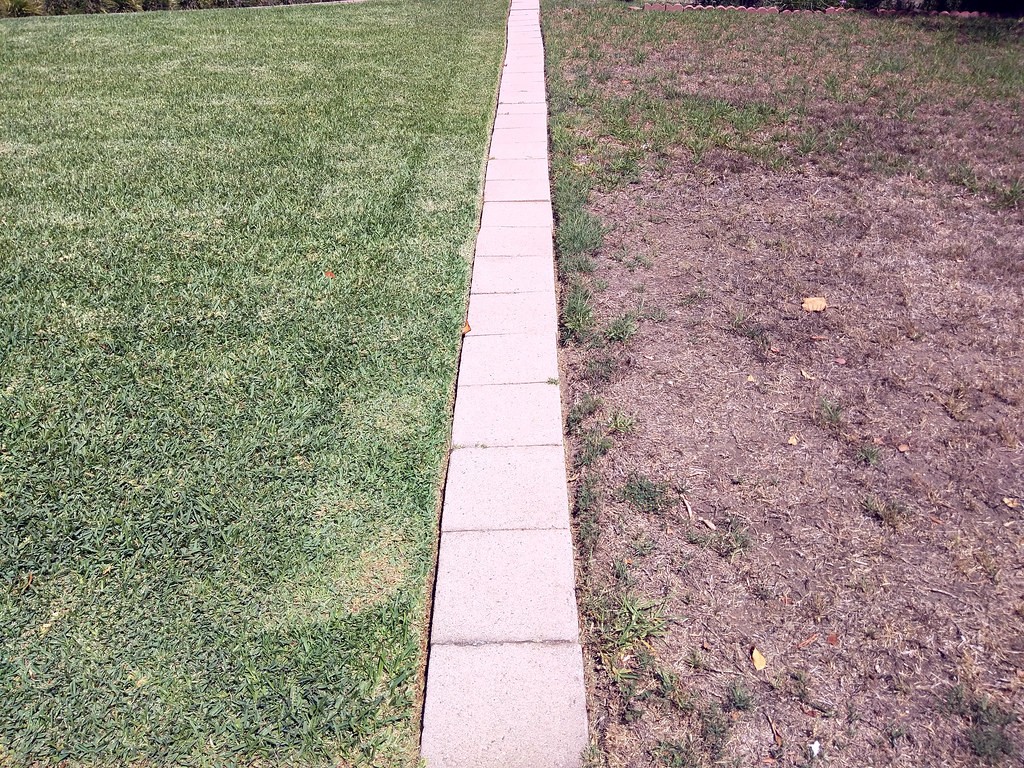
Warm-season lawns (bermuda, zoysia, St. Augustine, buffalograss) do their best growing in the heat, and NC State notes their root growth often peaks in summer. They need far less water than cool-season grass in the same weather: NC State’s Raleigh figures for July are 1.76 inches of irrigation for warm-season turf against 2.83 inches for cool-season, so a deep soak every one to three weeks, set by the footprint test, is usually enough.
In either case, if the lawn is visibly wilting in the afternoon, a 5 to 10 minute midday rinse (greenkeepers call it syringing) cools the canopy and does no harm. It is a stopgap, not a substitute for the deep morning soak.
When it is too cold to water grass
The cold side is about the soil, not the air. Once the soil is frozen, water cannot reach the roots and just sits on top as ice. Two rules cover almost every case:
- Stop routine irrigation when the grass stops growing. For cool-season lawns that is when daytime highs stay in the 40s°F (5–9°C) and the mower has not been needed for two weeks, usually mid-October to November in the northern US, Canada and the UK; warm-season lawns go dormant after the first frost. Rain normally covers what a dormant lawn needs.
- Never water when the soil is frozen or the air is below freezing. Water that cannot soak in freezes on the crowns and forms ice sheets. Colorado State University Extension warns that a solid ice layer persisting for more than a month can suffocate or mat the grass.
Watering before a hard freeze
Going into winter dry is worse than going in wet. University of Minnesota Extension advises watering the lawn before the soil freezes after a dry autumn so the crowns can rehydrate, because plants that are already moisture-stressed going into winter suffer more winter stress. Do it on a mild day, a week or more before a forecast hard freeze (28°F / -2°C or lower), so the water has time to drain. Check first with a long screwdriver: if it slides in easily to 6 inches (15 cm), skip it.
UMN adds that in-ground systems must be blown out before the ground freezes (the third or fourth week of October in Minnesota; usually November in the mid-Atlantic and the UK), so water a dry lawn once before shut-down and leave the system off afterwards.
Winter desiccation in dry climates
In the arid West, the High Plains and the prairie provinces, dormant lawns can die of thirst in winter. Nebraska Extension explains that winter desiccation is worst on sunny, dry, windy days when the air is above freezing but the soil is dry or frozen, because the leaves lose water that the roots cannot replace. Nebraska and Colorado State give the same rules for dry, snow-free spells from October to March:
- Water only on days when the air is above 40°F (4°C) and the ground is not frozen.
- Water around midday so it soaks in before night-time freezing.
- Once or twice a month is enough. In our experience about 0.5 inch (1.3 cm) is plenty; more cannot soak into cold soil.
- Use a hose or bucket, then disconnect and drain the hose. Do not run the sprinkler system.
- Give priority to lawns seeded or sodded that year and to south- and west-facing slopes, which Colorado State says are also prone to late-winter mite damage when dry.
Homeowners in wet-winter climates (the UK, the Pacific Northwest, the US Southeast) can skip this. For a schedule by grass type and region, see our guide on how often to water grass in winter.
Frost on the lawn: stay off it
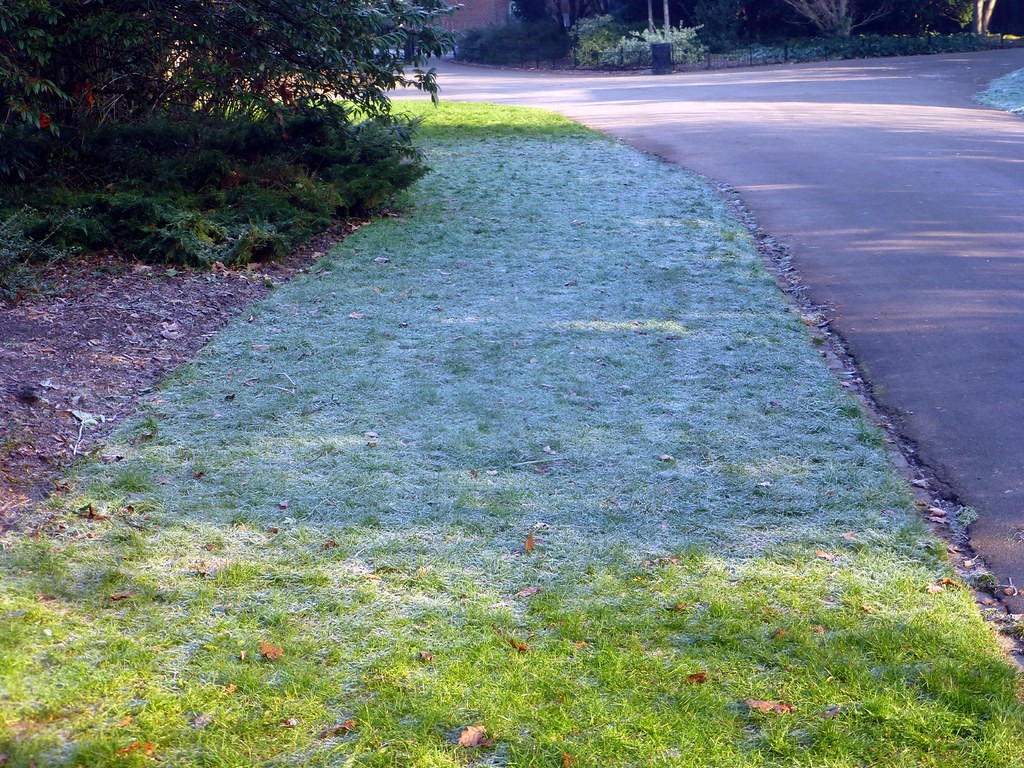
Watering in the evening before a forecast frost leaves the blades wet and iced by morning. Frost itself rarely kills established grass, but traffic on frosted grass does damage it. Kansas State University turf specialists describe foot or vehicle traffic pushing the ice crystals through the leaf surface and puncturing the cells so they collapse, leaving brown footprints and tracks. Research reported by the USGA Green Section found morning soil temperature the best predictor of injury: when it was below 32°F (0°C), traffic in either the morning or the afternoon damaged the turf, frost or no frost. Wait until the frost has burned off and the surface thawed before walking or mowing, and do not run sprinklers to melt it.
Temperature guide: what to do at each air temperature
| Air temperature | Lawn status | What to do |
|---|---|---|
| Below 32°F / 0°C, soil frozen | Dormant | No watering. Irrigation system drained. Stay off frosted grass. |
| 32–40°F / 0–4°C | Dormant | No watering; soil freezes at night. Keep off the lawn until frost is gone. |
| 40–50°F / 4–10°C | Dormant or barely growing | Dry climates only: hand-water about 0.5 in once or twice a month, midday, on snow-free days with unfrozen soil. |
| 50–65°F / 10–18°C | Cool-season grass growing; warm-season waking up | Rain is usually enough. If two dry weeks pass and footprints linger, give 0.5–1 in in the morning. |
| 65–85°F / 18–29°C | Peak growth | 1–1.5 in per week including rain, in one or two early-morning soakings (4–9 am). |
| 85–95°F / 29–35°C | Cool-season under heat stress; warm-season thriving | Cool-season: full 1.5 in weekly, or let it go dormant and give 1 in every 2–3 weeks. Warm-season: deep watering every 1–3 weeks by footprint test. |
| Above 95°F / 35°C | Heat wave | Still not too hot to water. Water at dawn; a brief midday rinse for wilting turf is fine. Skip nitrogen until it breaks. |
Common mistakes
- Waiting for a cooler day to water a wilting lawn. The heat is not the hazard; the dryness is. Water now, then move the schedule to early morning.
- Daily light sprinkling in summer. Ten minutes a day wets the top inch, evaporates by noon and keeps roots shallow. Two deep soakings beat seven light ones.
- Feeding a heat-stressed lawn. Nitrogen pushes leaf growth the roots cannot support. Our post on fertilizing wet grass covers the burn risk in detail.
Sources
- Washington State University Extension – The Myth of Hot-Weather Watering
- Penn State Extension – Garden Myths: Watering
- Purdue Extension – Irrigation Practices for Homelawns (AY-7-W)
- University of Missouri Extension – Home Lawn Watering Guide (G6720)
- University of Georgia Extension – Turf Grasses, Like All of Us, Need Water
- University of Georgia Extension – Ten Steps to a Healthier Home Lawn (C1009)
- NC State Extension – Water Requirements of North Carolina Turfgrasses
- University of Minnesota Extension – Should You Water Your Lawn Before Winter?
- Nebraska Extension – Winter Watering
- Colorado State University Extension – Fall and Winter Watering of Plants and Trees
- Kansas State University Turf and Landscape – Frost posts
- USGA Green Section – The Effect of Traffic on Turf During Frost and Freezing Conditions