
Short answer: Water lettuce (Pistia stratiotes), sold in the pond trade as water lettuce, Nile cabbage or “dwarf water lettuce”, is a free-floating plant that forms velvety, pale green rosettes with ribbed leaves and long feathery roots. In warm, nutrient-rich water it spreads by runners into mats that can cover a pond or canal completely, cutting dissolved oxygen by more than half and sheltering disease-carrying mosquito larvae. It is banned across the EU, is an offence to release in Great Britain, and is regulated in at least seven US states. Small patches can be netted out; large infestations need aquatic-labelled herbicides applied in sections, and in the tropics a South American weevil has removed 80–100% of heavy infestations.
How to identify water lettuce
The UF/IFAS Center for Aquatic and Invasive Plants describes the plant in detail. Look for these features together:
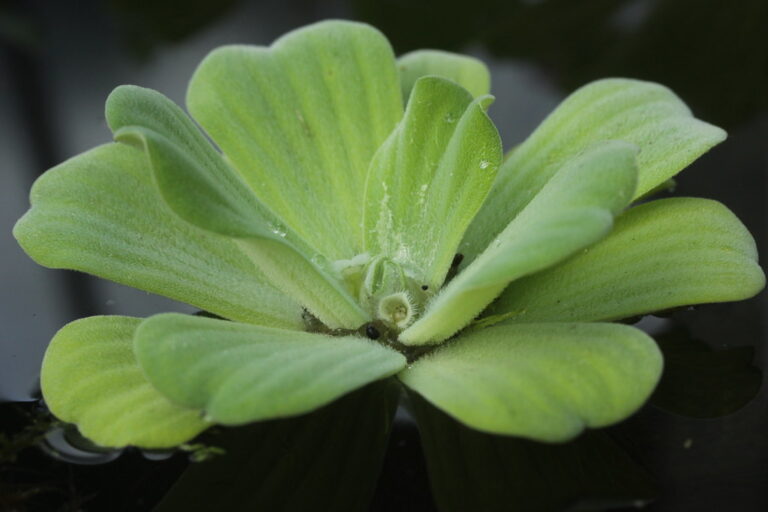
- Rosette: a floating cluster of thick, spongy leaves, like an opened head of lettuce, with no leaf stalks.
- Leaves: 0.5–6 in (1–15 cm) long, wedge-shaped with a rounded, often wavy tip, pale green to grey-green, with 7–15 prominent parallel ridges running lengthwise.
- Texture: covered in short dense hairs, giving a matt, velvety feel that sheds water droplets.
- Roots: a mass of feathery roots hanging below, up to 20 in (50 cm) long.
- Flowers: tiny, white to pale green, hidden in the centre of the rosette from late summer into early winter, followed by small green berries.
- Daughter plants: short, brittle runners (stolons) link a mother rosette to a ring of smaller plants.
“Dwarf water lettuce” is a trade name for small plants or compact selections, not a separate species. Pistia stratiotes is the only species in its genus, and small plants grow into full-sized ones in good conditions.
Water lettuce vs water hyacinth, frogbit and salvinia
Several floating plants share the same ponds and ditches. These differences separate them quickly:
| Plant | Leaves | Surface | Key feature |
|---|---|---|---|
| Water lettuce (Pistia stratiotes) | Wedge-shaped, in a rosette, no stalks | Velvety, matt, strongly ribbed | Parallel ridges; hairy leaves |
| Water hyacinth (Pontederia crassipes) | Rounded, on stalks | Glossy, waxy | Swollen, bulb-like leaf stalks; lavender flower spikes |
| European frogbit (Hydrocharis morsus-ranae) | Round to kidney-shaped, 1.2–6 cm, heart-shaped base | Smooth, like a small water lily | Three white petals |
| Giant salvinia (Salvinia molesta) | Small oval fronds, 2–4 cm, in pairs | Covered in bristles | “Egg-beater” hairs on the upper surface; a fern, no flowers |
The GB Non-native Species Secretariat’s water lettuce ID sheet points to the bulbous floats and shiny leaves of water hyacinth as the easiest contrast. Frogbit measurements come from the USGS Nonindigenous Aquatic Species fact sheet. Water hyacinth has its own section in our overview of introduced invasive weeds.
Why water lettuce is invasive
Fast growth and mats
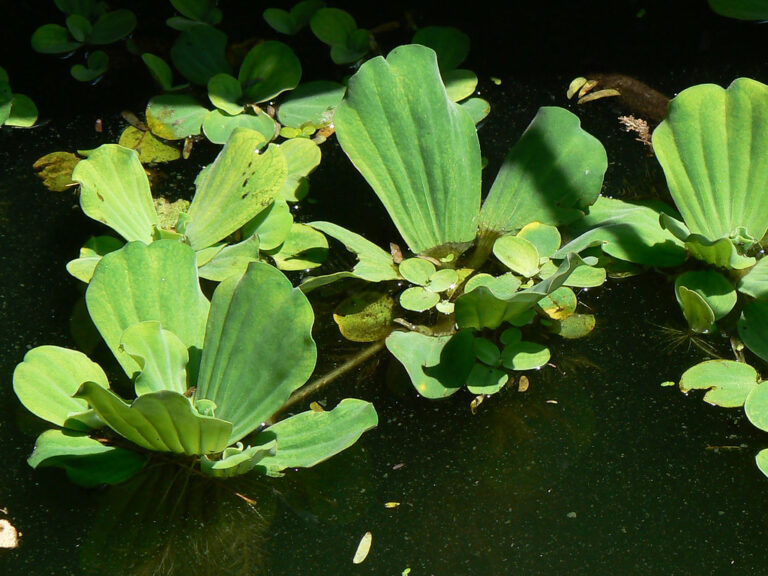
Water lettuce spreads mainly by runners that break easily, so every rosette that drifts or is carried away can start a new colony. The US Fish and Wildlife Service’s Ecological Risk Screening Summary rates it as a high risk and cites standing crops of up to 2 kg per square metre (about 0.4 lb per square foot) at the peak of the season. It also sets seed: one south Florida stand produced more than 700 seeds per square metre with over 80% viability. UF/IFAS notes that seeds germinate in water above 68°F (20°C), which helps populations come back after a cold spell kills the floating plants.
Oxygen depletion and water quality
A closed mat blocks light and gas exchange at the surface, and the dying leaves and roots use oxygen as they decompose. The USFWS summary reports a Slovenian site where dissolved oxygen under the cover fell by more than 50%, to 2.5 mg per litre, a level critical for fish survival. The same review lists heavier siltation, slower water flow, damaged fish nesting sites and fish and invertebrate deaths. Mats also block boats, irrigation and drainage intakes, and fishing and swimming access.
Mosquitoes
Larvae and pupae of Mansonia and Culex mosquitoes attach to water lettuce roots to breathe, and the USFWS summary notes that these mosquitoes are vectors of St. Louis encephalitis in the southeastern US.
Native or not?
The plant’s origin is still debated. It now grows throughout the tropics and subtropics, and UF/IFAS considers it historically native to Florida on fossil and genetic evidence, while still managing it as a nuisance weed. Outside the tropics frost usually kills it (the NNSS notes it is not frost tolerant in the UK), but UF/IFAS records populations surviving temperate winters in warm effluent outflows and returning from seed. Climate warming and heated water are the reasons northern states and the EU now regulate it.
Legal status: where you cannot keep or sell it
- European Union: added to the Union list of invasive alien species of concern in 2022. It may not be imported, kept, sold, grown, bred or released anywhere in the EU.
- Great Britain: listed on Schedule 9 of the Wildlife and Countryside Act 1981 for England, Wales and Scotland, so it is an offence to plant it or allow it to grow in the wild (NNSS).
- United States (federal): not on the federal noxious weed list.
- United States (states): the USFWS summary lists regulations in Alabama, Florida (a state noxious weed), North Carolina, South Carolina, Texas and Wisconsin. Texas Parks and Wildlife says no one may possess it or place it in Texas waters without authorization. Michigan made it unlawful to introduce, import, sell, possess with intent to distribute or propagate from June 19, 2026.
- Australia: a restricted invasive plant in Queensland and managed in New South Wales.
In short, selling, swapping or moving water lettuce is illegal in many places, and online listings that ship across state or national borders often break those rules. Never tip unwanted pond plants into a ditch, stream or lake anywhere.
How to control water lettuce
1. Prevent spread
UF/IFAS’s first rule is simple: do not sell, propagate or move plants, and clean boats, trailers and nets before leaving infested water. In garden ponds, remove plants before they spread into overflow channels.
2. Hand removal and harvesting
For ponds and small ditches, net or rake out every rosette, including the small daughter plants hidden among other vegetation. Repeat every week or two, because any fragment left behind regrows. Let removed plants dry out well away from any water, then compost or bin them; our guide on how to dispose of invasive plants explains the safe options. On larger waters, UF/IFAS says mechanical harvesting works if it is set up so that plantlets do not escape to other parts of the lake. Where water levels can be controlled, a drawdown strands plants on the shore to dry, though large mats take a long time to die.
3. Herbicides labelled for aquatic use
UF/IFAS lists contact herbicides (diquat, carfentrazone, flumioxazin), which show damage within days, and slower systemic ones (imazapyr, penoxsulam, bispyribac). For farm ponds, Mississippi State University Extension gives two spray mixes per gallon of water: 0.1 oz of a 4-lb flumioxazin product, or 1.28 oz of a 3.73-lb diquat product, each with 1.3 oz of non-ionic surfactant, sprayed to wet all plants. The key instruction is to treat only one third of the pond at a time, with at least 2 weeks between sections, because a whole mat rotting at once can strip the oxygen from the water and kill fish. Follow the label, check water-use restrictions (irrigation, livestock, swimming), and check whether your state or country requires a permit or a licensed applicator for public waters.
4. Biological control
The water lettuce weevil, Neohydronomus affinis, comes from Argentina and Brazil. According to LSU AgCenter, it was first released in the US in 1987 and has eliminated 80–100% of heavy infestations in South Africa and northern Australia; in Louisiana its populations rise and fall with colder winters. In Florida, UF/IFAS reports that the weevil is established statewide but its effect on water lettuce growth has been negligible. A leaf moth, Spodoptera pectinicornis, was released in Florida in 1990 but failed to establish. Biocontrol agents are released by government programmes, not by homeowners.
Uses and nutrient-uptake research
Water lettuce absorbs nitrogen and phosphorus quickly, which is why it is studied for cleaning wastewater. In one trial on Nile tilapia effluent, published in Environmental Science and Pollution Research, tanks planted with water lettuce, water hyacinth or salvinia showed significant improvements in nitrogen, phosphorus, turbidity and other water-quality measures over 7 days compared with settling alone. In garden ponds, a partial cover also shades the water and competes with algae.
The catch is that the nutrients only leave the water if the plants are harvested. UF/IFAS notes that floating plants can reduce nutrients at first but that monocultures may make a waterbody more prone to algal blooms, and decomposing mats add their nutrients back. Treatment systems that use it are contained and harvested, and are only legal where the plant is permitted. The same logic applies to other fast-growing wetland weeds such as Ludwigia: useful traits do not make a plant safe to release.
Sources
- UF/IFAS Center for Aquatic and Invasive Plants – Pistia stratiotes
- US Fish and Wildlife Service – Water Lettuce Ecological Risk Screening Summary (2025)
- Mississippi State University Extension – Water Lettuce
- LSU AgCenter – Water Lettuce Biological Control
- GB Non-native Species Secretariat – Water lettuce ID sheet
- USGS Nonindigenous Aquatic Species – European frogbit
- EUR-Lex – Union list of invasive alien species of concern (consolidated 2025)
- Texas Parks and Wildlife – Prohibited aquatic plants
- Michigan Invasive Species Program – Water lettuce
- de Vasconcelos et al. 2020 – Floating aquatic macrophytes for the treatment of aquaculture effluents