
Short answer: Japanese knotweed, giant hogweed, kudzu and water hyacinth were all moved around the world on purpose in the 1800s and early 1900s, as garden ornamentals, erosion control or forage. Away from the insects and diseases that keep them in check at home, each one found a way to outgrow everything around it: knotweed regrows from rhizome pieces as small as 1 cm (0.4 in), a giant hogweed plant can shed up to 50,000 seeds, kudzu vines can add 1 ft (30 cm) in a day, and water hyacinth populations can double in as little as two weeks. Today all four are restricted by law in the EU and Great Britain, and giant hogweed is a US Federal Noxious Weed. None of them can be dealt with by one cut or one spray; each needs a multi-year plan and careful disposal.
Why introduced plants turn invasive
Most plants moved to a new country never escape the garden. The few that do tend to reproduce in more than one way (seed plus rhizomes, root crowns or runners), outgrow the native plants they meet, and arrive without the insects and fungi that feed on them at home, which ecologists call enemy release. Add help from people, such as planting schemes or the garden trade, and a curiosity can become a landscape-scale weed within a few decades.
Japanese knotweed (Reynoutria japonica, syn. Fallopia japonica)
Where it came from and how it arrived
Japanese knotweed is native to China, Japan and Korea. According to UConn Integrated Pest Management, it was introduced to the United States as an ornamental in the late 1800s, was also used for erosion control, and was already noted as a problem species by 1930. Britain received it as a garden plant in the 19th century too.
How to identify it
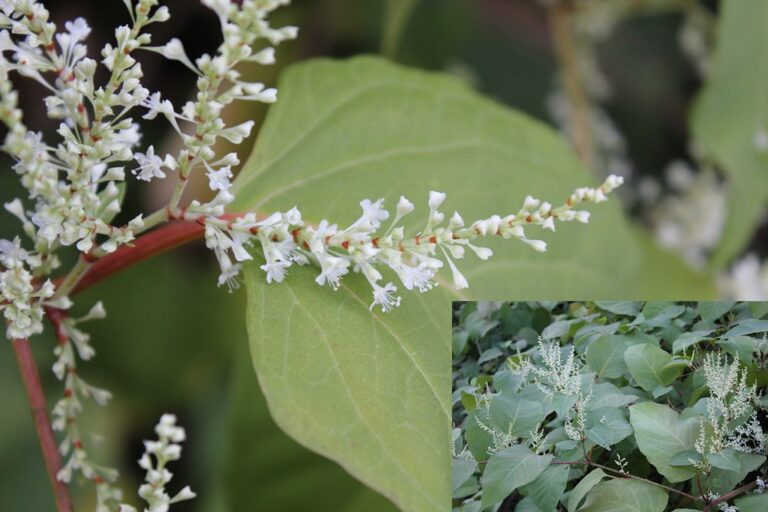
- Stems: hollow, bamboo-like canes with obvious nodes, green with reddish-purple speckles, zig-zagging slightly from leaf to leaf. Dead brown canes stand through winter.
- Leaves: broad, shield- or spade-shaped with a flat base, about 4–6 in (10–15 cm) long, arranged alternately along the stem.
- Flowers: sprays of small creamy-white flowers in late summer and early autumn.
- Size: UConn gives 6–15 ft (2–4.5 m) in the US; the Royal Horticultural Society says it typically reaches about 2 m (6.5 ft) in UK gardens.
- Underground: rhizomes with a dark skin and bright orange flesh when snapped.
Why it became invasive
Up to two-thirds of the plant’s mass is underground, and the RHS notes that rhizome sections as small as 1 cm can grow into a new plant and can lie dormant in soil for years. In the UK almost every plant is female, so it spreads by fragments rather than seed: careless digging, strimming, moved soil and dumped garden waste are the main routes.
How much damage does it really do?
Knotweed is often said to burst through concrete and spread 7 m underground. A 2018 study published in PeerJ surveyed 68 homes and 81 excavations and found no evidence that knotweed causes significant structural damage, and certainly no more than other plants; butterfly bush was linked to more damage. Rhizomes rarely extended more than 4 m (13 ft) from the visible stand and were typically within 2–2.5 m. It does exploit existing cracks in paths and drains, and its real costs are ecological, legal and financial (UK mortgage lenders still ask about it).
Giant hogweed (Heracleum mantegazzianum)
Where it came from and how it arrived
Giant hogweed is native to the Caucasus mountains. It was planted in 19th-century European gardens as a spectacular ornamental; the GB Non-native Species Secretariat’s identification sheet dates the first wild records in the UK to the late 19th century. The New York State Department of Environmental Conservation says it reached America in the early 20th century, also as a garden plant.
How to identify it
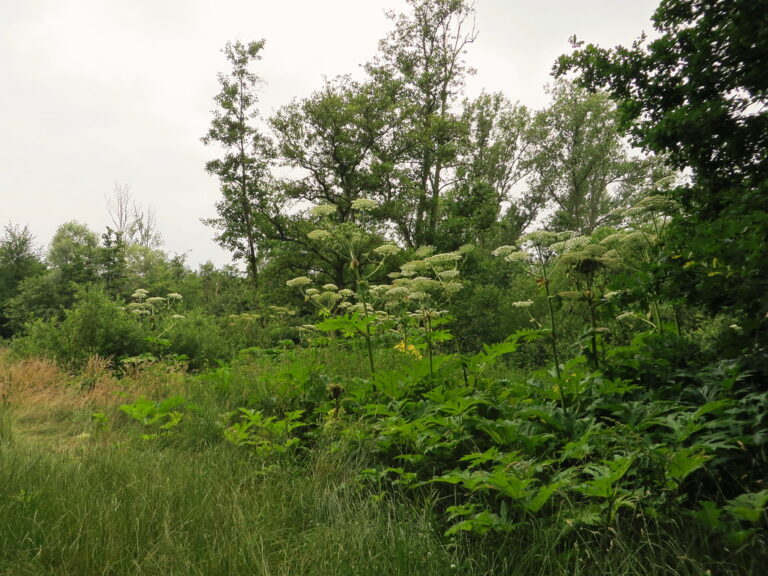
- Size: 7–14 ft (2–4.3 m) tall according to NYSDEC, and up to 5 m in the UK. Most look-alikes stop well short of this.
- Stem: 2–4 in (5–10 cm) thick, green with purple blotches and coarse white bristles, especially at the leaf bases.
- Leaves: deeply cut and sharply toothed, up to 5 ft (1.5 m) across.
- Flowers: flat-topped white umbrellas up to 2.5 ft (75 cm) wide, from late June to mid-July in New York.
- Look-alikes: native cow parsnip (Heracleum maximum) in North America and common hogweed (H. sphondylium) in Europe. The Washington State Noxious Weed Control Board notes cow parsnip grows only 5–8 ft tall with flower heads up to about 1 ft across.
Why it became invasive
Unlike knotweed, giant hogweed spreads by seed. The NNSS sheet puts output at up to 50,000 seeds per plant, and the Washington board says seeds stay viable in soil for 7 years or more. Seeds float, so colonies line river banks and move downstream each year. Plants cut at ground level regrow from buds on the root crown, which is why simple mowing fails.
Why it matters: phototoxic burns
The clear sap contains compounds that stop skin protecting itself from sunlight. NYSDEC describes the result as phytophotodermatitis, with blisters appearing within 48 hours of contact followed by sunlight, and the Washington board notes scars can last for years. If you touch the plant: wash the skin thoroughly with soap and water straight away, keep it covered and out of the sun for 48 hours, and see a doctor if a reaction develops. Never cut or strim hogweed without waterproof gloves, long sleeves and eye protection.
Kudzu (Pueraria montana var. lobata)
Where it came from and how it arrived
Kudzu is a perennial climbing legume from East Asia, where its roots and fibres have traditional uses. Alabama Cooperative Extension traces its US story to the Japanese pavilion at the 1876 Philadelphia Centennial Exposition. It was promoted as cheap forage from 1905, and in the 1930s the Soil Conservation Service handed out about 85 million seedlings and paid farmers up to $8 per acre to plant it against erosion. By 1946 roughly 3 million acres had been planted. The USDA dropped it from its list of permitted cover plants in 1953 and listed it as a common weed in 1970.
How to identify it
- Leaves: three leaflets, each 2–8 in (5–20 cm) long, often shallowly lobed.
- Stems: twining vines, hairy when young (golden hairs), becoming woody at the base.
- Flowers and pods: spikes of violet, pea-like flowers in August and September, followed by flattened pods 1.2–3 in long, as described by Mississippi State University Extension.
- Look-alikes: poison ivy also has three leaflets, but it climbs with hairy aerial roots rather than by twining, and its leaflets are smaller and glossy.
Why it became invasive
Alabama Extension reports vines growing up to 60 ft (18 m) in a season and as much as 1 ft in a day in early summer, with roots reaching 12 ft (3.7 m) deep and weighing 200–300 lb. Mississippi State notes that it spreads mainly by rooting where stem nodes touch the soil, so one patch becomes many linked plants, each with its own crown. In the long, warm, wet summers of the southeastern US, it climbs over trees and power poles and smothers them.
Water hyacinth (Pontederia crassipes, syn. Eichhornia crassipes)
Where it came from and how it arrived
Water hyacinth is a floating plant from the Amazon basin in South America. It was carried around the tropics for its lavender flowers, and according to the University of Florida IFAS Center for Aquatic and Invasive Plants, it entered the US at the 1884 Cotton Centennial Exposition in New Orleans. It is now a serious weed of lakes, rivers and irrigation canals across South and Southeast Asia, Africa, the southern US and parts of Australia.
How to identify it
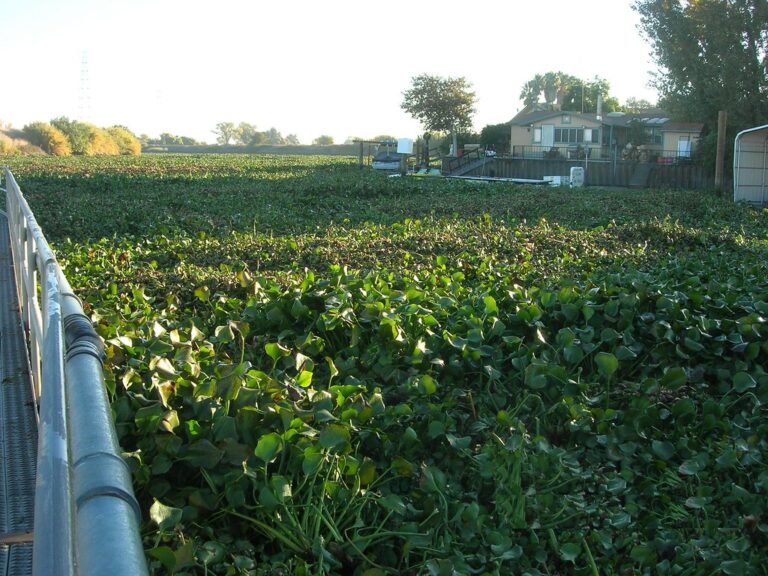
- Rosettes of glossy, rounded leaves on swollen, spongy stalks that act as floats.
- Dark, feathery roots hanging in the water.
- Spikes of lavender-blue flowers with a yellow spot on the upper petal.
- It can be confused with water lettuce, which has velvety, ribbed leaves and no inflated stalks; see our guide to water lettuce (Pistia stratiotes).
Why it became invasive
Water hyacinth multiplies mainly by sending out runners that form daughter plants, and it also sets seed. UF/IFAS’s management overview says populations can double in as little as two weeks, and seeds can lie dormant in sediment for years, germinating en masse when dried-out sediment floods again. The mats block light and air exchange at the surface, so oxygen levels fall and fish and native plants suffer; they also harbour mosquitoes, block boat access and raise flood risk in rivers.
The four species compared
| Japanese knotweed | Giant hogweed | Kudzu | Water hyacinth | |
|---|---|---|---|---|
| Native range | China, Japan, Korea | Caucasus | East Asia | Amazon basin |
| Why it was moved | Ornamental, erosion control | Ornamental | Ornamental, forage, erosion control | Ornamental |
| Main way it spreads | Rhizome and stem fragments | Seed (up to 50,000 per plant) | Rooting stem nodes, root crowns | Runners and fragments; seed |
| Habitat | Riverbanks, roadsides, gardens, rail lines | Riverbanks, waste ground, woodland edges | Forest edges, roadsides, old fields | Still or slow fresh water |
| Main harm | Dense thickets; property and legal costs | Phototoxic burns; bank erosion | Smothers trees and structures | Mats cut oxygen, block water use |
| Typical control time | At least 3 growing seasons | Several years (seed bank) | Several years (root crowns) | Ongoing in warm climates |
Legal status in the UK, EU and US
Rules differ by state and country and change often, so check your own list before planting, selling or moving any of these plants.
| Species | Great Britain | European Union | United States |
|---|---|---|---|
| Japanese knotweed | Schedule 9, Wildlife and Countryside Act 1981: offence to plant or cause to grow in the wild; controlled waste | On the Union list | Not federally listed; regulated by several states |
| Giant hogweed | Schedule 9; species of special concern (widely spread); controlled waste | On the Union list | Federal Noxious Weed; also on many state lists |
| Kudzu | Species of special concern (not widely spread) | On the Union list | Not on the current federal list; state-listed (for example Washington, Class A) |
| Water hyacinth | Schedule 9; species of special concern (not widely spread) | On the Union list | Not federally listed; prohibited in Florida and other states |
The plants named on Schedule 9 of the Wildlife and Countryside Act 1981 may not be planted or otherwise caused to grow in the wild. In England and Wales, the GOV.UK guidance on invasive alien plants says you must not import, keep, breed, transport, sell, grow or let species of special concern reproduce, with penalties up to 2 years in prison for an indictable offence. In the EU, the consolidated Union list (updated August 2025) covers all four species, which brings the same kind of ban on keeping, selling and releasing. Kudzu’s state-level status is summarised by the National Invasive Species Information Center.
How each one is controlled
The common thread: never spread fragments or seed while you work, expect to repeat treatments for several years, and dispose of waste so it cannot regrow. Our guide on how to dispose of invasive plants safely covers bagging, drying, burning rules and licensed disposal for each of these species.
- Japanese knotweed. UConn recommends either cutting stems three times a year (May or early June, mid-July and late August) for at least three years, or applying glyphosate or triclopyr in late summer to first frost, when the plant is moving sugars down to its rhizomes. The RHS says weedkiller usually needs at least three growing seasons. In the UK, many homeowners use a professional contractor because lenders want an insurance-backed management plan. Do not dig it out without a plan and do not put any part in garden compost or green waste bins.
- Giant hogweed. The NYSDEC Giant Hogweed Control Guide recommends waterproof gloves, long sleeves, boots and eye protection, then one of three methods. Cut through the root below the thick stem base, usually 2–6 in (5–15 cm) below ground, between late April and early June. Or spray glyphosate or triclopyr in early to mid-May, when the largest plants are about knee-high. On plants already flowering, cut the flower heads after the petals drop but before the seed dries, double-bag them and leave the bags in the sun for a week or more. Once a season passes with no plants, keep checking for another three years. Report plants to your local authority or state agency where it is being eradicated.
- Kudzu. Mississippi State lists clopyralid, aminopyralid, metsulfuron and glyphosate among effective herbicides, repeated over several seasons. On a small scale, cut vines and dig out or cut below every root crown (the knob where vines join the root); killing the crowns is what ends the patch. Continuous grazing can also wear a stand down.
- Water hyacinth. In ponds, net or rake out every plant and fragment and let it dry well away from water before composting or binning. Large water bodies need mechanical harvesters, aquatic-labelled herbicides applied by licensed operators, or biological control; UF/IFAS notes that three insects have been released in Florida to reduce its vigour and seed production.
Common mistakes
- Strimming or flailing knotweed. It scatters fragments that root wherever they land; the same goes for running bamboo rhizomes.
- Cutting hogweed in shorts on a sunny day. Sap splashes are the usual cause of burns.
- Passing on “spare” pond plants. Water hyacinth and water lettuce are still swapped between gardeners even where selling them is banned.
Sources
- UConn IPM – Invasive Plant Factsheet: Japanese Knotweed
- Royal Horticultural Society – Japanese knotweed
- Fennell et al. 2018, PeerJ – Japanese knotweed: capacity to cause structural damage and typical rhizome extension
- GB Non-native Species Secretariat – Giant hogweed ID sheet
- New York State DEC – Giant Hogweed and Giant Hogweed Control Guide
- Washington State Noxious Weed Control Board – Giant hogweed
- Alabama Cooperative Extension – The History and Use of Kudzu in the Southeastern United States
- Mississippi State University Extension – Kudzu
- UF/IFAS Center for Aquatic and Invasive Plants – Water hyacinth
- GOV.UK – Invasive non-native (alien) plant species: rules in England and Wales
- EUR-Lex – Union list of invasive alien species of concern (consolidated 2025)
- National Invasive Species Information Center – Kudzu