
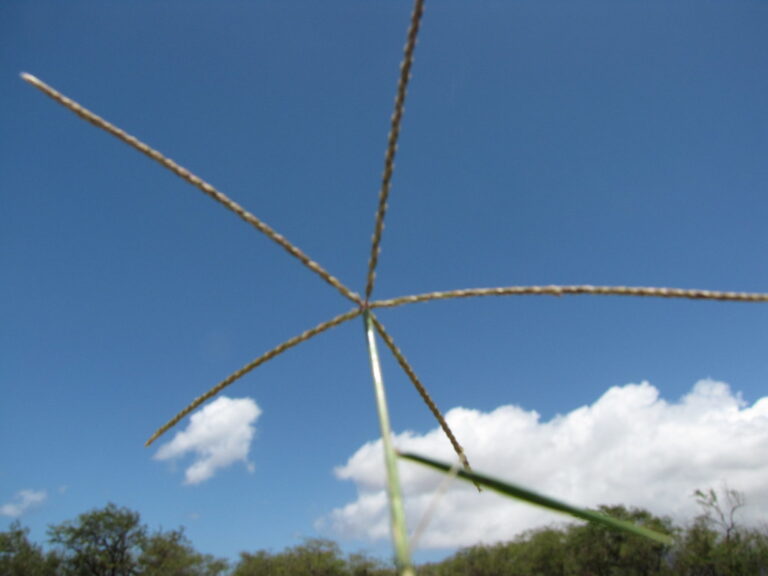
Short answer: bermuda grass (Cynodon dactylon and its hybrids) is a fine- to medium-textured, bright-to-dark green warm-season grass with narrow, sharp-pointed blades about 1.5 to 3 mm (1/16 to 1/8 in) wide, a ring of white hairs where the blade meets the sheath, and creeping stems both above ground (stolons) and below it (rhizomes). In summer it sends up a seedhead of 3 to 7 thin spikes radiating from one point, like a bird’s foot. It earns its place in hot, sunny lawns because it tolerates drought, heat, heavy wear and salty soil or water better than almost any other lawn grass. The price is poor shade tolerance, a tan winter dormancy, and a habit of creeping into flower beds and neighbouring lawns.
What bermuda grass looks like, feature by feature
Identification is easiest on a plant you can pull up with its runners attached. Check these features in order:
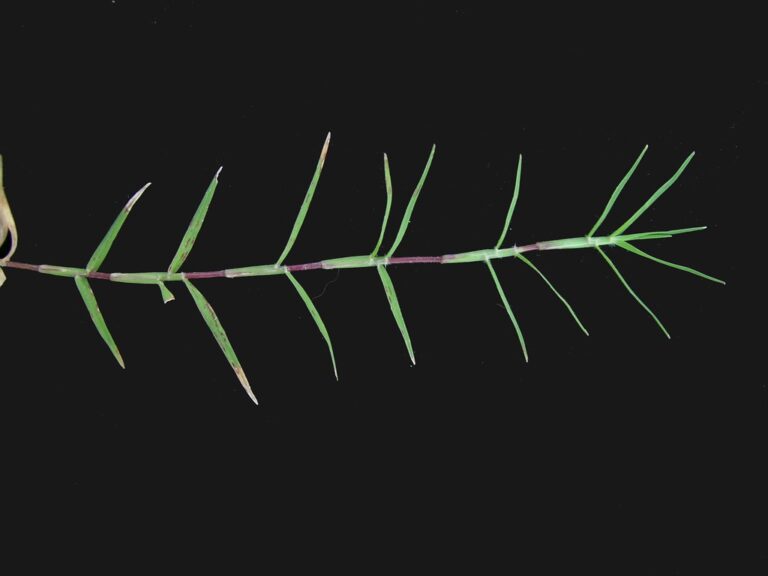
- Leaf blade: flat, narrow and tapering to a sharp point, 0.06 to 0.1 in (1.5 to 3 mm) wide, sparsely hairy with rough edges, according to NC State Extension. The blades stand out from the stem at a wide angle, often in a two-ranked “ladder” along the runner.
- Ligule (the collar zone): a fringe of hairs 1 to 3 mm long. UC IPM describes it as a conspicuous ring of white hairs at the junction of blade and sheath. This single feature separates it from bentgrass and nimblewill, which have a papery membrane instead.
- Vernation: new leaves are folded in the bud, not rolled. Roll a young shoot between your fingers: a folded shoot feels flat, a rolled one feels round.
- Stolons and rhizomes: wiry runners creep across the surface and root at every node; below ground, pale scaly rhizomes run through the top few inches of soil. This is why bermuda is sometimes called “wiregrass” when it shows up as a weed.
- Seedhead: a cluster of 3 to 7 slender, finger-like spikes joined at the top of an upright stem, each spike carrying two rows of tiny spikelets on one side.
- Colour through the year: green from late spring to autumn, then straw-tan after the first frosts while the crowns stay alive.
The species is found through the tropics and subtropics and has many local names, which helps when you are reading older references: couch grass (Australia and South Africa), dog’s tooth grass, scutch grass, star grass, Bahama grass, kweek (Afrikaans), durva or doob (Hindi and Sanskrit), arugampul (Tamil) and grama bermuda (Spanish). In farming it is also a valuable pasture and hay grass; “Coastal” and similar forage types are bred for that use rather than for lawns.
Grasses that are often confused with bermuda
| Grass | How it differs from bermuda |
|---|---|
| Zoysia | Also has a hairy ligule and creeps, but the blades are stiffer, new leaves are rolled rather than folded in the bud, and it spreads much more slowly. |
| Nimblewill | A short membranous ligule instead of a fringe of hairs, and wiry stems that sprawl in loose patches. It is usually found in shaded, damp spots where bermuda fails. |
| Crabgrass | A summer annual: wider, often hairy blades, a membranous ligule, no rhizomes, and it dies with the first frost rather than going dormant. Its seedhead also has finger-like spikes, which causes most of the confusion. See our crabgrass identification guide. |
| Creeping bentgrass | Cool-season grass with a tall, papery membranous ligule; stays green in cool weather when bermuda is tan. |
| St. Augustine grass | Blades are several times wider with blunt, rounded tips; thick flat stolons. |
Why bermuda grass is so stress tolerant
Bermuda is a C4 grass, a group whose photosynthesis keeps working efficiently in heat and strong sun. Add a dense network of stolons and rhizomes that can regrow from almost any node, and you get a lawn that takes punishment and recovers quickly. Here is what the research and extension ratings say about each stress:
Drought
Texas A&M AgriLife Extension rates bermudagrass drought tolerance as very good to excellent. It survives dry spells mainly by going dormant: the leaves turn brown, and the plant regrows from rhizomes when moisture returns. The SARE weed profile notes that rhizomes can occur as deep as 40 in (1 m), but also that the plant will not resprout after about seven days in completely dry soil, so “drought tolerant” does not mean it survives no water at all. Our guide to helping a lawn recover from drought explains how to tell dormant grass from dead grass.
Heat and full sun
Bermuda grows fastest in the hottest part of summer, when cool-season grasses such as Kentucky bluegrass and perennial ryegrass slow down or go dormant. That is why it dominates lawns, sports fields and golf fairways across the southern United States, Australia, South Africa and similar climates.
Wear and traffic
Extension services consistently rate it high for wear tolerance and recovery. Because it spreads sideways from stolons and rhizomes, worn areas fill back in during the growing season without reseeding, which is why hybrid bermuda is the standard turf on many sports fields.
Salt
University of California turfgrass specialists place bermudagrasses in the salt-tolerant group, above 10 dS/m of soil salinity, compared with 6 to 10 dS/m for tall fescue and below 3 dS/m for Kentucky bluegrass (UC Riverside, California Turfgrass Culture). UF/IFAS Extension describes its salt tolerance as excellent. In practice that makes it a good choice for coastal lawns and for sites irrigated with recycled or slightly saline water, though seashore paspalum is the specialist for truly salty sites.
Common vs hybrid bermuda: the main cultivars
Lawn bermuda comes in two broad groups. Common and improved seeded types (Cynodon dactylon) are sold as seed, are cheaper to establish and tolerate lower maintenance, but are coarser and less dense. Hybrids are crosses between common bermuda and African bermuda (C. transvaalensis); they are sterile, so they are planted only as sod, sprigs or plugs, and they make a finer, denser, darker turf that usually needs more fertilizer and more frequent mowing.
| Cultivar | Type | What extension trials report |
|---|---|---|
| Common, Arizona Common, Princess 77, Sultan, Riviera, Blackjack, Savannah | Seeded | Cheapest to establish; seeded improved types are finer and denser than old common types (Texas A&M), but performance is generally lower than the vegetative hybrids (UF/IFAS). |
| Tifway (419) | Hybrid, sod | Long-time standard for fairways and sports fields; fine texture but needs higher fertility, frequent mowing and more pest control. |
| Celebration | Hybrid, sod | Tolerates slightly more shade than most bermudas, needs less maintenance than Tifway, and can be mown at 1 to 2 in with a rotary mower (UF/IFAS). |
| TifTuf | Hybrid, sod | Bred at the University of Georgia Tifton campus; UGA reports it uses 38 percent less water than Tifway while keeping better turf quality, and it holds colour longer into autumn. |
| TifGrand | Hybrid, sod | Needs fewer hours of direct sun than Tifway; like Celebration, “promising” in moderate shade but not truly shade tolerant. |
| Latitude 36, NorthBridge | Hybrid, sod | Selected for cold tolerance and earlier spring green-up; Latitude 36 is more resistant to spring dead spot but prone to nematode injury. |
The TifTuf figures come from the University of Georgia CAES, where Wayne Hanna and Brian Schwartz developed it; the other cultivar notes are from UF/IFAS and Texas A&M. For home lawns, Texas A&M points out that the high-input hybrids are really fairway and sports-field grasses, so Celebration, TifTuf or a good seeded type is usually the more practical choice. If you are still choosing a species, our lawn grass comparison sets bermuda against St. Augustine, zoysia, fescue and buffalo grass.
The weaknesses you should know before planting
Shade
Mississippi State University Extension says bermudagrass requires the most light of all maintained turfgrasses and rates its shade tolerance as very poor. Under trees or on the north side of a house it thins out, and weeds or moss take over. Celebration and TifGrand help in light shade only.
Winter dormancy
Bermuda stops growing quickly after frost and turns straw-tan for the winter; the transition starts as nights drop below about 70°F (21°C), according to Clemson Cooperative Extension. The grass is alive, but a brown lawn for four or five months is the trade-off. Some owners overseed with perennial ryegrass for winter colour, which adds cost and can slow spring green-up. Tan or white patches that do not green up in spring are a different problem; see why bermuda grass turns white.
Invasiveness into beds and neighbouring lawns
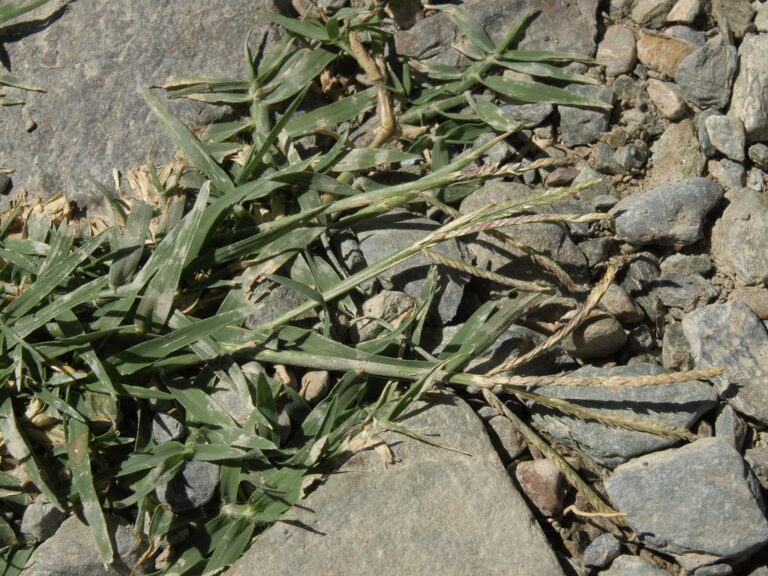
The same runners that make bermuda recover from wear make it a weed next to flower beds. UF/IFAS warns that it can rapidly invade flower and landscape beds. In one study summarised by SARE, small rhizome fragments produced 3.3 to 6.6 ft (1 to 2 m) of runners in four weeks. UC IPM notes that rhizomes are usually 1 to 6 in (2.5 to 15 cm) deep in undisturbed soil but run deeper under sidewalks and along foundations, and that cut pieces left on moist soil re-root.
Practical defences: install a solid edging strip that reaches at least 6 in (15 cm) deep with a lip above the soil, edge the lawn every few weeks in summer, keep a mulch-free strip you can see runners crossing, and never compost fresh runners. If it has already moved into a bed, our guide to stopping grass growing through mulch covers removal; UC IPM also reports that clear plastic solarization for 4 to 6 weeks in the sunniest part of summer kills both plants and seed.
Other weak points
- Thatch: vigorous hybrids build thatch quickly; Clemson suggests removing it once it exceeds 1/2 in (1.3 cm).
- Pests and diseases: UF/IFAS lists nematodes as the most serious problem (no cultivar is resistant), with mole crickets, sod webworms, armyworms and bermudagrass mites as the main insects and dollar spot and large patch among the diseases. NC State adds spring dead spot on lawns three to five years old.
Basic bermuda lawn care
| Task | What extension guides recommend |
|---|---|
| Sunlight | Full sun; avoid areas with more than light, dappled shade. |
| Planting | Late spring to early summer, once the soil is warm (NC State schedules common bermuda seeding for late May). Seed at 1 to 2 lb hulled seed per 1,000 sq ft; sprigs at 3 to 5 bushels per 1,000 sq ft. |
| Mowing height | 1 to 2 in (2.5 to 5 cm) for most home lawns with a rotary mower; hybrids look best at 3/4 to 1 in with a reel mower. Remove no more than a third of the blade per mowing. |
| Nitrogen | Roughly 1/2 to 1 lb N per 1,000 sq ft per application in early, mid and late summer; Clemson gives 2 to 4 lb N per 1,000 sq ft per season, UF/IFAS 3 to 7 lb depending on region. Wait until green-up is complete; do not feed in autumn. |
| Soil pH | About 6.0 to 6.5 (Clemson); test before liming. |
| Watering | Water deeply, about 3/4 to 1 in (2 to 2.5 cm), only when the lawn shows drought stress, rather than little and often. Good drainage matters; bermuda does not like waterlogged soil. |
Seedheads appearing in a mown lawn are usually a sign of stress (drought, low fertility or mowing too high and too seldom) rather than a disease; correct the stress and keep mowing. Thin areas fill in on their own in summer if the lawn is fed and mown regularly, so reseeding bare patches is rarely needed except with seeded types. And if you prefer a different grass, do not blend bermuda seed into it: once established it tends to take over the whole lawn, as described in our guide to different grass types in one lawn.
Sources
- NC State Extension – Bermudagrass (Cynodon dactylon) identification
- UC Statewide IPM Program – Bermudagrass pest note
- UF/IFAS Extension – Bermudagrass for Florida Lawns (ENH19)
- University of Georgia CAES – TifTuf bermuda grass ideal for home lawns
- Texas A&M AgriLife Extension – Turfgrass Selection for Texas
- UC Riverside – California Turfgrass Culture (salinity tolerance)
- Mississippi State University Extension – Selecting and Managing Turfgrass for Shade
- Clemson Cooperative Extension – Bermudagrass Yearly Maintenance Program
- NC State Extension – Bermudagrass Lawn Maintenance Calendar
- SARE – Manage Weeds on Your Farm: Bermudagrass