
Short answer: a lawn with obviously different grasses in it is nearly always the grass you planted plus one or two uninvited perennials: coarse clumps of forage-type tall fescue, rough bluegrass patches that go yellow-green then brown in summer, bermudagrass or zoysia creeping in from a neighbour and turning straw-brown in winter, nimblewill, quackgrass, or a spring flush of annual bluegrass. The uncomfortable fact is that for most of these there is no selective herbicide: nothing you can spray removes tall fescue from Kentucky bluegrass, quackgrass from any lawn, or bermudagrass from fescue without harming the grass you want. The three real options are to spot-kill the patch with glyphosate and reseed 7 to 14 days later, to dig the clump out with 2 inches (5 cm) of root, or to accept the blend and manage the whole lawn so the differences show less. The exceptions worth knowing are mesotrione for nimblewill and creeping bentgrass in cool-season lawns, fenoxaprop or fluazifop for bermudagrass suppression (not eradication) in tall fescue and zoysia, and a fall pre-emergent for annual bluegrass.
Why one lawn ends up with several grasses
- Contaminated or cheap seed. Penn State Extension notes that turfgrass seed may legally contain up to 0.5 percent “undesirable grass seed” and up to 1.0 percent weed seed by weight. Grass seed is tiny, so a bag that is 99.5 percent clean still drops thousands of rough bluegrass, tall fescue or orchardgrass seeds across a lawn. Penn State adds that Poa trivialis often arrives “as a contaminant in bags of turfgrass seed, or from cultivation equipment and soil containing small stolon pieces”.
- Sod meeting seed. Sod is grown as a single cultivar; the lawn around it usually is not, and the more aggressive grass gains a few inches a year along the seam.
- Creeping grasses from next door. Bermudagrass and zoysia spread by stolons above ground and rhizomes below it. The University of Georgia credits bermudagrass’s “prolific rhizomatous and stoloniferous growth during summer months” for its takeover of mixed stands; a mowed strip is no barrier.
- Old pasture grasses in the soil. Forage-type tall fescue (the old Kentucky 31 type) and quackgrass persist for decades in seedbanks and rhizome networks under new housing.
- Summer annuals opening gaps. Crabgrass dies each autumn but leaves bare soil that perennial invaders fill. If you are unsure whether your patch comes back every year, start with our crabgrass identification guide.
How to tell which grass you have
Most of the identification can be done from the mower seat with two questions: when does the patch look different from the rest of the lawn, and does it grow as a tight clump or a spreading circle? Use the table, then confirm with the close-up clue.
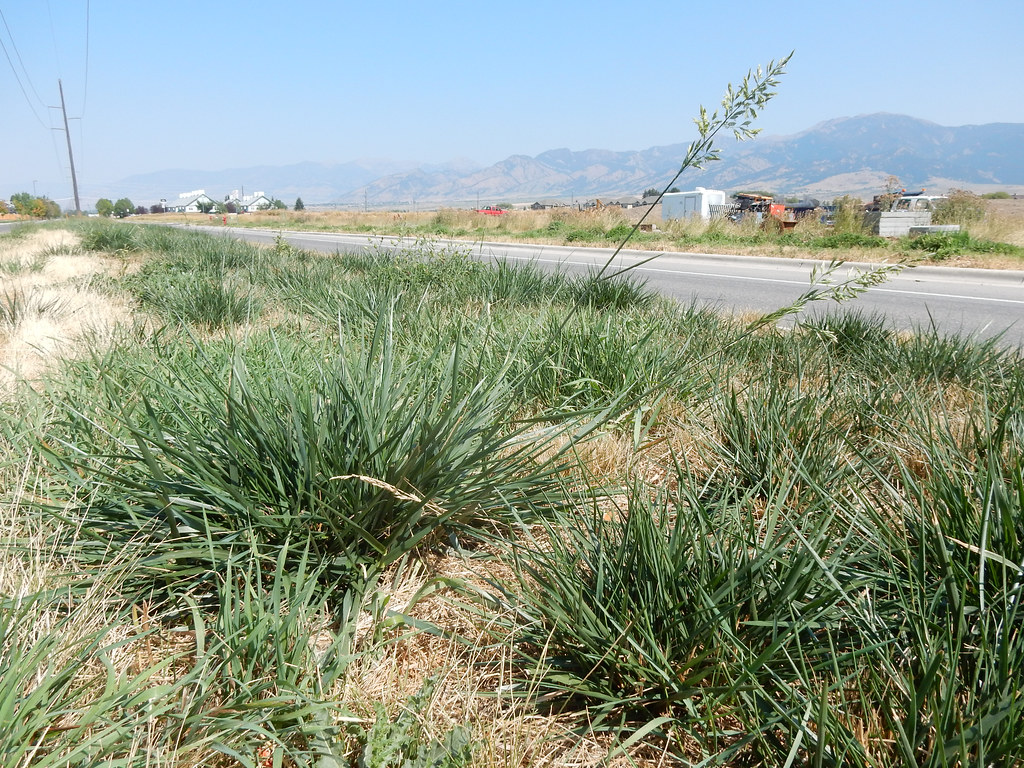
| Grass | Colour and texture | Growth habit | When it stands out | Close-up clue |
|---|---|---|---|---|
| Forage-type tall fescue | Dark green, coarse, wide blades | Bunch grass; distinct clumps that grow faster and taller | Early spring (greens up before bluegrass) and drought (stays green while bluegrass browns) | Prominent ridged veins on the upper leaf; bluegrass shows only a midrib |
| Rough bluegrass (Poa trivialis) | Yellow-green to light green, fine, glossy underside | Circular patches spreading by stolons; shallow roots pull up easily | Summer heat: patches turn yellow, then purplish, then brown while the lawn stays green | Surface stolons; reddish stem bases in April; boat-shaped leaf tip like bluegrass |
| Annual bluegrass (Poa annua) | Lighter green than the lawn, slightly coarser | Small tufts merging into a carpet in damp or compacted areas | Late winter to spring: whitish seedheads even at low mowing heights; dies in early summer leaving brown gaps | Germinates in fall once soil drops below 70°F (21°C) |
| Bermudagrass | Grey-green to medium green, fine to medium, wiry runners | Aggressive circles and fingers advancing from edges; stolons and rhizomes | Winter: straw-brown at the first frost while fescue and rye stay green | Fringe of hairs where blade meets sheath; runners root at every node |
| Zoysia | Medium green, stiff, dense, prickly to the hand | Slow-expanding rings that thicken into a mat | Winter and early spring: tan-brown circles, last to green up | Brush-like density; thatchy underneath |
| Nimblewill | Grey-green or blue-green, fine, wiry | Circular patches from thin stolons; often in shade | Late fall to late spring: patches sit tan-brown until May | Short blades 0.75 to 2 inches (2 to 5 cm) held horizontally on wiry upright stems |
| Quackgrass | Dull green to blue-green, blades 1/8 to 1/2 inch (3 to 12 mm) wide | Loose colonies from long white rhizomes | Late spring and summer; 2 to 6 inch (5 to 15 cm) wheat-like spikes from late May | Slender claw-like auricles wrapping the stem; crabgrass has none |
| Creeping bentgrass | Very fine, pale to bluish green, puffy | Dense flat mats that scalp brown when mowed | After mowing (brown scalped patches) and during drought | Fine stolons that lift as a mat |
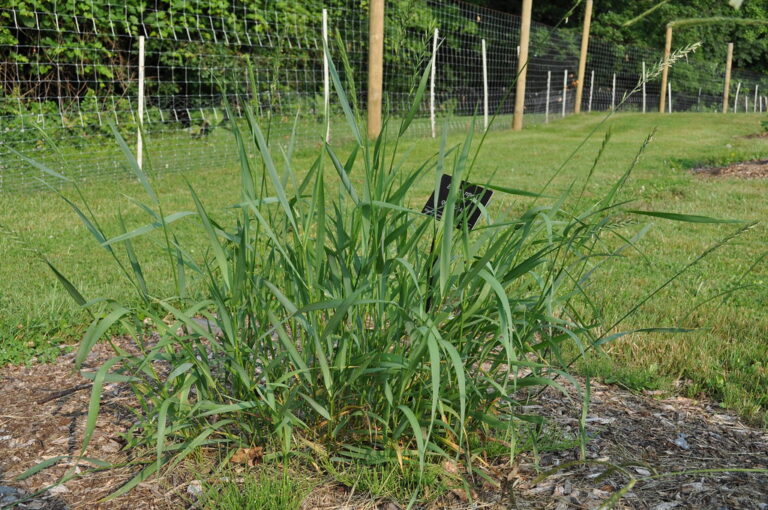
Two confirmations are worth the walk. Purdue Turfgrass Science says forage tall fescue “can be easily spotted in lawns in early spring when they green-up faster than Kentucky bluegrass and by its bunch-type growth habit”, and again in a dry July because it “stays green and actively growing during drought whereas Kentucky bluegrass will often enter a drought-induced summer dormancy”. For rough bluegrass, Penn State Extension gives the decisive feature: “leaves of P. trivialis have a glossy underside, whereas Kentucky bluegrass leaf surfaces are not glossy or shiny”. Patches that yellow before they brown are easy to confuse with disease or drought; our guide to why grass turns yellow separates those causes.
What will and will not kill each invader selectively
A selective herbicide works because the weed and the lawn grass break the chemical down differently. When both are perennial grasses in the same family that difference is usually too small, and the label says so. The table is the honest version for home lawns; “suppression” means the invader is knocked back for a season, not removed.
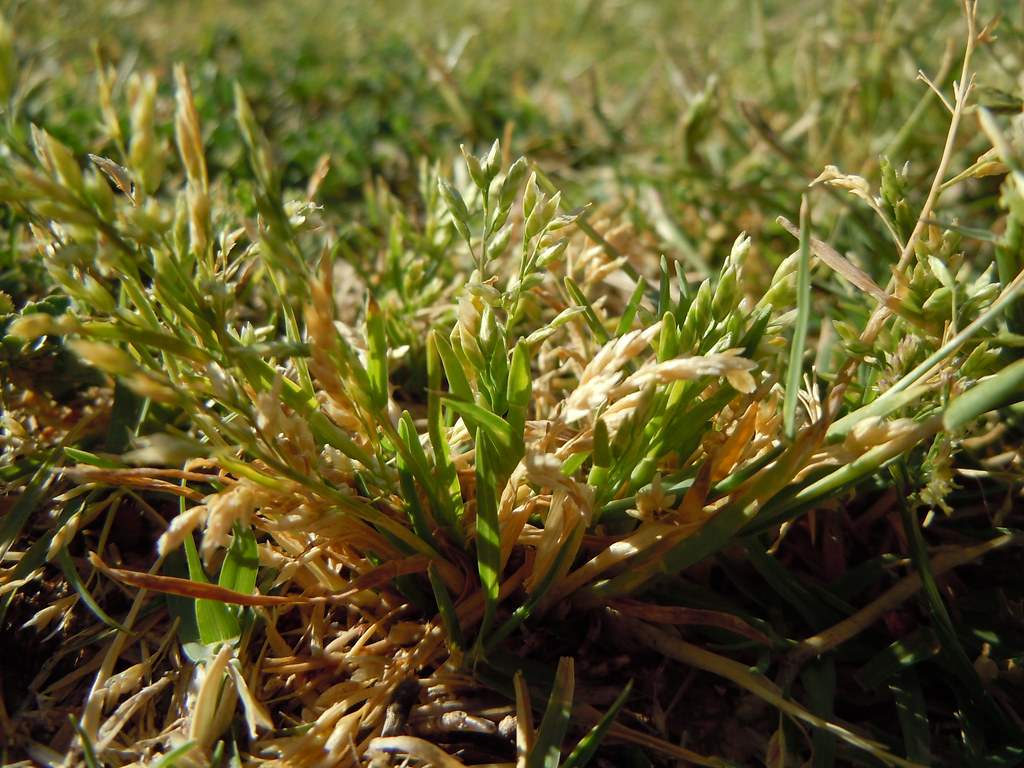
| Unwanted grass | In bluegrass, ryegrass or fescue lawns | In bermuda, zoysia or St Augustine lawns | Realistic plan |
|---|---|---|---|
| Tall fescue clumps | No selective herbicide | Generally none; in centipedegrass, sethoxydim or clethodim remove most other grasses (check the label) | Dig or spot-spray with glyphosate, reseed |
| Rough bluegrass | No selective postemergence herbicide labelled for lawns | Rarely a problem | Glyphosate the patch plus a 12 inch (30 cm) margin, reseed |
| Annual bluegrass | Late-summer pre-emergent (prodiamine, dithiopyr, pendimethalin, bensulide); postemergence very limited, spot-spray | Pre-emergent as left; postemergence foramsulfuron, trifloxysulfuron, atrazine or simazine by turf species | Prevent in fall, tolerate the spring flush, thicken the lawn |
| Bermudagrass | Suppression only: fenoxaprop or fluazifop, usually with triclopyr, repeated through summer in tall fescue and zoysia | Clethodim or sethoxydim in centipede; ethofumesate plus atrazine in St Augustine | Repeated suppression plus high mowing, or glyphosate renovation in late summer |
| Zoysia | No selective herbicide | None in bermuda | Glyphosate in summer while it is growing, repeat on regrowth, reseed in fall |
| Nimblewill | Mesotrione or topramezone, two to three applications | No selective option | Selective programme from late spring, reseed thin spots in early fall |
| Quackgrass | No selective herbicide | No selective herbicide | Glyphosate in spring or fall, recheck after a week, reseed |
| Creeping bentgrass | Mesotrione, repeated applications | No selective option | Selective programme, or glyphosate and reseed |
For bermudagrass in tall fescue, a University of Tennessee Extension trial made three applications at 28-day intervals from mid-May and recorded 67 percent suppression from fenoxaprop plus triclopyr, 74 percent from fluazifop alone and 69 percent from fluazifop plus triclopyr; the triclopyr is there because it “safens” the fescue. Good numbers for a season, but a quarter of the bermuda survives to regrow, which is why the University of Georgia adds that fall glyphosate “generally control[s] bermudagrass more effectively than summer treatments”, when the plant is moving sugars, and herbicide, down into its rhizomes. For nimblewill, Iowa State University Extension recommends three mesotrione applications at two to three week intervals starting in late April; the weed “stops growing, turns white, and eventually dies”, and you should expect temporary white tips on the bluegrass too. For annual bluegrass the University of Georgia is blunt: pre-emergents “must be applied in late summer/early fall before annual bluegrass germination”, and in cool-season lawns “spot treatments of nonselective herbicides are generally the most effective treatment”. Whatever you spray, new seedlings need protecting from it; the timing rules are in our post on killing weeds before overseeding.
Step by step: kill the patch and reseed it
For anything in a “no selective herbicide” row, this is the procedure. It suits a few clumps or a few hundred square feet; beyond that you are renovating the whole lawn.
- Pick the window. Spray in late summer so seeding lands in the best establishment window, which Nebraska Extension puts between 15 August and 15 September for Kentucky bluegrass and tall fescue. Bermuda or zoysia patches in a cool-season lawn must be actively growing when sprayed, so late August is the sweet spot: warm enough for uptake, early enough to seed afterwards.
- Do not mow the patch for a week beforehand. Glyphosate needs leaf area and active growth. Iowa State University Extension advises applying it “while plants are actively growing (typically when temperatures are above 50°F)”, or 10°C. A brown, dormant rough bluegrass patch in July takes up nothing.
- Spray the patch plus a margin. Penn State recommends treating at least 12 inches (30 cm) beyond the visible edge of a rough bluegrass patch because the stolons run further than the discolouration shows. Spray on a still morning and accept a slightly larger dead circle. A sponge or paintbrush dipped in solution works for single fescue clumps.
- Wait, then check. Dieback takes one to three weeks. University of Missouri IPM advice for removing zoysia applies to every rhizome and stolon spreader: “continue to monitor any regrowth every 10 to 14 days” and spot-spray whatever re-sprouts. Bermuda, zoysia, quackgrass and rough bluegrass almost always need a second pass.
- Clear and open the soil. Rake out the dead thatch and loosen the top inch (2.5 cm). For single clumps Purdue’s method is simpler: cut them out with a shovel or knife “a couple of inches into the soil to get all the stems” and refill with soil. Larger areas follow our steps for preparing soil for grass seed.
- Reseed 7 to 14 days after the final spray. Purdue suggests reseeding “7 to 14 days after the final application”. Use the bare-ground rate, which Nebraska gives as 6 to 8 lb per 1,000 square feet (3 to 4 kg per 100 m²) for tall fescue and 2 to 3 lb (1 to 1.5 kg) for Kentucky bluegrass, rake lightly for seed-to-soil contact, and match the variety to what is already there, or the repair becomes the next “different grass”.
- Water little and often. Keep the top half inch moist with two to four light waterings a day for two weeks, then move to two or three deeper soakings a week. Apply no herbicide until the new grass has been mowed three times.
Option three: keep the blend and make it look intentional
If a third of the lawn is now tall fescue, or the bermuda arrives fresh from next door every June, spot-killing is a treadmill. Instead, manage the differences. Mow high (3 to 4 inches, 7.5 to 10 cm, for cool-season mixtures) to hide texture differences and shade out bermuda and annual bluegrass; fertilise in fall so cool-season grasses thicken while warm-season invaders shut down; and irrigate deeply in midsummer so rough bluegrass never browns and gives itself away. Overseeding every autumn with a turf-type tall fescue and Kentucky bluegrass blend gradually turns a patchy lawn into a deliberate mixture in which no clump stands out. If you live where both warm-season and cool-season grasses survive, our comparison of St Augustine, bermuda, zoysia, fescue and buffalo grass will help you decide which is worth converting to.
Mistakes that make it worse
- Spraying a dormant patch. Brown rough bluegrass in July and brown bermuda in January take up nothing.
- Hand-pulling quackgrass or rough bluegrass and leaving fragments. Every piece of rhizome or stolon is a new plant; Kansas State University notes that quackgrass rhizomes run 2 to 8 inches (5 to 20 cm) deep and that “removing the entire underground portion of the plants may be difficult”. Hand removal only suits tall fescue clumps, after rain.
- Rototilling a bermuda or quackgrass area before spraying. Tilling chops rhizomes into hundreds of cuttings. Kill first.
- Reseeding with “contractor” or “quick lawn” mixes. Look for 0 percent weed seed and other crop, named cultivars rather than “variety not stated”, and certified blue-tag seed where available.
- Expecting one fluazifop or fenoxaprop spray to remove bermuda. It is a multi-year suppression programme; the Ask Extension warning that “you will continue to battle Bermudagrass in the fescue in perpetuity” without a full renovation is fair, and the same answer notes that mowing high “could drastically reduce the amount of herbicide needed”.
Prevention: keep the next invader out
- Buy seed by the label and keep it; if a new grass appears within a year of seeding, that is your evidence.
- Install a physical edge against a bermuda or zoysia neighbour: a 6 to 8 inch (15 to 20 cm) deep plastic or steel strip, or a 12 inch (30 cm) mulched or paved band you can inspect and spot-spray each June. Rhizomes still get under shallow edging.
- Clean the mower deck after cutting a bermuda, zoysia or nimblewill area; stolon pieces root where they land.
- Use screened topsoil or compost from a known source for top-dressing, not soil scraped from a field edge.
When to expect a uniform lawn again
Dug-out fescue clumps disappear within one season once the seed comes in. A glyphosate-and-reseed patch sprayed in late August looks bare through September, thin by October and blends in by the following June. Judge bermuda and zoysia removal over two summers, because unseen rhizomes send up shoots the next year and need spot-spraying. Nimblewill and bentgrass programmes take one full season of two to three sprays plus a fall overseed. Annual bluegrass is never finished; a fall pre-emergent every year keeps it below the level you notice.
Related guides: Poa Annua in Lawns: How to Identify and Control Annual Bluegrass · How to Get Rid of Foxtail Barley (Wild Barley Grass) in Lawns and Pastures · Running vs Clumping Bamboo: Which Kinds Are Invasive and How to Contain Them
Sources
- Purdue Turfgrass Science – Tall Fescue (identification and control in lawns)
- Iowa State University Extension – How do I control tall fescue in my lawn?
- Penn State Extension – Lawn and Turfgrass Weeds: Roughstalk Bluegrass (Poa trivialis)
- University of Tennessee Extension – Controlling Bermudagrass in Zoysiagrass and Tall Fescue Turf (PDF)
- University of Georgia Extension – Bermudagrass Control in Southern Lawns (Bulletin 1393)
- University of Georgia Extension – Annual Bluegrass Control in Residential Turfgrass (Bulletin 1394)
- Iowa State University Extension – How to Control Nimblewill in Lawns
- Kansas State University Turfgrass – Quackgrass (lawn problem solver)
- University of Missouri IPM – My Zoysiagrass Lawn was Beautiful – Now What Should I Do?
- Penn State Extension – Turfgrass Seed and Seed Mixtures (reading the label)
- Nebraska Extension – Time for Fall Lawn Seeding (dates, rates, watering)
- Ask Extension – Control/Suppression of Bermuda Grass in Tall Fescue