
Short answer: weeds come through mulch for four reasons, and each has a different fix. Seeds blowing onto the surface germinate in the fine, decomposed layer on top, so the mulch needs to be coarse and kept at 3 to 4 inches (7.5 to 10 cm). Perennials such as bindweed, nutsedge and bermudagrass push up from roots and rhizomes underneath, so they have to be dug or killed before you mulch, because no depth of bark stops them. Lawn grass creeps in over the edge, so the bed needs a clean edge or mowing strip that is recut once or twice a year. And cheap mulch, hay and manure can carry their own seeds. Landscape fabric and corn gluten meal are the two “solutions” that extension trials say to skip.
Why weeds still come through mulch
Mulch works by blocking light so small seeds cannot germinate, and by drying out fast at the surface so any seedling that does start is killed. The failures follow from that.
- Seeds landing on old mulch. Bark and wood break down into something close to compost within a season or two. According to UC IPM, decomposed mulch “becomes a means of weed propagation rather than a means of prevention”: annual weeds germinate inside the mulch itself, above the soil.
- Mulch that is too thin. A 1 inch (2.5 cm) skim looks tidy but does little. Washington State University’s wood chip fact sheet notes that shallow layers can actually increase weed growth, because they hold moisture without blocking enough light.
- Perennial roots and rhizomes underneath. UC IPM’s mulch pest note states that field bindweed and nutsedges have “sufficient root reserves to enable them to penetrate even thick layers of mulches.” Quackgrass, bermudagrass, Canada thistle and horsetail behave the same way.
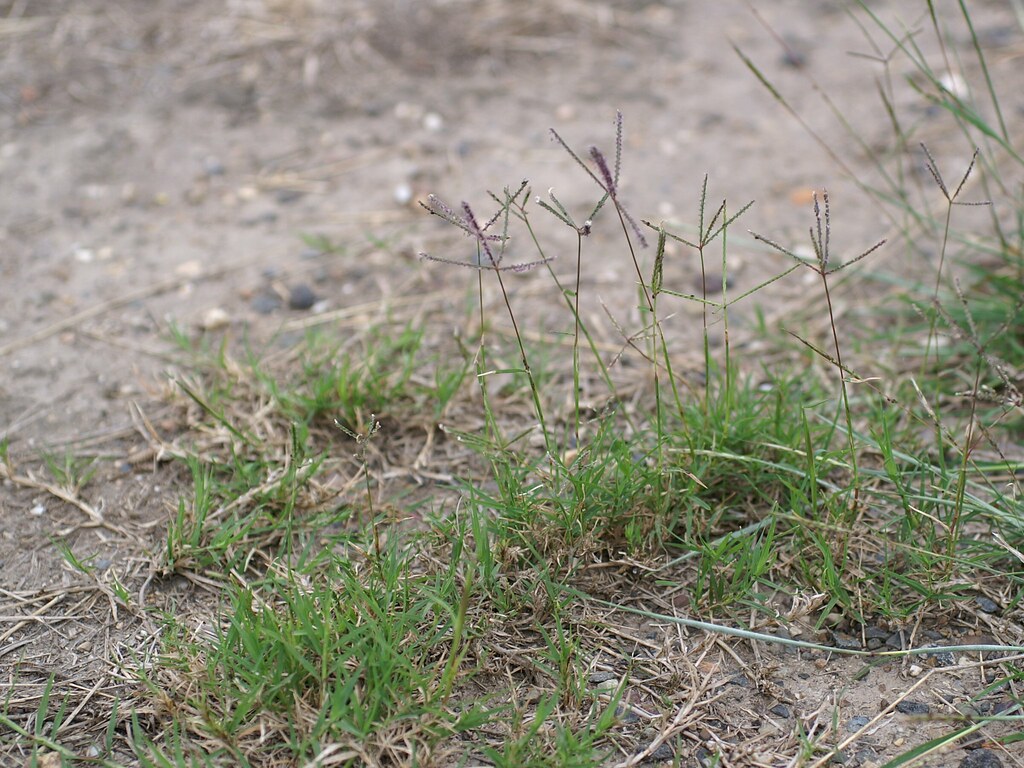
- Grass creeping in from the lawn. Bermudagrass spreads by surface stolons and by rhizomes usually 1 to 6 inches (2.5 to 15 cm) deep, according to the UC IPM bermudagrass pest note. Quackgrass does the same in cool climates. Wood chips alone will not stop either.
- Seeds in the mulch bag. Penn State Extension warns that hay, straw and strawy manure “might introduce additional weed seeds into the planting area.” Uncomposted tree-trimming mulch can carry seed as well.
How to tell which case you have
| What you see | Likely cause | Fix |
|---|---|---|
| Many small seedlings, pull out with almost no root, mulch looks dark and crumbly | Seeds germinating in decomposed surface layer | Top up with coarse mulch to 3 to 4 in; hoe or hand-pull; consider a pre-emergent |
| Single strong shoots, snap off and regrow, white or cream roots running sideways underneath | Perennial rhizomes (bindweed, nutsedge, quackgrass, thistle) | Dig out all root or spot-treat; then re-mulch |
| Grass runners entering from the lawn side, thickest at the edge | Bermudagrass or quackgrass creeping in | Recut the edge, install a mowing strip, use a grass-selective herbicide or dig runners |
| A flush of weeds a few weeks after fresh mulch or compost, evenly across the bed | Seeds came in with the material | Hoe before they set seed; switch supplier or use aged bark |
| Weeds rooted into a mat you cannot pull cleanly, fabric showing at the edges | Old landscape fabric with mulch decomposed on top | Remove the fabric; re-mulch with 3 to 4 in of coarse chips |
How deep should mulch be? What the trials show
- A Cornell study in Arboriculture & Urban Forestry compared pine chips and shredded hardwood at 7.5, 15 and 25 cm (3, 6 and 10 in). Three inches gave significant but incomplete suppression; the 25 cm plots had only 3.5 percent weed cover at the end of the second season. The 7.5 cm depth was judged best overall because it raised soil moisture by 58 percent without over-cooling the soil as the deeper layers did.
- A University of Florida trial in HortTechnology tested pine bark, hardwood chips and pine straw at 1 and 2 inches. Mulch alone controlled large crabgrass by 15 to 36 percent at 1 inch and 43 to 45 percent at 2 inches; garden spurge went from 49 to 59 percent to 75 to 87 percent. Doubling the depth roughly doubled the effect, and neither depth was enough on its own for crabgrass.
- UC IPM recommends 3 to 4 inches for organic mulches with particles of about 1/4 to 3/4 inch, about 2 inches for fine materials such as compost, and warns that more than 4 inches can starve roots of oxygen. Pieces larger than 1.5 inches let light through and need 6 inches or more.
- WSU’s fact sheet on arborist wood chips says chips “maintained at a depth of 4 to 6 inches will control weeds” and that coarse, mixed-size chips resist the compaction that makes sawdust and fine bark fail.
The practical rule: 3 to 4 inches (7.5 to 10 cm) of coarse bark or arborist chips over shrubs and trees, 2 to 3 inches (5 to 7.5 cm) over perennials whose crowns need air, tapered to nothing against any living stem. Gravel works at 1 to 2 inches but brings its own problems, covered in our guide to killing weeds in rock gardens and gravel beds.
Prepare the bed before you mulch
Mulch preserves whatever is under it. If perennials are there, they come back.
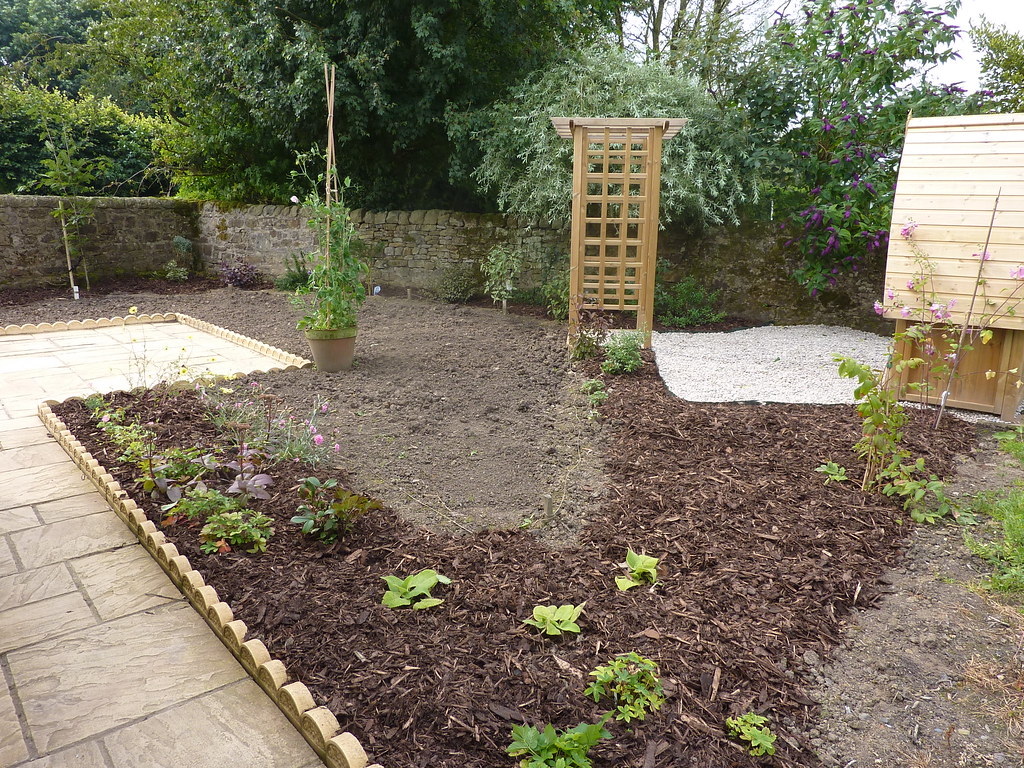
- Remove every perennial with its roots. Mississippi State Extension says to “excavate or extract roots” rather than pull tops, because bindweed, nutsedge and thistle regrow from fragments. Use a dandelion knife or hand fork when the soil is moist enough to release roots whole. Nutsedge tubers sit deep; our yellow and purple nutsedge guide covers getting them out.
- Kill established bermudagrass or quackgrass properly. For bermudagrass, UC IPM advises a grass-selective herbicide (fluazifop or sethoxydim) in spring “when new bermudagrass growth is less than 6 inches,” repeated as it regrows, or glyphosate in late summer when the plant is moving reserves to its roots. Solarizing under clear plastic for 4 to 6 weeks in high summer also works if the plastic extends about 2 feet (60 cm) beyond the last stolons. Do not rototill a moist bed with bermudagrass in it; every chopped rhizome roots.
- Cut a clean edge. A spade-cut trench 4 to 6 inches (10 to 15 cm) deep, or a steel, aluminium or concrete mowing strip set flush with the lawn, stops most surface runners. UC IPM notes that mowing strips and borders “help to reduce weed encroachment” from turf. Recut a spade edge in spring and late summer.
- Sheet mulch if you are converting lawn or a weedy annual patch. Oregon State’s sheet mulching guide says to use plain brown corrugated cardboard, strip tape and staples, soak it, overlap edges by at least 8 inches (20 cm), cover with mulch, and lay it in autumn so it breaks down over winter. Illinois Extension suggests 2 to 3 sheets of newspaper as the lighter option. Both fail against blackberry, bindweed, morning glory and quackgrass, which OSU says must be removed first, and thick cardboard slows water and air into the soil, so use a single layer.
- Buy mulch that will not seed the bed. Aged, screened bark or arborist chips carry few viable seeds. Keep hay and unrotted manure out of ornamental beds.
Pre-emergent herbicides in mulched beds
A pre-emergent stops seeds germinating; it does nothing to weeds already up or to perennials. On a prepared bed it deals with the blown-in seed that a 3 inch layer cannot fully stop.
- Which products. Active ingredients labeled for ornamental beds include prodiamine, trifluralin, oryzalin, pendimethalin, dithiopyr, isoxaben (for broadleaf seeds) and, for professionals, indaziflam and flumioxazin, according to Mississippi State University Extension. Check the label for the plants in your bed, and never use one where you plan to sow seed or want self-sown annuals to return.
- When. For summer annuals such as crabgrass and spurge, apply in late winter or early spring while soil is still below 55°F (13°C), then again 6 to 10 weeks later. For winter annuals such as annual bluegrass and chickweed, apply in late summer or early autumn as soil drops below about 70°F (21°C). In the UK and cooler parts of Canada that usually means March and September.
- Over or under the mulch. UC IPM says most pre-emergents work best on bare soil beneath the mulch, and some still give “a fair amount of control” spread over the top. For an existing bed, apply over the mulch and water it in: UF/IFAS Extension notes that granules need at least 0.25 inch (6 mm) of rain or irrigation within a few days. The Florida trial found sprayable prodiamine outperformed granular versions and that mulch plus herbicide beat either alone.
- Corn gluten meal is not worth the money. Iowa State researchers found it inhibits root formation in germinating seed, but only at 20 pounds per 1,000 square feet (about 1 kg per 10 m²) on soil that stays fairly dry for weeks. Illinois Extension explains that the peptides are water-soluble and leach away in a wet spring, and that the rate delivers far more nitrogen (about 10 percent by weight) than a bed needs. A Washington State University review found no difference in weed control in its own field trial and concludes that mulch and solarization “are cheaper and often more effective.”
Landscape fabric under mulch: the extension view
Fabric works for the first year. After that, the mulch on top decomposes into a seed bed, wind-blown seeds germinate in it, and their roots grow down through the weave. University of New Hampshire Extension describes the outcome: weeds “take root through it” and become extremely difficult to remove, fine particles clog the pores so less water reaches the soil, and “plants mulched with landscape fabric are often not as healthy or vigorous.” Illinois Extension adds that pulling a weed often brings a section of fabric up with it, and that soil under old fabric can be dry after heavy rain.
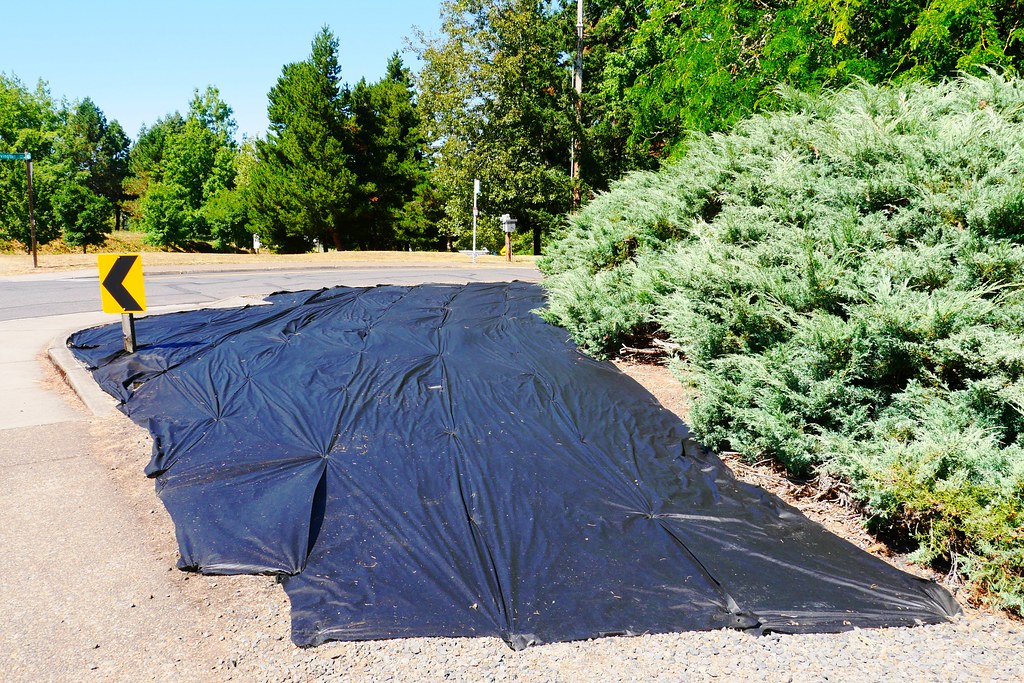
Fabric earns its place in two narrow cases: under gravel, where it stops the stone sinking into the soil, and as an overlapped barrier against bermudagrass, which UC IPM says can work if stolons cannot slip between the sheets. In an ordinary shrub or perennial bed, skip it. If you inherit failing fabric, rake off the mulch, cut and lift the fabric, remove the weeds rooted through it, and re-mulch at full depth.
Comparison of methods
| Method | Stops seeds blowing in | Stops perennials from below | Stops lawn grass creeping in | How long it lasts | Main drawback |
|---|---|---|---|---|---|
| Coarse bark or wood chips, 3 to 4 in | Good while fresh, fades as it decomposes | No | No | 1 to 2 seasons before topping up | Needs annual top-up; too deep harms roots |
| Cardboard or newspaper sheet mulch plus chips | Good | Annuals and lawn grass yes; bindweed, quackgrass, bermuda no | Slows it | Several months | Can restrict water and air if laid thick |
| Pre-emergent (prodiamine, trifluralin, isoxaben) | Good, 2 to 4 months per application | No | No | Reapply each season | Cannot be used where seeds are wanted; label limits |
| Corn gluten meal | Poor in field trials | No | No | Weeks | High rate, high nitrogen, fails in wet springs |
| Landscape fabric under mulch | Year one only | Partly, nutsedge and bindweed still come through | Yes if overlapped | 1 to 3 years before it becomes a problem | Weeds root through it; soil dries and degrades under it |
| Spade edge or mowing strip | No | No | Yes for surface runners; recut for rhizomes | Permanent strip; edge recut twice a year | Labour to install |
| Grass-selective herbicide (fluazifop, sethoxydim, clethodim) | No | Grasses only | Yes, repeat as regrowth appears | Per application | Does nothing to broadleaf weeds; check label for your ornamentals |
| Hand weeding and hoeing | Removes what comes up | Yes if all root is extracted | Yes with a fork | Ongoing | Time; fragments regrow if left |
Removing grass runners that are already in the bed
Follow each runner back to the lawn edge with a hand fork and lift it whole; bermuda and quackgrass rhizomes snap easily and every piece left behind regrows. Work when the soil is moist, not wet. Where runners are tangled in shrub roots, a grass-selective herbicide containing fluazifop, sethoxydim or clethodim kills grasses without harming most broadleaf ornamentals; UC IPM lists these as the standard tool for grasses in landscape beds, and two or three applications in a season are normal. Household remedies do not reach rhizomes; see what horticultural vinegar really does.
A maintenance routine that keeps beds clean
- Early spring: recut the lawn edge, hoe winter annuals before they seed, apply a pre-emergent if you use one, then top up mulch to 3 to 4 inches. Check depth with a ruler; most beds lose an inch over winter.
- Every 2 to 3 weeks in the growing season: ten minutes with a hoe while seedlings are small. Never let a weed set seed on the bed.
- Midsummer: second pre-emergent 6 to 10 weeks after the first if crabgrass or spurge is a problem, and a grass-selective spray on runners that got past the edge.
- Late summer or early autumn: recut the edge, treat perennial grasses while they are moving reserves down, apply an autumn pre-emergent if winter annuals are your main trouble, and rake mulch back from stems.
- Every second year: UNH suggests shredded wood needs replacing about every other growing season. Rather than piling new on old, rake the decomposed layer into the soil, then lay fresh coarse material to full depth.
Common mistakes
- Mulching over living bindweed, nutsedge or bermudagrass and expecting it to smother them.
- Adding an inch of dyed mulch each spring on top of 4 or 5 inches of decayed material, so the bed is too deep at the stems and a seedbed at the surface.
- Applying a pre-emergent where you want to sow seed or where self-seeders such as foxgloves should return.
- Rototilling a bed that contains rhizomatous grass; the pieces multiply the problem.
Related guides: Does Bleach Kill Weeds? Why It’s a Bad Idea and What to Use Instead · Bindweed vs Morning Glory: How to Tell Them Apart
Sources
- UC IPM – Weeds in Landscapes: Mulches (Pest Note 7441)
- UC IPM – Weed Management in Landscapes
- UC IPM – Bermudagrass (Pest Note 7453)
- Arboriculture & Urban Forestry – The Effect of Wood Mulch Type and Depth on Weed and Tree Growth
- HortTechnology – Mulch Type and Depth, Herbicide Formulation, and Postapplication Irrigation Volume Influence on Control of Common Landscape Weed Species
- Washington State University Extension – Using Arborist Wood Chips as a Landscape Mulch
- Mississippi State University Extension – Weed Management Strategies for Ornamental Landscape Beds and Ground Covers
- Oregon State University Extension – Sheet Mulching and Lasagna Composting with Cardboard
- University of New Hampshire Extension – Should I Use Landscape Fabric to Keep Weeds Out of My Perennial Garden?
- Illinois Extension – The Disadvantages of Landscape Fabric
- Illinois Extension – Corn Gluten Meal: Can It Naturally Prevent Weeds?
- Washington State University – Corn Gluten Meal (Horticultural Myths)