
Short answer: it depends on whether the crown, the pale growing point at the base of each grass plant, survived. If it did, burnt grass greens up again in about 2 to 4 weeks during the growing season, and drought-dormant lawns are quicker still: Purdue University says dormant plants should recover within 10 to 14 days of the soil being wet again. If the crown is dead, the grass never comes back on its own. The spot fills in only by creeping from the edges (4 to 8 weeks for spreading grasses such as Kentucky bluegrass, bermuda or zoysia) or by reseeding or patching with sod, which takes 6 to 8 weeks from sowing to a mowable stand. Fertilizer, urine and pool-water burns are salt injuries and respond to heavy flushing with water; fuel and herbicide spills usually need the soil replaced first.
First, work out which kind of burn you have
The pattern of the damage usually gives the cause away, and the fix differs for each.
| Cause | What it looks like | Crown usually alive? | Typical time to green again |
|---|---|---|---|
| Fertilizer or salt burn | Stripes, bands or a blotch where the spreader overlapped, stalled or spilled; tips brown 2 to 5 days after feeding | Light streaks: yes. Spill piles and heavy overlaps: often no | 2 to 3 weeks after flushing; reseed if dead |
| Heat, sun scorch or drought dormancy | Whole lawn goes evenly straw-coloured, worst on slopes and thin soil; footprints stay visible | Yes, for 4 to 6 weeks without rain in cool-season lawns | 10 to 14 days after soaking rain or irrigation |
| Actual fire (grass fire, fire pit, grill, fireworks) | Blackened blades; a flash fire leaves the soil cool underneath, a fire pit bakes it for hours | Flash fire: usually yes. Under a fire pit: usually no | 2 to 4 weeks from a flash burn; patch or seed under fire pits |
| Dog urine | Round straw-coloured spots 6 to 10 in (15 to 25 cm) across, ringed with darker green grass | The rim yes, the centre often not | Rim 2 weeks; centre fills from the edges in 4 to 8 weeks, or reseed |
| Herbicide or chemical spill | Sharp-edged dead area matching a spill, footprints or wheel tracks, 1 to 2 weeks after use | Rarely | Reseed after the label interval; residual products can take months |
| Fuel, oil or hot equipment | Sudden black patch where the mower was refuelled or parked; smells of fuel | No, if the soil is soaked | Replace soil, then 6 to 8 weeks from seeding |
| Chlorinated pool water | Bleached pale patch where the pool was drained, often on the lowest part of the lawn | Usually yes | 2 to 3 weeks after flushing |
How to tell if the crown is alive
Brown blades tell you nothing on their own; grass sheds leaves to save water and regrows them from the crown. The Iowa State University summer-lawn guide puts it simply: in a dormant lawn “turfgrass crowns and roots remain alive” even though the foliage looks dead. Two quick checks:
- Tug test. Grab a handful of brown blades and pull. Living grass resists and the blades tear; dead grass lifts out with its roots, like loose thatch.
- Look at the base. Part the blades and inspect the bottom 1/4 in (5 mm) of the plant. A whitish or pale green crown that is firm and slightly moist is alive; a brown, papery crown that crumbles is dead. On creeping grasses (bluegrass, bermuda, zoysia, St. Augustine) snap a rhizome or stolon: white inside means new shoots are coming.
Still unsure? Water the area with about 1 in (2.5 cm) and wait. Purdue’s rule is that if nothing greens within two weeks of the soil being wet, treat the spot as dead and plan to reseed.
Fertilizer burn: flush, then wait
Fertilizer is a salt, and applied too heavily it pulls water out of leaf and root tissue. The University of Maryland Extension describes the signature as “banded streaks or irregular patterns in the lawn” where the spreader overlapped, and advises that you “soak the affected area with one-inch applications of water, three to four times” to leach the salts below the root zone. In practice: sweep up any visible granules, then give the area a full inch (2.5 cm, measured in a tin) each day for three or four days. Do not add more fertilizer, lawn tonic or lime; stressed roots cannot use it and you only add salt. Streaks that kept some green fill back in over two to three weeks; solid dead patches from a spilled pile are raked out, topped with 1/2 in (1 cm) of fresh soil and reseeded once flushing is done.
Prevention is mostly arithmetic. University of Illinois Extension recommends about 1 lb of actual nitrogen per 1,000 sq ft (roughly 0.5 kg per 100 m²) per application, and notes that fast-release nitrogen such as urea is “likely to burn grass” while controlled-release products are not. Washington State University adds the habits that stop most burns: apply to moist soil and water in thoroughly, keep dry granules off wet foliage, and never fertilize a lawn already stressed by heat or drought. See also fertilizing wet grass.
Heat scorch and drought dormancy
A lawn that has gone evenly brown in a hot, dry spell is almost always dormant, not dead. Iowa State says most healthy cool-season lawns “can survive in a dormant state for 4 to 6 weeks without rainfall or irrigation”; beyond that crowns start to die, so if the dry spell drags on, apply 1 to 1.5 in (2.5 to 4 cm) in one go and repeat about a week later. When rain returns, Purdue advises watering every 3 to 5 days so the top 2 to 4 in (5 to 10 cm) of soil stays moist; green shoots appear within 10 to 14 days.
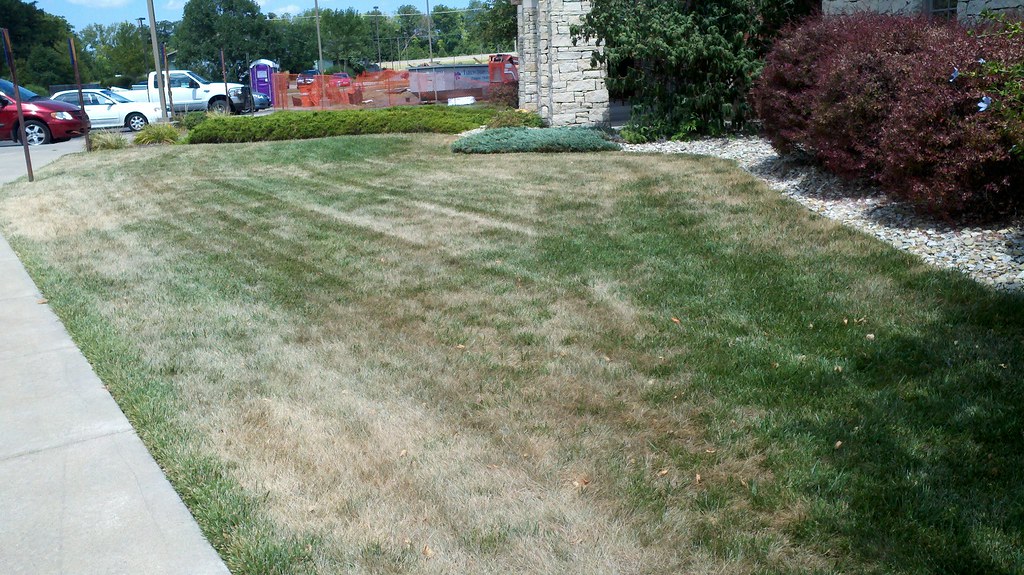
What not to do: mow low, fertilize or spray herbicide while the lawn is brown. Iowa State’s position is that it is “generally not advisable to fertilize Kentucky bluegrass and other cool-season grasses during the summer months”, and raising the mower to 3 to 3.5 in (7.5 to 9 cm) shades the crowns from lethal surface heat. Keep traffic off dormant turf; a crushed dormant crown does not regrow. More in how to help a lawn recover from drought.
Fire, fire pits and grills
Grass is built to survive fire: its growing point sits at or just below the soil surface, so a fast grass fire or firework scorch burns off the blades in seconds while the soil barely warms. Those areas green up in two to four weeks in the growing season, fastest in warm-season grasses that spread by rhizomes and stolons. Rake off loose ash, water as after drought, and hold the fertilizer until new growth is up.

A fire pit, chiminea or bonfire is different: hours of radiant heat cook the crowns and the top inch or two of soil, and the circle beneath almost never recovers on its own. Once cold, dig out the top 2 in (5 cm) of baked soil and ash (ash is alkaline, so do not just rake it in), refill with topsoil, and reseed or lay a sod patch. Burning a lawn on purpose is not worth it either; Kansas State University says of buffalograss lawns that “burning dead foliage in the spring is not recommended” because it is often prohibited by ordinance, endangers buildings and leaves soot everywhere.
Dog urine spots
The Colorado State University Extension fact sheet explains that damage “occurs when a high concentration of nitrogen-containing compounds and associated salts from dog urine are deposited in a small area of the lawn”. It is a concentrated fertilizer burn, not an acid or alkaline one: “dog spots do not occur because a dog’s urine is alkaline”, and “no dietary supplements have been scientifically proven to reduce either the incidence or severity of dog spotting in lawns”. Squatting dogs of either sex cause it; big dogs simply deliver more.
The University of Maryland describes the classic spot as a straw-coloured patch 6 to 10 in across ringed with dark green grass, and says heavy irrigation “as soon as possible after a dog visit” is the most effective first aid. Where the crown in the centre has died, “surrounding grass will usually grow to fill in the spot”, which takes four to eight weeks in a spreading grass and may never happen in a bunch-type lawn such as tall fescue or perennial ryegrass. For those, use Colorado State’s repair: lift the dead turf plus 0.5 to 1 in (1 to 2.5 cm) of soil, refill, and spot-seed with perennial ryegrass in a bluegrass lawn, turf-type tall fescue in a fescue lawn, or a sod patch for zoysia and bermuda. Prevention that works: rinse the spot within minutes, add water to the dog’s food (the one dietary change Colorado State endorses), and train the dog to a mulch or gravel area, which the fact sheet calls “the ONLY sure solution”.
Herbicide, fuel and chemical spills
A sharp-edged dead patch that appeared a week or two after you sprayed or refuelled is a chemical kill; the crown is gone and the question is whether the soil can be reused.
- Non-selective herbicide spray or footprints (glyphosate, glufosinate, pelargonic acid). These do not persist in soil. Check the label’s replant interval, rake out the dead grass and reseed; many lawn labels allow seeding within about a week.
- Residual “total vegetation” products, pre-emergents or a concentrate spill. Clemson University turf specialists describe deactivating organic herbicides with activated charcoal at 2 to 4 lb per 1,000 sq ft (1 to 2 kg per 100 m²) as a slurry worked into the top few inches, after which the area “can be seeded 24 hrs after treatment”; charcoal does not leach, so it must go where the chemical is. For a concentrated spill, removing the top 4 to 6 in (10 to 15 cm) of soil is simpler and more certain.
- Petrol, diesel, two-stroke mix, oil. The University of Maryland notes that a small splash that evaporates needs no action, but saturated soil should be removed and replaced. Dig until you no longer smell fuel, refill and seed. Do not wash fuel through with water; you only spread it. A hot muffler parked on grass cooks a small footprint that also needs patching.
Pool water
Pool chlorine runs at about 1 to 4 ppm, and Iowa State University notes that turf tolerates more chlorine than trees and shrubs. Damage from a drained pool is usually light bleaching plus, on salt-system pools, salt scorch where water pooled. Flush as for fertilizer burn and expect recovery in two to three weeks if the crowns are firm. Next time, leave the pool uncovered for at least ten days without adding chlorine so sunlight breaks it down, then drain over several days while moving the hose.
Reseeding a dead spot
Once a patch is dead, do not wait; bare soil fills with crabgrass within weeks. Rake out the dead material, loosen the top 1 to 2 in (2.5 to 5 cm), and sow seed that matches the lawn. Purdue’s starter rate for new seedings is 0.5 to 0.75 lb nitrogen and 1 to 1.5 lb phosphate per 1,000 sq ft at sowing, repeated four weeks after germination, and the best window for cool-season lawns in the northern US is mid-August to mid-September, with spring second best. Warm-season grasses are seeded, plugged or sodded in late spring once soil temperatures hold above 65°F (18°C). Keep the seedbed moist with light watering several times a day until germination; sod gives an instant fix whenever the ground is not frozen. If a lawn keeps burning, our lawn grass comparison covers which species handle heat, salt and dog traffic best, and how to prepare soil for grass seed walks through the seedbed.
Sources
- Purdue University Turfgrass Science – Rejuvenating Turf Areas After Drought
- Iowa State University Extension – Summer Lawn Care
- University of Maryland Extension – Fertilizer Injury: Lawns
- University of Illinois Extension – Fertilizing Your Lawn
- Washington State University Hortsense – Fertilizer Burn
- Kansas State University Research and Extension – Buffalograss Lawns (MF658)
- Colorado State University Extension – Dog Urine Damage on Lawns
- University of Maryland Extension – Dog Urine Damage on Lawns
- Clemson University – Activated Charcoal for Pesticide Deactivation
- University of Maryland Extension – Oil or Gasoline: Lawns
- Iowa State University Extension – Emptying Pool Water on the Lawn