
Short answer: you can fertilize grass that is damp from dew or a light shower, but not grass that is soaked, puddled or about to be hit by heavy rain. Dry granules stick to wet blades, and quick-release nitrogen such as urea (salt index 75) or ammonium nitrate (105) can then burn the leaf where the granule sits. The safe pattern is: spread on dry or lightly damp leaves, keep the rate at or below 1 lb of nitrogen per 1,000 sq ft (0.5 kg per 100 m²), and water it in with about ¼ inch (6 mm) straight afterwards. Fertilize roughly 24 hours after a soaking rain rather than just before one. The one exception is granular weed-and-feed, whose label usually tells you to apply it onto dewy grass so the herbicide sticks to weed leaves.
Why wet grass and fertilizer are a bad mix (sometimes)
Almost all lawn fertilizers are soluble salts. When a granule dissolves in a film of water on a leaf, the salt concentration right at that spot is enormous, and it pulls water out of the leaf tissue. Kansas State University describes burn potential as exactly that: the fertilizer’s ability to draw water out of the plant by creating a high salt concentration, and notes that quick-release nitrogen forms are the most prone to it. Washington State University puts it plainly: do not apply dry fertilizers to moist leaves, because that causes burned spots on the foliage itself.
The same product spread on dry grass falls through the canopy to the soil, where watering in dilutes the salt across the whole root zone. Hence the two-part advice: dry leaves, then water.
Not every fertilizer carries the same risk. The salt index compares products with sodium nitrate set at 100. Penn State Extension lists ammonium nitrate at 105, urea at 75, potassium nitrate at 74 and ammonium sulfate at 69. Slow-release and coated nitrogen sources (sulfur-coated urea, polymer-coated urea, methylene urea, organic meals) release gradually and give what K-State calls “a greater margin of safety”. If you have to fertilize in damp conditions, a mostly slow-release product is the forgiving choice.
Dew, soaked soil or standing water: which case do you have?
“Wet grass” covers three quite different situations, and the answer differs for each.

- Dew or a light shower, soil not saturated. Blades are damp, your shoes get wet, but the ground is firm. Granules will stick to blades a little more than usual. This is acceptable if you water in right away, and ideal for a liquid feed.
- Soaked soil after heavy rain. Footprints leave water, the ground is spongy. Anything you add now has nowhere to go but sideways or downward. Nitrogen you apply moves past the roots or off the surface with the next runoff. Wait a day.
- Standing water or flooding. Do not fertilize. Purdue University’s flooded-turf guidance is to let the water drain, rinse silt off the leaves and only then apply nitrogen to push new growth. On heavy clay this can take several days; the same soil-moisture test we describe for aerating after rain works here.
Granular vs liquid fertilizer on damp grass
| Product | On dewy grass | On soaked soil | Why |
|---|---|---|---|
| Granular, quick-release (urea, ammonium sulfate, ammonium nitrate) | Risky unless watered in immediately | Wait 24 h | Granules stick to blades; highest salt index; leaches easily |
| Granular, mostly slow-release or coated | Acceptable, water in | Wait 24 h | Lower burn potential, but still pointless on saturated ground |
| Liquid or hose-end fertilizer | Fine | Wait 24 h | Already diluted; a damp leaf is normal for a spray |
| Granular weed-and-feed (2,4-D, dicamba, MCPP) | Required by most labels | Wait until drained, then apply to dew | Herbicide must stick to weed leaves and stay unwashed 1–2 days |
The “water in after applying” rule
Watering in is what makes granular fertilizing safe. It washes granules off the blades, dissolves them into the soil where the roots are, and dilutes the salt. Clemson University tells homeowners to apply when the grass leaves are dry and to water thoroughly afterwards to minimize burn; Penn State adds that watering in also keeps ammonia volatilization losses from urea to a minimum.
How much water? Not a lot. The Southwest Florida Water Management District recommends about a quarter inch (6 mm) after fertilizing, enough to carry nutrients to the root zone but not enough to push them past it. A quarter to half an inch (6–12 mm) is the practical range; running the sprinkler for an hour is not better, it is worse, because it moves nitrogen below the roots and off the property. A tuna tin on the lawn makes a good gauge. If your lawn already shows the signs of an overwatered lawn, that is another reason to hold off on feeding until it dries.
Fertilize before or after rain?
After, by about a day. Iowa State University Extension says the best options are to apply just before a light rain or to water it in yourself, and to avoid fertilizing if moderate to heavy rain is likely within 24 hours. Because nobody can forecast rainfall amounts reliably, their recommended habit is to fertilize roughly 24 hours after a good rain or irrigation: the soil is moist, the leaves have dried, and a quarter inch of irrigation finishes the job.
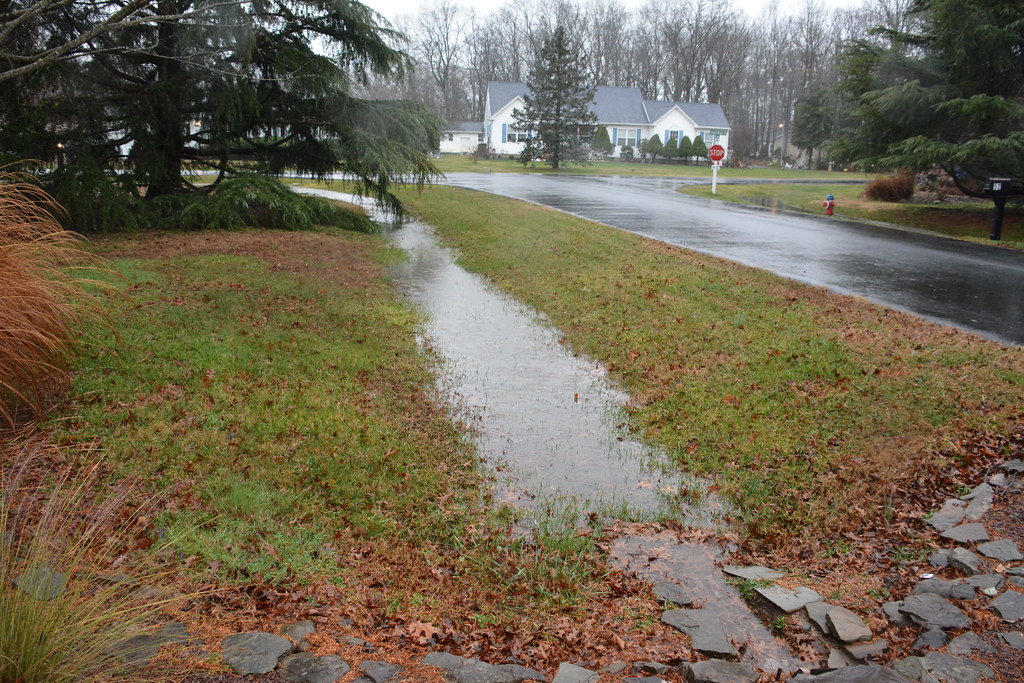
The reason this matters beyond your own lawn is water quality. Fertilizer that washes off in a storm carries nitrogen and phosphorus into storm drains, streams and lakes, and several states have written this into law. Maryland’s lawn fertilizer law, summarized by the Maryland Department of Agriculture, tells homeowners not to fertilize if heavy rain is predicted or the ground is frozen, to keep fertilizer 10 to 15 feet (3–4.5 m) from waterways, to apply no more than 0.9 lb total N per 1,000 sq ft in one go, to skip phosphorus unless a soil test calls for it or a lawn is being seeded, and not to apply at all between November 16 and March 1. New York’s Nutrient Runoff Law, described by the New York State DEC, bans lawn fertilizer from December 1 to April 1, restricts phosphorus, requires a buffer near water (a 10-foot vegetated strip, or 3 feet with a drop spreader or guard), and requires you to sweep, not hose, any granules that land on pavement. Several other states have similar rules, and water authorities in the UK, Canada and Australia give the same advice without the legal force. Wherever you live the practice is the same: none before a downpour, none within a few metres of a ditch or pond, and sweep the driveway.
Weed-and-feed is the exception
Combination products flip the rule. The herbicide granules only work if they stick to broadleaf weed leaves, so labels ask for moisture. A representative 12-0-6 weed-and-feed label containing 2,4-D, mecoprop-p and dicamba (on file with Washington State University’s PICOL label database) says to apply “preferably in the morning when dew is on the grass”, to sprinkle the lawn lightly first if it is not moist, not to wash the product off the weed leaves for 1 to 2 days, and to avoid applying when rain is expected that day. It also says to mow 1 to 2 days before, not after.
So with weed-and-feed you deliberately spread onto dewy grass and do not water in for a day or two. That works because the nitrogen rate in these products is modest and the granules are small; it is still a bad idea in hot weather; most labels also set a high-temperature limit, commonly around 85–90 °F (29–32 °C). Read your own bag. If the label says water in, water in; if it says keep it on the leaves, keep it on the leaves.
Decision table: fertilize now or wait?
| Condition | Granular fertilizer | Liquid fertilizer | Weed-and-feed |
|---|---|---|---|
| Dry grass, moist soil, no heavy rain for 24 h | Best case: apply, water in ¼ in | Apply | Wet the lawn lightly first, then apply |
| Morning dew, soil firm | OK if you water in immediately; prefer slow-release | Apply | Ideal |
| Light shower just finished, leaves dripping | Wait for the blades to dry (1–3 h), then apply | Apply | OK if no more rain expected today |
| Soaked soil after heavy rain | Wait about 24 h | Wait until surface drains | Wait |
| Standing water or flooding | No | No | No |
| Heavy rain forecast within 24 h | No | No | No |
| Above 85–90 °F (29–32 °C) or drought-stressed grass | No, whatever the moisture | Light rate only, evening | No (label limit) |
| Frozen or snow-covered ground | No (illegal in several states) | No | No |
Rates and timing by grass type
Moisture is only half of the burn equation; rate is the other half. K-State’s rule is never to exceed 1 lb of actual nitrogen per 1,000 sq ft in one application from water-soluble sources, and Clemson uses the same 1 lb figure for high-maintenance lawns and ½ lb for low-maintenance ones. To convert, divide 100 by the first number on the bag: a 20-5-10 product delivers 1 lb N at 5 lb of product per 1,000 sq ft (about 2.4 kg per 100 m²). Clemson also warns that centipedegrass should get no more than 2 lb N per 1,000 sq ft in a whole year.
| Grass type | Main feeding windows | Per application | Notes |
|---|---|---|---|
| Cool-season (Kentucky bluegrass, tall fescue, perennial ryegrass) | Early September, late October/after last mowing, then May; a light June feed if irrigated | ≤1 lb N/1,000 sq ft | Fall is the priority; avoid summer feeding in heat |
| Warm-season (bermuda, zoysia, St. Augustine, buffalo) | From full green-up in late spring, monthly through active growth, stop 6–8 weeks before first frost | ≤1 lb N/1,000 sq ft (zoysia usually less) | Never before green-up; soil warm and grass growing |
| Centipedegrass, bahiagrass | Late spring and mid-summer | ½ lb N/1,000 sq ft | ≤2 lb N per year for centipede |
If you are not sure what you have, our lawn grass comparison covers how to tell the common types apart.
Already spread it on wet grass? Do this now
- Water immediately. Put on ¼–½ inch (6–12 mm) right away to wash granules off the blades and into the soil. This one step prevents most burn.
- Check for clumps and spills. Wet granules bridge in the spreader and drop in heaps when it clears. Sweep or scoop any piles and overlaps; a pile left in place will kill a patch within days.
- If you also over-applied (double pass, wrong spreader setting), leach the salts out. University of Maryland Extension recommends one-inch (25 mm) applications of water, three to four times, spaced out so the ground drains between them. Do this only where you over-applied, not the whole lawn.
- Watch for stripes. Burn shows within 2–5 days as straw-coloured streaks or blotches that follow the spreader pattern, often with dark green stripes beside them where the rate was right. Maryland Extension describes exactly this banded look.
- Wait before reseeding. Mildly scorched leaf tips usually regrow from the crown in two to three weeks with normal watering. If the crowns are dead, rake out and reseed once the salt has been flushed. Our guide to how long burnt grass takes to grow back covers how to tell the two apart.
Common mistakes
- Fertilizing “before the rain to save watering”. A light drizzle helps; a thunderstorm takes the fertilizer with it.
- Filling the spreader on wet grass. Granules absorb moisture, cake and come out unevenly. Fill it on the driveway and sweep up.
- Watering in weed-and-feed, or leaving plain fertilizer unwatered. Each product has the opposite rule; the bag tells you which.
Sources
- Iowa State University Extension – Should I fertilize my lawn before or after it rains?
- Kansas State University Turfgrass – Fertilizing (Lawn Problem Solver)
- Clemson University HGIC – Fertilizing Lawns
- Penn State Extension – Turfgrass Fertilization: A Basic Guide
- Washington State University Hortsense – Fertilizer burn
- University of Maryland Extension – Fertilizer Injury, Lawns
- Southwest Florida Water Management District – How much should you water after fertilizing your lawn?
- Maryland Department of Agriculture – Lawn Fertilizer Law
- New York State DEC – Lawn Fertilizer (Nutrient Runoff Law)
- Purdue University Turfgrass Science – Wet and Flooded Turf
- WSU PICOL – Weed & Feed 12-0-6 product label (application directions)