
Short answer: yes, birds eat grass seed, but mostly seed that is left lying on top of the soil. House sparrows, doves, pigeons, finches and other ground-feeding seed-eaters will pick exposed seed off a new lawn, while robins, blackbirds, starlings and crows on the same lawn are usually hunting insects and worms. On a properly prepared seedbed the loss is small: University of Minnesota Extension says seed-eating by birds and other critters is not something its specialists have observed as a problem on dormant-seeded lawns. The protection that works is the same thing that makes seed germinate well. Rake it into the top 1/8 to 1/4 inch (3 to 6 mm), roll it, cover it lightly with straw, and keep it moist so it sprouts quickly. Scare devices lose their effect within days, and repellent sprays have little evidence behind them.
Which birds eat grass seed, and which are after something else
Not every bird on a freshly seeded lawn is eating your seed. Freshly worked soil exposes insects, larvae and worms, and many lawn birds are there for those. Knowing which is which saves a lot of worry.
| Bird | What it is doing on a new lawn | Risk to seed |
|---|---|---|
| House sparrow | Eats mostly grains and seeds, including crabgrass and other grass seeds, and feeds in noisy flocks on the ground, according to the Cornell Lab of Ornithology. In summer it also catches insects and follows lawnmowers. | High for surface seed |
| Mourning dove, collared dove, feral pigeon | Cornell reports that seeds make up 99 percent of the mourning dove’s diet and that it eats roughly 12 to 20 percent of its body weight a day. Doves feed on the ground in the open. | High for surface seed, low for covered seed |
| Finches, juncos, buntings, native sparrows | Small seed-eaters that also forage on the ground, especially in autumn and winter. | Moderate |
| Quail, chickens, wild turkeys | Scratch the soil surface as they feed, so they reach seed that is only lightly covered. | High where present |
| Robins, blackbirds, thrushes | Hunting earthworms and insects in soft, moist soil. | Low |
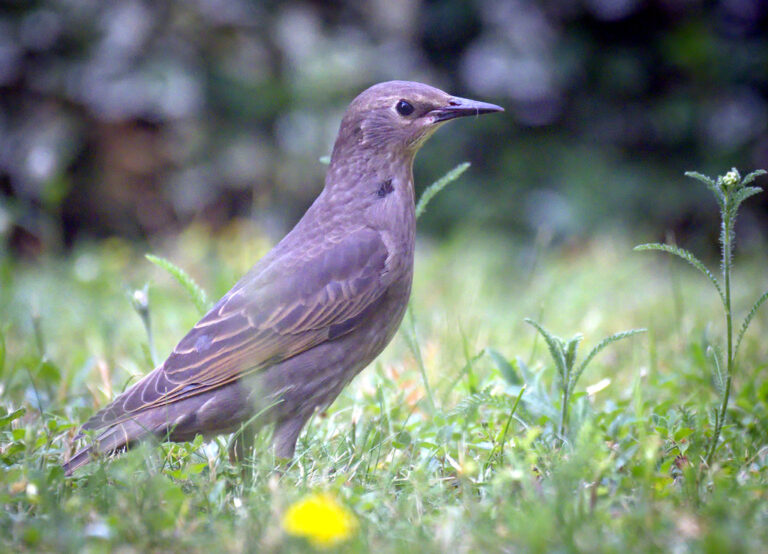
| Starlings, crows, rooks, magpies | Probing for grubs. The RHS notes that these birds search turf for leatherjackets and leave small round holes where they insert their beaks. | Low (but the probing can disturb seed) |
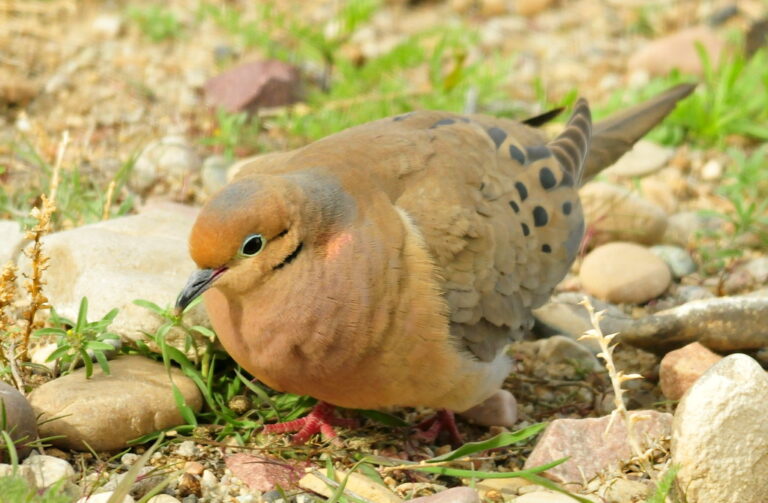
One detail from Cornell’s dove profile explains why covering seed works so well: mourning doves peck or push aside ground litter, but they do not scratch at the ground. Seed that is raked in and hidden under a light layer of straw is largely out of their reach.
How much seed do birds actually take?
Much less than it looks when a flock lands. Extension guidance on lawn establishment deals with birds in a sentence or not at all, because the causes of thin new lawns are overwhelmingly seed left on the surface, drying out, poor seed-to-soil contact, washouts and sowing at the wrong time. University of Minnesota Extension, asked directly whether birds and other critters eating seed is a concern, answers that it is not something its specialists have observed; if you are still worried about seeding bare ground without a blanket, it suggests sowing in late winter or early spring so the seed sits exposed for less time.
Losses become noticeable in a few situations: seed broadcast onto hard or compacted ground and not raked in, seed spread on top of an existing lawn where it cannot reach the soil, small patches next to a bird feeder or hedge where a flock already feeds every day, and sowing just before a long cold or dry spell that delays germination for weeks.
Is it birds, or something else?
| What you see | Most likely cause |
|---|---|
| Birds pecking at the surface; bare patches in open areas, but good germination under straw, along fences and under shrubs | Birds taking exposed seed |
| Small round holes in the turf; starlings or crows probing | Birds hunting grubs, not seed |
| Bare streaks running downhill, thick clumps of seedlings in low spots | Rain washout; see protecting new grass seed from heavy rain |
| Thin, even germination everywhere, including under straw | Soil too dry or cold, seed too deep, poor seedbed or old seed |
How to protect grass seed from birds, step by step
- Prepare a loose seedbed. Seed cannot be raked into hard ground, and seed that sits on top is the seed birds find. Our guide to preparing soil for grass seed covers loosening, levelling and starter fertilizer.
- Sow in the right window. Warm soil and steady moisture shorten the time seed lies exposed. University of Minnesota turfgrass scientists note that perennial ryegrass typically germinates in 3 to 5 days, while the other species in a mix take 10 to 30 days. For cool-season lawns, late summer to early autumn is the best time; for warm-season grasses, late spring to early summer.
- Rake the seed in. Iowa State University Extension recommends covering seed 1/8 to 1/4 inch deep by lightly raking or dragging the area. That is enough to hide most seed without burying it too deep to emerge.
- Roll it. A light pass with an empty lawn roller presses seed into the soil; Iowa State notes that light rolling ensures good contact between seed and soil, which also makes the seed much harder for birds to pick up.
- Cover lightly with straw. Iowa State suggests one bale of clean straw per 1,000 sq ft (93 m²), leaving about half the soil visible. It hides the seed, holds moisture and softens heavy rain. Use straw, not hay, which is full of weed and grass seed that birds also go for. On slopes, a stapled germination or erosion blanket does the same job and stays put.
- Keep the top inch moist. Iowa State’s guidance is to water lightly and often, usually daily and sometimes several times a day in sun and wind, until seedlings are about 2 inches (5 cm) tall. Moist seed germinates fast; dry seed lies on the surface for weeks.
- Move or pause bird feeders. Seed spilled under a feeder trains sparrows and doves to feed on the ground right next to your seedbed. Move feeders to the far side of the garden, or stop filling them for the three or four weeks until the grass is up.
- Cover small patches completely. For a few square metres of repair, a floating fabric row cover pinned at every edge works well. UC Master Gardeners report that birds seem uninterested in seedlings while they are covered, but only if the sides are firmly secured. Netting is the other option; the netting and covers section below explains how to raise it on hoops and why loose netting on the ground is a hazard to birds, snakes and hedgehogs.
Bird netting and covers for grass seed: what works and how to use them
A cover is the most reliable way to stop birds, because it removes access instead of trying to scare them. For most lawns, straw is enough; netting and fleece earn their keep on small, high-value or heavily raided patches. For setup, mesh choices and bird-safe use, see our guide to bird netting for grass seed.
When netting is worth the effort
- Small repair patches. A 3 by 4 ft (1 by 1.2 m) bare spot is easy to hoop and net, and a few birds can clear it in a morning.
- Expensive or slow seed. Kentucky bluegrass and premium fescue blends can take two to three weeks to germinate, a long window of exposure for seed that costs what it does.
- Visible heavy pressure. A resident flock of house sparrows, a pigeon roost overhead, or free-ranging chickens.
- Seed you cannot cover. Overseeding into thin turf where you cannot rake or mulch.
For a whole new lawn, netting is impractical. Oregon State University notes that exclusion netting is the most effective way to stop bird damage on fruit crops, but that the cost of posts, wire and netting adds up quickly and it needs constant upkeep. Straw or a blanket is the right tool for a 5,000 sq ft (465 m²) seeding.
Netting and cover types compared
| Cover | What it does | Pros | Cons | Cost class |
|---|---|---|---|---|
| Bird netting (plastic mesh, usually 1/2 to 3/4 in / 13 to 19 mm openings) | Physical barrier to birds | Reusable; lets light and water through; seedlings easy to see | Must be held off the soil; entangles wildlife if loose; no help with drying or washout | Low to moderate |
| Garden fleece / floating row cover (spun-bonded polyester or polypropylene) | Barrier plus a warmer, moister microclimate | Light grades pass 90 to 95 percent of light; wildlife-safe; speeds germination in cool weather | Tears; can overheat seedlings in hot sun; needs pinning at every edge | Low |
| Clean straw, about 1 bale per 1,000 sq ft | Hides seed, holds moisture, reduces washout | Cheapest; no removal needed if applied thinly; the standard extension recommendation | Hay (not straw) carries weed seed; blows in wind; not a full barrier | Very low |
| Erosion-control blanket / germination mat (straw or coconut fibre in a net) | Holds seed and soil on slopes | Best on banks and where rain washes seed; biodegradable versions rot in place | Plastic-net versions trap snakes; dearer than loose straw | Moderate |
| Burlap / hessian or coarse cheesecloth | Shade and moisture cover | Natural fibre, no entanglement risk, can rot in place on slopes | Blocks more light; must be lifted once seedlings show | Low |
The University of Maryland Extension says straw mulch and row covers help to hide seeds from hungry birds and speed up germination, and recommends 80 to 100 pounds of straw per 1,000 sq ft. Its row-cover guide supplies the light figures in the table: lightweight fabric at 0.45 oz per sq yd passes 90 to 95 percent of sunlight, while heavyweight frost fabric passes only 30 to 50 percent, too dark for a seedbed.
How to install bird netting over grass seed
- Prepare and sow first. Loosen the top 2 to 3 inches (5 to 8 cm), level, sow, then rake lightly so seed sits no deeper than 1/4 inch (6 mm). Our guide to preparing soil for grass seed covers the full sequence.
- Build a frame. Push stakes or hoops (9-gauge wire, half-inch PVC pipe, or fibreglass rods) into the ground every 3 to 4 ft (1 to 1.2 m) so the net sits 4 to 6 inches (10 to 15 cm) above the soil. A net on the ground lets birds peck through it and is the main cause of entanglement.
- Pull the net taut. Slack netting billows, snags and traps.
- Pin every edge. Landscape staples every 12 to 18 inches (30 to 45 cm), or boards or bricks along the edge.
- Check it daily. The RSPB’s guidance on netting is to check it at least once a day for looseness, damage or trapped animals, and to avoid flimsy materials that catch and hold wildlife.
- Remove at 1 to 2 inches of growth. Once seedlings are 1 to 2 inches (2.5 to 5 cm) tall and poking through the mesh, birds lose interest and the net starts pulling up grass when you lift it. Roll it up and store it indoors.
The wildlife problem with loose netting
This is the part most netting guides skip. A University of California Master Gardener writing about protecting seedbeds warns that bird netting tangles up birds, which results in them dying and does nothing against anything larger than a sparrow; her preferred setup is a hoop-and-fabric kit pinned with landscape staples. In the UK, the British Hedgehog Preservation Society asks gardeners to keep pea and fruit netting a foot above the ground so hedgehogs can pass underneath and to store nets away when not in use.
Snakes are the other regular casualty, and in North America the worst offender is the plastic mesh inside cheap erosion-control blankets. University of Illinois Extension reports that two studies found products containing a plastic mesh were the most dangerous to snakes, and cites a Wisconsin survey that found 22 fox snakes entangled in erosion blankets on a single June day. For a slope, choose a blanket with a loosely woven jute or biodegradable net, not a fine polypropylene one. The Australian rescue group WIRES uses a simple rule: wildlife-safe netting has openings under 5 mm, too small to poke a finger through, while standard bird netting with 1 cm or larger holes is what catches birds, bats, lizards and snakes.
For a lawn, a fine white insect mesh or fleece on hoops is safer than black bird netting and just as effective. If you already own bird netting, use it taut and raised, and remove it early.
Watering under netting or fleece
Covers change the routine less than you might think. Purdue’s schedule is to water two to four times a day depending on weather, just enough to keep the top 0.5 to 1 inch (1 to 2.5 cm) moist, then water less often and more deeply once seedlings reach 2 inches (5 cm). Maryland suggests about 1/4 inch (6 mm) per session. Netting does not interfere with sprinklers. Fleece slows evaporation, so one or two sessions a day is usually enough under it, but lift a corner and check with a finger. Under straw, water until the straw is wet through. If a storm is forecast, a blanket or fleece also stops seed washing into low spots; see how to protect grass seed from heavy rain.
Does coated grass seed stop birds?
Many lawn seed products are coated, and the packaging often implies the coating protects the seed. Most coatings are designed to hold water, carry fertilizer or fungicide, or make seed easier to see and spread; they are not marketed or tested as bird repellents, and we found no independent trial showing that a lawn seed coating reduces bird feeding.
What the research does show is that coating changes how much seed you are buying. An Oregon State University review of retail lawn seed lists products with a 50 percent super-absorbent polymer coating, meaning half of what you pay for by weight is coating. In its trials, uncoated seed germinated faster under good watering, and polymer-coated seed germinated more slowly and ended up with more weed intrusion. A University of Kentucky forage review found one coated product had about 33 percent fewer seeds per pound than the same seed uncoated, and notes that most recommendations call for higher seeding rates with coated grass seed. If you buy coated seed, compare products on the pure-seed percentage on the label, not the bag weight, and do not expect the coating to keep birds off. Our article on why grass seed is so expensive explains how to read those labels.
Bird deterrents: what works and what does not
Oregon State University Extension’s guide to nonlethal bird deterrents, written for fruit and crop growers, is the most useful reference here, because the problem is the same one on a larger scale.
| Method | Verdict | Why |
|---|---|---|
| Raking in, rolling and straw | Works | Removes the food source; doves in particular do not scratch for buried seed. |
| Fabric row cover on small patches | Works | Complete exclusion, provided the edges are pinned down. |
| Raised netting on hoops | Works on small areas | OSU calls netting the most effective method for crops; on lawns it is labour-intensive and must be installed safely (see our netting guide). |
| Reflective tape, CDs, scare-eye balloons | Short-lived | OSU notes that birds habituate to visual deterrents after repeated exposure; move and rotate them every few days if you use them. |
| Plastic owls and hawks | Short-lived | Same habituation problem, especially if the decoy never moves. |
| Noise and distress-call devices | Poor for gardens | OSU says birds quickly learn to ignore alarm calls repeated in the same pattern, and they annoy neighbours. |
| Repellent sprays (methyl anthranilate) | Little evidence | OSU describes it as the most popular chemical bird deterrent but says formal research has provided little evidence of its effectiveness. |
| Sowing extra seed “for the birds” | Counterproductive | If birds take less than you feared, you are left with an overcrowded stand; see too much grass seed. |
What to do if birds have already eaten some seed
Wait before reseeding. Much of the seed that seemed to vanish is only hidden, and it keeps germinating for two to four weeks depending on the species. Once seedlings are up, look for patches larger than your hand with no grass at all. Loosen the surface of those patches, sow at the normal rate for that grass, rake in, roll, cover with a little straw, and water. Patches that are thin rather than bare usually fill in as the young grass tillers, especially after the first mowing.
Sources
- University of Minnesota Extension – Dormant seeding
- Cornell Lab of Ornithology – House Sparrow life history
- Cornell Lab of Ornithology – Mourning Dove life history
- Royal Horticultural Society – Leatherjackets
- Iowa State University Extension – Seeding a New Lawn
- UC Master Gardener Program (Alameda County) – Protecting Seedlings and Seeds from Wildlife
- Oregon State University – Retail Lawn Seed Mixtures (EM 9100)
- University of Kentucky Master Grazer – The value of coated seed
- Oregon State University Extension – Nonlethal Bird Deterrent Strategies (EM 9286)
- Purdue Extension – Establishing Turfgrass Areas From Seed (AY-3-W)
- University of Maryland Extension – Starting a New Lawn
- University of Maryland Extension – Row Covers
- RSPB – The use of netting: what you need to know
- British Hedgehog Preservation Society – Gardening with Hedgehogs (leaflet L16)
- University of Illinois Extension – What kinds of gardening mesh are safe for snakes?
- WIRES – Wildlife Friendly Netting Tips