
Short answer: grass lies flat when the leaf has grown longer than the plant can hold up. The usual reasons are grass left uncut until it is 5 to 6 inches (13 to 15 cm) tall, a nitrogen feed that pushed out soft growth, heavy rain or irrigation on top of that growth, too much shade, a thatch layer over 1/2 inch (1.3 cm), or a creeping grass such as St. Augustine that naturally sprawls. Grub- or disease-weakened crowns and constant foot traffic do the same thing in patches. The fix is nearly always the same: rake the blades upright, mow with a sharp blade at the highest setting, remove no more than a third of the height, and step the deck down every few days until you are back at 3 inches (7.5 cm). Then correct the cause, usually by fertilizing less and mowing more often. Most lawns stand up again within two or three mowings.
What is actually happening when grass lies down
Agronomists call it lodging. The University of Minnesota defines lodging as any displacement of the plant from vertical, at the stem or the root, and links it to excess nitrogen, low light and plants that have become too big and heavy at the top. In a lawn it produces the matted, swirled look that a normal mow does not fix, because the deck rides over the flattened blades instead of cutting them.

Lodging is not wilting. Drought-stressed grass rolls its leaves and turns dull blue-grey; lodged grass is lush, green and long. If yours is dull and rolled, see our guide on helping a lawn recover from drought instead. For other common faults, browse our lawn problems section.
Eight causes of grass lying flat
| Cause | What it looks like | Quick check |
|---|---|---|
| Overgrown grass | Whole lawn lies one way or in swirls; blades 5 inches (13 cm) or longer; seed heads | Pull a blade upright and measure. Over 1.5 times your mowing height, height alone explains it |
| Too much nitrogen | Very dark green, soft blades that fell over within two or three weeks of feeding; clippings pile up | Work out the dose from the bag. Over 1 lb of quick-release N per 1,000 sq ft (5 g per m²) in one go |
| Rain, irrigation, wind | Flattened the morning after a storm or a long sprinkler run, in the direction of the wind or water | Stands back up on its own within a day or two if otherwise healthy |
| Shade | Thin, pale, spindly grass with long narrow blades under trees or north of buildings | Under 2 hours of direct sun a day |
| Thatch | Spongy footing; grass grows on a brown mat rather than soil; mower scalps in places | Cut a 2-inch (5 cm) wedge; brown layer over 1/2 inch (1.3 cm) |
| Grass type | Runners creep over the surface; St. Augustine, centipede and Bermuda look flat even when short | Above-ground stolons rooting at the nodes |
| Grubs or disease | Irregular limp, thin patches while the rest stands up | Tug a handful. If it peels back like carpet, dig a square foot and count grubs |
| Foot traffic | Flat paths to the gate, the shed, the bins or along the dog’s fence route | The pattern follows where people and pets walk |
Overgrown grass
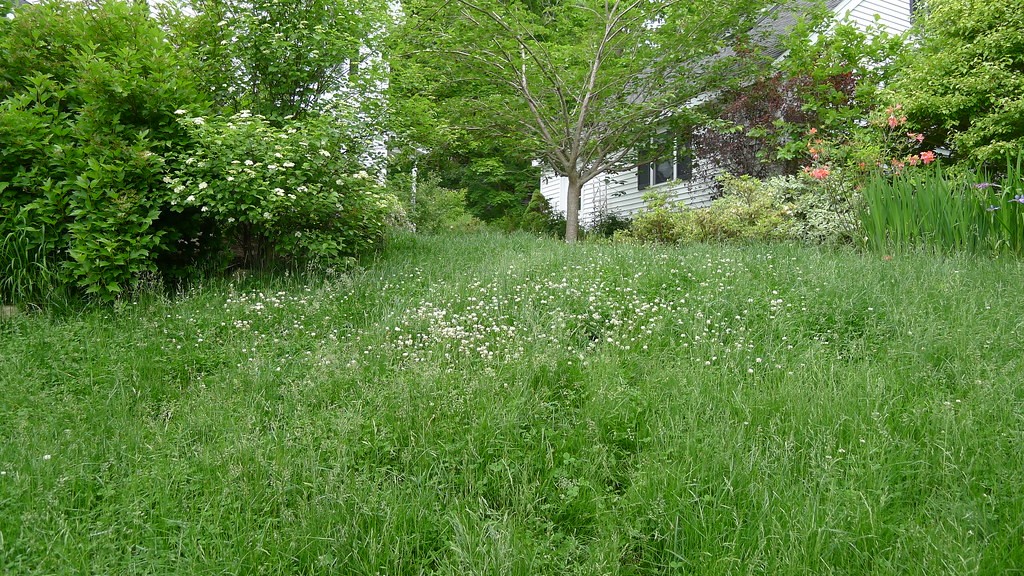
The most common cause, and it creeps up over a wet fortnight or a holiday. Bluegrass, ryegrass and fescue lawns are meant to be held at 2 to 4 inches (5 to 10 cm), according to Purdue Extension. The University of Minnesota Extension puts it simply: to keep a lawn at 3 inches, mow before it reaches 4.5 inches (11.5 cm), because you should never remove more than one-third of the leaf at once. Fix: the staged routine below, then mow whenever the lawn reaches 1.5 times your cutting height.
Too much nitrogen
Quick-release nitrogen builds leaf fast and thin-walled. Kansas State University lists the results of over-fertilizing as excessive shoot growth, more thatch, more mowing, higher water demand, less root growth and more disease, and advises never applying more than 1 lb of actual nitrogen per 1,000 sq ft from a quick-release source at one time. Its annual totals are modest: 2 to 4 lb per 1,000 sq ft for tall fescue, ryegrass, improved Kentucky bluegrass, zoysia and St. Augustine, and 0 to 2 lb for buffalograss. Fix: stop feeding and let the flush grow out over four to six weeks of frequent mowing; next time use a slow-release source and keep to the annual total for your species.
Heavy rain, irrigation and wind
A downpour or an overnight sprinkler loads every blade while wind pushes the canopy one way. On a healthy lawn at the right height this is temporary; it becomes permanent on grass that is already too long or too soft, because those blades kink at the base instead of bending. Fix: leave it two days, then mow as normal, and water early in the morning so the canopy dries. If the lawn also squelches and smells sour, read our article on the signs of an overwatered lawn.
Shade
Grass short of light stretches toward it. Penn State Extension describes shaded turf as having shortened roots, reduced shoot density and erect, elongated stems: a tall, thin plant that is easily knocked flat. Illinois Extension recommends at least 2 hours of direct sun for an acceptable lawn, mowing shaded areas near 3 inches, and cutting nitrogen to 1 to 2 lb per 1,000 sq ft per season, because extra nitrogen in low light only produces soft leaf. Fix: mow higher, feed less, thin low branches and keep traffic off; below 2 hours of sun, switch to a shade groundcover or mulch.
Thatch
Thatch is the layer of dead and living stems and roots between soil and green leaf. Up to 1/2 inch is useful cushioning. Beyond that, Illinois Extension notes the grass starts rooting in the thatch rather than the soil, and a plant anchored in a spongy mat leans over. Texas A&M AgriLife Extension allows St. Augustine up to 3/4 inch (2 cm) before removal. Fix: core aerate in late August to early October for cool-season lawns or April to May for St. Augustine, and run a vertical mower only for severe layers. Our guide to the pros and cons of dethatching explains when aeration alone is enough.
Grass type
Some grasses are supposed to lie down. St. Augustine, centipede and Bermuda spread by above-ground stolons that root at the nodes, so a healthy lawn of these species looks more prostrate than a bunch-type fescue. Fix: accept the habit. Mow St. Augustine at 2.5 to 3 inches often enough to remove no more than a third, and feed 3/4 to 1 lb of nitrogen every 8 weeks in season as Texas A&M advises; it will look dense rather than flat. If you are choosing a new lawn, our comparison of St. Augustine, Bermuda, zoysia, fescue and buffalo grass covers growth habit alongside climate.
Grubs and disease
Grass lies flat in patches when the crown or roots holding it up are damaged. Penn State Extension describes grub-eaten sod as rolling back like carpet; the treatment threshold is 5 to 10 grubs per square foot, found by lifting a square foot of turf 2 to 4 inches deep in several places. Patch diseases such as brown patch and Pythium rot the base of the leaf, and Kansas State lists excess nitrogen as a trigger for both. Fix: above threshold, treat grubs in August to mid-September while they are small, or apply a preventive in mid-June to mid-July; for disease, cut nitrogen, water only in the morning and improve airflow.
Foot traffic
UMass Extension describes wear as bruising and crushing of the shoots, followed by compaction that squeezes air out of the root zone. Perennial ryegrass and tall fescue tolerate traffic best, Kentucky bluegrass is intermediate, and fine fescue, bentgrass and rough bluegrass worst. Fix: move the route or lay stepping stones, core aerate in early spring or early autumn, and overseed worn strips with perennial ryegrass or tall fescue.
How to diagnose it in ten minutes
- Measure the leaf from the soil with the blade held upright. Over 4.5 inches (11.5 cm) on a cool-season lawn, or over 4 inches on St. Augustine, means height is at least part of it.
- Check the pattern. Everywhere in one direction points to rain, wind or always mowing the same way. Patches point to grubs, disease or traffic. Only under trees points to shade.
- Cut a wedge 2 inches (5 cm) deep with a trowel, as the University of Minnesota Extension recommends, and measure the brown layer between soil and green.
- Tug test. Healthy turf resists; grub-eaten turf lifts with no roots attached.
How to mow grass that is lying down
A mower cannot cut what it rolls over, and one low pass across overgrown grass scalps the lawn; Purdue notes that mowing below the optimum height restricts root growth and increases susceptibility to insects, disease, drought and traffic. This routine brings the lawn down safely in three or four cuts.
- Wait for the grass to dry. Wet, lodged grass clumps, clogs the deck and tears instead of cutting.
- Rake or fluff first. Drag a leaf rake or stiff broom against the direction the grass is lying so the mower can reach the blades.
- Sharpen the blade. Dull blades shred tips, which brown and invite disease.
- Set the deck to its highest position, usually 3.5 to 4 inches (9 to 10 cm). If the grass is over 8 inches (20 cm), take the top off with a string trimmer first.
- Mow slowly in half-width passes, against the lean, so the blade gets a second chance at anything the wheels pushed down.
- Bag the clippings for this cut, or mow the windrows twice; long clippings smother the grass beneath. Our piece on mulching grass clippings covers when bagging is better.
- Come back in three to four days and lower the deck one notch. Repeat until you reach normal height: 3 inches for bluegrass, ryegrass and tall fescue; 2.5 to 3 inches for St. Augustine in sun and 3 to 3.5 inches in shade.
- Alternate direction every mow from now on. Minnesota Extension recommends changing direction at right angles every other time to promote upright shoot growth.
A note from the agronomist’s side
Lawn lodging is the same problem cereal breeders have worked on for decades. Wheat and rice lodge under heavy nitrogen for exactly the reason a lawn does: more leaf on top, weaker tissue at the base. The semi-dwarf varieties of the Green Revolution were bred largely so the crop could take high fertilizer rates without falling over. A lawn owner cannot change the genetics of the grass, but the lesson carries over: when the lawn keeps lying down, the fix is almost always less nitrogen and more frequent cutting, not a stronger feed.
How long until it stands up again
Rain-flattened grass recovers in one to two days; an overgrown lawn after two or three staged mows (about ten days); a nitrogen flush in four to six weeks. Shade and thatch corrections take a season, and grub or disease patches need reseeding and six to eight weeks of growing weather to fill. Whatever the cause, do not roll the lawn: a roller compacts the soil and does nothing for the leaf.
Prevention
Mow on the one-third rule, change direction each time, feed in split doses of no more than 1 lb of nitrogen per 1,000 sq ft (largest dose in autumn for cool-season lawns), water deeply in the morning, and check thatch each autumn. If the lawn mats even when mowed properly, see our article on how to thin out grass that is too thick.
Sources
- University of Minnesota Extension – Mowing practices for healthy lawns
- Purdue Extension – Mowing, Dethatching, Aerifying, and Rolling Turf (AY-8-W)
- Kansas State University Turf – Lawn Problem Solver: Fertilizing
- University of Minnesota – Gardening with Native Grasses: Management (lodging)
- Illinois Extension – Managing Thatch in Lawns
- University of Minnesota Extension – How to control thatch in your lawn
- Penn State Extension – Growing Turf Under Shaded Conditions
- Illinois Extension – Managing Shady Lawns
- Texas A&M AgriLife Extension – Maintaining St. Augustine Grass Lawns
- Penn State Extension – White Grubs in Home Lawns
- UMass Extension – Traffic Stress and Turf Cultivation