
You finally get around to raking the last leaves in November and there it is: a low, sprawling mat of round, crinkly leaves on long stalks, still bright green while the grass around it is fading. You tug, the stem snaps, and the root stays put. That stubborn plant is almost certainly common mallow.
Short answer: Common mallow (Malva neglecta) is a low-growing broadleaf weed with round, scalloped leaves, small white-to-pale-lavender flowers and button-shaped seed pods. It is easiest to kill while young: pull or hoe seedlings with four or fewer true leaves, dig older plants out with the whole taproot, and in lawns use a 3- or 4-way broadleaf herbicide in spring or summer, expecting to repeat it. Thick turf and 3 inches of mulch keep new seedlings from taking over (UC IPM; Virginia Cooperative Extension).
Common mallow is not hard to find, but it is easy to fight the wrong way. Mowing doesn’t touch it, snapping the stem just makes it regrow, and plain glyphosate often lets it down. By the end of this guide you’ll be able to identify it with confidence, tell it apart from its look-alikes, pick a removal method that matches the plant’s size, and set up a calendar that stops next year’s flush.
What Is Common Mallow? Names, Life Cycle and Why It Spreads
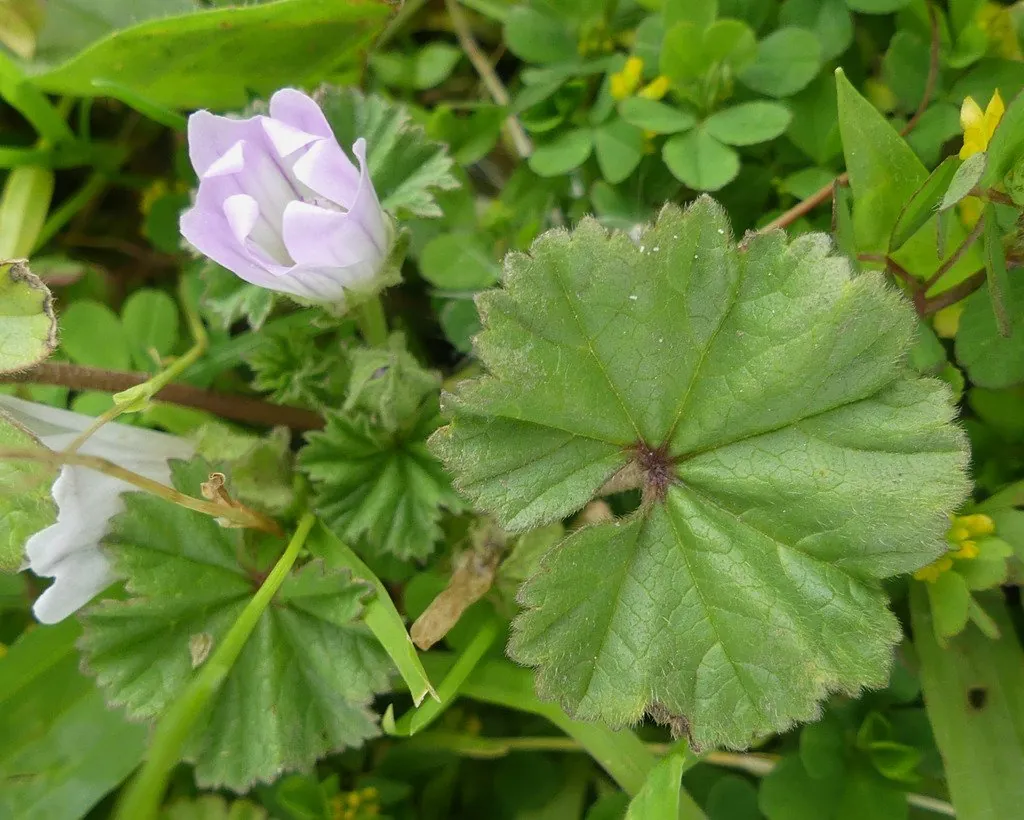
Common mallow is a Eurasian member of the mallow family (Malvaceae), the same family as hibiscus, okra and cotton (Colorado State University; UC IPM). Around the yard you’ll also hear it called cheeseweed, cheese mallow, buttonweed or dwarf mallow, names that come from its flat, wheel-shaped seed pods (WSU Hortsense).
Its life cycle is flexible, and that is a big part of the problem. Extension sources describe it as an annual, winter annual or biennial, because you can find plants growing at almost any time of year. In Colorado it can even survive winter and behave like a short-lived perennial, regrowing in spring from overwintered stems.
Why it keeps coming back
- A deep, woody taproot. The root develops quickly and turns woody as the plant ages, so older plants are very difficult to pull by hand or even with tools (UC IPM).
- A long-lived seed bank. The seeds have a tough coat, so only a small fraction germinate each year, but they stay viable for a long time. Colorado State notes they can survive in soil for decades.
- Staggered germination. Seeds germinate from spring to early autumn, and in mild-winter California they begin with the first fall rains. That makes one perfectly timed treatment unrealistic.
- It survives mowing. Common mallow grows flat, and the plant keeps viable buds on its stems below the mower blade (UC IPM).
- It tolerates tough sites. Colorado State lists freezing, dry and compacted soils among the conditions it handles well.
The seed biology is worth one more sentence. A closely related weed, round-leaved mallow (Malva pusilla), has seeds that are impermeable to water and germinate poorly unless the coat is scratched, which lets them stay dormant for long periods (Makowski & Morrison, 1989). Practically, that means digging and tilling can “wake up” buried mallow seed. Expect a few new seedlings after any soil disturbance.
How to Identify Common Mallow (Key ID Features)
Once you know these features, you can spot this weed from across the yard. Start with the leaves, then confirm with the flowers or the seed pods.
| Feature | What to look for |
|---|---|
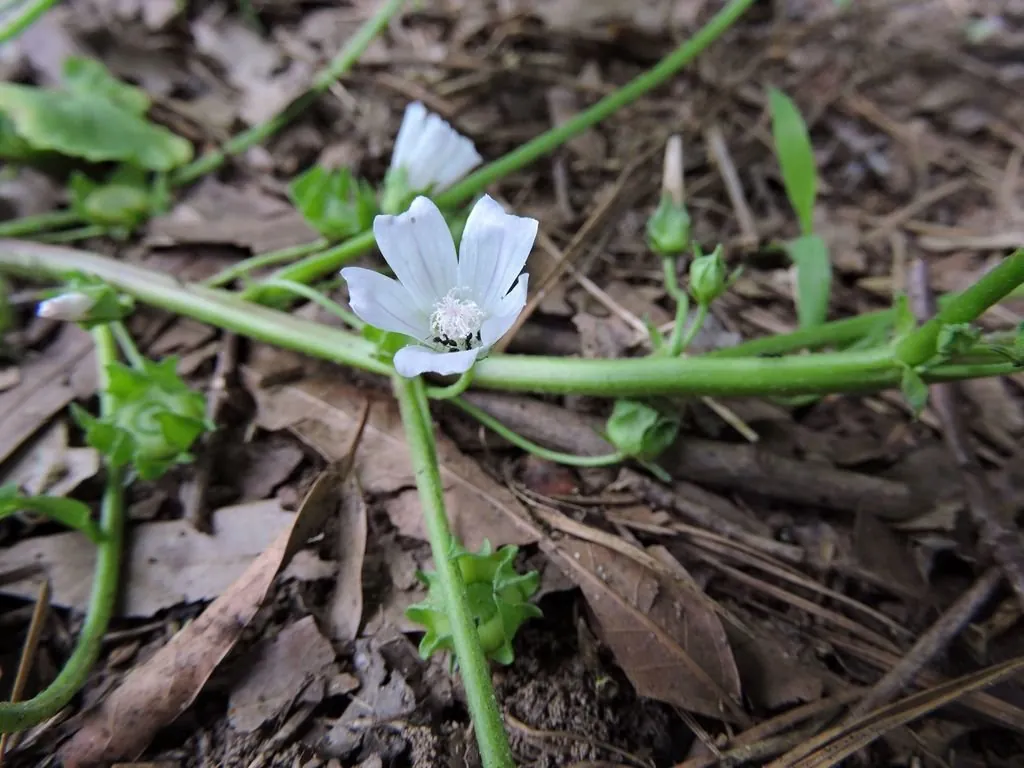
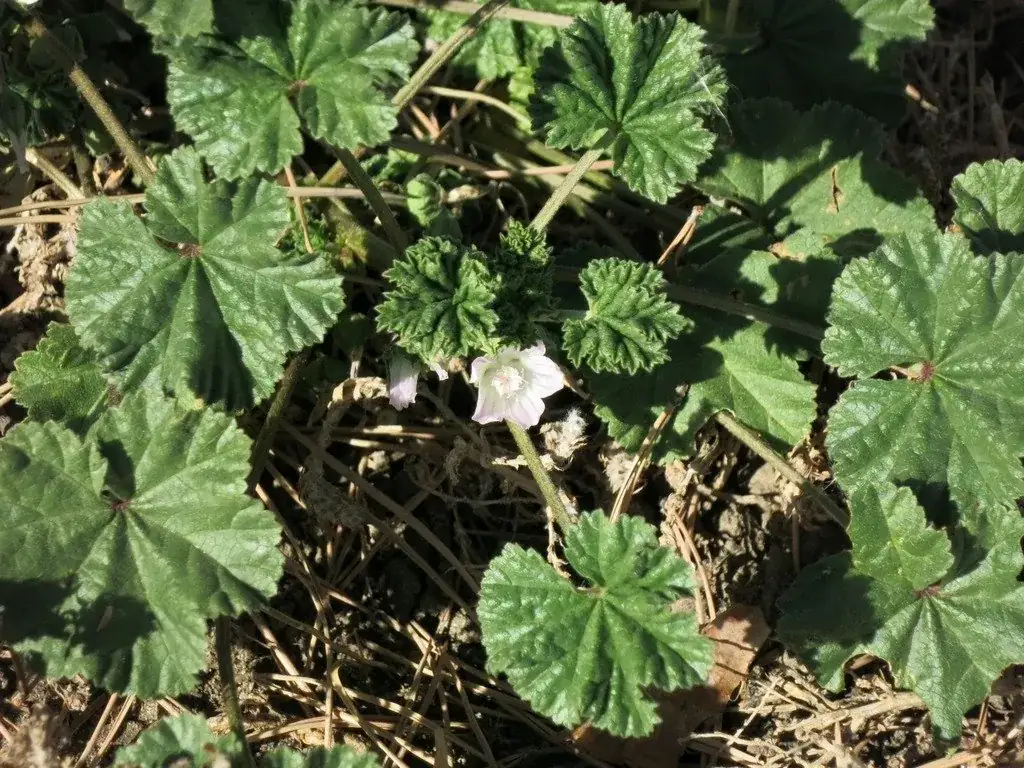
| Leaves | Nearly round to kidney-shaped, 0.5–1.5 in across, with 5–7 shallow rounded lobes and toothed edges; slightly crinkled and hairy; veins radiate from where the stalk attaches |
| Leaf stalks | Long and slender, arranged alternately along the stems |
| Growth habit | Starts as a rosette, then sends out spreading stems from a few inches to nearly 2 ft long; tips turn upward |
| Flowers | Small, 5 petals, white to pale pink or lavender with darker veins; each petal is notched, so it can look like 10; borne in leaf axils |
| Fruit (seed pod) | Flat, smooth, round “cheese wheel” or button with 10–12 wedge-shaped segments, one seed each |
| Root | A single deep taproot that becomes woody with age |
Common mallow look-alikes
The plant people most often confuse with common mallow is ground ivy, also called creeping Charlie. The test is easy: ground ivy has square stems, opposite leaves and a minty smell when crushed, while mallow has round stems, alternate leaves and no mint scent (Ohio State University Extension).
| Plant | Stems and leaves | Flowers / fruit | Quick tell |
|---|---|---|---|
| Common mallow (Malva neglecta) | Round stems; alternate, round scalloped leaves on long stalks | White to pale lavender; petals about twice as long as the sepals; smooth button fruit | Cheese-wheel seed pods |
| Little mallow (Malva parviflora) | Similar leaves; more upright, can be shrubby up to 5 ft | Petals about as long as the sepals; fruit wrinkled | Wrinkled pods, taller plant |
| Ground ivy / creeping Charlie (Glechoma hederacea) | Square stems; opposite leaves | Blue-violet, tube-shaped flowers | Smells minty when crushed |
| Wild violet (Viola spp.) | Heart-shaped leaves rising from a crown, no trailing leafy stems | Purple, blue or white violet flowers | No cheese-wheel pods |
If your plant has heart-shaped leaves and violet-like flowers, read our guide to wild violets in lawn instead. They take a different control plan. And if you’re curious about mallow’s tropical relatives, Caesar weed belongs to the same plant family.
Is mallow harmful or useful?
For most homeowners, mallow is a looks problem, not a danger. In lawns and beds it crowds out desirable plants and leaves bare, sprawling patches when it dies back. Gardeners growing vegetables have a better reason to care. UC IPM and Colorado State both note that mallows can host whiteflies and thrips and act as a reservoir for plant viruses, including tomato spotted wilt and tomato yellow leaf curl. So keep it out of the vegetable patch.
A common search is “common mallow vs marshmallow.” The original marshmallow ingredient came from a different plant, Althaea officinalis, which is in the same family but is a separate species (UC IPM). UC IPM also notes that some wild mallows can be eaten. If you ever forage it, only pick from areas that haven’t been treated with herbicides or fertilizer and that dogs don’t use, and be 100% sure of the ID.
How to Get Rid of Common Mallow Without Chemicals
Here’s the good news: for a handful of plants, hand tools beat any spray. The key is to match the method to the plant’s size.
1. Pull or hoe seedlings early
UC IPM’s advice is specific: pull or hoe young mallow while it has four or fewer true leaves, before the taproot runs deep and turns woody. Slicing young plants off at the crown can also kill them, but older plants often resprout from the crown, so don’t rely on cutting once they’re established (UC IPM).
2. Dig out mature plants, root and all
Bigger plants have to come out with the taproot, or they’ll regrow (Colorado State University). Water the area the day before, push a dandelion fork or narrow trowel straight down beside the crown, and lever the root up. Honestly, for a few plants this is the most reliable fix you have. Bag any plants carrying seed pods: Colorado State recommends green-waste collection or a properly hot compost pile for seedy plants.
3. Mulch beds 3 inches deep
In landscape beds, at least 3 inches of bark or wood chips blocks the light mallow seedlings need and physically stops many from emerging. The mulch has to be topped up to stay at that depth, or seedlings will push through (UC IPM). Our guide to stopping weeds in mulch beds covers how to keep it working.
4. Thicken the turf
Mallow is a weed of disturbed, open ground. WSU notes it is occasionally a problem in new lawns, and Colorado State points to compacted, dry soil. In practice, a dense, well-fed lawn shades out seedlings. If your mallow patches line up with hard, bare ground, fix the soil first. See how to plant grass seed in compacted soil.
What doesn’t work
- Mowing. The buds sit below the blade, and common mallow’s flat growth makes it even less affected (UC IPM).
- Solarization and flame weeding. Both are listed as ineffective for mallow by UC IPM and Colorado State.
- Biocontrol products. There are no commercially available biological controls for this weed. In a turf study, the bioherbicide fungus Phoma macrostoma gave little control of common mallow, even though it worked well on dandelion (Smith et al., 2015).
Common Mallow Weed Killer Options (by Active Ingredient)
This is where most of the frustration comes from. Mallow is one of the tougher broadleaf weeds, so a single spray of a basic product often just burns it back. Here is what the research and extension guides say, with the product type matched to where the weed is growing.
| Where it’s growing | Active ingredient(s) | What to expect | Source |
|---|---|---|---|
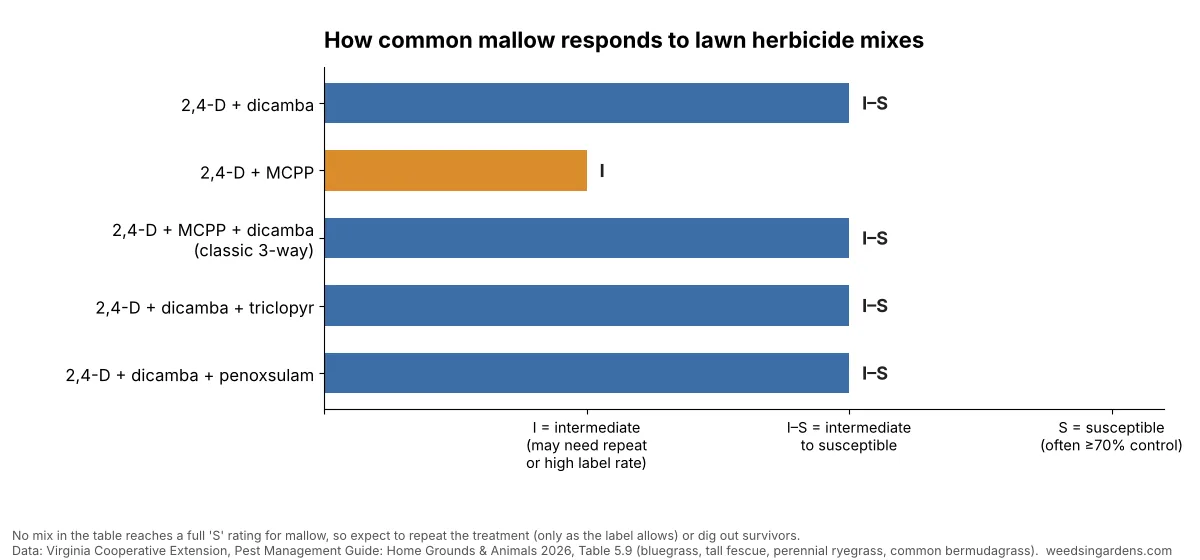
| Cool-season lawns and common bermudagrass | 2,4-D + dicamba; 2,4-D + MCPP + dicamba (3-way) | Rated I–S (intermediate to susceptible); spring and summer preferred | VCE PMG 2026, Table 5.9 |
| Same lawns | 2,4-D + dicamba + triclopyr, or + penoxsulam | Rated I–S | VCE PMG 2026, Table 5.9 |
| Same lawns | 2,4-D + MCPP only | Rated I (intermediate); may need high label rates or repeats | VCE PMG 2026, Table 5.9 |
| Lawns | 2- or 3-way mixes containing triclopyr, fluroxypyr or quinclorac | Listed as effective options | Penn State Extension |
| Landscape beds (not lawn) | Pre-emergents such as oxadiazon or flumioxazin (check the label for your plants) | Prevents seedlings; mostly professional or ornamental-bed products | Penn State; Ohio State |
| Patios, bare ground, spot-only | Glyphosate or glufosinate | Mixed reports: UC IPM calls glyphosate ineffective on mallow | Penn State; UC IPM |
How to spray mallow in a lawn so it actually works
- Pick a combination product. Choose a 3- or 4-way broadleaf weed killer labeled for your grass type. The Virginia ratings above apply to Kentucky bluegrass, tall fescue, perennial ryegrass and common bermudagrass (VCE PMG 2026). Check that your grass is on the label and whether the label restricts use on new seedings.
- Spray young, actively growing plants. UC IPM notes 2,4-D gives only limited control even on young plants, and big woody plants are tougher still. Spring and summer are the preferred windows in the Virginia guide.
- Watch the temperature. Spray at or below 85°F when the weed has had enough water to be actively growing. Above 85°F, and in dry air, these herbicides are more likely to volatilize and drift onto flowers and vegetables (South Dakota State University Extension).
- Plan the follow-up. No mix in the Virginia table reaches a full “S” rating for mallow, so expect a second application (only as the label allows) or digging out survivors.
- Keep it off ornamentals. 2,4-D injures any broadleaf plant it contacts (UC IPM). For the basics of selective lawn sprays, see our post-emergent herbicide guide.
Follow the label. Rates, re-entry times, grass-type safety, temperature limits and mowing intervals are set by the product label, which is the legal guide for its use. If the label and this article ever disagree, the label wins.
When to Treat Common Mallow: A Season-by-Season Plan
Timing matters more than product choice. Seeds germinate from spring into early autumn, flowers appear from May to October, and older stems can overwinter (Colorado State; Penn State). That gives you a clear plan.
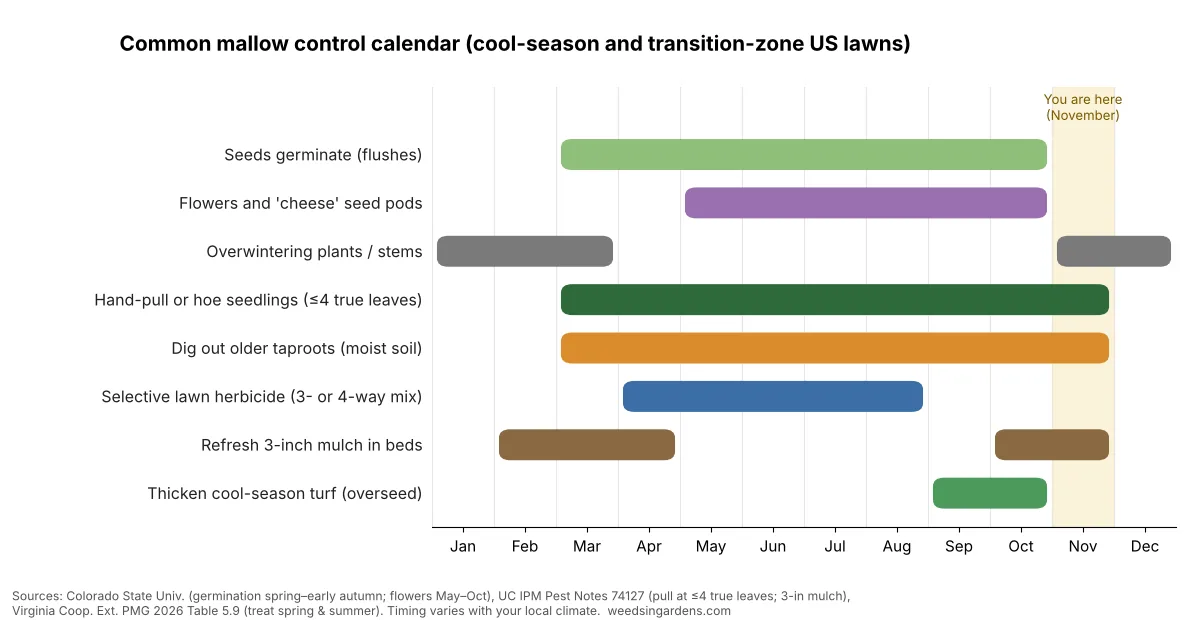
| Season | What mallow is doing | Your move |
|---|---|---|
| Late fall (Nov) | Rosettes and old stems hanging on; seed pods dropping | Dig out established plants while the soil is moist and unfrozen; bag seedy plants; refresh bed mulch to 3 in |
| Winter | Some plants overwinter, especially in mild regions | Mark problem patches; plan soil and turf fixes |
| Early spring | New flush germinates; overwintered crowns regrow | Pull or hoe seedlings at ≤4 true leaves; top up mulch |
| Late spring–summer | Plants spread and flower from May; seed pods form | Spray a 3-/4-way lawn herbicide on young, actively growing plants (≤85°F); dig survivors; never let plants set seed |
| Early fall | Late germination flushes | Overseed thin cool-season turf; keep pulling seedlings |
Doing a fall renovation? Read how to kill weeds before overseeding so mallow doesn’t come back up through new grass. For the bigger picture of what germinates in the cold months, see our list of winter annual weeds.
A Note from the Agronomist’s Side
If you read three mallow fact sheets, you’ll find what looks like a contradiction. UC IPM says no effective chemical controls exist for home use and that glyphosate is ineffective. Penn State and Ohio State say a 3-way lawn product “should provide adequate control.” Virginia’s guide sits in the middle with I–S ratings. These aren’t really in conflict. They describe different plants at different stages.
Think about the plant’s biology. A seedling has a thin root and soft, actively growing leaves, so herbicide absorbed there reaches a small root. A mature mallow has a woody taproot, hairy leaves, and a lot of stored reserves, so the same dose gets diluted and the crown simply regrows. California’s mallows also grow through the cool, wet season, so plants can be large and woody by the time anyone notices them. So the practical rule of thumb is: chemicals work on mallow when the plant is small, and the shovel works when it’s big.
The second insight is about the seed bank. Because only a small share of hard-coated seed germinates each year, you’ll see new plants for several seasons even after you’ve won the battle on the surface. That isn’t failure. It’s the bank slowly emptying. Every plant you remove before it sets pods is a deposit you didn’t make, and that’s the real return on your effort. Combine that with denser turf or deeper mulch, and the yearly flushes keep shrinking.
Common Mallow Mistakes to Avoid
- Snapping the stem instead of lifting the root. A broken plant regrows from the crown. Loosen the soil first.
- Spraying big, woody plants in hot, dry weather. Stressed weeds take up little herbicide, and above 85°F you risk drift onto garden plants.
- Relying on one spray. The best lawn mixes are rated only intermediate to susceptible, so plan a follow-up.
- Composting seedy plants in a cool pile. Long-lived seed can survive and come back with the compost.
- Tilling a bed and leaving it bare. Disturbance can scratch hard seed coats and trigger a flush. Mulch or plant right away.
- Using a non-selective spray in the lawn. Glyphosate kills grass, and UC IPM reports it doesn’t reliably kill mallow anyway.
FAQ
What kills common mallow?
In lawns, a 3- or 4-way broadleaf herbicide (2,4-D plus dicamba, with MCPP, triclopyr or penoxsulam) applied to young, actively growing plants in spring or summer gives intermediate-to-good control; expect a follow-up. For a few plants, digging out the whole taproot is the most reliable method. Always follow the label.
Is common mallow invasive?
Common mallow is a non-native weed from Eurasia that is widespread in US yards, gardens and farm fields. It spreads only by seed, but its long-lived seed bank and deep taproot make it persistent once established.
Why won’t Roundup kill mallow?
UC IPM notes that mallow is one of the few weeds glyphosate is ineffective against, especially once plants are large with woody taproots. Glyphosate also kills lawn grass, so it is not a good choice in turf.
When is the best time to get rid of common mallow?
Pull or hoe seedlings as soon as you see them, ideally with four or fewer true leaves. Spray lawns in spring or summer while plants are young and actively growing, at or below 85°F. Dig out established plants any time the soil is moist and unfrozen, including late fall.
Is common mallow the same as marshmallow?
No. The original marshmallow ingredient came from Althaea officinalis, a related plant in the same family. Common mallow is Malva neglecta.
Will mowing get rid of common mallow?
No. Common mallow grows flat and keeps live buds on its stems below the mower blade, so mowing alone does not control it.
How do I tell common mallow from creeping Charlie?
Creeping Charlie (ground ivy) has square stems, opposite leaves and a minty smell when crushed. Common mallow has round stems, alternate leaves on long stalks, no mint scent and button-shaped seed pods.
Sources
- Wilen, C.A. Pest Notes: Mallows. UC ANR Publication 74127. UC Statewide IPM Program. ipm.ucanr.edu
- Peterson, M. (2024). Common mallow, Malva neglecta. Colorado State University, Agricultural Biology. agsci.colostate.edu
- Washington State University Hortsense. Weeds: Mallow, common (Malva neglecta). Reviewed 2026. hortsense.cahnrs.wsu.edu
- Abbey, T. (2025). Landscape Management: Common Mallow. Penn State Extension. extension.psu.edu
- Ohio State University Extension, Adams County. Weed of the Week: Common Mallow (Malva neglecta) (2023). adams.osu.edu (PDF)
- Virginia Cooperative Extension. Pest Management Guide: Home Grounds & Animals 2026, Lawn: Weeds, Table 5.9 Broadleaf Weed Control (ENTO-634P). PDF
- South Dakota State University Extension. Use Caution With Turf Herbicide Applications During Extreme Heat and Drought. extension.sdstate.edu
- Smith, J., Wherley, B., Reynolds, C., White, R., Senseman, S., & Falk, S. (2015). Weed control spectrum and turfgrass tolerance to bioherbicide Phoma macrostoma. International Journal of Pest Management, 61(2), 91–98. doi:10.1080/09670874.2015.1014450
- Makowski, R.M.D., & Morrison, I.N. (1989). The biology of Canadian weeds. 91. Malva pusilla Sm. (= M. rotundifolia L.). Canadian Journal of Plant Science, 69(3), 861–879. doi:10.4141/cjps89-101
More in Lawn Weeds.