
Short answer: whether a bamboo is invasive comes down to its rhizome. Running bamboos (Phyllostachys, Pleioblastus, Sasa, Pseudosasa) have long, horizontal “leptomorph” rhizomes that travel in the top 12 in (30 cm) of soil and can extend more than 3 ft (1 m) a year in a garden and up to 15 ft (4.5 m) a year for a large golden bamboo in a warm climate. Clumping bamboos (Fargesia, Bambusa, Chusquea) have short, U-shaped “pachymorph” rhizomes and widen by a few inches a year. If you already have a runner, contain it with a 60-mil HDPE barrier 24–30 in (60–75 cm) deep with 2–3 in above grade plus a yearly rhizome-pruning trench, or remove it by digging or by cutting regrowth and spraying it with glyphosate, which typically takes two to three seasons. In some US states and towns, a runner near a boundary is now a legal liability.
Running vs clumping: what the rhizome does
Every bamboo spreads from underground stems called rhizomes, and their shape is the whole difference between a well-behaved screen and a plant that lifts your neighbour’s patio.

- Leptomorph (running) rhizomes are long, thin and hollow, with a bud at every node. They grow horizontally for many feet before turning up into a new cane. The RHS notes that these rhizomes generally sit in the top 30 cm (1 ft) of soil and “can spread over 1m (3⅓ft) each year, often unnoticed until they send up shoots.” University of Maryland Extension puts it more bluntly: left unchecked they can run “a hundred or more feet in any unobstructed direction.”
- Pachymorph (clumping) rhizomes are short, thick and curved. Each turns upward into a cane within inches of the parent, so the clump widens slowly and never sends a shoot up across the lawn. Alabama Cooperative Extension describes them as producing “very little horizontal growth before they turn upward,” which is why clumping types are not treated as invasive in the southeastern US.
| Feature | Running (leptomorph) | Clumping (pachymorph) |
|---|---|---|
| Common genera | Phyllostachys (golden, black, yellow groove), Pleioblastus, Sasa, Sasaella, Pseudosasa, Semiarundinaria | Fargesia, Bambusa, Chusquea, Thamnocalamus, Himalayacalamus |
| Rhizome shape | Long, thin, horizontal, hollow; buds at every node | Short, thick, curved; turns up into a cane close to the parent |
| Rhizome depth | Mostly top 12 in (30 cm); occasionally deeper under paving | Shallow; roots of old clumps can reach 3 ft (1 m) |
| Typical yearly spread | 3 ft (1 m) or more in UK gardens; 15 ft (4.5 m) for large species in the southern US | A few inches at the clump edge |
| Cold hardiness | Mostly temperate; many hardy to USDA zone 5 or 6 | Fargesia hardy to zone 5; Bambusa warm-climate only (zones 8–10) |
| Where new canes appear | Anywhere along the rhizome, including beds, lawns and next door | Only at the edge of the clump |
| Invasive risk | High without a barrier | Low |
How to tell which one you have
Labels get lost and some nurseries sell “clumping” bamboo that is not. Three checks settle it:
- Dig at the edge of the plant. A runner shows pale, jointed rhizomes as thick as a finger heading away horizontally, often 3–6 ft (1–2 m) beyond the last cane. A clumper has a tight knot under the canes and nothing radiating outward.
- Look for the groove. Phyllostachys canes have a flattened channel (the sulcus) up one side of each internode above the branch. Feel that with your thumb and assume a runner.
- Watch the spring shoots. New culms emerge over a 6- to 12-week window between March and May in the northern hemisphere, according to Maryland Extension. Shoots a few feet from the parent, especially in the lawn, are the giveaway.
One caveat from the RHS: in poor, dry soil Phyllostachys often behaves as a clump for years, then runs once it finds moist ground or a warm sheltered spot. Good behaviour so far proves nothing.
Where running bamboo is regulated
No country bans bamboo outright, but several places now put the cost of a spreading runner on whoever planted it.

- Connecticut (US). Public Act 13-82 covers only the genus Phyllostachys. Since October 2013 “a person who allows running bamboo to grow beyond the boundaries of his or her property is liable for any damages caused by the bamboo,” and buyers must be given a written statement at the point of sale, as explained by the Connecticut Invasive Plant Working Group at UConn. Public Act 14-100 then barred planting running bamboo “forty feet or less from any abutting property or public right-of-way” unless it is contained by a properly installed barrier, with a $100 fine for each day of violation.
- New York (US). Golden bamboo (P. aurea) and yellow groove bamboo (P. aureosulcata) are state-prohibited plants that “cannot be purchased, introduced, propagated, transported or sold,” though existing plants may stay, according to the New York Botanical Garden. A number of towns in New York, New Jersey and elsewhere have their own setback ordinances; check before planting.
- United Kingdom. The Property Care Association confirms there are “no legislative control requirements for bamboo as they are not listed on The Wildlife and Countryside Act 1981, or the Invasive Alien Species Order 2019.” Encroachment onto a neighbour’s land is instead a civil matter between the two owners, and specialist contractors now survey and treat bamboo much as they treat Japanese knotweed, so expect questions if you sell a house with a runner on the boundary.
- Australia. In New South Wales golden and black bamboo are naturalised weeds and every landholder has a “general biosecurity duty” to prevent or minimise the risk they pose, according to NSW WeedWise. Some councils list Phyllostachys as an environmental weed.
Bamboo is not yet regulated like the plants in our guide to Japanese knotweed, giant hogweed and kudzu, but the direction of travel is the same.
Containment done right
If you want to keep a running bamboo, treat it as a pond-liner project, not a planting job. Maryland and Alabama Extension and the RHS agree on the essentials.
- Material. Use purpose-made rhizome barrier: high-density polyethylene (HDPE) or polypropylene at a minimum of 60 mil (1.5 mm) thick; Maryland Extension suggests 80 mil for vigorous colonies. Landscape fabric and thin pond liner are pierced within a season or two.
- Depth. Buy a 30- to 36-in (75–90 cm) roll and bury 24–30 in (60–75 cm). Alabama Extension gives 2 ft as the minimum; NSW WeedWise specifies 75 cm.
- Above grade. Leave at least 2–3 in (5–7.5 cm) showing (the RHS says 7.5 cm; Maryland Extension prefers 6–8 in), because rhizomes that hit the barrier turn upward and will hop over a lip buried under mulch.
- Angle it outward. Lean the barrier slightly away from the bamboo so a rhizome that meets it is deflected up to the surface, where you can cut it, rather than down under the bottom edge.
- Seal the joints. Overlap ends by at least 12 in (30 cm) and bond them with mastic, per the RHS. Avoid sharp corners, which crack the plastic.
- Inspect every year. A barrier redirects growth; it does not stop it. Each late summer, walk the inside of the barrier and cut back rhizomes that have turned up along it. In spring, knock over any shoot outside the line while it is still soft.
The trench alternative. Where a barrier is impractical, the RHS and Alabama Extension both describe an annual rhizome-pruning trench: a spade-width trench 12 in (30 cm) deep, about 12–20 in (30–50 cm) out from the edge of the plant. Sever every rhizome crossing it, remove the cut pieces and loosely backfill so you can reopen it next year. Alabama Extension calls this “the most cost-effective long-term containment for many situations.”
The mowing-strip method. For a grove in a large garden or field, keep a mown buffer of at least 20 ft (6 m) around it. New culms are mostly water and snap under a foot, a mower or a string trimmer; mow the strip weekly through the shooting season.
Removing running bamboo: three methods that work
Whatever the route, the goal is to kill or remove the whole rhizome system. Clemson Extension notes rhizomes are “very resistant to adverse environmental conditions and most herbicides,” so one treatment of anything will not do it.
1. Dig it out
For a young plant or a small escaped patch, excavation is the fastest permanent fix. Cut the canes low, then lift the rhizome mat with a mattock or, for larger groves, a mini-excavator; most rhizomes are in the top 12 in (30 cm), though old clumps can root to 3 ft (1 m). Sieve the spoil, because any piece with a node can regrow, and check the area for a full season. This is the only method that lets you replant straight away.
2. Cut, and cut again
Rhizomes live on starch made by the leaves. Cut every cane to the ground, then mow or trim all regrowth at lawn-mowing frequency. Clemson Extension says “two to three years of regular mowing are often needed to see results.” Missing a month lets the rhizomes refuel.
3. Cut, let it regrow, then spray
Spraying a 20 ft bamboo is pointless; the leaves are out of reach. The extension protocol is:
- Cut all canes to the ground in late winter or spring.
- Let regrowth reach 3–4 ft (1–1.2 m) with fully expanded leaves; that is usually mid-summer.
- Spray the new foliage to wet with a 5 percent solution of glyphosate mixed from a 41 percent (or stronger) concentrate. Alabama Extension warns that ready-to-use glyphosate sprays are too dilute for bamboo.
- Repeat on any further regrowth. Maryland Extension finds applications made from mid-September to mid-October, repeated 14 days later, are the most effective, when the plant is moving sugars, and the herbicide, down to the rhizomes.
- Expect the cycle to run two to three growing seasons. Clemson gives that range for complete control; the Property Care Association tells UK homeowners to budget for annual late-summer treatments “for several consecutive years.”
Glyphosate has no soil activity, so trees and shrubs rooting under the bamboo are safe as long as their leaves are not sprayed. Imazapyr is more effective on bamboo but is soil-active and not labelled for residential use in the US; Alabama Extension says not to apply it “anywhere within at least twice the distance of the dripline of valued hardwoods.” Near water, use only an aquatic-labelled formulation. In Australia, NSW WeedWise lists glyphosate at 1:50 for spot-spraying regrowth about 0.5 m tall, or 1:6 on stumps within 15 seconds of cutting canes to 20 cm.
If you would rather avoid herbicide, the RHS “does not support the use of weedkillers” for bamboo and notes that even repeated systemic treatments “can take several years,” which is roughly the timescale of the cutting method anyway.
What not to do
- Do not chop it and walk away. Cutting canes once, or rototilling the patch, leaves living rhizome fragments that each become a new plant.
- Do not plant Phyllostachys near a boundary. A 40 ft (12 m) setback is the law in Connecticut and a sensible minimum anywhere for an unbarriered runner. Fence-line screening is exactly where disputes start.
- Do not rely on mulch, gravel or a lawn to stop it. NSW WeedWise records rhizomes travelling “several metres under sealed surfaces such as concrete.” Paving is not a barrier.
- Do not pour herbicide into hollow cut stumps. Alabama Extension points out this quickly exceeds the maximum label rate per acre while delivering little to the rhizomes.
- Do not expect salt, bleach or vinegar to reach the rhizomes. They burn foliage and damage soil; see what horticultural vinegar really does.
- Do not put rhizomes in the compost. A home heap will not get hot enough to kill them. Bag them or take them to a green-waste site; our guide to disposing of invasive plants safely covers the options by region.
Safe alternatives if you still want bamboo
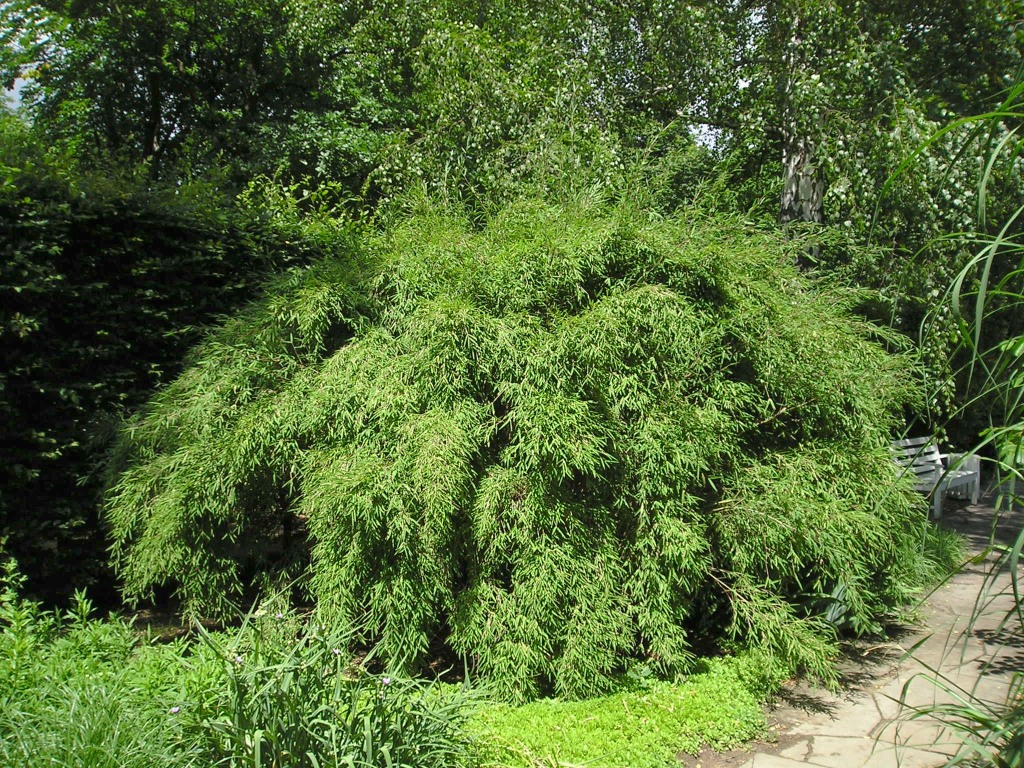
Clumping bamboo gives the same evergreen screen with no barrier and no legal exposure. Match the genus to your climate:
| Climate | Clumping choice | Notes |
|---|---|---|
| Cold temperate (USDA zones 5–7; most of the UK, Canada, northern US) | Fargesia: F. murielae (umbrella bamboo), F. nitida (fountain bamboo), F. robusta | Hardy to roughly −20 °F (−29 °C); 8–15 ft (2.5–4.5 m); prefers light shade and moist soil |
| Mild temperate (zones 7–9; southern UK, Pacific Northwest, coastal Australia) | Fargesia robusta, Chusquea culeou, Thamnocalamus | Tolerate more sun; Chusquea is one of the RHS’s named clump-formers |
| Warm and subtropical (zones 8–10; Gulf states, southern California, Queensland, NSW coast) | Bambusa multiplex (hedge bamboo), B. textilis (weaver’s bamboo), B. oldhamii | Tight clumps 10–50 ft (3–15 m) depending on species; frost-tender below about 15–20 °F (−9 to −7 °C) |
Give a clumper 3–4 ft (1 m) of room on each side and it will fill that space over a decade without going further. If a nursery cannot tell you the genus, do not buy it. As with lantana, the useful question is whether a plant is invasive where you live, not whether it is invasive somewhere.
What to expect
Shoots will still appear the spring after your first season of cutting or spraying; that is normal. In year two they come up thinner, shorter and fewer, and most small infestations finish there. Old groves, and anything still connected to a neighbour’s untreated bamboo, need a third season. If shoots keep arriving from over the fence, switch to permanent containment on your side, a barrier or an annual trench along the boundary, which Alabama Extension calls the best long-term option when the source cannot be treated.
Sources
- Royal Horticultural Society – Bamboo control
- University of Maryland Extension – Containing and Removing Bamboo
- Alabama Cooperative Extension System – Bamboo Growth and Control (FOR-2088)
- Clemson University Home & Garden Information Center – Bamboo Control
- Connecticut Invasive Plant Working Group (UConn) – FAQ on Connecticut’s Bamboo Law, Public Act 13-82
- Connecticut General Assembly – Public Act 14-100, An Act Concerning Liability for the Growing of Running Bamboo
- New York Botanical Garden – Are bamboos allowed to be planted in New York State?
- Property Care Association (UK) – Bamboo removal advice and legislation
- NSW WeedWise – Rhizomatous bamboo (Phyllostachys species)