
You mow the lawn, and two weeks later the same spiny, gray-green shoots are back in the same patch, only now there are more of them. You pull one, it snaps off at the soil line, and you already suspect it will be back by the weekend. That suspicion is correct, and understanding why is the first step if you want to get rid of thistle for good.
Short answer: To get rid of thistle for good, first work out which thistle you have. Bull and musk thistle die if you cut the taproot just below the crown or spray the rosettes in fall or early spring. Canada thistle spreads from deep creeping roots, so the way to get rid of thistle of this kind is to starve the roots: mow or cut it repeatedly, then spray a lawn-safe broadleaf herbicide in fall while the leaves are still green, and repeat for two or more seasons.
This guide shows you how to identify the thistle in front of you in under a minute, why pulling Canada thistle often makes it worse, which herbicide active ingredients are safe for lawns and which belong only in pastures, and exactly when to act each season. Early November is still a good time to start in many areas, as long as the thistle leaves are green.
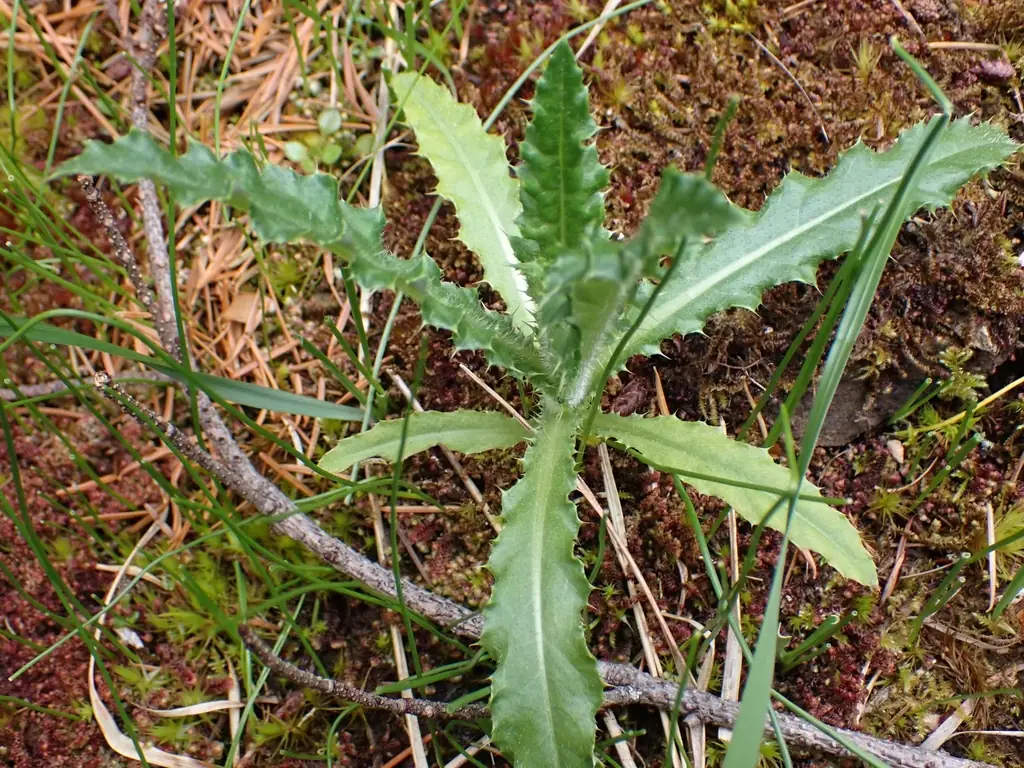
How to Identify Thistle: Which One Is in Your Yard?
If you want to get rid of thistle quickly, this step matters more than any product you buy. The plan that clears a bull thistle in ten minutes does almost nothing to Canada thistle, and some thistles in meadows are natives that are worth keeping. Iowa State’s weed scientists put it simply: biennial thistles are “much easier to control than Canada thistle due to the lack of perennial root systems” (Iowa State Integrated Crop Management).
| Feature | Canada thistle (Cirsium arvense) | Bull thistle (Cirsium vulgare) | Musk thistle (Carduus nutans) | Native tall / field thistle |
|---|---|---|---|---|
| Life cycle | Perennial; comes back from roots | Biennial (rosette year 1, flowers year 2) | Biennial | Biennial |
| Roots | Extensive creeping horizontal roots that sprout new shoots | Taproot | Taproot | Taproot |
| Leaves | Wavy, spiny margins; upper surface smooth (not hairy) | Very hairy on top, deeply lobed, each lobe ending in a sharp spine | Deeply lobed with silvery or white margins; few hairs | Underside white and woolly; top hairless |
| Stem | 1–4 ft; no spines on the stem | 2–6 ft; spiny wings on upper stem | 2–8 ft; spiny wings | 2–8 ft; no spiny wings |
| Flower heads | Small (about ½–1 in), pink to lavender, in clusters; bracts without sharp spines | 2–3 in tall, gumdrop shape, purple; every bract tipped with a long spine | Large, 2–3 in wide, deep rose, nodding (“nodding thistle”) | 1.5–2 in, purple, leafy bracts below the head |
| Growth habit | Dense patches or colonies | Single plants | Single plants | Scattered single plants |
| What to do | Multi-year root-starving plan | Dig or spray rosettes | Dig or spray rosettes | Leave in meadows if possible |
A few quick field checks settle most cases:
- Patch or single plant? A dozen or more shoots spaced across a lawn patch, all connected under the soil, is almost always Canada thistle. A single large star-shaped rosette is usually a biennial.
- Run a finger along the stem. Canada thistle stems have no spines; bull and musk thistle stems carry spiny wings (University of Minnesota Extension).
- Feel the top of the leaf. Bull thistle is rough and hairy on top; Canada thistle is smooth (Penn State Extension).
- Look at the flowers. Canada thistle has clusters of small pink-lavender heads; musk thistle has big, heavy heads that droop.
- Yellow flowers and milky sap? That’s a sowthistle, not a true thistle. UMN notes Canada thistle sap is clear, while sowthistles often have milky sap and yellow flowers. Annual sowthistles are much easier to control.
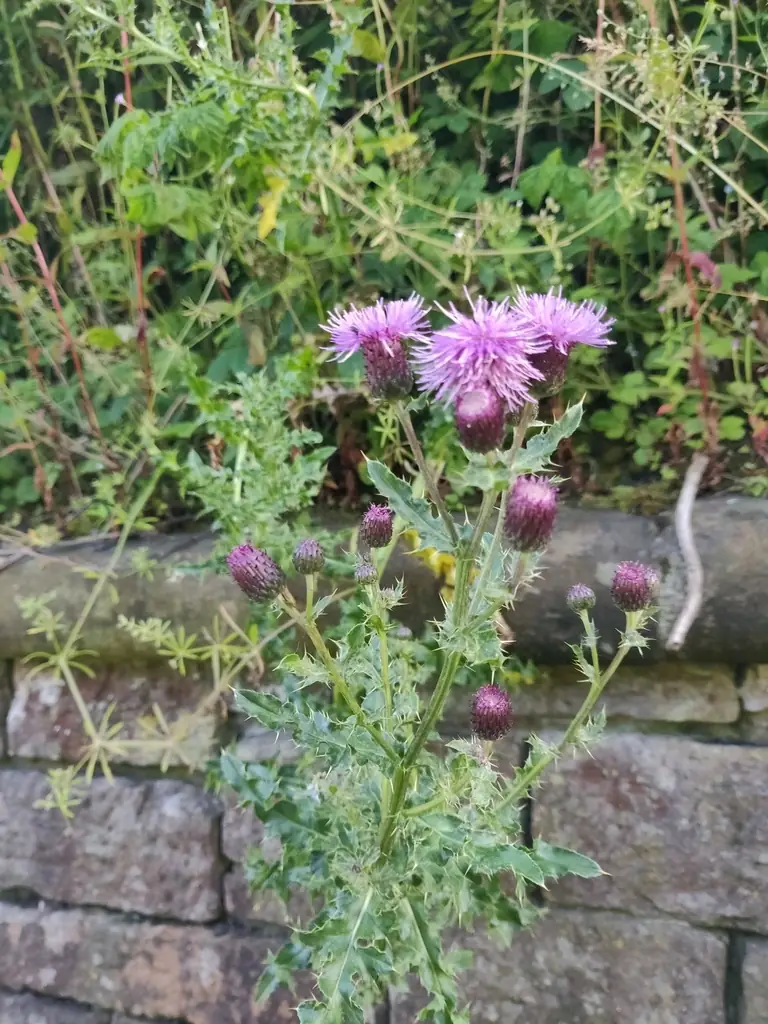
Canada thistle is also dioecious: each patch is usually one clone and one sex, so some patches never set seed while others do (Colorado State Extension). That’s why you can have a dense patch that has “never flowered” and still keeps growing. It’s spreading from roots, not seed. If you’re sorting several purple-flowered weeds at once, our guide to weeds with purple flowers helps narrow it down.
Why Canada Thistle Is So Hard to Kill
Here’s the part most quick-fix guides skip. Canada thistle stores its energy underground, in a root system that Penn State describes as able to reach 6 feet or more deep and spread about 15 feet sideways. Colorado State reports vertical roots of 6 to 15 feet. Those roots carry buds, and every bud is a potential new shoot.
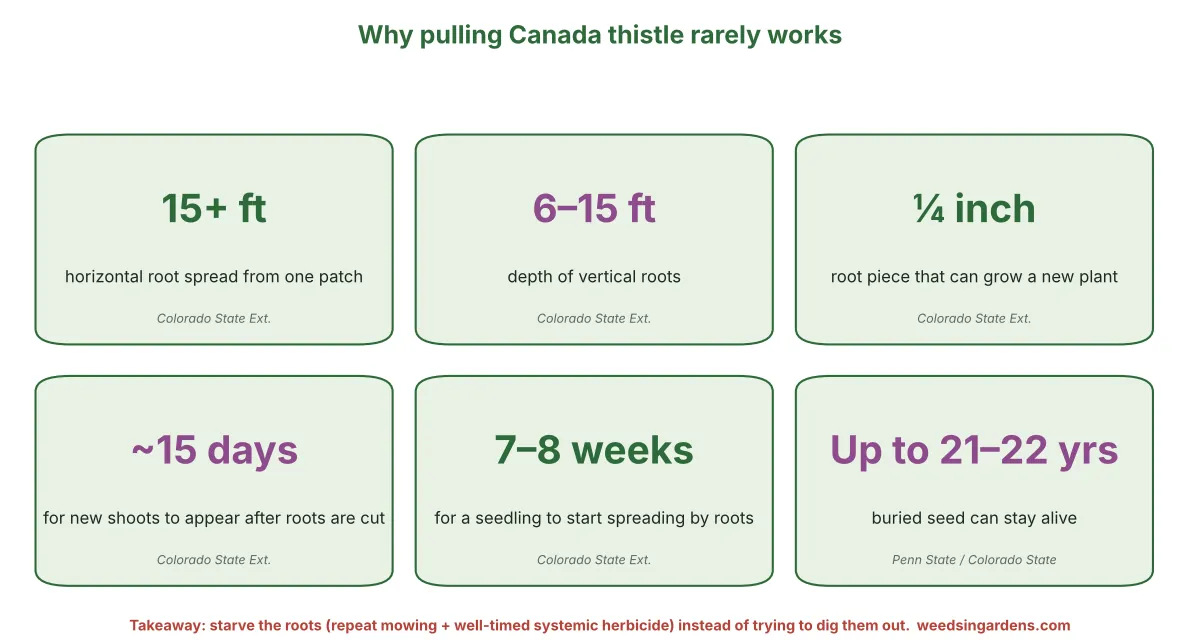
Now picture what pulling or tilling does. Colorado State found that root pieces just 0.25 inch long and 0.125 inch thick hold enough stored energy to grow a new plant, can survive at least 100 days without making food, and send up new shoots about 15 days after the soil is disturbed. So when you yank a stem or rototill a bed, you aren’t removing the plant. You’re cutting it into cuttings.
The roots also grow fast. A single plant can colonize a circle 3 to 6 feet across in one or two years, and seedlings start behaving like perennials, sprouting from their own roots, only seven to eight weeks after they germinate (Colorado State Extension, Fact Sheet 3.108). Add a seed bank that can stay alive for over 20 years when buried, and you can see why the job takes seasons, not a weekend.
The good news is that the same biology tells you how to win. A thistle shoot you cut off has to be replaced from root reserves. Each regrowth costs the root more than it earns until the new leaves mature. In fall, the plant flips into storage mode and sends sugars down to the roots, and a systemic herbicide sprayed then travels with them. The rest of this guide is about using those two facts.
How to Get Rid of Thistle in Your Lawn and Garden Beds: A 5-Step Plan
This plan targets Canada thistle, the one that causes real frustration, and it’s how to get rid of thistle that keeps returning to the same patch. If you’ve confirmed bull or musk thistle, skip to the biennial section below; it’s much quicker.
Step 1: Make the lawn the stronger competitor
Penn State’s turf team found that Canada thistle seedlings weaken when they’re shaded, and grass stands with a dense canopy hold thistle back better than thin ones. Montana State adds that mechanical and chemical control “will be much more successful” when the thistle has to compete with healthy grass. In practice, that means mowing cool-season grass at the high end of its range, fixing compacted or bare spots, and overseeding thin areas in early fall. Our guide on how to kill weeds before overseeding explains how to time a spray around new seed.
One caution from Colorado State: go easy on nitrogen. Excess available nitrogen can favor the weed as much as the grass, so fertilize to your soil test, not by guesswork.
Step 2: Mow or cut on a schedule, and never let it flower
Mowing alone won’t kill an established patch, and Iowa State says older stands are frequently “unphased” by it. What mowing does well is drain the roots and stop seed. Colorado State found mowing is effective only when it’s done at about one-month intervals over several growing seasons, and it works best combined with herbicide. In a regularly mowed lawn you’re already doing this. In rough corners, fence lines and meadows, mow or string-trim the thistle every few weeks from late spring through summer.
Hand removal has a place too, but only for a few young plants. Montana State recommends pulling or digging again every two to three weeks, whenever new stems appear, and putting the plants in the trash rather than the compost, since root fragments can start new plants. See our guide on how to dispose of invasive plants for safe disposal options.
Step 3: Spray in fall, the window that matters most
If you do only one thing to get rid of thistle, do this. Iowa State says Canada thistle is most susceptible to herbicides in fall, when the plant is actively growing and much of its growth goes into the underground stems. Fall spraying can be done late in the season, “even after the first frost, as long as leaves are still green.” That makes now, in early November, a good time in many northern and central areas if the rosettes still look healthy.
For the best results, let the thistle regrow after its last mowing so there’s plenty of leaf to absorb the spray. In one Colorado State regimen, a clopyralid + 2,4-D product worked better when it was preceded by two or three mowings about a month apart, with the spray applied in October roughly a month after the last cut. Then spray on a calm day. Montana State advises avoiding windy days and temperatures above 80°F, because products such as dicamba can turn to vapor and drift onto shrubs and flowers.
Step 4: Follow up in spring, before the buds form
Canada thistle shoots emerge from mid-April to mid-May in Pennsylvania, and flower heads start forming in June (Penn State). Penn State recommends a spring broadleaf application after most shoots have emerged but before plants get tall and set flower buds. Iowa State gives a matching window: early summer, “when flower buds are starting to form.” Most yards need both the fall and spring sprays for two or more years to get rid of thistle completely.
Step 5: Scout every season
Once the patch collapses, the job changes to patrol. New plants keep arriving from seed, and Iowa State warns that “even with the best of weeding efforts, new plants will appear in subsequent years.” A young thistle caught early, before it has seven or eight weeks to build roots, is easy to pull or spot-spray. The same “catch it early” logic applies to the perennials in our fall weed control guide.
In garden beds and vegetable gardens
Trying to get rid of thistle in beds is harder, because the selective lawn herbicides that kill thistle also damage flowers and vegetables, and Iowa State notes that nearly all the herbicides used for Canada thistle are not labeled for garden beds. Your options:
- Wipe, don’t spray. Iowa State suggests sponging the herbicide onto the thistle leaves only, and shielding nearby plants with buckets, boxes or plastic sheets. For a non-selective option, UMN lists glyphosate for spot treatment in gardens. Use a product labeled for the site and keep it off every leaf you want to keep.
- Cut at the soil line, repeatedly. Snipping every new shoot every week or two keeps the plant from refilling its roots. It’s slow, but it’s safe around crops.
- Shade it out. UMN reports some success by shading Canada thistle out. Heavy cardboard plus a thick mulch layer on an empty bed for a full season is the home-garden version. Watch the edges, where the roots will try to escape.
- Don’t till. Every pass of a tiller makes more root fragments. Our guide on how to stop weeds in mulch beds covers mulch depth and edging that help keep thistle from creeping back in.
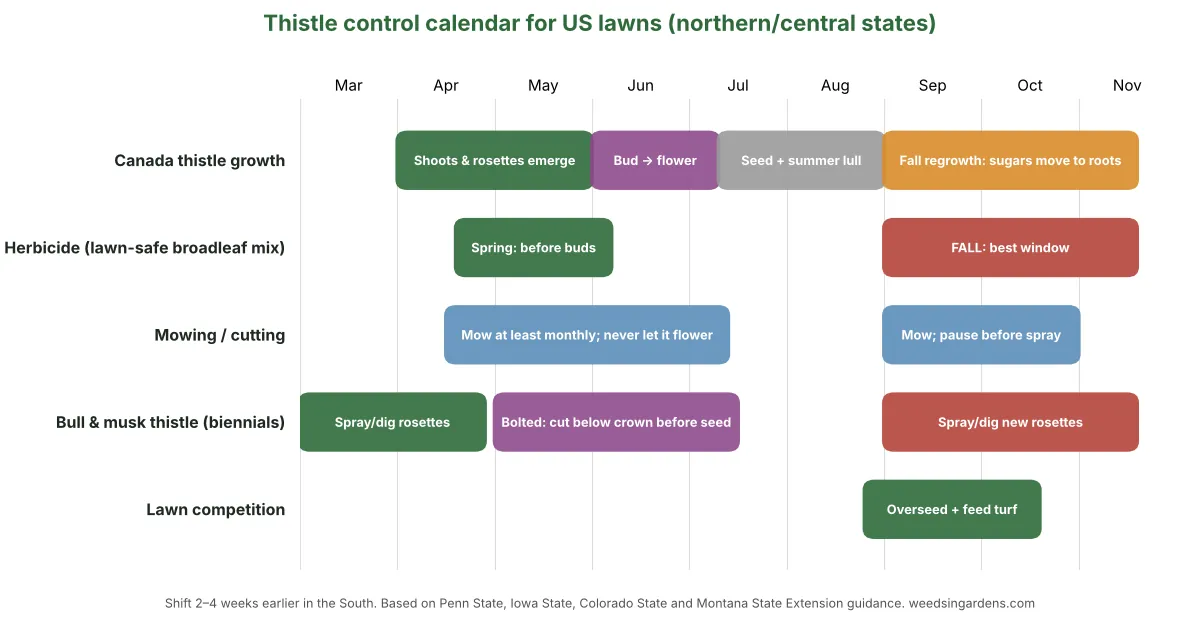
| Season | What Canada thistle is doing | What you should do |
|---|---|---|
| Early spring (Mar–Apr) | Root buds and seeds start to emerge as rosettes | Spray or dig biennial rosettes; mow and feed the lawn normally |
| Late spring (Apr–May) | Most shoots are up; stems elongate | Spring spray of a lawn-safe broadleaf mix after most shoots emerge, before buds |
| Early summer (Jun) | Flower buds form; flowering | Mow or cut before flowering; second spring-spray window at the bud stage |
| Mid–late summer (Jul–Aug) | Seeds disperse; growth slows in heat | Keep mowing; don’t spray above 80°F; plan fall overseeding |
| Early fall (Sep) | Regrowth; energy moves to roots | Let leaves regrow after the last mow; overseed thin turf |
| Mid–late fall (Oct–Nov) | Rosettes stay green through light frost | Main herbicide window: spray while the leaves are green |
| Winter | Top growth dies back; roots alive | Map patches so you know where to look in spring |
Thistle Killers for Lawns: Which Active Ingredients Work
Ignore the brand names for a moment and read the active ingredients on the back of the bottle. That’s what decides whether a product kills thistle, and whether it’s legal on your lawn. Every source here repeats the same rule, and so do we: follow the label. It lists the grasses the product is safe on, the rate, and any temperature limits, and it overrides anything in an article.
| Active ingredient(s) | Where it’s used | What to know |
|---|---|---|
| 2,4-D + MCPP (mecoprop) + dicamba (“three-way”) | Home lawns | The classic lawn broadleaf mix; Penn State lists several three-way products for Canada thistle. Dicamba can volatilize in heat, so spray below 80°F. |
| 2,4-D or MCPA + fluroxypyr and/or triclopyr | Home lawns | Named by Montana State and Penn State for Canada thistle. Triclopyr and fluroxypyr strengthen the mix on tough perennials. |
| Mixes with carfentrazone or quinclorac | Home lawns | Listed by Iowa State. Carfentrazone burns top growth quickly; the auxin partners do the root work. |
| Clopyralid | Mostly non-residential turf, pastures | A standard for Canada thistle on golf courses, but Penn State notes certain clopyralid products should not be used on residential turf. Check the label. |
| Aminopyralid (+ 2,4-D) | Range, pasture and natural areas only | Very effective on Canada thistle (Enloe et al., 2007), but not for home lawns, ornamentals or high-maintenance turf. |
| Glyphosate | Spot use in beds and non-lawn areas | Non-selective: kills grass and garden plants too. Wipe or shield-spray only the thistle leaves. |
A practical note on what you’ll see: these are systemic products, so the thistle twists and yellows over the following weeks rather than collapsing overnight. Older plants killed in spring can leave stiff dead stems standing for weeks, which Penn State also observed in its trials, so a fall treatment of low rosettes gives a cleaner result. For a deeper look at how these products work, read our guide to post-emergent herbicides.
Skip mowing for a few days before and after spraying (the label gives the exact interval), because the herbicide needs leaf surface to land on and time to move down to the roots. And don’t treat a lawn you just seeded until the new grass is established, as the label will explain.
Bull and Musk Thistle: The Easiest Thistles to Get Rid Of
If your identification pointed to a biennial, relax. These plants have a single taproot and no spreading root network, and every plant dies after it sets seed. That means you only need to stop each plant from seeding, and the population falls. To get rid of thistle of this type:
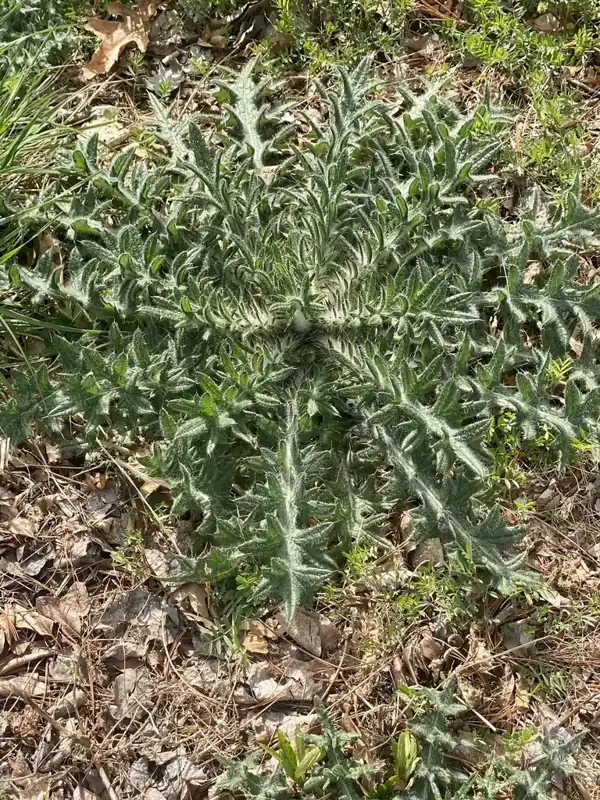
- Dig below the crown. Iowa State says isolated plants can be removed by cutting the plant below the crown with a spade or hoe. Slice just under the soil surface, below the crown, so the crown buds can’t resprout.
- Spray rosettes, not bolted plants. Biennial thistles are much easier to kill in the rosette stage, so spray in fall or early spring before the stem starts to grow. Iowa State notes fall treatments work well “after several frosts have occurred,” while thistle tolerance “increases greatly after bolting.” The same lawn-safe broadleaf mixes in the table above work in turf.
- Mow at least twice before seed. Cutting a bolted plant prevents seed, but dormant crown buds often resprout, so Iowa State recommends at least two summer mowings to stop seed production completely.
- Bag the flower heads. A musk thistle averages about 50 heads, each producing several hundred seeds (Iowa State). Once flowers have opened, cut the heads into a bag rather than leaving them on the ground.
A word on biological control: musk thistle weevils have been released throughout the Midwest, and Colorado State discusses a stem-mining weevil and a gall fly for Canada thistle. They suit large, undisturbed infestations and take years to have an effect. They don’t fit a mowed lawn, and Iowa State notes the musk thistle weevil also lays eggs on other thistles that flower at the right time, which can include natives. That’s one more reason to identify the plant before you act.
What Works and What Doesn’t: Thistle Methods Compared
Honestly, most of the wasted effort people spend trying to get rid of thistle comes from using a biennial method on a perennial weed. Here’s how the common methods stack up against Canada thistle, with a rough idea of what each costs you in time.
| Method | Effect on Canada thistle | Time and cost | Verdict |
|---|---|---|---|
| Pulling or digging | Removes top growth; root fragments as small as ¼ in regrow | Repeated every 2–3 weeks; free | Only for a few young plants |
| Tilling | Cuts roots into many new plants within about 2 weeks | Low effort, high regret | Avoid |
| Vinegar or boiling water | Burns leaves; roots untouched | Cheap, many repeats | Top-kill only; see our vinegar test |
| Regular mowing alone | Drains roots slowly; stops seed | Already part of lawn care | Helpful, rarely enough by itself |
| Selective broadleaf herbicide, spring only | Kills tops; some root kill | 1 spray a year | Better, but patches return |
| Mowing + fall herbicide + spring follow-up | Steadily depletes and kills roots | 2–3 sprays a year for 2+ years | The most reliable plan for lawns |
| Smothering (cardboard + mulch) | Shades shoots; roots weaken over a season or more | One afternoon, one season of waiting | Good for empty beds |
A Note from the Agronomist’s Side
Think of a Canada thistle patch as a bank account with a big balance kept underground. Every method on this page either makes a withdrawal or blocks a deposit. Mowing makes a withdrawal, because the plant has to spend root reserves to replace the leaves. Shading by dense turf blocks deposits. A fall herbicide is the closest thing to closing the account, because in autumn the plant is actively moving sugars down to the roots and the herbicide moves with them. That’s why every extension source in this guide returns to the same point: the timing matters more than the brand.
The second principle is patience measured in seasons. Nobody can get rid of thistle with deep roots in a single spray. Colorado State’s fact sheet says it plainly: success “requires a sound management plan implemented over several years.” A realistic goal is a large drop in shoots after the first fall-plus-spring cycle and a few stragglers in year two. If shoots return in the second spring, that’s not failure. It’s the leftover root reserve, and each round leaves it smaller.
Third, read the label as carefully as you read the patch. The ingredients that are most effective on Canada thistle in fields, such as aminopyralid and many clopyralid products, are often the ones not allowed on home lawns. Those restrictions exist for good reasons, and the label, not the weed, decides where a product can go. Staying with lawn-labeled mixes and spraying them at the right moment will get you most of the benefit with far less risk.
Finally, keep the native thistles in perspective. Field and tall thistle seldom spread into managed turf, and UMN points out that native thistles provide food and habitat for birds and insects. Removing a Canada thistle colony from a lawn is good stewardship; spraying every thistle in a wildflower meadow is not.
FAQ: Getting Rid of Thistle
What is the fastest way to get rid of thistle?
For bull or musk thistle, cut the taproot just below the crown with a spade, which removes the plant in seconds. For Canada thistle there is no one-day fix: spray a lawn-safe broadleaf herbicide in fall while leaves are green, follow up in spring before buds form, and repeat for at least two seasons.
Should I pull Canada thistle?
Only a few small, young plants, and plan to repeat every two to three weeks. Pulling mature Canada thistle snaps the stem and leaves root pieces behind; Colorado State found root fragments as small as a quarter inch can regrow into new plants.
What kills thistle but not grass?
Selective lawn broadleaf herbicides that contain 2,4-D, MCPP, MCPA, dicamba, triclopyr, fluroxypyr, carfentrazone or quinclorac, in the combinations labeled for your grass type. Read the label for turf-type restrictions and temperature limits, and avoid spraying above 80°F.
When is the best time to kill thistle?
Fall. Iowa State Extension says Canada thistle is most susceptible to herbicides in fall, when growth is going into its underground stems, and applications can be made even after the first frost as long as the leaves are still green. The second-best window is late spring, before flower buds form.
Does vinegar kill thistle permanently?
No. Household or horticultural vinegar burns the leaves it touches but does not move into the roots, so Canada thistle regrows from its root system. It can kill very young seedlings, but it isn’t a permanent fix for established patches.
Will mowing get rid of thistle?
Mowing alone rarely eliminates an established Canada thistle patch, but it stops flowering and seed, and it drains root reserves. Colorado State found mowing works only when repeated at about one-month intervals over several growing seasons, and best when combined with a fall herbicide.
How do I stop thistle from coming back?
Once you get rid of thistle, keep the lawn thick, since dense turf shades out thistle seedlings; never let thistle flower; scout each spring and fall for new plants; and spot-treat young plants within their first weeks, before they develop a creeping root system.
More help: browse every guide in our Lawn Weeds category.
Sources
- Abbey, T., Landschoot, P., and Delvalle, T. Lawn and Turfgrass Weeds: Canada Thistle [Cirsium arvense (L.) Scop.]. Penn State Extension, updated May 2026.
- Steil, A. Control of Canada Thistle. Iowa State University Extension and Outreach, Yard and Garden, reviewed April 2025.
- Hartzler, B. Biennial Thistles of Iowa. Iowa State University Integrated Crop Management.
- Beck, K.G. Canada Thistle. Colorado State University Extension Fact Sheet 3.108.
- Mangold, J. and Orloff, N. Managing Canada Thistle in Lawns. Montana State University Extension, Monthly Weed Post, August 2020.
- Burley, N., Gupta, A., Rager, A., and Weber, M.M. Canada thistle. University of Minnesota Extension, reviewed 2026.
- Enloe, S.F., Lym, R.G., Wilson, R., et al. (2007). Canada thistle (Cirsium arvense) control with aminopyralid in range, pasture, and noncrop areas. Weed Technology 21:890–894.