
Mushrooms in lawn grass are almost always a sign of healthy soil life, not a lawn disease. They are the short-lived fruiting bodies of fungi that are breaking down buried wood, old roots and thatch, and they pop up after rain or heavy watering. The grass rarely needs treatment, and fungicides will not make them go away. The two real reasons to act are safety (some lawn mushrooms are poisonous to dogs and children) and appearance, and both are handled by picking, drying the lawn out and removing the food source.
This guide explains why mushrooms appear where they do, how to tell a harmless flush from a fairy ring that is actually killing grass, what to do the moment your dog eats one, and which fixes extension specialists say work. Every number below comes from a university extension service or veterinary poison-control source listed at the end.
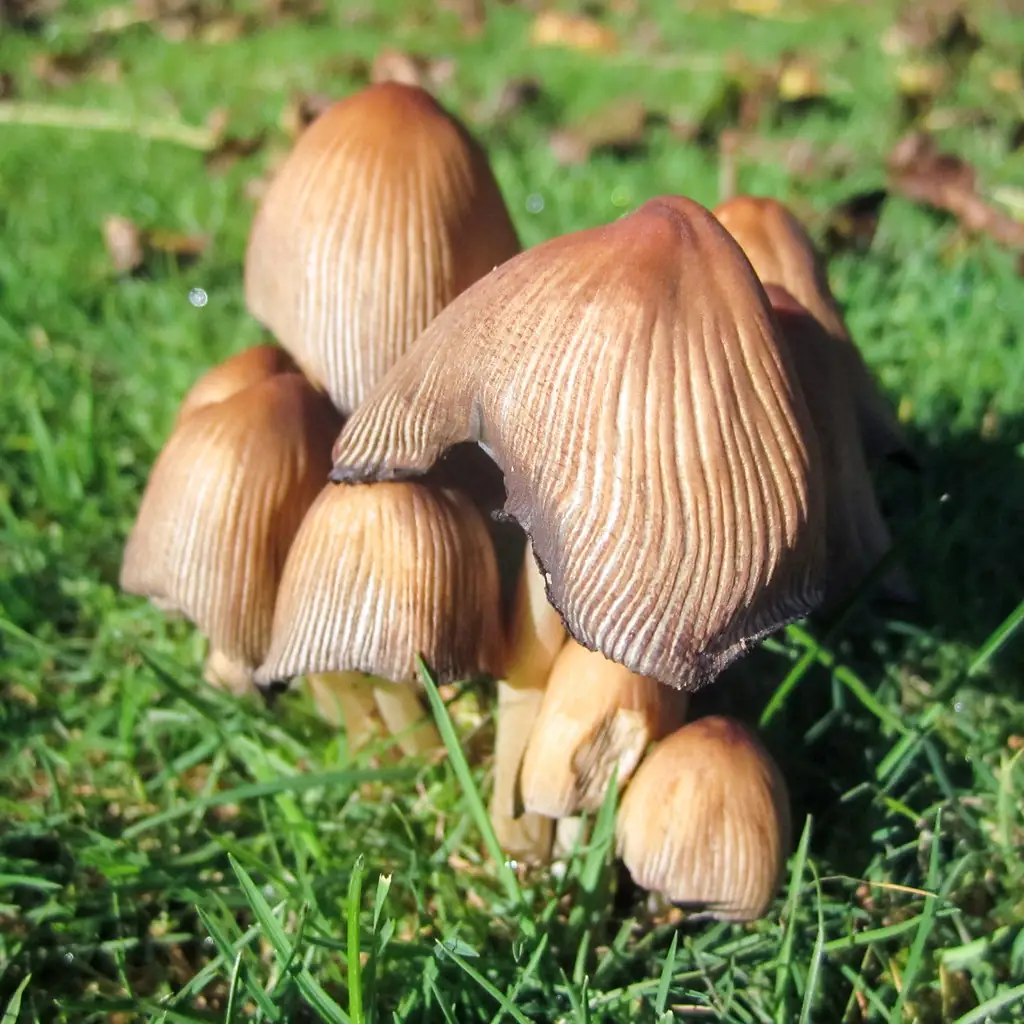
Why Mushrooms Pop Up in Your Lawn
A mushroom is only the reproductive part of a much larger organism. The main body of the fungus is the mycelium, a mat of fine threads (hyphae) hidden in the soil and thatch. As University of Maryland Extension puts it, many of these fungi recycle nutrients or partner with tree roots, and they live in the lawn whether or not you see mushrooms.
The mycelium only produces mushrooms when moisture and food line up. University of Minnesota Extension links lawn mushrooms to heavy rain or excessive irrigation, and UC IPM adds that the fungi can persist in soil for years and fruit mainly after prolonged wet weather. That is why a lawn can be clean all summer and then sprout dozens of caps after a wet week in early fall.
The five usual food sources
- Buried wood. Old stumps, tree roots left after removal, construction lumber and deep wood chips. UMD lists jack-o’-lantern, stinkhorn, Armillaria and Ganoderma among the mushrooms that fruit from decaying wood.
- Thick thatch and organic matter. Decomposer fungi feed on dead roots, clippings and thatch; UC IPM ties lawn mushrooms to excess thatch, overirrigation and poor drainage.
- Living tree roots. Mycorrhizal fungi that partner with nearby trees can fruit in the turf around them. They are beneficial.
- New sod. The frequent watering new sod needs favors small brown lawn mushrooms such as Panaeolus foenisecii and Conocybe, which UC IPM says disappear once irrigation is reduced.
- A dying tree. Clusters at the trunk or on surface roots can signal wood-decay pathogens such as Armillaria or Ganoderma. UMD recommends having the tree checked by a certified arborist, because wood decay cannot be cured.
Overwatering is the factor you control most directly. If mushrooms keep appearing in the same low spot, read our guide to signs of an overwatered lawn; the fix for one usually fixes the other.
Are Mushrooms in Lawn Grass Bad for the Grass?
Usually not. UMN states that “a vast majority of mushrooms in lawns are not related to disease,” and UC IPM describes most lawn fungi as beneficial decomposers. The fungus is turning dead organic matter into nutrients, especially nitrogen, that the grass then uses. Many lawn disease fungi have tiny fruiting bodies you would never mistake for a mushroom.
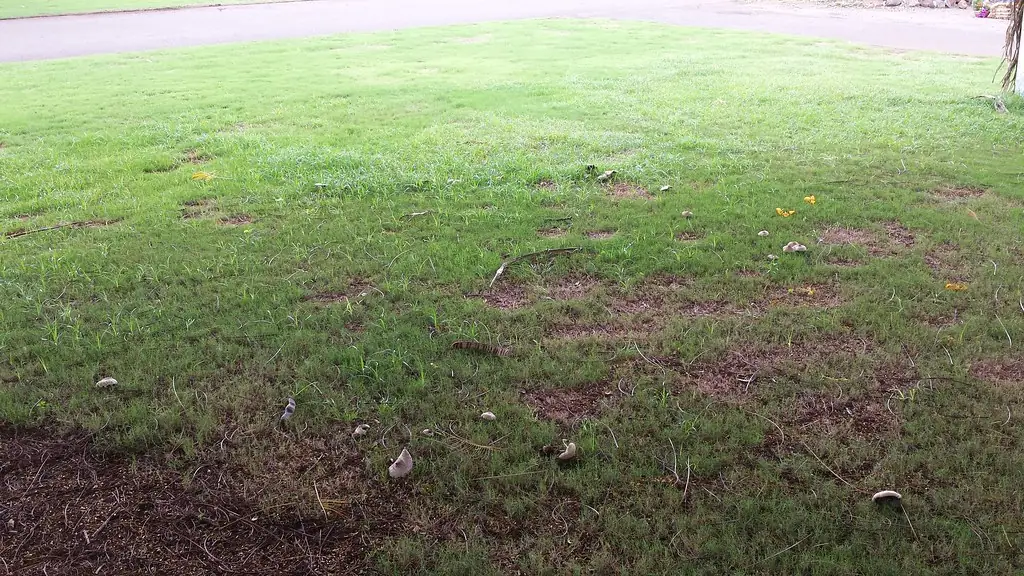
The exception is a Type 1 fairy ring, where the mycelium becomes so dense that it repels water and the grass above it dies of drought. The table below shows how to sort what you are seeing.
| What you see | Likely cause | Harm to grass | What to do |
|---|---|---|---|
| Scattered caps after rain, gone in days | Decomposer fungi in thatch or soil | None | Mow or pick; reduce watering |
| Cluster in one spot, returns each wet spell | Buried stump, root or lumber | None to the turf | Pick; dig out the wood if practical |
| Honey-colored clusters at a tree base in fall | Armillaria (UC IPM) | Signals a declining tree | Arborist inspection |
| Dark green circle or arc, mushrooms after rain | Fairy ring Type 2 or 3 | Cosmetic | Mask with fertilizer and irrigation |
| Ring of dead or wilted grass, dry soil | Fairy ring Type 1 (hydrophobic soil) | Kills turf | Core aerate, soak, wetting agent |
| Small brown caps in new sod | Panaeolus, Conocybe | None | Cut back irrigation once rooted |
| Gray, white or yellow slimy patches | Slime mold (not a true fungus) | Only shading if dense | Rake, mow or hose off |
How to Identify Common Lawn Mushrooms (and Look-Alikes)
You do not need to name the species to manage mushrooms in lawn areas, and you should never use these features to decide whether a mushroom is edible. UC IPM is clear that only an expert can reliably tell edible from poisonous species, and that there is no simple home test. The groups below simply help you match what you see to the right action.
Cap-and-stem mushrooms
These are the classic toadstools. One worth knowing is Chlorophyllum molybdites, the green-spored parasol, a large white mushroom with brownish scales that forms fairy rings in lawns. Mycologist Thomas Volk of the University of Wisconsin–La Crosse notes its gills and spore print turn greenish with age, that it causes severe gastrointestinal illness, and that it is among the most common causes of mushroom poisoning in North America.
Inky caps
Inky caps (Coprinus and relatives) have bell-shaped caps that, according to UC IPM, dissolve into a dark liquid shortly after appearing. They often come up in clusters from buried roots.
Puffballs and earthballs
Puffballs are round, stemless balls, usually about an inch or less across in lawns, creamy white when young and full of dark spores when mature (UC IPM). Earthballs look similar but are firmer; the ASPCA lists Scleroderma (earthballs) as a cause of vomiting and diarrhea in pets.
Stinkhorns
Stinkhorns start as an egg-shaped lump and grow into a finger- or phallus-shaped stalk tipped with a foul-smelling slime that attracts flies. They grow from buried dead wood and can be dug out or hand-picked.
Bird’s nest fungi and slime molds
Bird’s nest fungi are tiny cups holding egg-like spore packets; UC IPM knows of none that are toxic. Slime molds are not true fungi at all. They appear as gray, white, pinkish or yellow patches in warm, wet weather and, per UMD, turn powdery and vanish after several dry days.
Mushrooms in Lawn and Dogs: Risks and What to Do
This is the section that matters most. The ASPCA says most mushrooms are not fatal to pets, but many cause illness that needs veterinary care, and a few are deadly. In 2025 the NC State College of Veterinary Medicine reported two dogs dying of mushroom poisoning in the same week, both referred with severe liver failure.
The dangerous trick is timing. Mild stomach-upset mushrooms act fast, but the liver-destroying amanitins found in the death cap (Amanita phalloides) produce no signs for hours. The ASPCA Animal Poison Control Center says amanitin signs can be delayed 6 to 12 hours; the ASPCA consumer guide gives 8 to 24 hours. NC State adds that dogs may then go through a misleading “honeymoon” phase when they seem better before liver failure sets in.
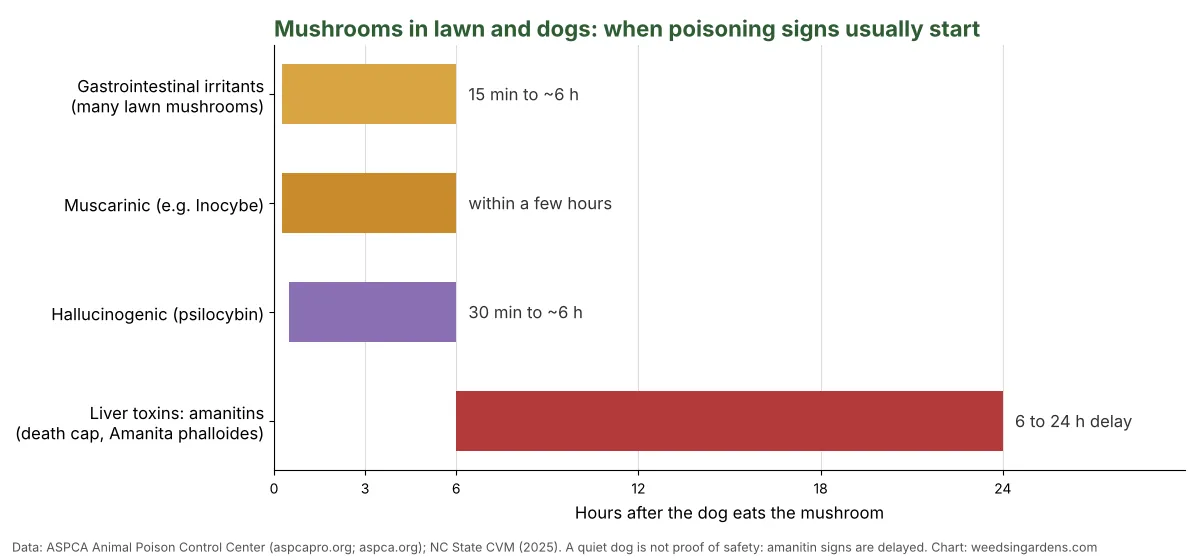
| Toxin group | Example | Typical onset in dogs | Main signs |
|---|---|---|---|
| Gastrointestinal irritants | Earthballs (Scleroderma), many lawn species | 15 minutes to under 6 hours | Vomiting, diarrhea, dehydration |
| Muscarinic | Inocybe | Within a few hours | Vomiting, diarrhea, drooling, slow heart rate |
| Hallucinogenic | Psilocybin species, Conocybe | 30–90 minutes, usually within 6 hours | Wobbliness, agitation, tremors |
| Isoxazoles | Some Amanita species | Varies | Disorientation, agitation, tremors, seizures |
| Hepatotoxic (amanitins) | Death cap, Amanita phalloides | 6–24 hours (delayed) | GI upset, then liver failure; can be fatal in 1–2 days |
Sources for the table: ASPCA Animal Poison Control Center and ASPCA pet-owner guidance.
If your dog eats a lawn mushroom
- Do not wait for symptoms. Call your veterinarian or the ASPCA Animal Poison Control Center at (888) 426-4435 straight away.
- Collect any remaining mushrooms of the same kind, including the base, in a paper bag. Take close-up photos of the cap, gills and stem, and of where they were growing, as the ASPCA advises.
- Follow the vet’s instructions. Do not try to induce vomiting at home unless a veterinarian tells you to.
- Ask about identification. The APCC suggests a mycologist at a local university or a volunteer listed by the North American Mycological Association can help identify samples once the pet is stable.
The same urgency applies to toddlers. For a child, call Poison Control at 1-800-222-1222 in the US.
How to Get Rid of Mushrooms in Lawn Areas: 7 Methods That Work
No method permanently removes the fungus from a living lawn; UMD says plainly that there is no practical or permanent way to eliminate lawn mushrooms. What you can do is stop the fruiting, remove the food and make the lawn less inviting. Ranked roughly from quickest to most involved:
1. Pick, rake or mow them off
Removing caps does not kill the mycelium, but UC IPM notes that early removal can limit spore spread and, more importantly, keeps children and pets from eating them. Wear gloves, bag the caps and put them in the trash, not the compost. Mowing chops them up but leaves pieces a dog could still eat.
2. Water less, and water in the morning
Because overirrigation is a key trigger, deep and infrequent watering early in the day helps the surface dry. UMN recommends reducing or turning off irrigation to dry the lawn. Fall rain often does the job for you, so turn off automatic schedules once temperatures drop; our guide on watering grass in cold weather covers when to stop.
3. Core aerate to improve drainage
UMN recommends fall aeration to relieve compaction and improve drainage, and UC IPM lists aeration and thatch removal as ways to improve drainage. If your soil stays soggy, see our notes on aerating a lawn after rain and fixing compacted soil.
4. Reduce excess thatch
A thatch layer gives decomposer fungi a ready food supply. Dethatching or power raking removes it, but timing matters for your grass type; weigh it up with our dethatching pros and cons guide.
5. Remove buried wood
If mushrooms return to the same spot, probe for a stump, root or old lumber. UMN recommends grinding or digging out stumps and roots after tree removal. Otherwise, UMD notes, the flushes fade once the wood has fully broken down.
6. Feed nitrogen-hungry turf
UC IPM reports that a readily available (not slow-release) nitrogen fertilizer at 1 lb of actual nitrogen per 1,000 sq ft can eliminate some mushrooms or speed decomposition of the organic matter they feed on. Examples it gives per 1,000 sq ft: 5 lb of ammonium sulfate (21-0-0) or 4 lb of a 27-3-4 product. Base fertilizer on a soil test, and avoid heavy nitrogen on cool-season grass in summer heat.
7. Improve light and airflow
Shaded, damp corners stay wet longer after rain. Thinning low tree limbs lets the turf dry faster and grow denser. The same changes help with other shade problems such as moss in lawns.
What does not work: fungicides, vinegar and baking soda
Fungicides are the wrong tool for ordinary lawn mushrooms. UC IPM says the fungicides labeled for fairy rings (such as azoxystrobin and flutolanil) are not readily available to home gardeners and need multiple well-timed applications, and NC State notes that curative sprays have little effect. Household sprays such as vinegar or baking soda are not recommended by any of the extension sources reviewed here; at best they wither the caps you can see, which picking does just as well without damaging the grass.
Fairy Rings: When Mushrooms Mean a Real Problem
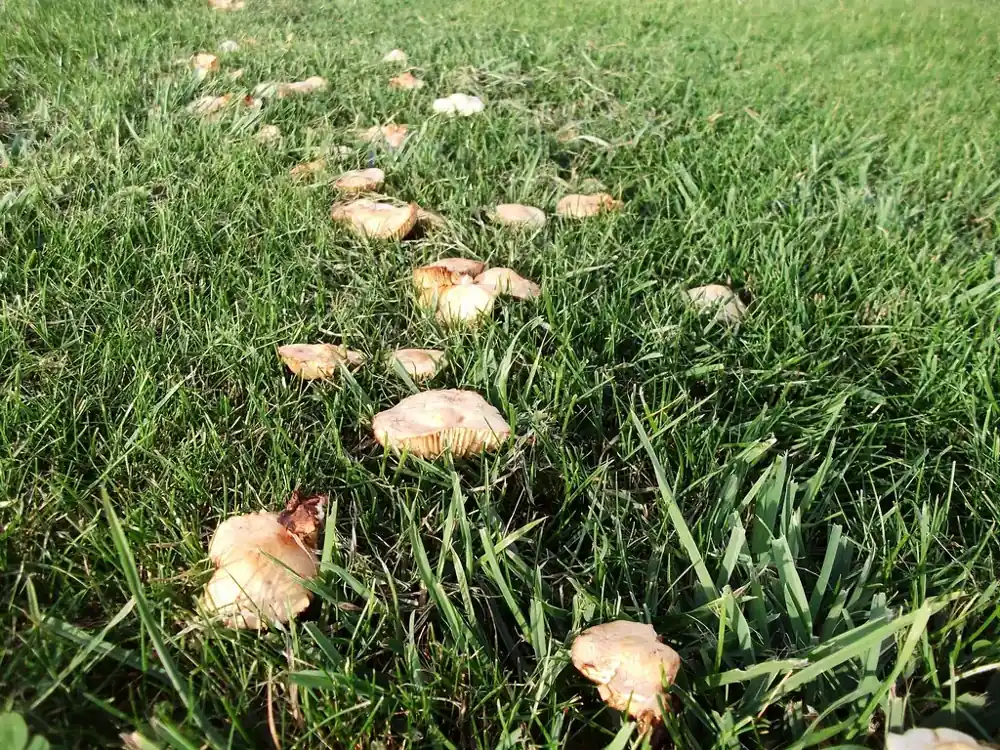
A fairy ring is a circle or arc of mushrooms, dark green grass or dead grass caused by one fungus growing outward from a central point. The University of Arkansas counts about 50 soil fungi that can cause them, with Chlorophyllum, Lycoperdon (puffballs) and Marasmius the most common in the South. UMD reports rings typically 1 to 20 feet across, expanding roughly 3 to 19 inches per year, faster in sandy, moist soils.
| Fairy ring type | What it looks like | Main cause | Management (extension advice) |
|---|---|---|---|
| Type 1 | Ring of dead or wilting grass, often between two green bands | Dense mycelium makes soil water-repellent | Core aerate (UMD: the ring plus 2 ft each side), apply a wetting agent, soak deeply |
| Type 2 | Dark green, faster-growing ring or arc | Nitrogen released as fungi decompose organic matter | Fertilize the rest of the lawn to mask contrast; use iron instead of extra nitrogen on cool-season grass in summer (NC State) |
| Type 3 | Mushrooms or puffballs in a ring, no turf change | Wet weather, poor drainage, overwatering | Pick or mow mushrooms; improve drainage |
Rescuing a Type 1 ring
The goal is to get water through the water-repellent layer. UC IPM suggests probing to find how deep the white fungal mat goes. If it is under 3 inches, aerate several times a year, starting 2 feet outside the ring and working inward with cores slightly deeper than the mat. The University of Arkansas advises soaking the area to 1 to 2 feet deep weekly for four to six weeks after spiking, and says wetting agents may help.
Full removal (digging out soil at least 1 foot deep and 18 inches beyond the ring, per UC IPM) is a last resort; Arkansas notes rings often return if the food source remains. Clean aerator tines afterward so you do not carry infested soil to healthy turf.
What about fungicides for fairy rings?
The NC State fairy ring guide rates flutolanil, tebuconazole and several combinations as excellent and azoxystrobin as good, but stresses that fungicides work only preventively: “curative applications have little effect.” Programs start in spring once mean daily soil temperature is consistently above 55°F, and are watered in with 1/8 to 1/4 inch of irrigation. Several listed products are not labeled for home lawns. For most homeowners, the cultural fixes above are cheaper and, according to UC IPM, generally faster. If you do use a product, read and follow the label for turf type, rate and re-entry interval.
Seasonal plan for mushroom-prone lawns
Because mushrooms are a symptom of moisture plus organic matter, the plan is mostly about water and soil through the year. Adjust timings for your grass type and region.
| Season | What to expect | Actions |
|---|---|---|
| Early fall (Sep–Oct) | Peak flushes after rain; fairy rings show clearly | Pick caps before pets go out; cut irrigation; core aerate cool-season lawns |
| Late fall–winter | Rings fade; fungi persist in soil | Rake leaves so turf dries; probe for stumps and roots; plan wood removal |
| Spring | Mushrooms return in cool, wet spells | Light dethatch if thatch is thick; soil test; start fairy ring prevention only on high-value turf once soil is above 55°F |
| Summer | Type 1 rings brown out in heat and drought | Spot-soak Type 1 rings deeply; use iron rather than extra nitrogen on cool-season grass |
A note from the agronomist’s side
From a soil-biology point of view, a flush of mushrooms is a sign that decomposition is working. The fungi are converting thatch, dead roots and old wood into plant-available nutrients, which is why Type 2 rings are greener than the lawn around them. Treating that with fungicide would be like treating a compost heap: expensive, temporary and aimed at the wrong target.
The sound approach is to separate three questions. Is anything eating them? If dogs or small children use the lawn, daily picking during wet spells is the single most important step, because the delayed onset of amanitin poisoning means you cannot wait and watch. Is the grass dying? If not, it is cosmetic. If it is, look for hydrophobic soil and fix the water, not the fungus. Is there a food source you can remove? Buried wood is the one cause you can permanently eliminate.
It is also worth reading the pattern. Mushrooms only in one corner usually point to buried wood or poor drainage; mushrooms all over a newly sodded lawn point to watering frequency; a perfect arc points to a fairy ring. Matching the fix to the pattern saves time and avoids unnecessary products.
[AUTHOR NOTE — replace with your own observation or photo before publishing]
FAQ
Should I remove mushrooms from my lawn?
Remove them if dogs or young children use the lawn, or if you dislike the look. Picking does not kill the fungus underground, but it keeps them from being eaten and can limit spore spread. Otherwise they disappear on their own once the weather dries.
Do mushrooms in the lawn mean the soil is healthy?
Generally yes. Most lawn mushrooms come from fungi that decompose thatch, roots and buried wood, recycling nutrients for the grass. University of Minnesota Extension notes the vast majority are not related to lawn disease.
Will vinegar or baking soda kill lawn mushrooms?
Extension services do not recommend them. They may wither the visible caps, but they do not reach the mycelium in the soil and vinegar can scorch the grass. Picking the caps and reducing moisture is safer and works as well.
Are lawn mushrooms poisonous to dogs?
Some are. The ASPCA says most mushrooms are not fatal, but many cause vomiting and diarrhea, and death cap types can cause fatal liver failure with signs delayed 6 to 24 hours. Call your vet or ASPCA Poison Control at (888) 426-4435 right away if your dog eats one.
Why do mushrooms keep coming back in the same spot?
A repeat spot usually has a food source such as a buried stump, roots or old lumber, or it stays wet because of poor drainage. Digging out the wood or improving drainage stops the cycle; otherwise flushes continue until the wood fully decays.
Does fungicide get rid of mushrooms in lawn grass?
Not in any practical way. University of Maryland Extension says there is no practical or permanent way to eliminate lawn mushrooms. Fungicides labeled for fairy rings only work preventively, need repeat applications and are mainly used on golf and high-value turf.
Why do mushrooms appear overnight after rain?
The fungus lives in the soil all season. When moisture and temperature are right, it pushes up fruiting bodies very quickly, often overnight, to release spores. UC IPM notes fruiting happens mainly after prolonged wet weather.
Sources
- University of Minnesota Extension. Mushrooms in lawns.
- University of Maryland Extension, Home & Garden Information Center. Mushrooms and fairy rings in lawns.
- University of California Statewide IPM Program. Mushrooms and other nuisance fungi in lawns.
- NC State Extension. Fairy ring in turf (turf pathology factsheet with fungicide efficacy table).
- Vann, S. Fairy Ring of Turfgrass, FSA7539. University of Arkansas Division of Agriculture Cooperative Extension Service.
- ASPCA Animal Poison Control Center (ASPCApro). Mushroom poisoning in dogs.
- ASPCA (2017). Not-so-magic mushrooms: tips to keep your pets safe.
- Wheeler, B. E. (2025). Pet owner alert: toxic mushrooms claim dogs’ lives. NC State College of Veterinary Medicine.
- Volk, T. J. (1999). Chlorophyllum molybdites, Tom Volk’s Fungus of the Month. University of Wisconsin–La Crosse.