
You finally cleared the bed by the front walk, and the garden center has a tidy roll of black “weed barrier” that promises no more weeding. Lay it down, cover it with mulch, done. Two springs later, though, grass is rooting straight through the cloth, the mulch on top has turned into a seedbed, and pulling anything tears the fabric. So is the stuff worth it or not?
Short answer: the real landscape fabric pros and cons come down to where you use it. Under gravel, rock and in permanent shrub beds, a heavy, tightly woven or spunbonded fabric that is pinned tight does reduce weeds and keeps stone from sinking into soil. In flower, vegetable and perennial beds it usually fails within a few years, because weeds grow in the mulch on top, roots grow through it, and the fabric clogs and complicates every replanting. Coarse wood-chip mulch alone often does as well or better.
By the end of this guide you’ll know what the research actually measured, which fabric types hold up, exactly where fabric earns its place, how to install it properly if you use it, and what to do instead in your planting beds.
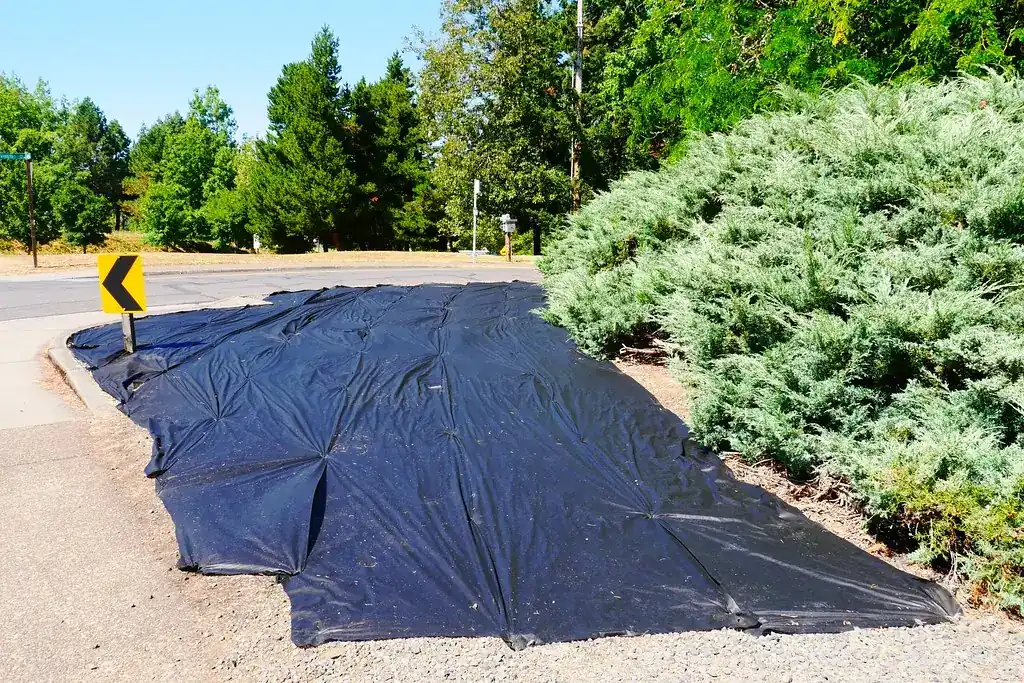
Landscape Fabric Pros and Cons at a Glance
Before the details, here’s the honest scorecard. Each line below is drawn from university extension guidance or published field and greenhouse trials listed in the Sources section.
| Pros | Cons |
|---|---|
| Blocks light, so fewer weed seeds germinate in the soil below (WSU Extension) | Weeds still germinate in the mulch or debris that collects on top |
| Under mulch, gives more weed control than mulch alone in some tests (UC IPM) | Weed and shrub roots grow through it, so pulling tears holes (Appleton & Derr 1990) |
| Keeps rock and gravel from sinking and soil from rising through it (UC IPM) | Pores clog with soil over time and can leave soil beneath dry (Illinois Extension) |
| Lets air and water pass, unlike solid black plastic (UC IPM) | Organic mulch can’t break down into the soil, so the soil isn’t improved |
| Can be cost-effective where plantings stay put 4 or more years (UC IPM) | Not suited to beds you replant, divide or fill with groundcovers (UC IPM) |
| Heavy fabrics suppress some tough weeds, at least for a season (UH CTAHR 2024) | Yellow nutsedge grows through most geotextiles (UC IPM); weed control fades within a few years (Illinois Extension) |
Notice the pattern. Most of the pros are about stone and permanence. Most of the cons appear the moment you add organic mulch, plants that need dividing, or time.
What the Research Says About Weed Barrier Fabric
Extension advice can sound like opinion until you see the numbers. Three trials in the Journal of Environmental Horticulture are the backbone of what we know about landscape fabric pros and cons, and they agree more than you’d expect.
Fabric alone barely slowed weeds in a planted bed
At the University of Delaware, Watkinson and Pill (2007) planted wildflower plugs into killed turf and compared no cover, woven polypropylene fabric alone, 3 inches (7.5 cm) of shredded wood mulch alone, and fabric plus mulch. Weeds sprang up in the fabric plots within a week of planting, entering through the planting cuts and around the edges.
At 90 days, weeds covered 93–100% of the fabric-only plots, about the same as bare ground. Mulch-only plots had just 0.8–8.5% weed cover. The authors concluded that 3 inches of wood-chip mulch gave the best wildflower growth and the fewest weeds, and that fabric under the mulch added no further benefit in their trial.
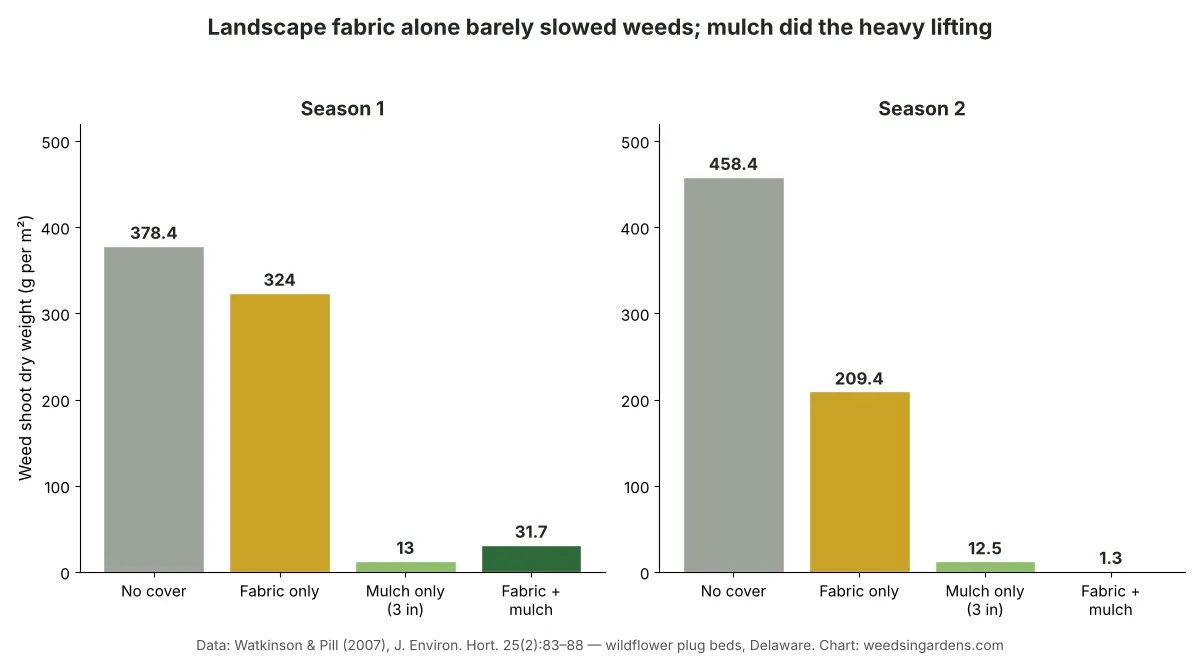
Look at the second season in the chart: fabric plus mulch did reach the lowest weed weight (1.3 g/m²). But mulch alone (12.5 g/m²) already had about 97% less weed weight than bare ground (458.4 g/m²), with no fabric to buy, install or later pull out. That is the economics in one picture.
Every fabric leaked, but tighter fabrics leaked less
At Virginia Tech, Appleton and Derr (1990) covered containers with eight barrier materials topped with 1 inch of shredded pine bark, then sowed large crabgrass and bermudagrass. Weed roots penetrated all of the materials marketed for landscape weed control. Penetration tracked how “open” the material was:
| Material (open area) | Bermudagrass root penetration (0–10) | Crabgrass root penetration (0–10) |
|---|---|---|
| Weed-X (about 3% open) | 2.4 | 2.2 |
| Weed Barrier (woven) | 7.8 | 9.2 |
| Duon (about 60% open) | 8.9 | 9.5 |
| Brown polyethylene (solid film) | 1.1 | 1.0 |
Solid plastic stopped roots best, but it also stops air and water, which is why UC IPM does not prefer black plastic in landscapes. The study’s practical message is to choose the most closed fabric that still breathes.
Spunbonded nonwoven beat meshed and perforated types
At Auburn, Martin, Ponder and Gilliam (1991) tested eight fabrics against six weeds, including bermudagrass, yellow nutsedge and johnsongrass. No fabric gave total suppression of the weeds tested. Spunbonded nonwoven fabrics outperformed meshed nonwoven ones, and a perforated polyethylene product let through 110.7 pigweed seedlings per flat against 139 on uncovered flats. That is barely any help at all.
| Fabric type | What it looks like | How it performed in trials | Best use |
|---|---|---|---|
| Spunbonded nonwoven (felt-like) | Smooth, paper-like sheet of bonded fibers | Best weed suppression among nonwovens (Martin et al. 1991) | Under rock, under thin mulch around shrubs |
| Tightly woven polypropylene (heavy) | Woven strips, often 5–6+ oz/sq yd | Very strong suppression of purple nutsedge for about 4 months when left bare (UH CTAHR 2024) | Under gravel paths and rock beds |
| Lightweight or open-mesh | Thin, see-through when held up to light | More weed penetration than closely woven or spunbonded (UC IPM) | Short-term use only |
| Perforated plastic film | Solid plastic with pin holes | Poor: weeds came through almost as on bare soil (Martin et al. 1991) | Avoid in landscapes |
A University of Hawaiʻi trial adds a useful twist. Heavy woven fabric (6.35 oz/sq yd) laid bare cut purple nutsedge from 29.4 shoots per square foot to 0.03. Adding a thin mulch layer on top let slightly more through (0.52). Mulch on top looks nicer, but it gives weeds a place to grow.
The Hidden Costs: Soil, Roots and the “Permanent” Promise
The weed counts are only half of the landscape fabric pros and cons story. The bigger complaints from extension horticulturists are about what happens under the fabric, and to your time, years later.
It clogs and starves the soil
Washington State University Extension explains that as fabric breaks down or fills with soil particles, the pores close and the mat becomes far less permeable. The possible results are compacted soil, nutrient shortfalls and root rot. Illinois Extension educator Christopher Enroth describes pulling up fabric after a deep soaking rain and finding dry soil beneath.
There’s also a slower cost. Organic mulch on top keeps breaking down, but the fabric stops that organic matter from ever reaching the soil. So you get the downside of decomposing mulch (a fine, moist seedbed for weeds) without the upside (better soil).
Roots grow in, so removal gets ugly
UC IPM warns that tree and shrub roots can grow into fabric, and pulling up fabric that has been in place longer than about 5 years can damage those roots. Penn State Extension’s Lee Stivers described rehabbing a bed where fabric had been down roughly 20 years. Weeds had rooted through it and were almost impossible to pull, and removing it took two days and 40 bags of mulch to fix the bed.
Every new plant means another hole
Each time you add a perennial or annual you cut another X, and Illinois Extension calls the end result “Swiss cheese” fabric. Every cut is an open door for weeds. That is why UC IPM says geotextiles should not be used where an area will be replanted periodically.
Where Landscape Fabric Works (and Where It Doesn’t)
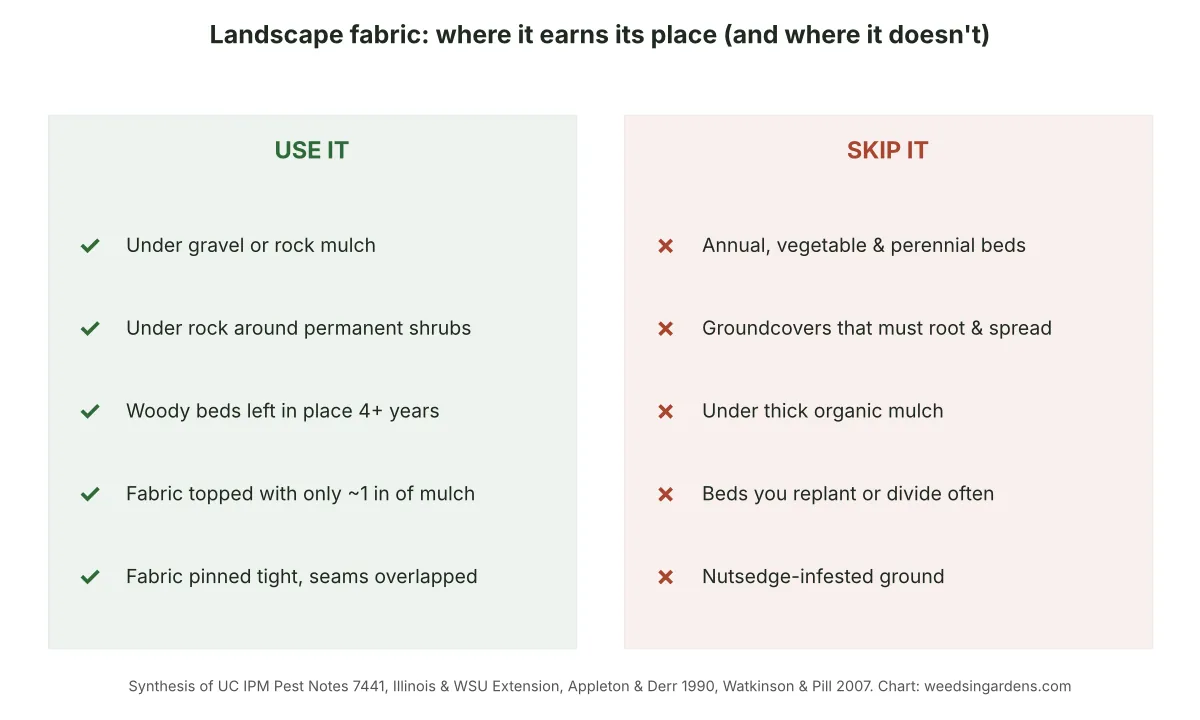
Put the research and the extension guidance together and the landscape fabric pros and cons resolve into one clear rule. Fabric is a stone-and-shrub tool, not a flower-bed tool.
Good places to use it
- Under gravel or rock mulch. UC IPM recommends considering fabric under rock because it keeps rock from sinking and stops soil from working up through it. This applies to areas like a gravel driveway or a rock garden.
- Permanent woody beds. Trees and shrubs that won’t be moved for 4+ years are where UC IPM finds geotextiles cost-effective.
- Beds you’ll top with only a shallow mulch layer. UC IPM’s woody-bed advice is to use fabric with a shallow mulch layer, or a thick mulch layer with no fabric. Choose one approach, not both.
Places to skip it
- Annual, vegetable and perennial flower beds, where you dig, divide and replant.
- Groundcover beds, because creeping plants need to root as they spread (UC IPM).
- Ground infested with yellow nutsedge, which grows through most geotextiles (UC IPM). See our nutsedge guide for better options.
- Under thick, fine organic mulch, where weeds simply germinate in the mulch.
How to Install Landscape Fabric So It Actually Works
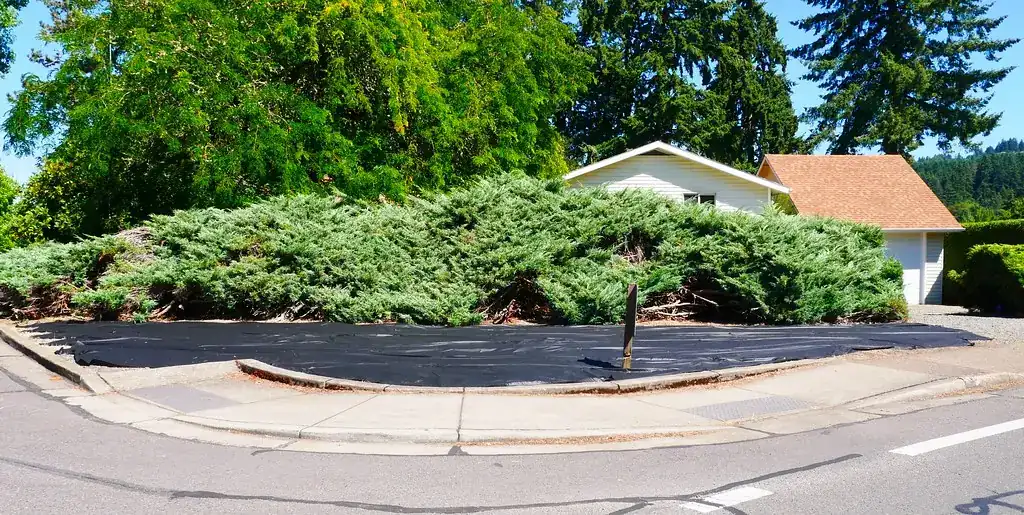
If your project is on the “good places” list, installation decides whether the fabric lasts. These steps follow UC IPM’s landscape weed management guidelines.
- Kill or remove existing perennial weeds first. Fabric won’t stop established bermudagrass or nutsedge from pushing through.
- Plant first, then lay fabric. Cut an X over each plant and slip the fabric around it, keeping the opening as small as the stem allows.
- Overlap seams and pin tightly with long U-shaped staples. UC IPM notes that weeds grow through any gap.
- Keep soil from planting holes off the fabric surface. Soil on top is a seedbed.
- Cover with about 1 inch of mulch or a layer of rock to shield the fabric from UV breakdown. A deeper organic layer just becomes a weed bed.
- Blow or rake leaves and debris off each fall, because decomposing litter on top is where new weeds start.
Choose the heaviest spunbonded or tightly woven fabric you can afford. Hold a sample up to the light; if you can see through it easily, weeds will find a way through too.
Removing old fabric
If you’ve inherited a failing fabric bed, the late-fall or early-spring dormant season is the kindest time to pull it, because shrubs are not actively growing. Cut the fabric into strips rather than ripping one big sheet, and snip any roots that have grown through instead of tearing them. Then mulch the bare soil right away with coarse wood chips so the first flush of weeds has no light.
Better Alternatives to Landscape Fabric for Planting Beds
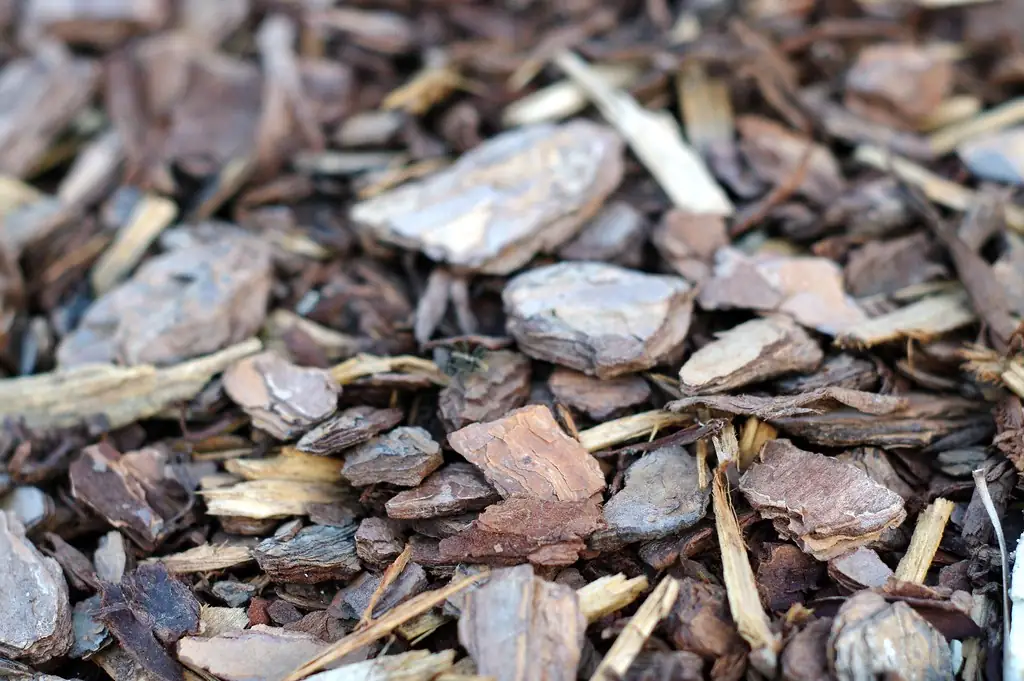
For most beds, the evidence points to a simpler system: coarse organic mulch, kept at the right depth, plus a little timely weeding.
| Option | Weed control | Effect on soil | Effort and cost |
|---|---|---|---|
| Coarse wood chips, 3–4 in (UC IPM) | Strong; mulch alone beat fabric alone (Watkinson & Pill 2007) | Adds organic matter as it breaks down | Top up yearly; WSU Extension recommends arborist chips |
| Cardboard or newspaper under mulch (Illinois Extension) | Good for smothering existing weeds | Breaks down within a season | Low; remove tape and staples, leave room around plants |
| Pre-emergent herbicide plus mulch | Stops annual weed seeds before they sprout | None if label followed | Moderate; follow label rates and plant lists |
| Landscape fabric plus thin mulch | Good under rock or in permanent shrub beds | Blocks organic matter, may clog | High; installation and later removal |
Particle size matters more than most people think. UC IPM suggests a medium mulch (about 3/4-inch pieces) at 3 to 4 inches deep. Coarse mulch can go up to 4 inches, while fine-textured mulch should stay around 2 inches because it holds moisture and lets weed seeds sprout in it. For bed-specific products and safe plant lists, see our pre-emergent for flower beds guide, and for upkeep read how to stop weeds in mulch beds.
A season-by-season plan for a fabric-free bed
| Season | What to do | Why |
|---|---|---|
| Late fall (now) | Smother weedy areas with cardboard plus 3–4 in of wood chips; pull out failing fabric while shrubs are dormant | Gives the layer all winter to settle; root disturbance hurts less now |
| Late winter to early spring | Top up thin spots to 3–4 in; apply a labeled pre-emergent if annual weeds were a problem | Blocks the spring germination flush |
| Late spring to summer | Hand-pull or hoe seedlings weekly while they’re small; rake fine mulch that has crusted | Small weeds come out cleanly from loose mulch |
| Early fall | Spot-treat perennial weeds and clear leaf litter off mulch and rock | Perennials move herbicide to roots in fall; litter is a seedbed |
A Note from the Agronomist’s Side
From a weed-science standpoint, landscape fabric fights only one stage of the weed life cycle: germination of seeds already in the soil beneath it. That stage is real, which is why fabric looks great in year one. But a bed’s weed pressure also comes from seed rain (wind, birds, mowers) landing on top, from perennial weeds with rhizomes and tubers, and from roots that grow toward moisture. Fabric does little against any of those, and the mulch you lay over it creates the moist, organic layer that seed rain needs.
That’s why the trials line up so neatly, and why the landscape fabric pros and cons look so different from one yard to the next. In stone beds, nothing on top is hospitable to seeds, so fabric’s one job is enough. In mulched planting beds, the mulch itself is doing most of the work, and the fabric mostly adds cost, a clogging layer and a future removal job. A useful rule of thumb: if you’d never add organic matter to the area, fabric can help; if you want the soil to improve, skip it.
One more point is easy to miss. “Weed barrier” is a marketing name, not a performance standard. Fabric weight, construction and the open-area percentage vary enormously, and the Appleton and Derr data show root penetration rising sharply as open area increases. If you buy fabric, buy for the job you need it to do, not for the label.
If you’re weighing the bigger picture of yard-wide weed prevention, our guide to weeds between pavers covers hard surfaces, and the Prevention category collects the rest.
FAQ
Is landscape fabric worth it?
Weighing the landscape fabric pros and cons, it’s worth it under gravel, rock and in permanent tree and shrub beds you won’t replant for 4+ years, where UC IPM finds it cost-effective. In vegetable, annual and perennial beds it usually isn’t, because you’ll keep cutting holes and weeds grow in the mulch on top.
Is landscape fabric the same as weed barrier?
Mostly yes. “Weed barrier” is a common retail name for landscape fabric or geotextile. The products vary widely, from thin open-mesh sheets to heavy spunbonded or woven fabrics, and trials show they perform very differently.
Is landscape fabric bad for soil?
It can be. WSU Extension notes that fabric pores clog with soil over time, which can lead to compaction, nutrient shortfalls and root rot. It also prevents decomposing mulch from adding organic matter to the soil.
Is landscape fabric water permeable?
New fabric lets water and air pass, unlike solid plastic. But permeability falls as pores fill with soil, and Illinois Extension reports finding dry soil under fabric after a soaking rain.
Do I need landscape fabric under gravel?
It’s a good idea. UC IPM recommends fabric under rock mulch because it keeps rock from sinking into the soil and keeps soil from rising up through the stones.
How long does landscape fabric last?
There’s no single lifespan. Illinois Extension says it suppresses weeds for only a couple of years in mulched beds, and UV breaks down exposed fabric. Under rock and kept covered, heavy fabric lasts much longer, but roots growing into it make removal after about 5 years harder (UC IPM).
Should I put mulch on top of landscape fabric?
Only a thin layer, about 1 inch, to protect it from UV (UC IPM). Thick organic mulch over fabric becomes a weed seedbed, which is why UC IPM suggests choosing either fabric with shallow mulch or thick mulch with no fabric.
Sources
- Wilen, C.A. (2018). Pest Notes: Weed Management in Landscapes (Publication 7441). UC Statewide IPM Program, University of California Agriculture and Natural Resources.
- Enroth, C. (2021, June 25). The disadvantages of landscape fabric. University of Illinois Extension, Good Growing.
- Barany, C. (2025, May 31). Weed Barrier Fabric. Washington State University Extension, Yakima County.
- Stivers, L. (2025). Putting an End to My Landscape Fabric Nightmare. Penn State Extension.
- Watkinson, J.I., & Pill, W.G. (2007). Efficacy of non-chemical weed control during plug establishment of a wildflower meadow. Journal of Environmental Horticulture, 25(2), 83–88.
- Appleton, B.L., & Derr, J.F. (1990). Growth and root penetration by large crabgrass and bermudagrass through mulch and fabric barriers. Journal of Environmental Horticulture, 8(4), 197–199.
- Martin, C.A., Ponder, H.G., & Gilliam, C.H. (1991). Evaluation of landscape fabrics in suppressing growth of weed species. Journal of Environmental Horticulture, 9(1), 38–40.
- Lutgen, H., Baldos, O., Waisen, P., & DeFrank, J. (2024). Evaluation of Physical Barriers to Suppress Purple Nutsedge (Cyperus rotundus) in Landscape Beds in Maui, Hawaiʻi (WC-13). University of Hawaiʻi at Mānoa, CTAHR.