
Short answer: here is how to get rid of moss in lawn areas for good: kill the moss you have with an iron-based moss killer (or rake it out by hand), remove the dead mat, and then overseed with a grass that suits the spot. Moss has no true roots, so it lifts out easily, but the RHS is blunt that no product kills moss permanently. It comes back unless you also fix why the grass thinned out in the first place: too much shade, acidic or infertile soil, compaction, poor drainage, overwatering, or mowing too short.
That second half is where most guides on moss in lawn care stop short. Moss does not push healthy grass out; it fills the gaps a struggling lawn leaves behind. This guide walks you through confirming it is really moss, finding which cause applies to your yard, choosing a killer by active ingredient, and timing the repair so the grass, not the moss, owns the space by spring.
What causes moss in lawn grass? (It’s a symptom, not the disease)
Extension services agree on the short list of conditions behind moss in lawn turf. Clemson’s Home & Garden Information Center names excessive shade, acidic soil, poor drainage, compacted soil, excessive irrigation and low soil fertility. University of Illinois Extension adds high soil pH as well as low, plus irregular mowing and too little fertilizer.
The common thread is weak turf. As University of Wisconsin horticulture specialists put it, moss does not invade vigorous turf; it develops as turfgrasses thin out. Moss also loves moisture. Oregon State University’s moss guide (EM 9175) notes that it needs a high-moisture environment and thrives in lawns that are mowed too short, infertile, wet, shady, or some combination of those.
That is why killing moss in lawn areas on its own disappoints so many homeowners. Illinois Extension warns that iron sulfate burns moss away temporarily, but it “tends to return fairly quickly” if the growing conditions stay the same.
| Cause | How to spot it in your yard | The fix that lasts |
|---|---|---|
| Shade | Moss is worst under trees, on the north side of the house or fences | Thin the canopy; switch to shade-tolerant grass; or accept a moss/groundcover area |
| Acidic (or very alkaline) soil | Soil test shows pH well outside 6.0–6.5 | Lime (or sulfur) only at the rate your soil test gives |
| Compaction | A screwdriver is hard to push in; water puddles; foot-traffic paths | Core aeration in the growing season |
| Poor drainage / overwatering | Soggy for days after rain; sprinklers run often | Regrade low spots; water deeply but less often |
| Low fertility | Pale, thin grass across the whole lawn | Feed based on a soil test |
| Mowing too short | Scalped areas, bumps and edges | Raise the mower; remove no more than one-third of the blade |
How to identify moss in lawn (and rule out look-alikes)
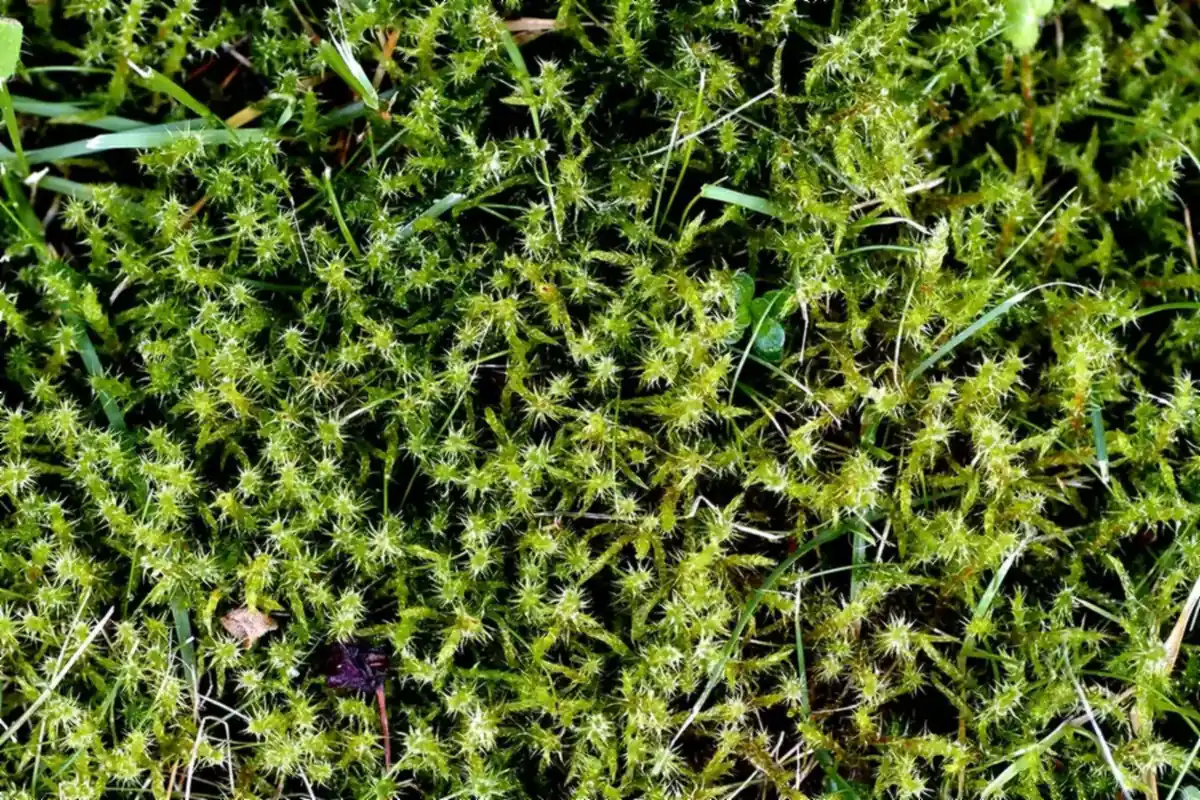
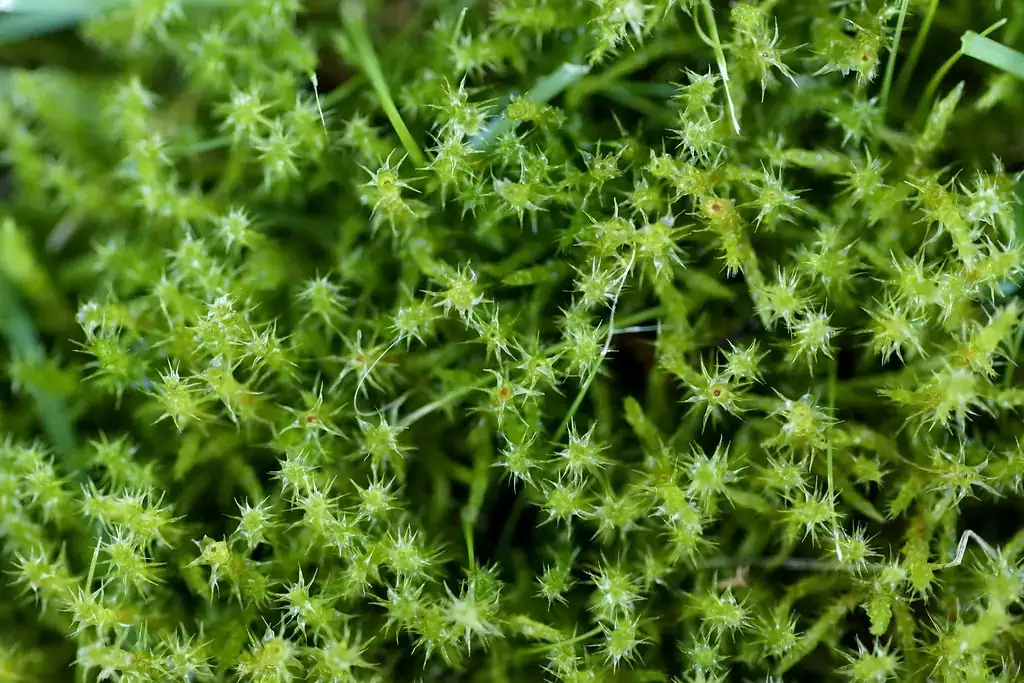
Before buying anything, confirm that what you are looking at is really moss in lawn turf and not algae or a creeping weed. Lawn mosses form soft, springy cushions or mats of tiny, leafy stems with no flowers and no true roots. Iowa State University Extension points out that because mosses lack true roots, they rake up easily, which is a quick field test: tug a patch and it lifts like a loose carpet.
Key ID features of moss in lawn grass:
- Texture: spongy and soft underfoot, often feeling like a thin cushion between grass blades.
- Leaves: tiny, needle- or star-like leaves along thin wiry stems (springy turf-moss, Rhytidiadelphus squarrosus, a very common lawn species, has star-shaped shoot tips).
- Colour: bright yellow-green to dark green when wet; it can dry to brown or grey in summer and green up again with fall rain.
- Roots: none; only hair-like rhizoids that barely grip the surface.
- Where: shaded, damp, compacted, or thin spots first.
Two common look-alikes need different treatment. Algae forms a slick green or black crust on bare soil, usually in wet spots; UGA notes it actually prefers full sun and fertile soils. Low creeping weeds such as creeping Charlie or chickweed have obvious true leaves, stems that root at the nodes, and flowers, so they call for broadleaf weed control instead.
How to get rid of moss in lawn areas: 5 steps that last
The order matters. Diagnose first, kill and clear second, then reseed and fix the site so the grass stays dense.
Step 1: Find your cause before you treat anything
Start with a soil test, because the fix for moss in lawn soil that is acidic is very different from the fix for shade. University of Maryland Extension recommends keeping turf pH around 6.0 to 6.8 by liming only according to soil test results and testing every 3 years (UMD Extension). Illinois Extension specifically advises against adding lime unless a soil test shows the pH needs raising, because many soils (northern Illinois is its example) are already alkaline. Liming on a hunch is one of the most common moss “fixes” that fixes nothing.
Then check light. Oregon State says turfgrass needs at least 4 hours of direct sunlight per day, and Maryland notes that tall fescue tolerates moderate shade but grows best with a minimum of 4–6 hours of direct sun. If the patch of moss in lawn shade gets less than that, no fertilizer or moss killer will keep grass dense there.
Finally, push a long screwdriver into the soil in the mossy area and in a healthy area. If it goes in noticeably harder where the moss is, compaction is part of the picture. If water stands there for a day after rain, drainage is too. Our guide to overwatered lawns covers the signs of a sprinkler schedule that is feeding the moss.
Step 2: Kill moss in lawn areas with the right active ingredient
Moss killers are useful for clearing an established mat of moss in lawn turf quickly, so new seed reaches soil. They do not prevent regrowth. Always read and follow the product label; the label is the law for any pesticide, and it gives the rate, the turf types it is safe on, and the conditions to avoid.
| Active ingredient | How it works | Typical home-lawn use | Key cautions |
|---|---|---|---|
| Ferrous sulfate (iron sulfate) | Desiccates moss; also greens up grass | UGA: 4–7 oz in 3–5 gal water per 1,000 sq ft. Clemson: 5 oz in 4 gal per 1,000 sq ft | Stains concrete, stone and clothing; moss tends to return if causes remain |
| Ferrous ammonium sulfate | Iron plus a little nitrogen | UGA: 10 oz in 3–5 gal water per 1,000 sq ft | Same staining risk; don’t over-apply nitrogen |
| Potassium salts of fatty acids (soap-based moss killers) | Contact “burn” of moss | Ready-to-spray products; follow the label | Oregon State warns it can cause significant damage to the human eye; wear eye protection |
| Carfentrazone-ethyl | Herbicide labelled for silvery-thread moss on golf greens | UGA lists a professional rate of 6.7 fl oz product per acre | Mostly a professional tool; tall fescue may discolor within 3–5 days |
| Copper or zinc roof/walkway products | Kill moss on hard surfaces | Not for lawns | Oregon State: they will injure or kill desirable grasses |
Application tips that matter. Apply when moss is actively growing and moist. Clemson’s timing for South Carolina is December through April, with a 24-hour rain-free period after spraying. Treated moss turns brown or tan as the products dry it out, per Maryland Extension. Sweep any granules or spray off driveways and patios immediately, because iron leaves rust-coloured stains.
What about ammonium sulfate? Oregon State reports that ammonium sulfate applied at 1 lb nitrogen per 1,000 sq ft significantly stunts moss growth while stimulating the grass, which is a neat two-for-one in climates where moss is a constant pressure. Iron sulfate, by contrast, stunts moss and gives a deep green colour but produces very little grass growth.
Household remedies. Baking soda and dish soap circulate widely online, and a 2003 golf-trade report in Golfdom describes superintendents trying both on silvery-thread moss on putting greens, noting that the timing and weather had to be ideal and that some yellowing of the turf occurred. That is not a controlled home-lawn trial. The RHS advises against using household products such as baking soda, vinegar, bleach or soap on lawns. If you are tempted, read our tests of vinegar and bleach on weeds first; neither is selective, and both can harm the grass you are trying to save.
Step 3: Rake out the dead moss and prepare the soil
Once the moss has turned brown or black, rake it out firmly with a spring-tine or leaf rake. For large areas, a dethatcher or power rake speeds this up, but match it to the season: Oregon State recommends dethatching from mid-March through April in western Oregon, and warns against fall dethatching there because moss will outcompete the lawn in the late fall and winter months. The RHS, in the UK’s mild climate, recommends scarifying in October or early November while the grass is still growing strongly. The rule underneath both is the same: only rough up the lawn when the grass has several weeks of growing weather ahead to fill the gaps. See our notes on dethatching pros and cons before you rent a machine.
If compaction showed up in Step 1, core aerate now. Maryland Extension recommends fall aeration for cool-season turf like tall fescue, and Iowa State suggests a core aerator in spring or fall. Bag or compost the raked moss rather than leaving it on the lawn.
Step 4: Overseed with a grass that fits the spot
Bare soil left after you remove moss in lawn patches is an invitation for more moss or weeds. Reseed straight away. University of Alaska Fairbanks Extension suggests waiting a few weeks after applying a moss killer before overseeding and fertilizing soon after the moss killer (UAF Cooperative Extension). Check your product label, since some iron products allow seeding sooner.
Pick the grass for the light you actually have:
- Cool-season shade: fine fescues (creeping red, chewings, hard fescue) are the shade specialists recommended by Oregon State, Wisconsin, Iowa State and Maryland. Tall fescue handles moderate shade.
- Warm-season shade: UGA lists St. Augustinegrass and zoysiagrass, plus tall fescue, as the more shade-tolerant choices.
- Wet-winter climates: Oregon State notes that spring through Memorial Day is an ideal planting window there, when weather warms and moss growth slows.
Our guides on preparing soil for grass seed and grass types in the lawn go deeper on seed choice and seedbed prep.
Step 5: Stop moss in lawn areas coming back: shade, pH, drainage, mowing
This is the step that decides whether you are fighting moss again next year.
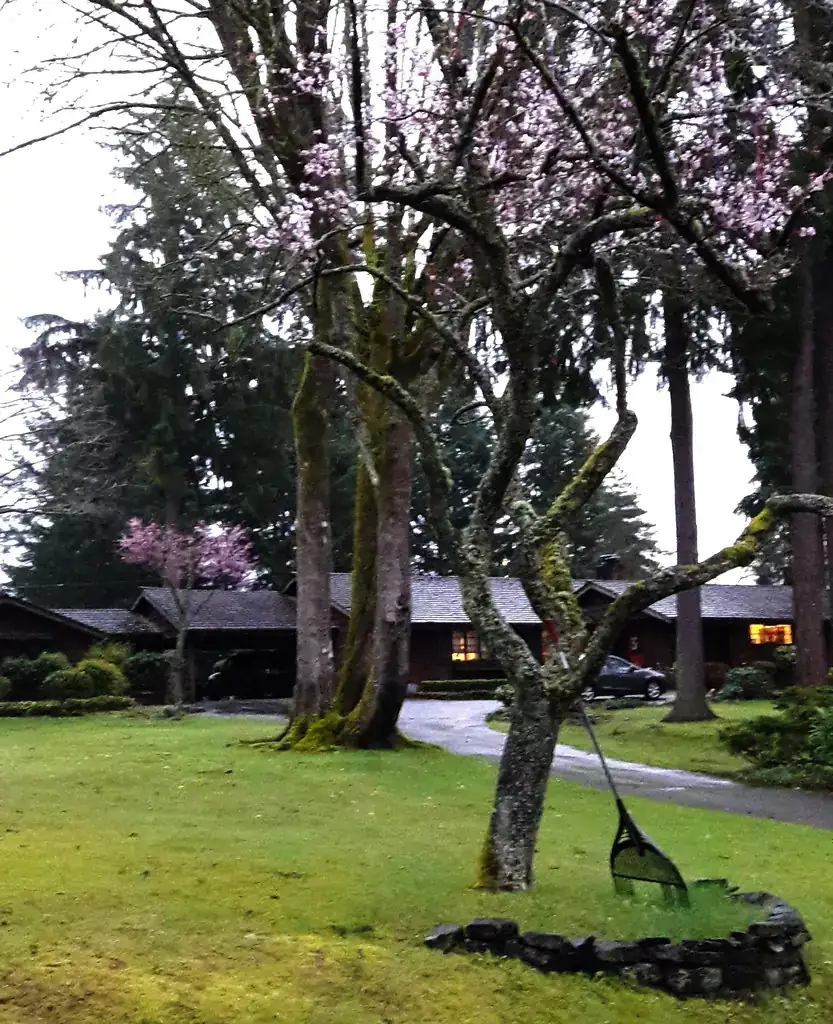
Light. UGA recommends pruning tree limbs below 10 feet to let in light and air. Thin the canopy rather than topping trees, and hire an arborist for large limbs.
Soil pH. UGA’s target for most turf is pH 6.0 to 6.5, and 5.5 to 6.0 for centipedegrass. Apply lime or sulfur only at the rate your soil test report gives.
Fertility. Shade lawns need less nitrogen, not none. Illinois Extension suggests 1–2 lb of actual nitrogen per 1,000 sq ft per season in shade versus 2–4 lb in full sun. Overfeeding shaded grass encourages soft, disease-prone growth. Note local rules too: Maryland, for example, bans fertilizer application between November 15 and March 1.
Mowing. Illinois recommends mowing most lawn grasses at 3–4 inches and never removing more than one-third of the leaf blade at once. Wisconsin suggests about 3 inches for shade lawns. Taller grass shades the soil surface and leaves moss fewer gaps to colonize.
Water. UGA advises about 1 inch of water per week, applied deeply (to at least 6 inches of soil) rather than in frequent light sprinkles. Shallow, frequent watering keeps the surface damp, which is exactly what moss wants.
Drainage. Regrade low spots so water runs off, and core aerate compacted areas. Iowa State notes that tile drainage may be needed in persistently wet areas.
Moss in lawn control calendar: when to do what
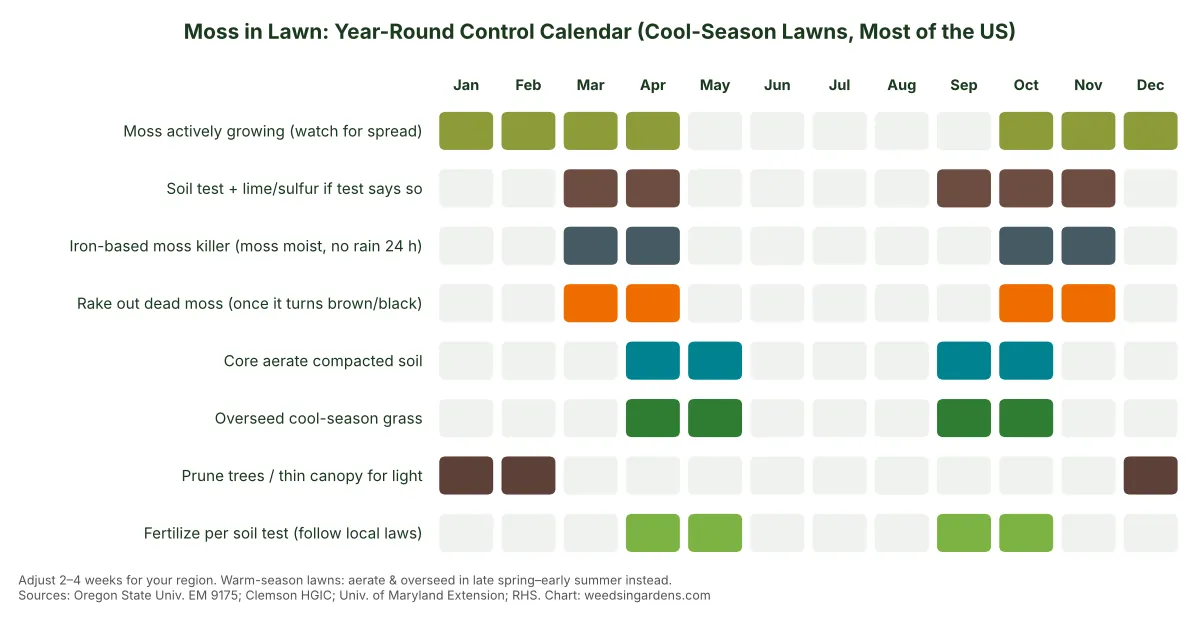
Timing is where many treatments for moss in lawn areas fail. In much of the US, moss starts growing with fall rains and peaks in early spring (Oregon State), so October is a smart time to act on cool-season lawns while the grass can still recover. Use this as a starting point and adjust for your region.
| Season | Cool-season lawns (fescue, bluegrass, ryegrass) | Warm-season lawns (St. Augustine, zoysia, centipede) |
|---|---|---|
| Early fall (Sep–Oct) | Soil test; core aerate; overseed thin and moss-cleared areas; feed per soil test | Soil test; avoid heavy nitrogen as grass slows down |
| Late fall (Oct–Nov) | Apply iron moss killer to actively growing moss; rake out dead moss once it browns | Spot-treat moss (moss grows in the cool, wet months); keep leaves off the turf |
| Winter (Dec–Feb) | Prune trees while dormant; stay off frozen or soggy turf | Iron-based moss control on moist moss (Clemson: Dec–Apr); prune trees |
| Spring (Mar–May) | Second moss-killer pass if needed; rake; overseed (ideal in wet-winter climates); fix drainage | Rake out dead moss; aerate and overseed or plug once grass greens up |
| Summer (Jun–Aug) | Mow high; water deeply and infrequently; don’t seed in heat | Prime season to aerate, sod or plug shady spots with a shade-tolerant grass |
When to accept moss (or replace grass in deep shade)
Sometimes the honest answer about moss in lawn shade is that grass will not win. If a spot gets far less than 4 hours of direct sun and the trees are staying, Illinois Extension notes that moss can serve as an adequate groundcover in difficult growing locations, and Wisconsin suggests shade-tolerant groundcovers or other shade plants instead of turf.
There is an upside, too. The RHS points out that moss provides habitat for small creatures including beetles and woodlice, feeds the caterpillars of many moths, and is used by birds as nesting material. A deliberate moss patch under a big shade tree, edged neatly, can look intentional rather than neglected, and it needs no mowing, feeding or moss killer at all.
A note from the agronomist’s side
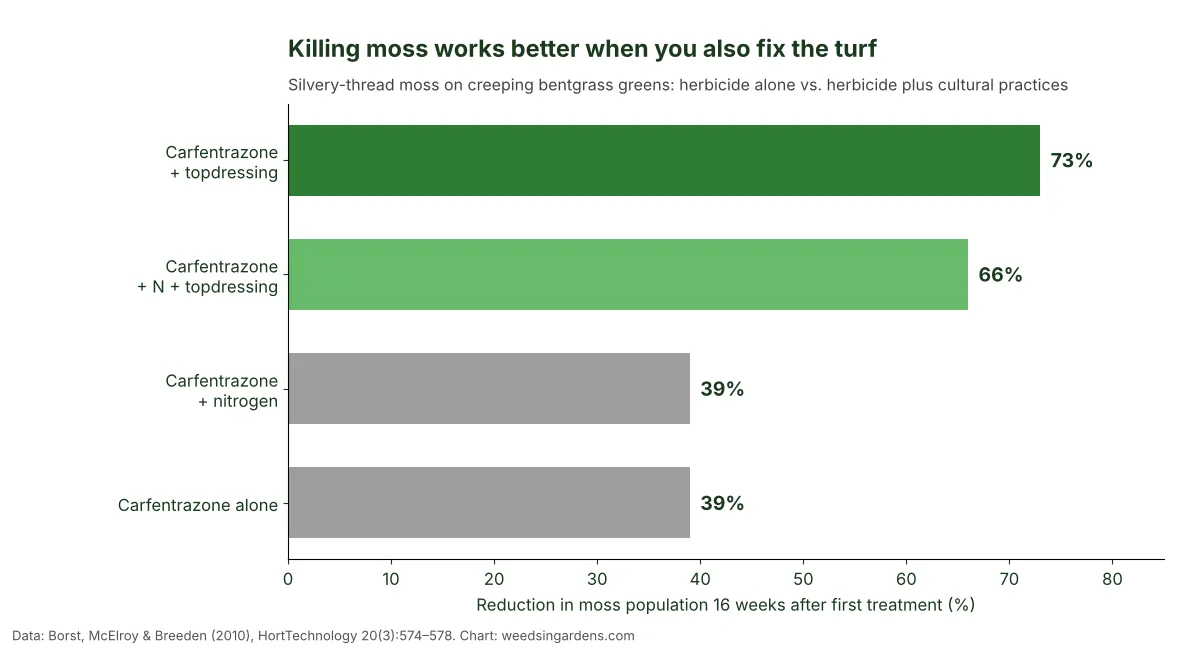
The research on golf greens makes the core point of this article in numbers. In a two-year field study, Borst, McElroy and Breeden (2010) compared the herbicide carfentrazone alone with carfentrazone plus cultural practices on silvery-thread moss in creeping bentgrass. Sixteen weeks after the first treatment, carfentrazone alone cut moss populations by 39%, while carfentrazone followed by sand topdressing cut them by 73% (HortTechnology).
A later dose-response study by Raudenbush and colleagues (2021) showed how quickly moss bounces back from a single herbicide hit: carfentrazone caused 76–84% injury at 14 days, but injury had faded to 45–48% by 28 days (Weed Technology). Moss can regenerate from small surviving fragments, which is why a “burn-down” alone rarely ends the problem.
Those studies were on putting greens, not home lawns, and with a different moss species and a professional herbicide. But the biological logic carries over. Any moss killer is a reset button. What you do in the following weeks, whether that is seeding, fixing light and soil, or improving the surface, decides whether grass or moss fills the space. From a plant-competition standpoint, think of moss control as a race for light and ground: a dense, well-adapted turf canopy is the only “pre-emergent” for moss that works.
A practical reading for homeowners dealing with moss in lawn areas: spend your money in this order. Soil test first (cheap and decisive), then light and drainage, then seed suited to the site, and only then a moss killer to clear the slate. If you reverse the order, you will buy moss killer every year.
FAQ
What is the fastest way to get rid of moss in lawn areas?
Spray or spread an iron-based moss killer (ferrous sulfate) on moist, actively growing moss, following the label. The moss turns brown or black within days and can then be raked out. It is fast but temporary unless you also overseed and fix shade, soil pH, compaction or drainage.
Will moss killer kill my grass?
Iron sulfate and potassium-salt moss killers are designed to be used on lawns at label rates, and iron usually greens up grass. Overdosing can burn turf, and copper- or zinc-based roof and walkway moss products will injure or kill lawn grasses, according to Oregon State University. Use only products labelled for lawns.
Is it better to remove moss in fall or spring?
Both work, and the best choice depends on your climate and grass. Moss grows actively from fall rains through early spring, so treat it then. For cool-season lawns in most of the US, early fall is ideal for aerating and overseeding; in wet-winter climates like western Oregon, Oregon State prefers spring dethatching and seeding.
Does lime get rid of moss?
Only if your soil is acidic. Lime raises pH, which helps grass compete where the soil is too acidic, but it does not kill moss directly. Illinois Extension advises against liming unless a soil test shows it is needed, since many soils are already neutral or alkaline.
How do I get rid of moss in lawn naturally?
Rake it out by hand (it has no true roots), then fix the conditions: prune for more light, aerate compacted soil, water deeply and less often, mow at 3–4 inches, and overseed with shade-tolerant grass. The RHS advises against household products such as baking soda, vinegar, bleach or soap.
Is moss in lawn grass bad for it?
Moss in lawn grass does not kill healthy turf; it moves into spaces where grass has already thinned. It is a sign that something about the site, such as shade, soil, water or mowing, is not right for turf. In deep shade, it can even be a reasonable low-maintenance groundcover.
Is moss killer safe for dogs and kids?
Follow the label’s re-entry instructions; most say to keep people and pets off until the product has dried or been watered in. Iron products stain paws, shoes and paving, and potassium-salt sprays can cause serious eye damage, so store and apply them carefully.
Sources
- Royal Horticultural Society. Moss in lawns: keep or remove?
- Clemson Cooperative Extension, Home & Garden Information Center. Moss & Algae Control in Lawns.
- University of Georgia Cooperative Extension. Controlling Moss and Algae in Turf (Circular 823).
- Oregon State University Extension Service. Managing Moss in Lawns in Western Oregon (EM 9175).
- University of Illinois Extension. Managing Moss in Lawns.
- University of Maryland Extension. Moss in Lawns.
- University of Wisconsin–Madison Division of Extension. Managing Moss Problems in Lawns (2024).
- Iowa State University Extension and Outreach. How to Manage Moss in the Lawn and Garden.
- University of Alaska Fairbanks Cooperative Extension Service. Moss Control in Lawns.
- Borst, S.M., McElroy, J.S., & Breeden, G.K. (2010). Silvery-thread moss control in creeping bentgrass putting greens with mancozeb plus copper hydroxide and carfentrazone applied in conjunction with cultural practices. HortTechnology, 20(3), 574–578. doi:10.21273/HORTTECH.20.3.574
- Raudenbush, Z., Keeley, S.J., Thompson, C.S., & Jugulam, M. (2021). Dose responses of silvery-thread moss (Bryum argenteum) to carfentrazone-ethyl. Weed Technology, 35(4), 611–617. doi:10.1017/wet.2021.42
- Andorra, F.H. Jr. (2003). Bring On the Baking Soda. Golfdom, June 2003.
More lawn fixes: browse all our lawn problems guides.