
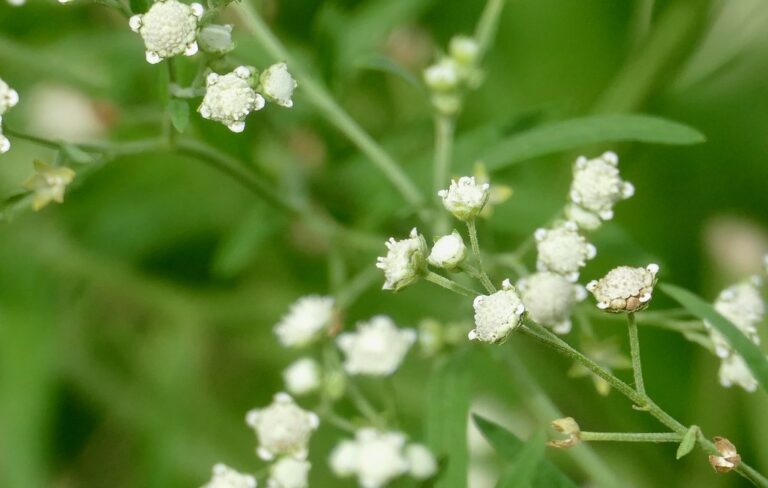
Short answer: parthenium weed (Parthenium hysterophorus), also sold to the world under the names carrot grass, congress grass, famine weed and Santa Maria feverfew, is a fast annual from tropical America that now infests roadsides, pastures and cropland on five continents. You know it by a flat rosette of pale, deeply lobed, hairy leaves that bolts into a branched plant 0.5–2 m (1.5–6.5 ft) tall, topped with hundreds of tiny white flower heads about 4 mm (1/6 in) across. One plant averages around 15,000 seeds, and it can go from seed to seed in four weeks. Its pollen and dried plant dust cause severe allergic dermatitis, hay fever and asthma, and it taints the milk and meat of grazing animals. Kill it at the rosette stage, before it flowers, with gloves and a mask on; use a registered herbicide for anything bigger than a few plants; and keep the ground covered with vigorous grass or crops so it has nowhere to come back.
What parthenium weed is and why it matters
Parthenium belongs to the daisy family (Asteraceae). It is native to the Caribbean, Mexico and Central and South America and has become one of the most damaging weeds of the tropics and subtropics. According to Weeds Australia, it is now established in the United States, Israel, Kenya, South Africa, Madagascar, Mauritius, India, Nepal, China, Vietnam, Taiwan, several Pacific islands and Australia. A review by Kaur and colleagues in International Scholarly Research Notices (2014) counts more than 20 invaded countries.
In India, the Indian Council of Agricultural Research (ICAR) estimates that it covers about 35 million hectares and traces its arrival to wheat imported in the early 1950s; ICAR runs a national Parthenium Awareness Week every August. Its common names in South Asia include gajar ghas (Hindi, “carrot grass”, after the carrot-like leaves) and chatak chandani. In southern Africa it is called famine weed.
How to identify parthenium: rosette to flowering plant
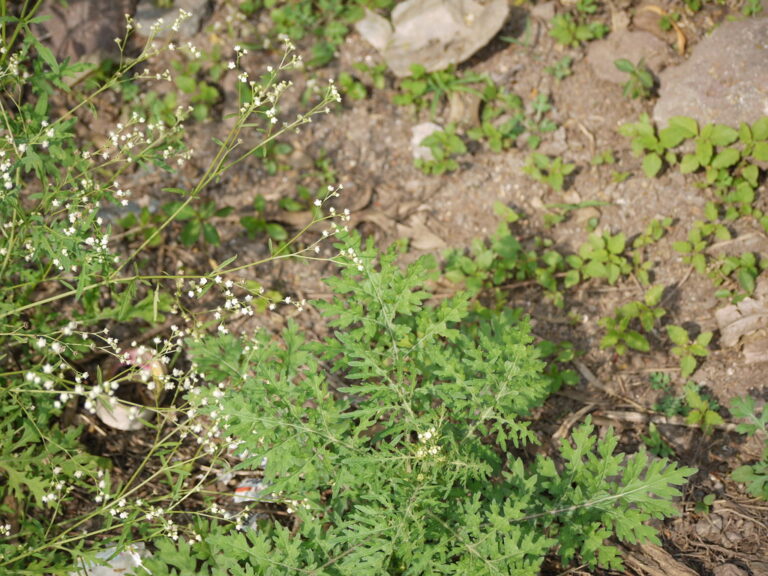
Parthenium changes appearance as it grows, and the stage matters because the rosette is the easiest and safest time to kill it.
| Stage | What you see | What to do |
|---|---|---|
| Seedling / rosette | A flat circle of pale green leaves lying close to the ground, deeply divided and fern-like, covered in fine soft hairs. Lower leaves reach 5–20 cm (2–8 in). | Best time to control: spray or remove before a stem forms |
| Bolting | One upright, ribbed, hairy stem rises from the rosette and starts to branch in its upper half. Stem leaves are alternate and get smaller towards the top. | Still controllable; act within days, flowering follows quickly |
| Flowering / seeding | Bushy plant 0.5–2 m tall with loose clusters of white or cream flower heads about 4–5 mm wide at the branch tips. Each head drops four or five black, wedge-shaped seeds about 2 mm long with two small white scales. | Do not hand-pull; spray, bag or slash only with full protection and a seed-spread plan |
These measurements come from Weeds Australia and the Queensland Government biosecurity page.
Look-alikes
- Annual ragweed (Ambrosia artemisiifolia): similar finely divided leaves, but its flowers are green and hang in slender spikes, not white button heads. Parthenium’s alternative name “false ragweed” comes from this resemblance.
- Feverfew (Tanacetum parthenium): a garden herb with small daisies that have obvious white petals around a yellow centre; parthenium heads look like tiny white buttons with no yellow disc.
- Wild carrot (Daucus carota): feathery leaves too, but the white flowers sit in flat umbrella-shaped clusters, and the root smells of carrot.
If a plant with ferny, hairy leaves and white button flowers turns up after a flood or where hay or machinery arrived from an infested area, treat it as parthenium until your local weed officer confirms otherwise.
How it spreads so fast
Parthenium germinates whenever there is moisture, often in spring and early summer, but in warm climates at any time of year. The ARC Plant Protection Research Institute (South Africa) reports flowering four to six weeks after germination and up to 25,000 seeds per plant. Weeds Australia puts the average at about 15,000 seeds, records soil seed banks of up to 400 million seeds per hectare, and notes that a large share of buried seed stays viable for six years or more.
The seeds travel in running water, on vehicles and earth-moving machinery, in mud on cattle and wildlife, and in contaminated hay, grain, feed and pasture seed. The plant moves into bare, disturbed ground first: overgrazed paddocks, stockyards, watering points, roadsides, railway lines and building sites. Drought makes this worse, because the grass cover thins and fodder is trucked in from other regions.
Impacts on crops, livestock and people
Crops and pasture
Parthenium releases chemicals that suppress germination and growth of neighbouring plants, including the nitrogen-fixing bacteria of legumes. The Kaur review cites crop yield losses of up to 40% in India and sorghum grain losses of 40–97% in Ethiopia when the weed is left uncontrolled. In Australia, where it is one of the national Weeds of National Significance, Weeds Australia puts the cost at more than AU$22 million a year in lost production and control.
Livestock
All parts of the plant are toxic at any growth stage. Animals that graze it develop skin lesions, mouth ulcers and excessive salivation; according to Weeds Australia, a diet of 10–50% parthenium can kill cattle, with young cattle most at risk. It also taints milk and meat.
People
This is the part that makes parthenium different from an ordinary weed. According to a review from the All India Institute of Medical Sciences published in Photochemical & Photobiological Sciences (2013), parthenium is the most common cause of plant dermatitis in India. The allergens are sesquiterpene lactones, chiefly parthenin, which sit in the tiny hairs on the leaves and in the dry dust of leaves and flowers. Because the dust and pollen are airborne, the rash appears on exposed skin: the face and eyelids, neck, the V of the chest and the creases of the elbows and knees.
The Indian Journal of Dermatology, Venereology and Leprology describes the sensitivity as lifelong, with flare-ups every summer, and a shift over several years from an airborne rash to chronic, light-sensitive skin disease. Middle-aged men who work outdoors are affected most often. South Africa’s ARC adds that continuous exposure causes hay fever and asthma in many people. Anyone with a known allergy to daisy-family plants (chrysanthemum, ragweed, feverfew) should stay away from it altogether.
Where parthenium is a declared weed
- Australia: a Weed of National Significance, declared in every state and territory. In Queensland it is Category 3 restricted matter under the Biosecurity Act 2014: it must not be sold, given away or released into the environment. Machinery moving from Queensland into New South Wales is inspected at the border.
- South Africa: a Category 1b invader under the NEMBA regulations, which means landholders must control it, according to the ARC fact sheet.
- United States: present across the southern states. The California Invasive Plant Council notes that it is on the California state noxious weed list with an A rating, which targets it for eradication. Cal-IPC describes it as native to the American tropics, not to the US.
- India: the target of an annual national awareness and eradication campaign led by ICAR.
How to control parthenium weed
No single method clears an infestation. The approach used by Queensland, South Africa and Indian agricultural universities is the same in outline: kill plants before they seed, stop new seed arriving, and fill the space with competitive plants. Plan to follow up for at least two years, because the seed bank keeps germinating.
1. Protect yourself first
- Wear gloves (nitrile or rubber), long sleeves, long trousers and closed shoes. Add a P2/N95 dust mask and eye protection when the plants are flowering or dry.
- Work on a still, damp day so dust and pollen stay down.
- Afterwards, wash your hands and face, and wash your work clothes separately. Do not let anyone with a daisy-family allergy do the job.
2. Manual removal: rosettes only
Hand-pulling works for small, scattered rosettes before flowering, with gloves and a mask, according to Weeds Australia. The Tamil Nadu Agricultural University (TNAU) Agritech portal recommends manual removal in gardens and lawns, with the condition that the person doing it is not allergic. Queensland advises against hand-pulling larger areas because of the allergy risk and because mature seed drops off as you pull. Once plants are flowering, bag them where they stand and do not compost them; our guide to disposing of invasive plants without spreading them covers bagging and green-waste options.
3. Herbicides
For more than a handful of plants, spraying is safer than handling. Queensland’s approach, in its biosecurity guidance, is a knockdown herbicide to kill the plants present plus, where the situation allows, a residual herbicide to stop the next flush, with repeat spraying in the same season if new plants appear. Timing is the key: spray small plants before they set seed, and at a time when the grasses are actively growing so they can fill the gaps.
Active ingredients registered against parthenium in Queensland include 2,4-D, dicamba, picloram, metsulfuron-methyl, glyphosate, atrazine and hexazinone, each only for particular situations; TNAU lists atrazine, 2,4-D, glyphosate and metribuzin in India. What you may use depends on your country and the label, so check with your extension office or weed authority. For a lawn or garden:
- A lawn weed killer containing 2,4-D and dicamba should control rosettes in most lawn grasses without killing the turf, if the label lists your grass type.
- Glyphosate kills parthenium in beds, paths and fallow ground but also kills any grass or plant it touches.
- Spray to wet the leaves thoroughly, and recheck the area every two to four weeks through the warm season.
Vinegar and similar contact sprays only scorch the top growth; parthenium regrows from the crown and keeps flowering. We cover why in does vinegar kill weeds.
4. Biological control
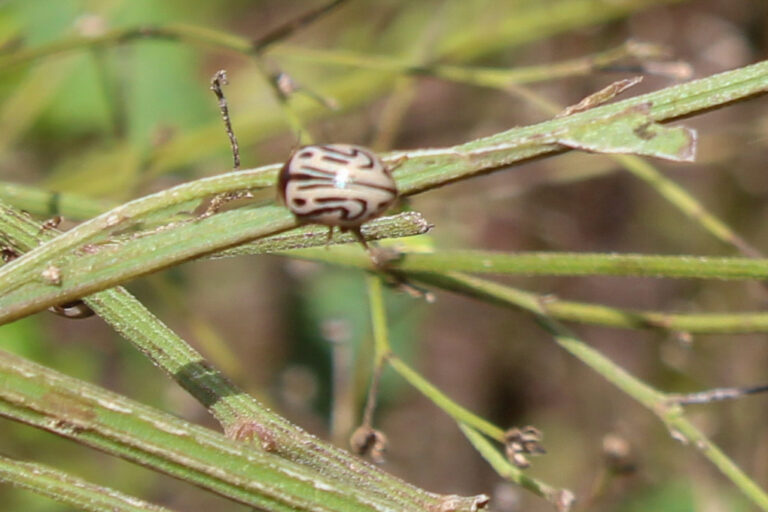
Eleven insects and two rust fungi from the plant’s native range have been released in Australia. The best known is the Mexican leaf beetle Zygogramma bicolorata (now often listed as Calligrapha bicolorata), whose adults and larvae strip the leaves. A Queensland Government fact sheet describes it as highly effective where present, active from late spring to autumn. Other agents include the stem-galling moth Epiblema strenuana, the seed-feeding weevil Smicronyx lutulentus, the stem-boring weevil Listronotus setosipennis and the winter and summer rusts Puccinia abrupta and Puccinia melampodii. South Africa has released the beetle and both weevils, and Indian agricultural universities collect and redistribute the beetle to infested areas.
Biocontrol reduces the density and vigour of parthenium and lets grass come back, but Weeds Australia stresses that it cannot eradicate an infestation on its own. Home gardeners do not usually need to buy or release agents; if you see the beetle on your parthenium, leave it be and avoid spraying insecticide near it.
5. Competitive plants and ground cover
Parthenium is a coloniser of bare ground, so the long-term fix is cover. Queensland’s guidance for pasture is to keep high grass crown cover and avoid overgrazing, and to time spraying for when grasses are growing actively so they recolonise the gaps. In India, TNAU recommends sowing competitive plants such as Cassia sericea, Cassia tora, Abutilon indicum and marigold (Tagetes) at the start of the rains so they occupy the space. In a lawn, a thick, well-fed turf mown at the right height does the same job; our guide to why grass won’t grow helps if bare patches keep reopening.
6. Stop new seed arriving
- Wash down vehicles, mowers and machinery in one spot after working in infested areas, and watch that spot for seedlings.
- Hold newly arrived cattle in a small yard until seed drops from their coats, and check areas where hay was fed out.
- Buy fodder, turf, soil and seed from suppliers who can confirm they are free of parthenium.
Common mistakes
The four that undo most control efforts: waiting until the plant flowers (it has already dropped seed); pulling it bare-handed or in short sleeves (sensitisation is lifelong); spraying once and walking away (the seed bank sends up new flushes after every good rain); and leaving the ground bare afterwards. Replant, reseed or mulch straight away.
Are there any uses?
A review by Patel in 3 Biotech (2011) lists folk uses of the plant for skin inflammation, rheumatic pain, diarrhoea, dysentery and malaria, and research into using the biomass for compost, biogas, bio-pesticides and removing heavy metals from water. None of this has led to a proven, safe medicine. Given how strongly the plant sensitises skin and airways and how toxic it is to livestock, do not use parthenium in any home remedy, tea or poultice, and do not feed it to animals. If you have a rash, eye swelling or breathing trouble after contact, see a doctor and mention the plant by name.
Sources
- Weeds Australia – Parthenium weed profile
- Queensland Government, Business Queensland – Parthenium
- ARC Plant Protection Research Institute (South Africa) – Parthenium fact sheet
- Kaur et al. (2014) – Effects and Management of Parthenium hysterophorus: A Weed of Global Significance
- Sharma et al. (2013) – Parthenium dermatitis, Photochemical & Photobiological Sciences
- Indian Journal of Dermatology, Venereology and Leprology – Parthenium dermatitis in India: past, present and future
- ICAR – Parthenium Awareness Week
- TNAU Agritech Portal – Parthenium management
- California Invasive Plant Council – Parthenium hysterophorus profile
- Patel (2011) – Harmful and beneficial aspects of Parthenium hysterophorus: an update