
Short answer: Bengal arum (Typhonium trilobatum) is a small tropical aroid, about 45 cm (18 in) tall, that grows from a round underground tuber. You can recognise it by its deeply three-lobed leaves on stalks 25 to 40 cm long and a low, dark reddish-purple spathe with a glossy red, finger-like spike. The plant contains needle-shaped calcium oxalate crystals, and eating the raw tuber has caused severe mouth and throat swelling that needed emergency airway treatment. The leaves and tubers are traditional foods and medicines in South and Southeast Asia, and animal and lab studies report pain-relieving, anti-inflammatory, anti-diarrhoeal and antibacterial effects, but it has never been tested as a treatment in people. As a weed it persists through its tuber and offsets, so dig it out whole, wearing gloves.
What Bengal arum is
Bengal arum is in the arum family (Araceae), the same family as taro, elephant ears, peace lilies and water lettuce. Linnaeus first named it Arum trilobatum in 1753. According to the Flora of China, it is native from India, Nepal, Bhutan and Sri Lanka through Myanmar, Thailand, Laos, Cambodia and Peninsular Malaysia to southern China, and it has been introduced to West Africa, western Borneo, the Philippines, Singapore and the American tropics.
It has many local names. In Bengali it is called ghet kochu, ghatkol, kharkon or ghatkanchu (“kochu” or “kachu” is the general Bengali word for aroids), in Tamil senai kizhangu or karunai-k-kilanku, and in Chinese 马蹄犁头尖 (ma ti li tou jian). English names include Bengal arum and lobed-leaf typhonium.
How to identify Bengal arum
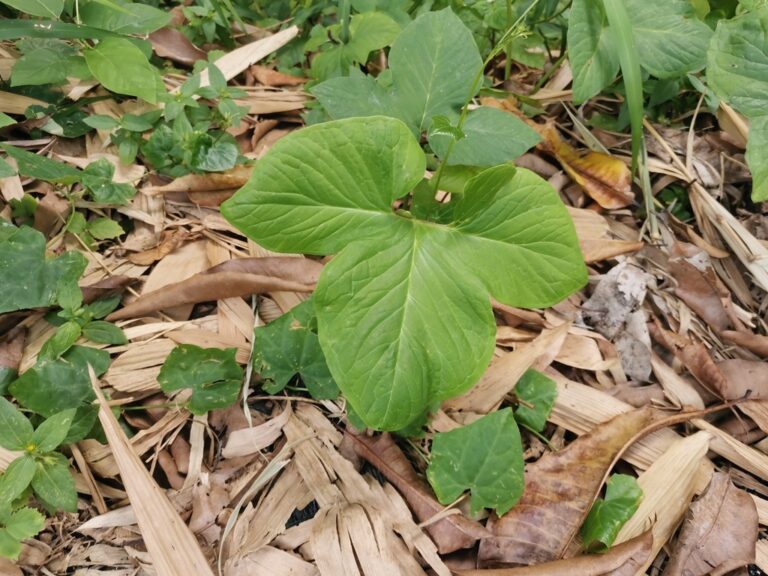
The Flora of China description and the Singapore National Parks Board (NParks) Flora & Fauna Web give these features:
- Underground part: a short, roughly round tuber (botanically a tuberous rhizome) that produces a few offsets each year or splits into pieces.
- Leaf stalks: 25 to 40 cm (10 to 16 in), green or flushed with purple.
- Leaves: heart-shaped to ovate in outline and usually cut deeply into three lobes (rarely five). The central lobe is ovate and pointed, 10 to 15 cm long and 6 to 11 cm wide (4 to 6 in by 2.5 to 4.5 in); the side lobes are slightly smaller, 8 to 13 cm. At a glance the leaf looks like three leaves joined at the base.
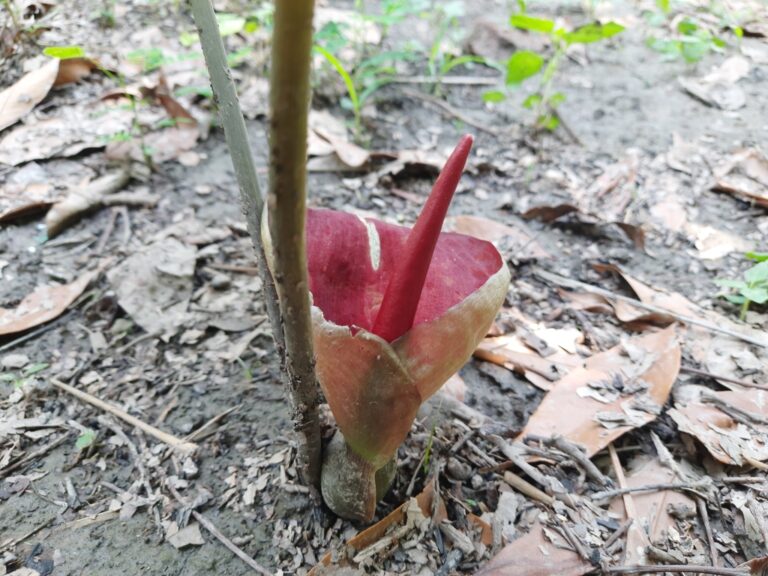
- Flower (inflorescence): appears after the leaves on a short stalk of 5 to 10 cm, so it sits close to the ground. The spathe has a green, barrel-like base 2.5 to 3.5 cm long, pinched at the top, and a spreading blade about 15 cm long that is green outside and dark purple to reddish purple inside.
- Spadix: ends in a glossy purple or red, narrowly conical “tail” (the appendix) 5 to 12 cm long. Hidden inside the chamber, a dense tangle of thread-like sterile flowers covers most of the female flowers.
- Fruit: ellipsoid berries, green with purple spots at first and white when ripe, each with one or two seeds.
- Season: in southern China it flowers from May to July. Like other Typhonium species it is seasonally dormant, dying back to the tuber between growing seasons.
Look-alikes among aroids
Several aroids share its habitats or its three-lobed leaves. A third Asian species, rodent tuber (T. flagelliforme), is told apart by the whole zone between its female and male flowers being covered in sterile flowers. The Flora of China key to Typhonium and NC State Extension’s plant pages help separate them:
| Plant | Leaf | Flower and fruit | How to tell it from Bengal arum |
|---|---|---|---|
| Bengal arum (Typhonium trilobatum) | Deeply three-lobed, lobes broad and ovate | Spathe blade broadly triangular, dark purple inside; berries white when ripe | Many long, curling thread-like staminodes cover the female flowers; short round tuber |
| Roxburgh’s typhonium (T. roxburghii) | Entire and triangular to arrow- or spear-shaped, or more or less three-lobed | Similar broadly triangular purple spathe blade | Staminodes curve downward and do not form a tangle; leaves may be unlobed |
| Taro, elephant ear (Colocasia esculenta) | Very large, heart- to arrow-shaped, stalk joined to the middle of the blade (peltate) | Not needed for identification | Leaf is never split into three lobes; stalk attaches underneath the blade, not at the edge |
| Arrowhead vine (Syngonium podophyllum) | Arrow-shaped when young, later 5 to 11 leaflets | Not needed for identification | A climbing or trailing vine with long stems, not a single tuft from a tuber |
| Italian arum (Arum italicum) | Arrow-shaped, glossy, with pale silver veins | Green-yellow or white spathe with purplish edges; berries ripen orange-red | Temperate plant of the US and Europe; leaves are not three-lobed and berries turn red, not white |
All of these contain calcium oxalate, so a wrong identification does not make any of them safe to eat raw. According to NC State Extension, all parts of taro are poisonous raw, Italian arum is rated highly toxic, and arrowhead vine causes oral irritation and swelling in pets.
Toxicity: calcium oxalate crystals

The best evidence on Bengal arum toxicity is a 2020 case series from an emergency department in southern India (Anandhi et al., Indian Journal of Critical Care Medicine). It describes four people who ate the raw tuber:
- Symptoms began within 15 to 30 minutes: a pin-pricking pain in the mouth, swollen lips and tongue, drooling, severe throat pain and difficulty swallowing.
- One patient developed severe upper-airway swelling and needed an emergency breathing tube. Heart rates of about 120 beats per minute, chest tightness and breathlessness were recorded in some patients.
- All recovered with hospital treatment (repeated adrenaline nebulisation, antihistamines and steroids) and went home after 2 to 5 days. The hospital’s records showed eight similar cases over two years.
- Laboratory analysis of the tuber measured 12.6 mg of calcium oxalate per 100 g, alongside saponins, coumarins, terpenoids and cardiac glycosides.
The authors explain the mechanism: aroid tissues contain special cells packed with needle-like calcium oxalate crystals (raphides) coated with a protein-digesting enzyme. Chewing bursts these cells and drives the needles into the lining of the mouth and throat, which triggers pain and swelling within minutes. In large amounts, soluble oxalate could in theory lower blood calcium, and calcium oxalate crystals can settle in organs such as the kidneys, but none of the four patients showed these systemic effects. The immediate danger is airway swelling, not slow poisoning.
Practical rules:
- Never taste the raw tuber, leaf or berries. Keep children and pets away from plants in flower or fruit.
- Wear gloves when digging or handling the plant; aroid sap can irritate the skin, as NC State notes for Italian arum, and the eyes.
- If someone chews any part and their lips, tongue or throat swell, or they have trouble breathing or swallowing, call emergency services at once. For milder mouth pain, rinse the mouth with water and contact a poison control centre.
Traditional and studied uses
Bengal arum is both a food and a folk medicine. A 2016 review in The Natural Products Journal (Manna et al.) describes it as a leafy vegetable in parts of India, known there as “kharkan”, and summarises reports of anti-inflammatory, analgesic, wound-healing, antibacterial, antifungal, anti-diarrhoeal, larvicidal, antioxidant, antidiabetic and antidepressant activity. NParks records that communities in Southeast Asia eat the tubers after slicing and drying them. Traditional uses mentioned in the literature include digestive upsets and diarrhoea, pain and swelling, wounds and ulcers.
The individual studies behind those claims are small and preclinical:
| Study | What was tested | Result | Limits |
|---|---|---|---|
| Ali et al., 2012, Asian Pacific Journal of Tropical Biomedicine | Ethanol extract of the leaves in mice: acetic-acid writhing (pain), xylene ear swelling (inflammation), castor-oil diarrhoea | Fewer pain responses, less swelling, fewer and later bouts of diarrhoea than controls | Mice only; extract, not food |
| Saha et al., 2022, Microbial Pathogenesis | Methanol extract of the leaves against multidrug-resistant Vibrio cholerae in the lab | Killed the bacteria at 8 to 32 mg/ml, blocked biofilm formation and cut cholera toxin production by up to 76% | Test tube only; high concentrations |
| Manna et al., 2016 review | Summary of published pharmacology | Many activities reported, mostly in lab and animal models | Mostly lab and animal data |
These results fit the traditional uses for diarrhoea and pain, but none shows that eating the plant treats a disease. Diarrhoea, especially with signs of cholera or dehydration, needs medical care and oral rehydration, not a home remedy. Pregnant or breastfeeding women, people with a history of kidney stones (where oxalate intake matters), and anyone on regular medication should avoid medicinal use and talk to a doctor first.
Plant uses are described here as background only. Nothing on this page is medical advice, and no wild plant should be eaten or used as a remedy based on a website. See our disclaimer.
Does cooking make it safe?
Not reliably, and no study has measured what cooking does to this particular species. Evidence from related aroids points in two directions:
- NC State Extension says the irritants in taro are neutralised by thoroughly drying or cooking the plant or by steeping it in water, and that taro corms should be boiled in salted water for at least an hour. That matches the Southeast Asian practice of slicing and drying Bengal arum tubers.
- A study of taro leaves (Savage and Dubois, International Journal of Food Sciences and Nutrition, 2006) found that boiling removed 36% of the soluble oxalate and 18 hours of soaking removed 26%, while baking removed none. The insoluble calcium oxalate, the crystal form, stayed about the same through soaking, boiling and baking.
Traditional cooks who use Bengal arum rely on local knowledge of which plants and which preparation work. Without that, and given that raw tuber has sent people to intensive care, it is not a plant to experiment with. If you want an edible aroid, grow taro from a food source and follow tested preparation guidance.
Weed status and control
The Flora of China lists its habitats as secondary tropical forest, thickets, grasslands and roadsides below 700 m, and NParks records it along roadsides, in gardens and in fields in Singapore. It grows in full sun or partial shade and often comes up among leaf litter in shady, damp corners. In the case-series area it grew as a weed in banana plantations, and farmers told the doctors it was difficult to restrict because of the underground corm. Each tuber produces offsets and can split, and white berries can add seedlings, so a single plant can become a clump.
How to control it:
- Wear gloves and eye protection. The sap and crushed tuber are irritants.
- Dig, don’t pull. Pulling snaps the leaf stalks and leaves the tuber to regrow. Loosen the soil with a hand fork 10 to 15 cm (4 to 6 in) around the plant and lift the tuber with its offsets. The same approach works for other tuber-forming weeds such as nutsedge.
- Remove flowers before berries ripen. Cut off the spathe once you see it, so no white berries fall and seed.
- Bag the tubers. Do not compost live tubers or leave them on the soil surface. See our guide on how to dispose of invasive plants.
- Check again next wet season. Missed fragments sprout when the rains return. Repeat digging for two seasons.
- Herbicides: we found no published trial of herbicides on this species. For the related weedy Italian arum, NC State reports that the plant is very difficult to control and does not respond well to herbicides, which is why digging is the standard method for tuberous aroids.
Classification
- Order: Alismatales
- Family: Araceae (arum family), subfamily Aroideae
- Genus: Typhonium, about 50 species from India to Polynesia
- Species: Typhonium trilobatum (L.) Schott; synonym Arum trilobatum L.
Related guides: Tiger Foot Morning Glory (Ipomoea pes-tigridis): Identification and Control · Acmella uliginosa (Marsh Para Cress): Identification, Uses and Safety
Sources
- Flora of China – Typhonium trilobatum
- Flora of China – Typhonium (genus description and key)
- National Parks Board Singapore – Flora & Fauna Web: Typhonium trilobatum
- Indian Journal of Critical Care Medicine – The first case series report of Typhonium trilobatum tuber poisoning in humans, Anandhi et al. 2020
- Asian Pacific Journal of Tropical Biomedicine – Analgesic, anti-inflammatory and anti-diarrheal activities of Typhonium trilobatum leaf extract, Ali et al. 2012
- Microbial Pathogenesis – Typhonium trilobatum against multidrug-resistant Vibrio cholerae, Saha et al. 2022
- The Natural Products Journal – A comprehensive review on pharmacognostical investigation and pharmacology of Typhonium trilobatum, Manna et al. 2016
- International Journal of Food Sciences and Nutrition – The effect of soaking and cooking on the oxalate content of taro leaves, Savage and Dubois 2006
- NC State Extension Gardener Plant Toolbox – Colocasia esculenta
- NC State Extension Gardener Plant Toolbox – Arum italicum