
Short answer: Acmella uliginosa, marsh para cress, is a small annual daisy (10 to 30 cm, about 4 to 12 in tall) with button-like yellow flower heads only 4 to 6 mm across and a ring of 4 to 7 short yellow ray florets. It is a close relative of the “toothache plant” (Acmella oleracea) and, like it, contains spilanthol, the compound that makes the leaves taste peppery and tingle. The leaves are cooked as a vegetable in parts of West Africa, and the flowers are a traditional pain remedy in Malaysia. Animal and lab studies back some of those uses, but no study has tested it in people, and one rat study found organ changes at high doses of a water extract. In wet, disturbed ground it is also a spreading weed that is easy to pull before it sets seed.
What Acmella uliginosa is
Marsh para cress belongs to the daisy family (Asteraceae) and was long filed under the old genus Spilanthes as Spilanthes uliginosa, a name still common in older books. According to Kew’s Plants of the World Online, it is native to tropical America (from the Caribbean to Brazil and Bolivia) and has been introduced across tropical Asia, Africa and the Pacific, from India, Thailand, the Philippines and China to Nigeria, Cameroon, Fiji and Samoa. It is an annual, and Kew records it as used both as food and as medicine.
The plant now grows wild across South and Southeast Asia and in much of tropical Africa. In Malaysia it is known as “subang nenek”, and in Chinese floras as 沼生金纽扣 (“marsh golden button”). Because several Acmella species look alike and share the tingling taste, names are often mixed up in herbal books and online. A botanical survey in Taiwan found that the “confusing of various species and misapplication of names is commonplace among folk herbalists” (Chung et al., Botanical Studies, Academia Sinica). So before reading anything about its uses, make sure you have the right plant.
How to identify marsh para cress
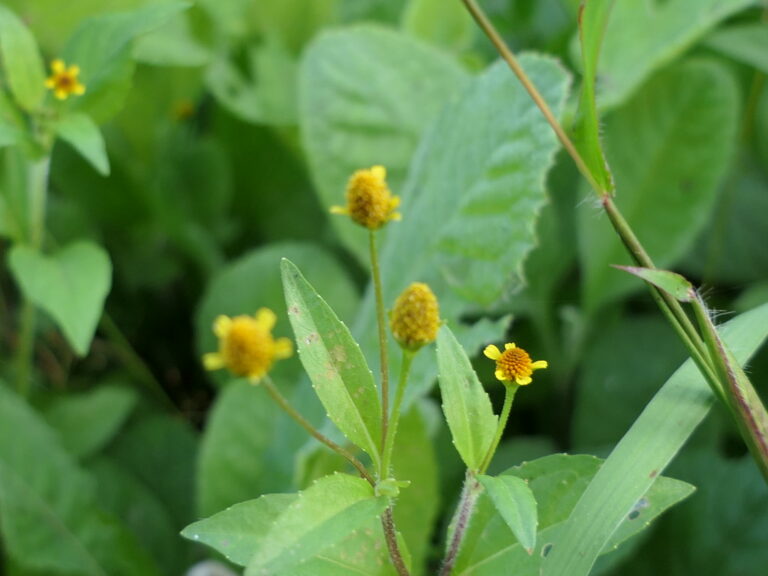
The description in the Flora of China gives the measurements that matter:
- Habit: annual herb, 10 to 30 cm (4 to 12 in) tall, occasionally to 50 cm (20 in). Stems single or several from the base, upright to sprawling, green to purple, smooth or slightly hairy. Stems lying on wet soil sometimes root at the nodes, which is why a patch can look like a low mat.
- Leaves: opposite, lance-shaped to narrowly ovate, 1.3 to 5 cm (0.5 to 2 in) long and 0.3 to 2.5 cm wide, with a wavy to toothed edge, a tapering base and a short stalk of 0.5 to 1.5 cm.
- Flower heads: egg- to cone-shaped, only 5 to 8 mm tall and 4 to 6 mm wide, borne singly or in twos and threes on stalks 1.2 to 3 cm long. Each head has 4 to 7 short yellow to orange-yellow ray florets around 68 to 148 tiny four-lobed disc florets.
- Seeds (achenes): black, 1.2 to 1.8 mm, fringed with short hairs, with two tiny bristles at the top. There is no fluffy parachute, so the seed does not blow far on the wind the way dandelion seed does.
- Flowering: year-round in the tropics, so plants in flower and seed can be found in any month.
A peppery, tingling taste in the leaves and flower heads is typical of the genus (see the spilanthol section below), but taste is a check, not an identification method. Use the flower-head and leaf characters first.
Acmella uliginosa vs Acmella oleracea vs Acmella paniculata
Three Acmella species cause most of the confusion. The toothache plant or paracress (A. oleracea) is the cultivated one sold as “buzz buttons”; A. paniculata is a wild Asian species often labelled “Spilanthes acmella” in older texts. The key characters from the Flora of China and the Taiwan survey are:
| Feature | A. uliginosa (marsh para cress) | A. oleracea (toothache plant, jambu) | A. paniculata |
|---|---|---|---|
| Ray florets (outer “petals”) | Present and conspicuous, 4 to 7, yellow to orange | Absent (discoid heads) | Absent (discoid heads) |
| Flower head size and shape | Small, 4 to 6 mm wide, cone-shaped | Large, over 1 cm (0.4 in) wide, cylindrical | Cone-shaped, under 1 cm wide |
| Leaves | Lance-shaped to narrowly ovate, tapering base, up to 5 cm | Ovate to triangular, broad blunt or slightly heart-shaped base | Ovate to lance-ovate, 2 to 4 cm, tapering base |
| Bracts around the head | 5 or 6, in one row | 15 to 18, in three rows | 9 to 12, in two rows |
| Achene edge | Hairy, no corky rim | No obvious corky rim | Distinct corky rim |
| Status | Wild weed of wet, disturbed ground | Mainly cultivated | Wild in South and Southeast Asia |
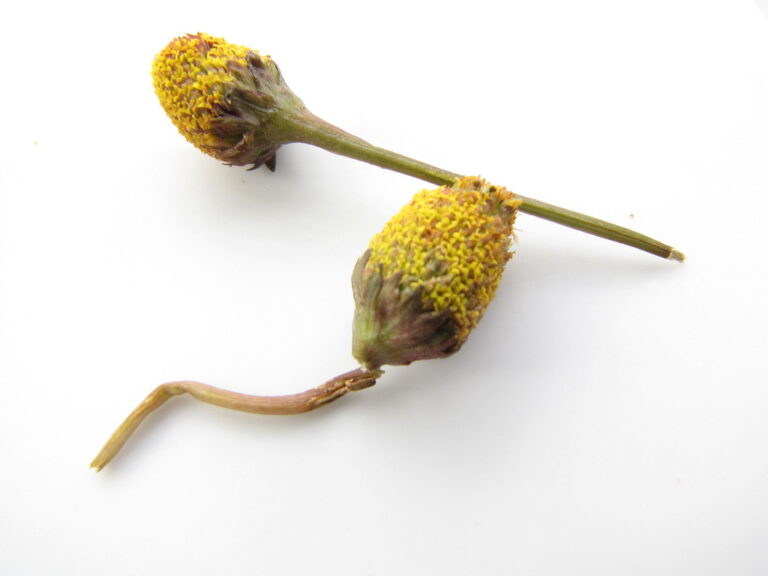
In short: small heads with a ring of little yellow rays point to marsh para cress. Big rayless “olives” are the toothache plant. Small rayless cones on a wild plant are usually A. paniculata. The Taiwan survey also noted that some local books showed a radiate Acmella with much larger heads, a different species again (A. ciliata), so check head size as well as rays.
Spilanthol: why the leaves tingle
The tingle comes from alkylamides, chiefly spilanthol. According to a review in the Revista Brasileira de Farmacognosia (Barbosa et al., 2016), spilanthol, also called affinin, is an N-isobutylamide with the formula C14H23NO. It causes pungency, tingling, numbness and a rush of saliva, which is why jambu (A. oleracea) is used in Brazilian cooking and why spilanthol-rich extracts appear in some toothpastes, mouth gels and “anti-wrinkle” cosmetics. Lab studies summarised in that review report local anaesthetic, anti-inflammatory, antimicrobial and mosquito-larvicidal activity.
Most spilanthol research has used A. oleracea. For marsh para cress specifically, a 2025 study in Fitoterapia (Borhan et al.) identified spilanthol and phytol in the leaf extract by GC-MS, so the same chemistry is present, although nobody has published how much it contains compared with the cultivated toothache plant.
Traditional and culinary uses
- Leafy vegetable in West Africa. In Benin the leaves are eaten as a vegetable. A survey of 300 rural households in central and northern Benin found that fresh leaves were mostly cooked into sauces, and that sun-drying was the usual way to keep them for later use (Vihotogbe-Sossa et al., Ecology of Food and Nutrition, 2012).
- Pain relief in Malaysia. The Malay community uses the plant to relieve the pain of mouth ulcers, toothache, sore throat and stomach ache (Ong et al., Journal of Ethnopharmacology, 2010). Borhan et al. (2025) add that it is used traditionally for various inflammatory conditions.
- Infections in Benin. The leaves are used traditionally as an “antibiotic” for infectious illness (Lagnika et al., BMC Complementary and Alternative Medicine, 2016).
- Chewing for a numb mouth. Chewing Acmella flower heads to numb toothache is an old and widespread practice, but the Taiwan survey documents it for the toothache plant (A. oleracea), not specifically for marsh para cress.
If you grow the toothache plant rather than foraging, NC State Extension notes that its leaves add a pungent flavour to salads and soups and that the flowers “can be eaten sparingly” and cause tingling, salivation and then numbness.
Plant uses are described here as background only. Nothing on this page is medical advice, and no wild plant should be eaten or used as a remedy based on a website. See our disclaimer.
What the studies actually found
Every study on marsh para cress so far has been done in test tubes or in rodents. None has tested it in people, so treat these as leads, not proof.
| Study | What was tested | Result | Limits |
|---|---|---|---|
| Ong et al., 2010 | Methanol extract of the flowers, given by mouth to mice in five pain models (chemical and heat) | Reduced pain responses in all models; the effect was partly blocked by naloxone, pointing to involvement of opioid pathways; no motor effects or deaths | Mice only; concentrated extract, not the food plant |
| Lagnika et al., 2016 | Dichloromethane, methanol and water extracts of the leaves against 6 bacteria and 6 fungi; antioxidant test; acute oral toxicity test in rats | Broad antibacterial activity (MIC 0.625 to 5 mg/ml), antifungal and antioxidant activity; no rats died, but the water extract at 2000 mg/kg caused blood, biochemical and tissue changes | Lab dishes and rats; the authors conclude “caution is required regarding its consumption” |
| Borhan et al., 2025 | Ethanol leaf extract and a hexane fraction in rats with induced arthritis for 28 days | Less paw swelling and lower COX-2, 5-LOX and VEGF levels; no changes in organ weights or blood markers | Rats only; one lab |
The honest summary: the traditional uses for pain and inflammation have some support in animals, and the antimicrobial use has some support in the lab. That is a long way from showing that eating or chewing the plant treats anything.
Safety
- No human data. The Memorial Sloan Kettering integrative medicine database, which covers the closely related toothache plant and spilanthol, states that human data are lacking for all its reported uses. There is one report of lip swelling after eating “Szechuan buttons”.
- Pregnancy. MSKCC advises avoiding the toothache plant in pregnancy because animal studies suggest harm to the foetus at high doses. Apply the same caution to marsh para cress and to breastfeeding.
- Daisy-family allergy. People allergic to ragweed, chamomile, marigolds or other Asteraceae may react.
- Medicines. MSKCC lists possible interactions with diuretics and some anti-androgen drugs for the toothache plant. If you take regular medication, talk to a doctor or pharmacist before using any Acmella as a remedy.
- Extracts. The only toxicity signal so far came from a large dose of concentrated water extract in rats, which is a good reason to avoid concentrated preparations.
- Wild-picked plants. Roadside ditches and field drains collect runoff, herbicide drift and sewage. Only pick from ground you know is clean, and never from recently sprayed areas.
Nothing here is medical advice. For toothache, mouth ulcers or joint pain that lasts, see a dentist or doctor.
Growing marsh para cress
It is not a common garden plant, and in wet tropical regions it tends to arrive on its own. If you want an Acmella for the kitchen, the toothache plant is the usual choice; NC State Extension describes it as growing 1 to 1.5 ft (30 to 45 cm) tall in full or partial sun and moist, well-drained soil, hardy only in USDA zones 9a to 11b and otherwise grown as an annual from seed or cuttings. Marsh para cress has similar needs:
- Light: it tolerates light shade under trees, but grows denser and flowers more in full sun.
- Water: it likes damp soil, as its spread through wet paddy margins shows; give water in dry spells.
- Temperature: it is a tropical annual and will not survive frost. In cool climates, sow indoors in spring and plant out after the last frost.
- Propagation: sow the tiny seeds on the surface of moist compost, or root pieces of stem that already show roots at the nodes.
- Containment: it seeds freely. Grow it in a pot or trim off heads as they brown to keep it from spreading into lawns and beds.
Is it a weed, and how do you control it?
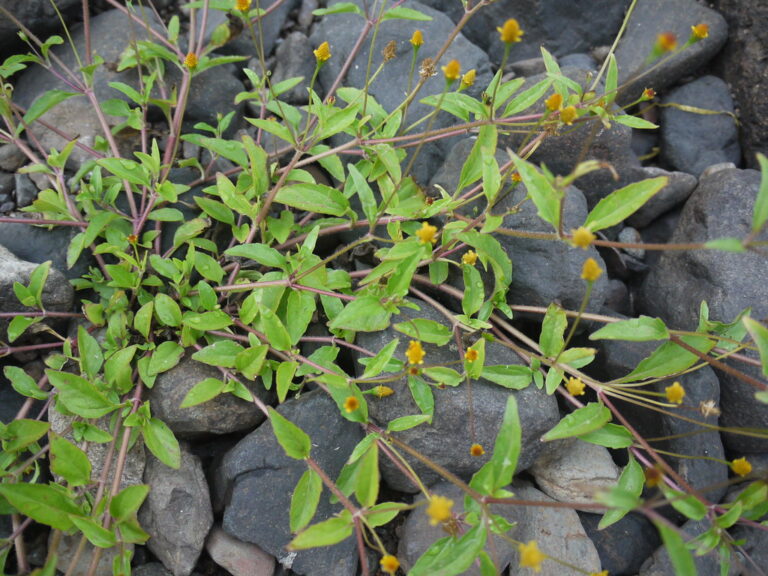
Yes, in the right conditions. The Taiwan survey describes it as naturalised and invasive in wet, disturbed habitats of the Pacific islands (including Fiji), New Caledonia, the Ryukyu Islands, the Philippines and Hong Kong. In Taiwan it spread through damp rice paddies, disturbed ground and roadsides, and became one of the dominant plants around a man-made pond and in an abandoned paddy field. It typically forms low mats along roadsides, ditches, riverbanks, field edges and bare ground, and it will also grow in light shade under trees. It often shares these wet spots with other paddy weeds such as linear-leaf water primrose.
Because it is a shallow-rooted annual, control is simple:
- Pull or hoe before flowering. Plants bloom all year in the tropics, so check wet corners every two to three weeks in the growing season.
- Bag plants that are already in seed. Ripe heads shed black seed as you handle them. Our guide to disposing of invasive plants covers bagging and solarising.
- Remove rooted stem pieces. Stems lying on wet soil can root at the nodes, so rake up fragments after weeding.
- Fix the wet spot. Improving drainage and keeping a dense lawn or mulch over bare soil removes the open, damp ground it needs.
- Herbicides are rarely needed. If you do use one, choose a product whose label covers annual broadleaf weeds on that site, and never spray near water unless the label allows it.
If you are interested in other small weeds with a history of use, see our pages on Euphorbia hirta (asthma plant) and creeping beggarweed.
FAQ
Can you eat marsh para cress raw?
Where it is eaten as a vegetable, the leaves are cooked into sauces rather than eaten raw in quantity. A small raw taste is what gives the tingle, but given the rat toxicity finding and the lack of human data, treat it as an occasional cooked green, not a daily food or remedy.
Related guides: Bengal Arum (Typhonium trilobatum): Identification, Toxicity and Uses · Mimosa pudica (Touch-Me-Not, Sensitive Plant): Identification, Why the Leaves Close, Uses and Weed Control
Sources
- Flora of China – Acmella uliginosa
- Botanical Studies (Academia Sinica) – Notes on Acmella in Taiwan, Chung et al. 2008
- Royal Botanic Gardens, Kew – Plants of the World Online: Acmella uliginosa
- BMC Complementary and Alternative Medicine – Antimicrobial, antioxidant, toxicity and phytochemical assessment of Acmella uliginosa, Lagnika et al. 2016
- Ecology of Food and Nutrition – Endogenous knowledge of four leafy vegetables in Benin, Vihotogbe-Sossa et al. 2012
- Journal of Ethnopharmacology – Antinociceptive activity of Acmella uliginosa, Ong et al. 2010
- Fitoterapia – Acmella uliginosa in adjuvant-induced arthritis in rats, Borhan et al. 2025
- Revista Brasileira de Farmacognosia – Spilanthol: occurrence, extraction, chemistry and biological activities, Barbosa et al. 2016
- Memorial Sloan Kettering Cancer Center – Spilanthes acmella (jambu)
- NC State Extension Gardener Plant Toolbox – Acmella oleracea