
Short answer: tiger foot morning glory (Ipomoea pes-tigridis) is a hairy, twining annual vine of the Old World tropics. You can recognise it by its leaves, which are cut almost to the base into 5 to 9 finger-like lobes (the “tiger’s paw”), and by its white funnel-shaped flowers, 3 to 4 cm (about 1.5 in) long, which sit in tight heads wrapped in hairy leafy bracts. It is native from tropical Africa through South and Southeast Asia, naturalised in northern Australia, and turns up as a weed of rainy-season crops such as maize in India. Because it is an annual that spreads only by seed, control comes down to one rule: pull or hoe it before the first seed capsules ripen, and keep doing that until the seed bank runs down.
What tiger foot morning glory looks like
Some web pages describe this plant with glossy heart-shaped leaves and orange, striped flowers. That is not Ipomoea pes-tigridis. According to the Flora of China species account, it has:
- Stems: annual, twining, 0.5 to 3 m (roughly 1.5 to 10 ft) long, covered in spreading stiff hairs.
- Leaves: round or wider than long in outline, 2 to 10 cm long by 3 to 13 cm wide, palmately and deeply divided into (3–)5–9 elliptic or oblong segments that taper at both ends; densely hairy, on stalks 2 to 8 cm long.
- Flower heads: few-flowered, capitate heads on stalks 4 to 11 cm long, with hairy outer bracts 2 to 2.5 cm long around the cluster; the individual flowers have almost no stalk.
- Sepals: lanceolate, 1 to 1.4 cm, hairy on both sides.
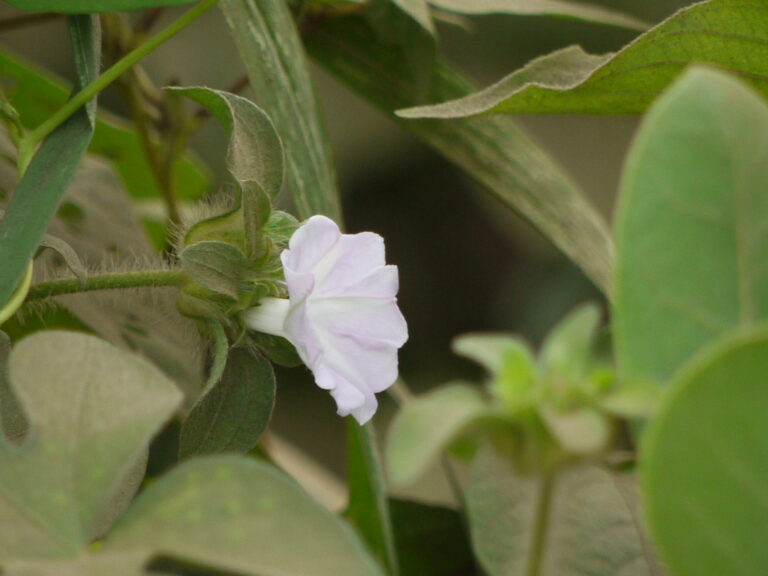
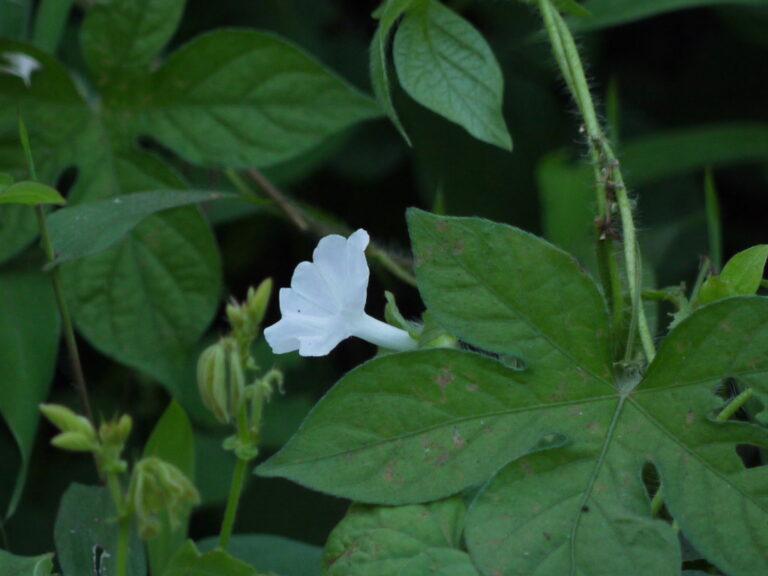
- Corolla: white, funnel-shaped, 3 to 4 cm long.
- Fruit and seed: an ovoid capsule about 7 mm long that splits into four; seeds about 4 mm, covered in grey felt-like hairs.
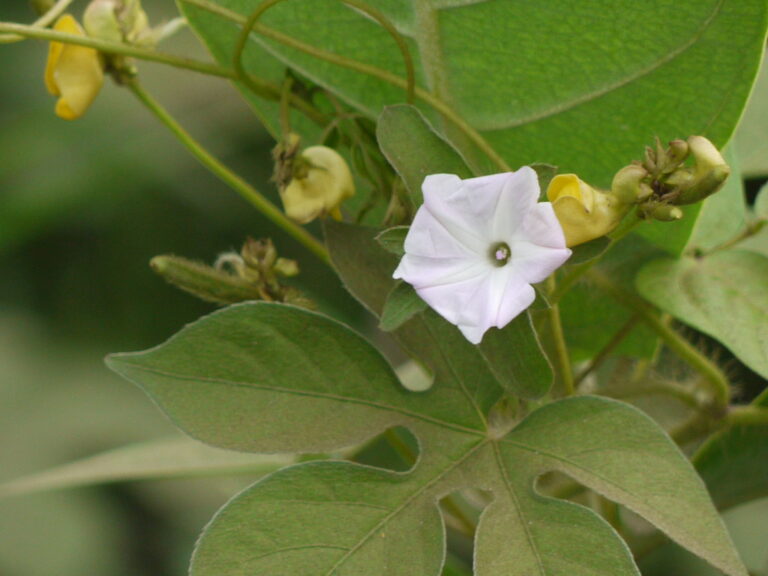
The Flora of Pakistan adds that the leaf segments are 3 to 7.5 cm long, that the leaf is “often wider than long”, and that stems may twine, sprawl or lie flat along the ground. A 2024 field description from Punjab in Tropical Plant Research notes that the lobes are narrowed at their base, which gives the paw-like, pinched look.
The quickest field check: narrow-waisted lobes cut nearly to the base, bristly stems, and white flowers held in a head inside a collar of hairy bracts.
Where it grows
According to Plants of the World Online (Kew), the native range is the tropical and subtropical Old World, mainly in the seasonally dry tropics: tropical Africa, the Indian subcontinent, mainland Southeast Asia, southern China and the Malay archipelago to New Guinea. Kew lists it as introduced in the Northern Territory, Queensland, Western Australia and the Mariana Islands.
In Western Australia, FloraBase records it as alien to the state, an annual herb or climber of grassland on river levees and red loam, in the Kimberley regions (Dampierland, Northern Kimberley, Ord Victoria Plain, Victoria Bonaparte). It is not listed there as a declared weed.
Habitats in China are thickets, roadsides and seashores up to 400 m; in Pakistan, thorn scrub and dry places. It is not established in the US, UK or Canada, where it is only grown occasionally from seed as an ornamental.
Life cycle and why it becomes a crop weed
Tiger foot morning glory is described as an annual by the Flora of China, the Flora of Pakistan and FloraBase (Kew allows that some populations may persist as short-lived perennials). It has no tubers or creeping roots, so every new plant comes from seed. In South Asia it germinates with the monsoon rains and flowers late in the season: the Flora of Pakistan gives a flowering period of August to October.
That timing puts it squarely in the kharif (rainy-season) crops. A 2018–2021 survey of weeds in the Malwa region of Punjab, published in Tropical Plant Research, recorded it among eight climbing Convolvulaceae weeds in kharif crops (rice, maize, cotton, sorghum, sugarcane) and rabi crops, and noted that all of them climb over the crop plants. A 2024 kharif survey of maize fields in Chhindwara district, Madhya Pradesh, published in the Journal of Medicinal Plants Studies, listed it among 127 weed species. Neither study measured yield loss from this species, and we found no trial that does, so treat it as one of several climbing broadleaf weeds rather than a major pest on its own.
Look-alikes and how to tell them apart
Several vines in the same family share its habitats. The Flora of China key to Ipomoea separates tiger foot morning glory by its palmately divided leaves, oblong involucral bracts, lanceolate sepals and white funnel corolla.
| Species | Leaves | Flowers | Key difference |
|---|---|---|---|
| Ipomoea pes-tigridis (tiger foot morning glory) | Palmately cut into 5–9 narrow-waisted lobes, very hairy | White, 3–4 cm, in bracted heads | Collar of hairy bracts around the flower cluster |
| Ipomoea nil (Japanese morning glory) | Heart-shaped, entire or 3- (rarely 5-) lobed | Blue with a whitish tube, fading pink, 5–6 cm | Blue flowers; sepals with long narrow tips |
| Ipomoea hederacea (ivyleaf morning glory) | 3-lobed, heart-shaped base, 5–13 cm, hairy | Off-white to light blue, turning pink-purple | Only 3 lobes; blue tones in the flower |
| Ipomoea triloba (littlebell) | Entire to deeply 3-lobed, mostly hairless | Pink or pale purple, only 1.5–2 cm | Small pink flowers, smooth leaves |
| Ipomoea cairica (Cairo morning glory) | Palmately divided right to the base | Funnel-shaped, not in bracted heads | Smooth leaves; small leaf-like “pseudostipules” at the leaf base |
| Merremia aegyptia (hairy woodrose) | Compound, with 5 separate leaflets | White or yellowish-white | Leaflets fully separate, not lobes of one blade |
Details for I. nil and I. triloba come from Flora of China, I. hederacea from SARE (below) and Merremia aegyptia from the Punjab study above.
Traditional uses
The plant has a modest folk-medicine record. Dr. Duke’s Ethnobotanical Database (USDA) lists uses for boils and carbuncles (Philippines), pimples and sores (Indonesia and Java), as a purgative and as an antidote to dog bite, with an old record of use against tumours in Sri Lanka. A 2018 review in the International Journal of Current Pharmaceutical Research summarises the leaf poultice for boils and sores and the purgative root, and lists laboratory studies of extracts (antimicrobial, antioxidant, analgesic and others). These are test-tube and animal results, not evidence of safe or effective treatment in people. The root is recorded as a purgative, so do not eat or dose yourself with any part of the plant, and see a doctor for dog bites or infected sores.
Plant uses are described here as background only. Nothing on this page is medical advice, and no wild plant should be eaten or used as a remedy based on a website. See our disclaimer.
How to control tiger foot morning glory
No extension service we found publishes a control programme for this species. The steps below combine its biology with research on the annual morningglories of US crops, which share its large seeds and twining habit.
- Pull or hoe before seed set. In related morningglories, seeds mature about four weeks after the flowers open, and plants keep flowering until killed, according to SARE. Remove vines as soon as you see the first white flowers, or earlier. Pull the whole plant; SARE notes that ivyleaf morningglory regrows if you only break off the tip once the vine is longer than 4 inches (10 cm).
- Bag plants that already have capsules. Capsules ripen after the vine is pulled. Put seed-bearing plants in a bag rather than the compost; see our guide to disposing of weeds safely.
- Hit the flush after the first rains. Morningglory seedlings emerge best from the top 1 to 2 inches (2.5 to 5 cm) of soil, per SARE. Shallow hoeing or cultivation a week or two after the rains start kills most of each flush before the vines reach the crop.
- Close the canopy. Crop shade suppresses seed production sharply: SARE reports pitted morningglory under crop competition set as little as 5% or even 0.4% of the seed of plants growing in the open. Narrow rows and good early crop growth help.
- Do not rely on straw or plastic mulch alone. SARE found both ineffective against these large-seeded vines, which push through or around them. Mulch still helps with small-seeded weeds; the tips in our mulch weed guide apply, but plan to hand-pull the vines.
- Herbicides. We found no published herbicide recommendation that names this species. In crops, use whatever your local agricultural extension or crop-protection guide lists for annual broadleaf and morningglory-type weeds in that crop, and follow the label.
When to expect results
Morningglory seed can stay alive in soil for years because of its hard seed coat. SARE reports ivyleaf seed persisting up to 17 years and 13% of buried pitted morningglory seed still viable after 5.5 years, though many seeds die sooner. Expect new seedlings every rainy season for several years after a heavy infestation, with numbers falling each year you prevent seeding. For other tropical weeds that spread the same way, see our pages on Caesar weed and lantana.
Related guides: Bengal Arum (Typhonium trilobatum): Identification, Toxicity and Uses · Bindweed vs Morning Glory: How to Tell Them Apart
Sources
- Flora of China (eFloras) – Ipomoea pes-tigridis
- Flora of China (eFloras) – Ipomoea, key to species
- Flora of Pakistan (eFloras) – Ipomoea pes-tigridis
- Royal Botanic Gardens, Kew – Plants of the World Online: Ipomoea pes-tigridis
- Western Australian Herbarium – FloraBase: Ipomoea pes-tigridis
- Dhillon (2024), Tropical Plant Research – Morphological study of Convolvulaceae weeds from Punjab, India
- Bano and Pandey (2025), Journal of Medicinal Plants Studies – Weeds of maize crop, Chhindwara district
- SARE – Manage Weeds on Your Farm: Morningglories
- USDA – Dr. Duke’s Ethnobotanical Database: Ipomoea pes-tigridis
- Venkateshan et al. (2018), International Journal of Current Pharmaceutical Research – Review of Ipomoea pes-tigridis