
Short answer: “barley grass” in a lawn or pasture is almost always one of three wild Hordeum species, and the fix depends on which one you have. Foxtail barley (Hordeum jubatum) is a short-lived perennial bunchgrass: dig or spot-spray clumps with glyphosate, then fix the wet, salty or bare ground it likes. Hare barley (Hordeum murinum, also called wall or mouse barley) and little barley (Hordeum pusillum) are winter annuals: they germinate in autumn, seed in late spring and die by early summer, so you beat them by pulling before the spikes form and by putting down a pre-emergent in late summer, not spring. In every case, mow or cut before the seed heads dry, because the barbed awns are what injure dogs and livestock and what carry the seed to new ground.
Which “barley grass” do you have?
The name is used loosely. In the western US and Canada it usually means foxtail barley, the plant with silky, pink-tinged plumes on roadsides and in wet patches of lawn. In California, the UK, Australia and the Mediterranean it usually means hare barley or wall barley, a stiff-headed annual along fences and in thin turf. In the central US, the lawn invader that appears in April and is gone by July is little barley. All three are true barleys and all three produce the barbed seed units that vets call foxtails. The summer weeds gardeners call foxtails (genus Setaria) and cheatgrass (Bromus tectorum) get lumped in too.
The quickest way to separate them is the life cycle plus the auricles, the little ear-like flaps where the leaf blade meets the stem. According to the UC Statewide IPM Program, hare barley has auricles that are “characteristically long, narrow, and clasp the stem”, while foxtail barley’s auricles “are absent or are poorly developed”. Foxtail barley is also the only perennial in the group, as the UC Weed Science blog points out in its comparison of the many “foxtail” grasses.
| Grass | Life cycle | Height | Seed head | Auricles | Seed heads appear | Typical site |
|---|---|---|---|---|---|---|
| Foxtail barley (Hordeum jubatum) | Short-lived perennial bunchgrass, also seeds freely | 1–3 ft (30–90 cm) | Soft, nodding plume 1–4 in (3–10 cm) long; awns up to 2 in (5 cm), green turning pink-tan then straw | Absent or tiny | June–August | Wet, saline or alkaline soil; ditch banks; low spots in lawns; roadsides salted in winter |
| Hare / wall barley (Hordeum murinum) | Winter annual | Up to 3 ft (1 m), but sprawls flat under mowing | Stiff, dense, bristly spike 1–3 in (3–8 cm); awns 1/4–1 in (0.5–2.5 cm) | Long, clasping | April–June | Fence lines, pavement cracks, thin turf, disturbed ground, salty spots |
| Little barley (Hordeum pusillum) | Winter annual | Usually under 1 ft (30 cm) in lawns | Small, narrow, bristly spike; plant browns off by July | Small or absent | May–June | Thin, dry, compacted lawns; bare soil under mowing |
| Yellow / green foxtail (Setaria spp.) | Summer annual | 1–3 ft (30–90 cm) | Bottlebrush spike with soft bristles, not barbed awns | None; ligule is a fringe of hairs | July–September | Warm bare soil, new lawns, garden beds |
| Cheatgrass / downy brome (Bromus tectorum) | Winter annual | 4–24 in (10–60 cm) | Drooping, open panicle that turns purple-red then tan; awned | None; leaves densely hairy | May–June | Dry banks, gravel, rangeland |
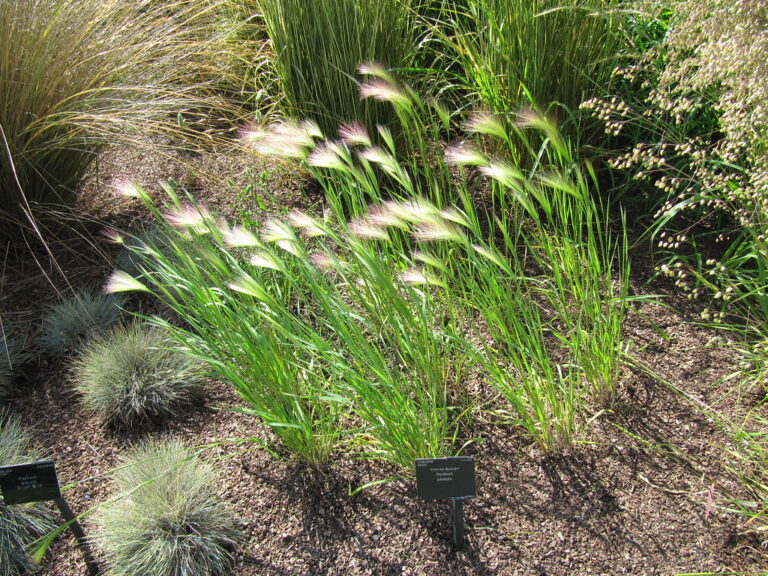
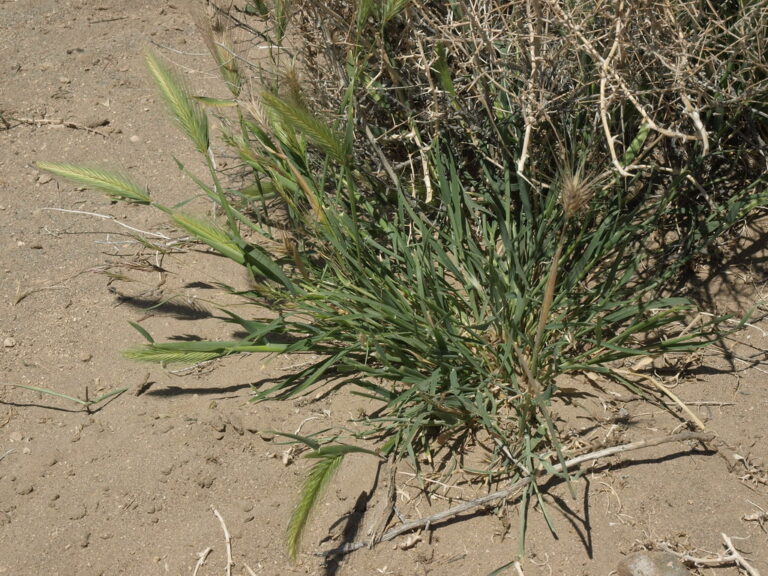
The measurements come from Colorado State University Extension, the University of Nevada, Reno Extension guide to hare barley, and Penn State Extension for the true foxtails. A fluffy plume on a clump that returns every year is foxtail barley. A short, stiff spike on a plant that appeared over winter and is yellowing by June is an annual barley. A soft bottlebrush that appears in July heat is a Setaria foxtail, and the summer-annual approach in our crabgrass identification and control guide applies instead.
Why the seed heads matter for dogs and livestock
The reason to act before the heads dry is not cosmetic. Each barley seed unit carries stiff awns with backward-pointing barbs. The UC Davis School of Veterinary Medicine explains that the barbed design is “intended to burrow seeds into the soil”, so once a foxtail enters a dog it “cannot reverse direction and come out on its own” and can migrate through tissue. The common entry points are the nose, mouth, ears and eyes, plus the skin between the toes. Warning signs are persistent sneezing or snorting, head shaking, a squinting or weeping eye, or a dog that keeps licking one paw. UC Davis notes the seeds are most dangerous “when they have dried out and hardened, typically during the summer months”, which is exactly the window after the plants have finished flowering.
Livestock suffer the same way. Colorado State Extension reports that the awns “can abrade or become lodged in the skin, mouth, nose and eyes” and that contaminated hay “should not be used or sold”. If you have a dog: cut or pull barley grass while the heads are green and soft, keep the dog off dried stands in early summer, and check ears, armpits and toes after walks through rough grass.
Why it is growing in your lawn
All three barleys are opportunists of thin, stressed turf, but each has a favourite kind of stress.
- Foxtail barley loves salt and standing water. Colorado State lists “alkaline/saline areas, moist soils and disturbed areas”. In a lawn that means the strip along a road or driveway that gets de-icing salt, a low corner where sprinklers pond, or where a water softener drains. University of Nebraska–Lincoln CropWatch adds that it has a shallow fibrous root system, spreads by seed and tillering, and that seeds stay viable for up to seven years.
- Hare barley wants bare, disturbed soil: “turf, vacant lots, in pavement cracks and other disturbed or unmanaged sites”, often “wet and salty areas”, in the Nevada guide’s words.
- Little barley signals a thin, dry, often compacted lawn. Kansas State University Extension says it comes up in late September to October wherever sunlight reaches the soil, overwinters small, “thrives in the cooler spring temperatures, forms seed heads, and dies out usually by July”.
That timing is what most lawn advice gets wrong. The annual barleys are not summer weeds. By the time you notice the heads in May, the plant is weeks from dying; what you are fighting is next year’s seed.
How to get rid of foxtail barley (the perennial) in a lawn
- Dig out clumps. The root system is shallow, so a garden fork lifts a whole crown. Do this in spring when the plants are green and before the June heads. Bag the plants if any heads have formed; do not compost them.
- Spot-treat what you cannot dig. Colorado State recommends spot treatment with glyphosate. Paint or spray individual clumps, accept the small dead patch, and reseed it two to three weeks later once the barley has browned. UNL notes that chemical control “declines if it is sprayed later in the growing season, after seed heads have become established”, so treat in April or May, not July.
- Mow before the heads open. Mowing does not kill foxtail barley; UNL and Oregon State University Extension both warn that it simply sends up a new head on a shorter stalk. But repeated mowing in May and June stops most seed from maturing and keeps the awns off your dog.
- Fix the site. Colorado State’s advice for pastures is to reduce irrigation-induced saturated soil before June, and the same applies to a lawn: correct the sprinkler that ponds, regrade the low spot, or add a drain. Along salted roadsides, flush the strip with heavy watering in early spring and consider a salt-tolerant grass or a gravel strip instead of turf.
- Crowd it out. Foxtail barley is a poor competitor in dense turf. Overseed the thin areas in early autumn and mow at 3 in (7.5 cm) or higher. If you are treating a large infested area first, our guide on whether to kill weeds before overseeding covers the waiting times after glyphosate.
How to get rid of hare barley and little barley (the annuals)
These are seed-bank weeds, and the control calendar runs backwards from what most people expect.
Spring (what you can still do now)
- Pull or hoe plants before the spike appears. The Nevada guide says to remove young seedlings by digging, hoeing or pulling before spike development, and warns that “mowing encourages plants to grow close to the ground and does not control them”. Hare barley in particular will set seed on 2 in (5 cm) stems under a mower.
- Once heads are showing, K-State is blunt: in a lawn “your only control option is to pull or dig the plants up to prevent more seeds from being spread”, because the post-emergent grass herbicides that would kill barley also damage the lawn grass. Bag the pulled plants.
- Do not waste money on spring pre-emergents for these species. A crabgrass pre-emergent applied in March goes down five months after the barley germinated.
Late summer (the step that actually works)
- Apply a pre-emergent before the autumn flush. K-State recommends products containing dithiopyr for little barley, applied in early August and watered in. Check the label: dithiopyr is listed for little barley on some labels; many crabgrass products do not list Hordeum at all.
- The standard crabgrass actives can disappoint. In a 2025 trial reported by the K-State Turf and Landscape programme, prodiamine, pendimethalin and dithiopyr applied at labelled rates on 26 August gave minimal control of little barley in a buffalograss lawn, while oxadiazon gave about 90 percent control. The researchers suspect germination starts earlier than the September–October window usually quoted, so apply in the first half of August and water in.
- Do not apply a pre-emergent where you plan to overseed that autumn; it will stop grass seed too. In a thin lawn, overseeding is the better investment: K-State says the best control for little barley “is a thick lawn mowed high enough that sunlight does not hit the soil”.
Autumn
- Overseed bare and thin patches in early autumn (tall fescue in the transition zone, perennial ryegrass or fine fescue further north, and the grasses in our lawn grass comparison for warm regions). A dense stand in October is the single best defence against a barley flush.
- Mulch beds and fence lines 3 in (7.5 cm) deep; the Nevada guide notes that thick mulch helps prevent germination.
When to replace the turf instead
If more than about half of an area is barley grass in spring, start over. Kill the patch with glyphosate while the barley is green, wait for it to brown, then either lay sod (which smothers the seed bank) or till shallowly, water to trigger a flush of seedlings, kill that flush, and then sow. Our step-by-step on removing old sod and reseeding covers the mechanics. On a chronically wet or salty spot, new turf without fixing the cause buys a year or two at most.
Control in pastures, paddocks and large areas
| Method | Foxtail barley (perennial) | Hare / little barley (annual) | Notes from extension sources |
|---|---|---|---|
| Mowing or topping | Reduces seed but plant regrows; repeat before each heading | Must be before heads emerge; plants re-head low | Oregon State: mowing alone “has been ineffective, as the plant will send up another seed head on a shorter stalk” |
| Grazing | Early, intense grazing in spring can help (Colorado State); heavy grazing later increases tillering and seed | Palatable when young, dangerous once headed | Oregon State: “Heavy grazing has been shown to increase production of seeds” |
| Tillage | Repeated summer tillage in heat stress, then reseed | Shallow tillage brings up seed; follow with competitive seeding | Oregon State renovation sequence: soil test, herbicide, disk, temporary pasture, then permanent seeding |
| Selective herbicides | Imazapic is labelled for foxtail barley in pasture and rangeland (UNL); propoxycarbazone gave partial control at 0.9–1.2 oz/acre (Oregon State); clethodim in conventional alfalfa | Aminopyralid applied pre-emergence suppressed hare barley germination in Oregon trials | All rates and grazing restrictions come from the current label for your state or country |
| Non-selective | Glyphosate spot treatment of clumps or patches, followed by reseeding | Best in April–May before heads form (UNL) | |
After renovation, Oregon State advises a minimum stubble of 3 in (7.5 cm) for tall fescue and orchardgrass and 2 in (5 cm) for ryegrass so the sward stays competitive. Move animals off infested paddocks before the heads dry, and not straight onto clean ground: seed travels in coats, hooves and manure. Never bale hay from a stand that has headed.
Common mistakes
- Treating an annual barley like crabgrass. Spring pre-emergents and summer post-emergents miss the winter-annual cycle.
- Mowing as the whole plan. Annual and perennial barleys both set seed below mower height.
- Composting pulled plants with heads on. Home compost rarely gets hot enough; bag them.
- Spraying after the heads have browned. Glyphosate on a dying annual achieves nothing.
- Using vinegar or salt. Salt makes the ground better for foxtail barley, and acetic acid only burns top growth; see what horticultural vinegar really does.
- Ignoring the cause. A wet, salty or bare spot grows barley again within two seasons.
What to expect
Foxtail barley clumps dug or spot-sprayed in spring are gone that season, but seedlings from the seven-year seed bank appear each spring for three to five years in falling numbers; a few minutes of pulling handles them. For hare and little barley, one well-timed August pre-emergent plus autumn overseeding usually cuts the next spring’s flush sharply, and two years with no seed set reduces the problem to the odd plant along the edges. The lawns that stay clear are mowed at 3 in (7.5 cm) with no bare soil showing in October.
Sources
- Colorado State University Extension – Foxtail Barley
- University of Nebraska–Lincoln CropWatch – Develop a Management Plan for Foxtail Barley in April and May
- University of Nevada, Reno Extension – A Northern Nevada Homeowner’s Guide to Identifying and Managing Hare Barley
- UC Statewide IPM Program – Hare Barley
- UC Weed Science – The Many Faces of Foxtails
- Kansas State University Extension – Little Barley
- K-State Turf and Landscape – Research Update: Pre-Emergent Control of Little Barley
- Oregon State University Extension – Foxtail Control in Pastures and Hayground
- UC Davis School of Veterinary Medicine – Foxtails and Dogs
- Penn State Extension – Yellow Foxtail and Green Foxtail