
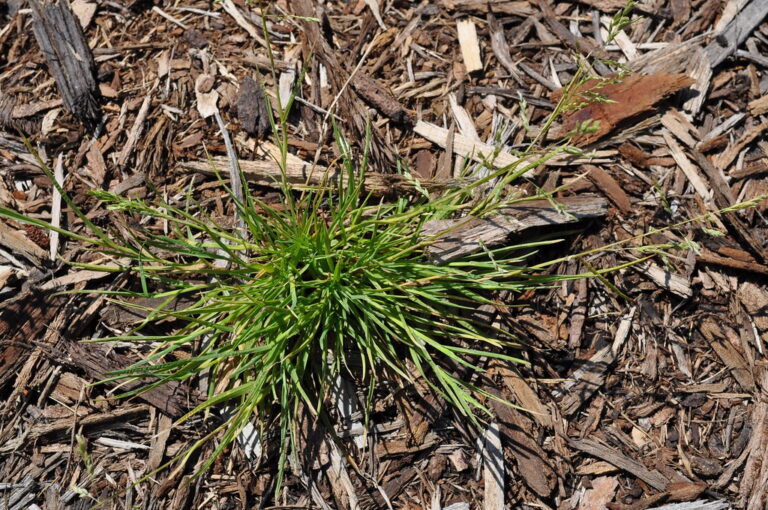
It’s fall, the lawn finally looks even again, and then you kneel to pull a stray weed and spot them: soft, pale-green tufts between the blades, too bright to be your grass. Come spring, they’ll be dotted with whitish seedheads no mower can catch. That’s Poa annua, and fall is exactly when it sprouts.
Short answer: Poa annua (annual bluegrass) is a light-green, clumping winter annual grass that sprouts in late summer and fall once soil temperatures drop below 70°F, flowers in spring even when mowed short, and then dies in summer heat, leaving brown gaps. You control Poa annua mainly by stopping its seed: a pre-emergent herbicide applied in late summer or early fall, a second application 8–10 weeks later, and a denser, taller, less-watered lawn that gives the seedlings nowhere to start.
Few home lawns can be cleared of it in one season, because the soil already holds seed. What works is a yearly routine timed to soil temperature, not the calendar.
By the end, you’ll be able to spot annual bluegrass at a glance and pick the right pre-emergent window for your grass type. The seven steps and the season-by-season calendar follow the recommendations of university turf programs in California, Georgia, South Carolina, Indiana, Maryland and North Carolina.
Table of Contents
What Poa annua is and why it keeps coming back
Annual bluegrass is a close relative of Kentucky bluegrass, but it lives on a completely different schedule. The University of California IPM program (Pest Notes 7464) describes the life cycle. Seed starts germinating in late summer or fall when soil temperatures fall below 70°F, plants grow through the cool months, and seed clusters can form when plants are only six weeks old. Each small plant can produce about 100 seeds in as few as eight weeks.
And that’s the low estimate. Purdue University’s turf program puts the figure at up to 360 viable seeds from a single plant, and notes that germination can happen in late summer, early autumn and again in spring. University of Georgia Extension (Bulletin 1394, 2024) adds the part that frustrates homeowners most: plants make hundreds of seeds even when closely mowed, and that seed can stay dormant in the soil for years before it germinates.
Put those together and you get a loop: every spring’s seed crop becomes next autumn’s weeds, and the autumn after that. In warm weather the annual type dies, which is why a lawn that looked patchy-green in April suddenly shows bare, brown spots in June. Golf courses also carry perennial biotypes that survive summer, but in a home lawn you’re almost always dealing with the annual form.
How to identify Poa annua in your lawn
From a standing height, annual bluegrass shows up as lighter green, slightly lumpy tufts that don’t match the rest of the lawn, and in spring those tufts turn whitish with seedheads a day or two after you mow. Up close, check these features, taken from NC State’s TurfFiles and UC IPM:
- Growth habit: bunch-type clumps, 6–8 inches tall if left unmowed; some types form short stolons.
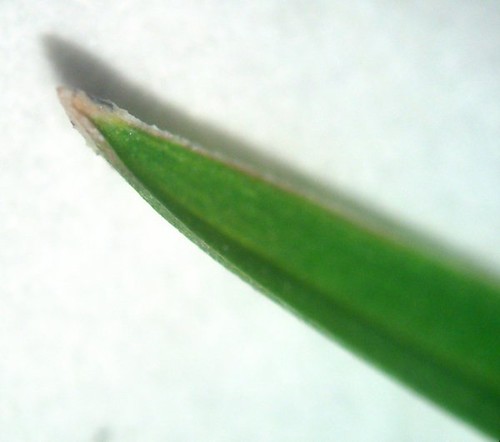
- Leaf tip: boat-shaped, like the bow of a canoe, with two clear lines running either side of the midrib.
- Leaf blade: light green, smooth, not glossy, 2–3 mm wide and often crinkled part way down; blades are 1–3 inches long.
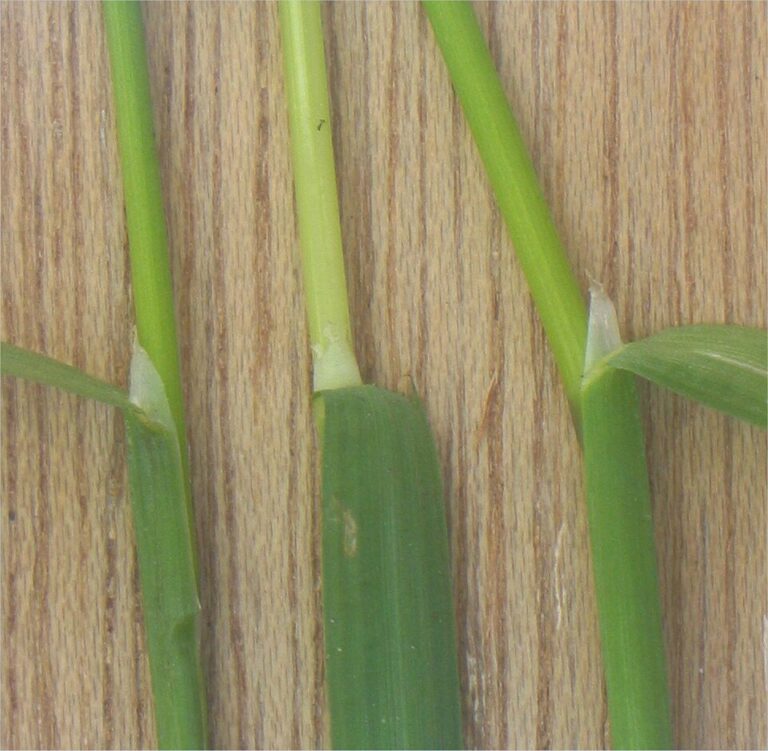
- Ligule: a membranous, pointed collar 1–3 mm long where the blade meets the stem.
- Vernation: the new leaf is folded in the bud, not rolled.
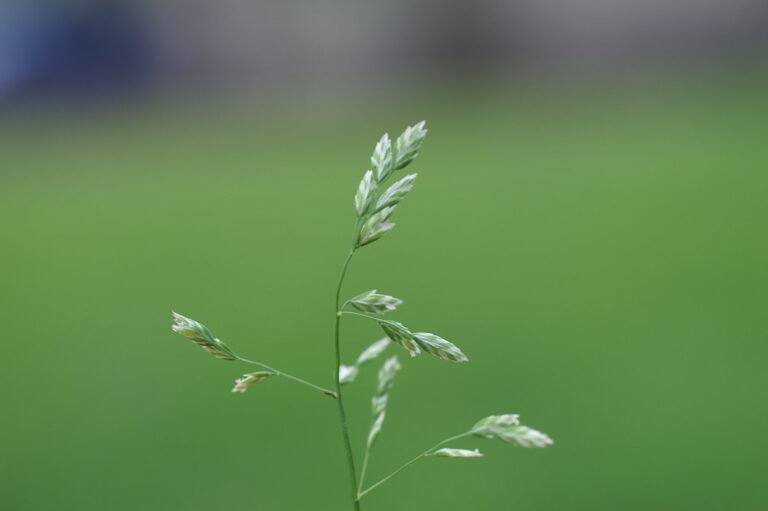
- Seedhead: an open, pyramid-shaped, greenish-white panicle 1–4 inches long, produced even at very low mowing heights.
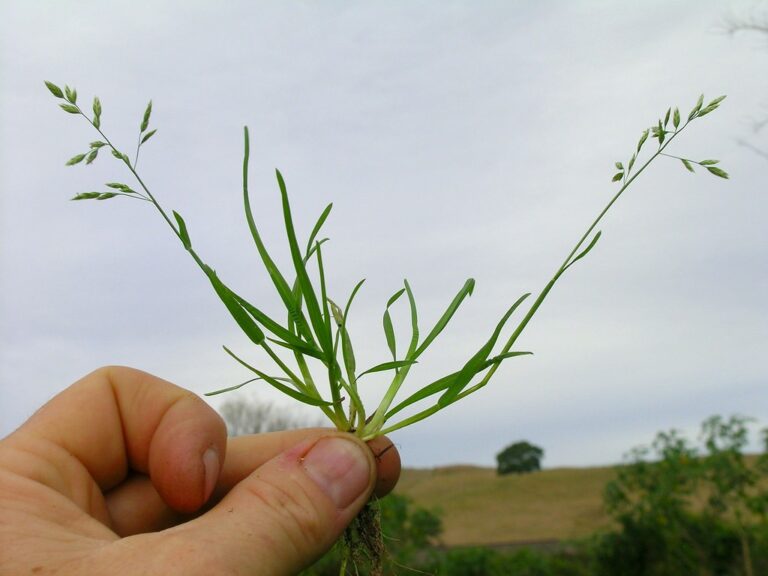
The seedheads are the giveaway
This is the maddening trait. Most lawn grasses stop flowering when you mow them regularly; Poa annua doesn’t. It keeps pushing short seedheads below the mower blade all through spring, and that is what gives an infested lawn its speckled, off-white look in April and May.
Leaf tip and ligule
No seedheads to go on? Fold a leaf and look at its tip. A boat shape means you have a bluegrass (genus Poa). Then peel a leaf back to the stem: annual bluegrass has a clear, pointed ligule, and the whole plant is a shallow-rooted clump that pulls up easily.
Annual bluegrass vs Kentucky bluegrass and other lookalikes
Before you treat anything, rule out the three grasses most often confused with annual bluegrass. Crabgrass is the most common mistake, but its timing is the opposite: it sprouts in spring and dies at the first frost.
The two bluegrasses are trickier. Penn State Extension separates roughstalk bluegrass from Kentucky bluegrass by its glossy leaf underside and stolons.
| Grass | Life cycle | Color and texture | How it spreads | Best field check |
|---|---|---|---|---|
| Annual bluegrass (Poa annua) | Winter annual; germinates late summer to spring, dies in summer heat | Light green, smooth, not glossy | Seed; clumps | Whitish seedheads below mowing height in spring |
| Kentucky bluegrass | Perennial lawn grass | No glossy underside | Rhizomes (underground stems) | Knits into even turf rather than separate clumps |
| Roughstalk bluegrass (Poa trivialis) | Perennial weed | Yellow-green, glossy underside | Stolons; round patches | Browns in summer heat; reddish stem bases in April |
| Crabgrass | Summer annual; germinates in spring | Wide, often hairy blades | Seed; sprawling stems | Appears in June–July, dies at first frost |
Want the wider lineup? See weeds that look like grass for a side-by-side guide to all the grassy weeds. If your lawn has several turf species mixed together, this guide to different grass types in one lawn explains which ones can be removed selectively. Crabgrass has its own page: crabgrass identification and control.
Why annual bluegrass takes over a lawn
Annual bluegrass is usually a symptom of a struggling lawn, not the cause. It’s an opportunist that needs open soil, moisture and light at the moment it germinates.
The University of Maryland Extension notes that it thrives in cool, moist, compacted soil and spreads fastest in thin turf and along paths and hard edges. NC State lists the habits that roll out the welcome mat:
- mowing too short;
- light, frequent watering that keeps the surface wet;
- poor drainage and shade;
- fertilizing at the wrong time;
- aerating or dethatching while the seed is germinating;
- compaction from heavy equipment or foot traffic.
Recognize two or three of these? Then herbicides alone won’t fix it: you’d kill seedlings but keep the conditions that invite the next batch. Our guides to overwatered lawns and compacted soil cover the underlying problems.
How to get rid of Poa annua: 7 steps
The order matters here. Steps 1–5 shrink how much seed lands and how many seedlings survive. Step 6 does most of the heavy lifting, and step 7 is for lawns where cultural control and pre-emergents aren’t enough.
1. Confirm the weed and your lawn type
It’s the step people skip. Check the seedheads, leaf tip and ligule described above. Then note whether your lawn is a cool-season grass (tall fescue, Kentucky bluegrass, ryegrass) or a warm-season grass (bermudagrass, zoysia, St. Augustine, centipede), because the herbicide choices differ completely between the two.
2. Stop this spring’s seed
Every plant you stop from seeding means fewer seeds in your soil. Small clumps dig out easily before they establish, according to Clemson’s Home & Garden Information Center. Once seedheads appear in spring, Clemson recommends mowing often, at about 2 inches in southern lawns, with a bagger fitted to collect the seed. UC IPM also advises cleaning mowers and tools before moving to another lawn.
3. Mow higher in cool-season lawns
Purdue advises mowing cool-season lawns above 2.5 inches. Why does that help? Taller, denser grass shades the surface, leaving less open, sunlit soil where seedlings can start. UGA adds that raising the mowing height during the peak germination period helps the lawn compete.
4. Water deeply and less often
This one surprises people. UC IPM and UGA both recommend deep, infrequent irrigation. A surface that stays damp every day is a perfect nursery for annual bluegrass seedlings, while deeper, less frequent watering favors the deeper-rooted lawn grass.
5. Relieve compaction at the right time
The advice here looks contradictory. Maryland Extension recommends core aeration in fall for cool-season lawns, but NC State warns against aerating while annual bluegrass is germinating; fresh cores open exactly the kind of bare, moist soil its seed is waiting for.
One way to satisfy both is to aerate cool-season lawns in late August, before the soil cools, and apply the pre-emergent afterwards. Warm-season lawns are usually aerated in early summer, while they grow actively and the annual bluegrass is dying off. See our note on when to aerate.
6. Apply a pre-emergent in late summer or early fall
This is the main event. UC IPM and UGA time it for when soil temperatures drop below 70°F. Clemson gives an easy trigger: apply when daytime highs fall to 75°F for four days in a row, then make a second application 8–10 weeks later for most products. UGA says a winter application catches later flushes.
Missed the early window? Germination carries on through fall and winter, so a later application still stops flushes that haven’t sprouted yet. It won’t touch seedlings already up.
Products for home use include dithiopyr, prodiamine, pendimethalin, benefin plus oryzalin, and bensulide. They work as a thin barrier at the surface, so the chemical has to stay in the top 0.25–0.33 inch of soil; water it in as the label directs. Clemson notes that indaziflam cannot be used on tall fescue. Always follow the label for rates, grass types and temperature limits.
The catch for cool-season lawns is seeding. These products stop grass seed as well as weed seed, so Maryland Extension warns that you cannot sow grass seed during the fall pre-emergent window. In practice, you have to choose between overseeding and pre-emergent control in the same fall. Our guide on killing weeds before overseeding helps you make that call.
7. Use a post-emergent only where it fits your lawn
Warm-season lawns get the most options. UGA lists foramsulfuron, trifloxysulfuron, sulfosulfuron and simazine, with atrazine for dormant bermudagrass.
Clemson notes atrazine is limited to St. Augustine and centipede lawns. On fully dormant bermudagrass, glyphosate, glufosinate or diquat can be used, but only while the lawn is completely brown.
Cool-season lawns have far fewer choices Maryland Extension says very few selective herbicides are available for home use. UGA mentions ethofumesate, which needs two or three applications 3–4 weeks apart. The simpler route is to spot-kill or dig large clumps and reseed the gaps in spring if needed.
Control options compared by lawn type
Here’s the short version. Check the column for your lawn type before you buy anything.
| Method | Cool-season lawns | Warm-season lawns | Notes |
|---|---|---|---|
| Digging small clumps | Yes | Yes | Easy before plants establish |
| Bagging clippings in spring | Yes | Yes | Reduces seed spread |
| Fall pre-emergent | Yes, but no fall seeding | Yes, main control | Soil below 70°F; repeat after 8–10 weeks |
| Selective post-emergent | Very limited (ethofumesate) | Several (sulfonylureas, simazine) | Check the label for your grass |
| Non-selective on dormant turf | No | Dormant bermudagrass only | Glyphosate, glufosinate, diquat |
| Kill and reseed | Rarely worth it | Rarely worth it | Seed bank re-infests |
Poa annua control calendar
This weed runs on soil temperature, so the calendar works by season, not date.
| Season | What Poa annua is doing | What to do |
|---|---|---|
| Late summer to early fall | Germination starts as soil drops below 70°F | Apply pre-emergent; mow higher; don’t aerate or dethatch now |
| Late fall | Seedlings establish | Second pre-emergent 8–10 weeks after the first |
| Winter | Slow growth; later flushes | Warm-season: winter pre-emergent or post-emergent on dormant turf |
| Early spring | Seedheads appear | Dig clumps; bag clippings; spot-treat per label |
| Late spring to summer | Plants die in heat | Reseed or let lawn fill bare spots; fix compaction and watering |
Where this applies: The timings are for temperate Northern Hemisphere lawns, mostly the United States. In the Southern Hemisphere, shift the months by six. Warm-season lawns follow the Georgia and South Carolina timings. Herbicide registration varies by country and state, so always read the product label.
Should you just live with annual bluegrass?
In some climates, yes. Oregon State University Extension notes that golf courses in western Oregon and Washington are almost entirely Poa annua, although nobody planted it. Where summers are mild and irrigated, it can survive as usable turf if you mow, fertilize and water consistently.
Oregon State also advises against killing the lawn and replanting. The seed bank stays in the soil, so you’d be fighting the same weed again from day one.
Herbicide resistance: why rotating products matters
If a product you’ve relied on seems to be slipping, read this. Annual bluegrass has evolved resistance to several herbicide groups. UGA reports triazine (simazine, atrazine) resistance and advises rotating modes of action, and Maryland Extension notes resistance to prodiamine emerging.
A study published in Weed Technology (Breeden et al., 2017) confirmed a Tennessee population resistant to both prodiamine and glyphosate, needing 9–31 times the normal dose for the same effect. That isn’t a typo.
For a home lawn the fix is simple: don’t use the same pre-emergent every year. Alternate between dithiopyr and prodiamine or pendimethalin, and combine chemical control with the cultural steps above.
A note from the agronomist’s side
Think of annual bluegrass as your lawn’s report card. The first question isn’t which herbicide went down; it’s how often the lawn is watered and how short it’s mowed. This weed germinates in cool, moist soil, tolerates compaction and fills thin turf fastest, so the worst patches sit where those stack up: wet, compacted, closely mown ground with thin grass.
Pre-emergents buy time. But the lawn itself has to take the space back, and that only happens once you change the conditions that let the weed in.
Then there’s the seed bank. If one plant leaves hundreds of seeds and some wait in the soil for years, no single season can empty that account. Plan for three seasons, not one; each year you stop seed set and thicken the turf, the flushes shrink. That steady decline is what success looks like.
Frequently asked questions
Will Poa annua die in summer?
The annual type usually dies in summer heat, leaving brown gaps. Perennial biotypes found on golf greens can survive. The seed it dropped in spring will germinate next fall.
Why does annual bluegrass come back every year?
Because the seed bank is large and long-lived. One plant can produce hundreds of seeds, and seed can stay dormant in soil for years.
Can you pull Poa annua by hand?
Yes, while plants are small. Clemson notes clumps dig out easily before they establish. Remove them before they set seed and fill the gap with lawn seed or sod.
More lawn weeds are in our lawn weeds identification hub and grassy weeds section. Also see which weeds survive winter.
Related guides: Weeds That Look Like Grass: 9 Grassy Lawn Weeds and How to Tell Them Apart · When to Apply Pre-Emergent: Soil Temperature Timing
Sources
- UC IPM, Pest Notes: Annual Bluegrass (Publication 7464)
- University of Georgia Extension, B1394: Annual Bluegrass Control in Residential Turfgrass (McCullough, 2024)
- Clemson HGIC: Annual Bluegrass Control (revised 2021)
- Purdue University Turfgrass Science: Annual Bluegrass
- NC State TurfFiles: Annual Bluegrass
- University of Maryland Extension: Annual Bluegrass
- Penn State Extension: Roughstalk Bluegrass
- Oregon State University Extension: What is the best way to manage Poa annua in my lawn?
- Breeden SM et al. (2017) Confirmation and control of annual bluegrass with resistance to prodiamine and glyphosate. Weed Technology 31(1): 111–119