
Short answer: yes, household bleach kills the weeds it touches. Sodium hypochlorite (5–10% in regular bleach, pH about 12) burns leaf tissue within a day or two. But it is a disinfectant, not a herbicide: no bleach label allows use on weeds, it does not reach the roots of dandelions, bindweed or grasses, and what it leaves in the ground is sodium, which wrecks soil structure for years. Runoff is toxic to fish at 19 micrograms of chlorine per litre, and mixing bleach with vinegar releases chlorine gas. For every place people pour bleach there is a cheaper option that works better, and the table below matches them to the situation.
What bleach actually does to a weed
Sodium hypochlorite is a strong oxidiser with a pH around 12, according to the manufacturer’s Clorox safety data sheet. On a plant it strips the waxy cuticle, ruptures cell membranes and bleaches the chlorophyll, so leaves turn pale, then brown, within 24 to 48 hours. That makes it a non-selective contact killer, in the same category as boiling water or salt.
Contact is the key word. The chemical does not move down through the plant the way a systemic herbicide such as glyphosate does. Annual seedlings die outright. Anything with a taproot, rhizome or stolon, which covers dandelion, plantain, bindweed, nutsedge, quackgrass, Bermuda grass and most weeds that colonise paving, loses its top and regrows from the crown in two to four weeks. As Iowa State University Extension says of contact treatments, one application rarely kills the entire plant, especially deep-rooted weeds.
Using bleach as a weed killer is off-label
Household disinfecting bleach is itself a registered pesticide in the United States. The EPA-approved label for Ultra Clorox Regular Bleach (Reg. No. 5813-50, 6.0% sodium hypochlorite) lists sanitising and disinfecting uses only, says do not mix with acid cleaners, ammonia or agricultural chemicals, and carries the statement that “it is a violation of Federal law to use this product in a manner inconsistent with its labeling.” The National Pesticide Information Center explains that this line appears on every registered pesticide label and that the label is the legal limit of how a product may be used.
In practice, University of Florida IFAS notes that EPA does not pursue homeowners who pour a kitchen concoction on their own property. A landscaper or property manager who does it for pay is applying an unregistered herbicide, which is illegal, and some states, Vermont among them, treat any substance used to kill weeds as a pesticide whoever applies it. The UK, Canada and Australia take the same line. Whatever the enforcement risk, nobody has tested a safe rate, re-entry time or crop interval for bleach on soil, so there is no label to protect you, your dog or your neighbour’s pond.
Five reasons it is a bad idea even where it is legal
1. Sodium stays in the soil
The chlorine in bleach breaks down within days in sunlight and organic matter. The sodium does not. Sodium hypochlorite decomposes to sodium chloride and sodium hydroxide, so every application salts and alkalises the top few centimetres. North Dakota State University Extension describes what excess sodium does: clay particles disperse, the soil swells and seals when wet, sets hard when dry, and water and roots stop penetrating. Sodic soils typically run above pH 8.2 and need gypsum, drainage and heavy leaching to recover. A bed edge dosed a few times over a summer can be bare for a season or more, and bare ground is where the next weed seeds land.
2. It sterilises what it touches
Bleach is sold to kill microorganisms, and it does the same to the bacteria, fungi and earthworms in the top layer of soil where it soaks in. Those organisms break down mulch, cycle nitrogen and hold soil crumbs together. Killing them does not stop weeds; seeds sitting deeper germinate into a soil with less competition.
3. Runoff reaches storm drains and streams
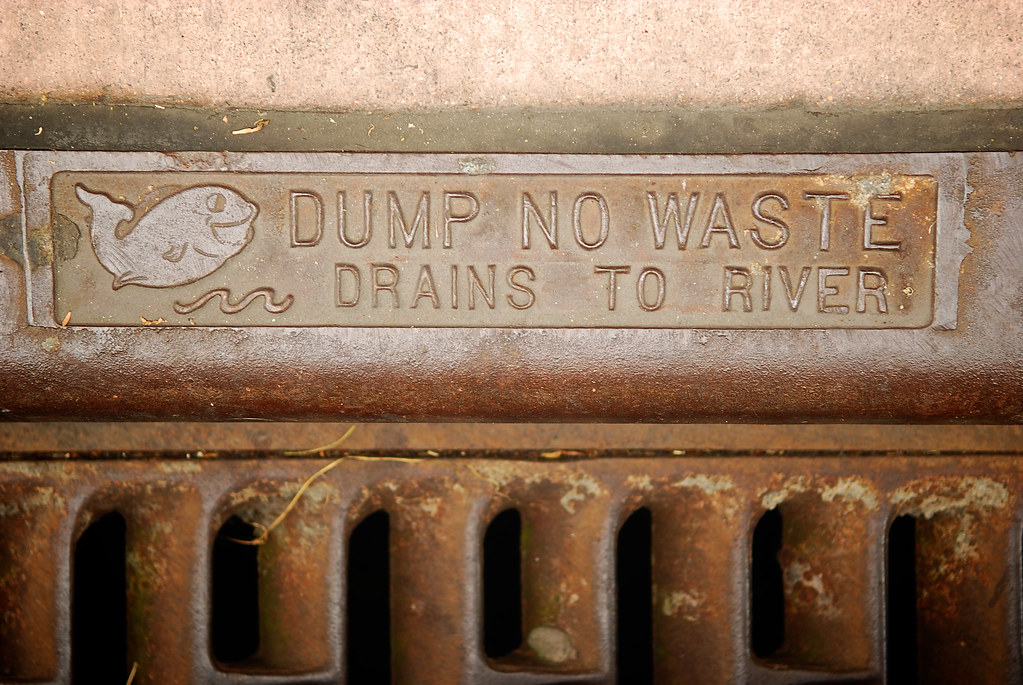
Driveways and paths drain to the street, and street drains usually discharge untreated to the nearest creek. The Clorox safety data sheet describes the product as very toxic to aquatic life with long-lasting effects. The EPA aquatic life criteria for chlorine are 19 micrograms per litre for a short exposure and 11 micrograms per litre for continuous exposure. A litre of 6% bleach holds about 57 grams of available chlorine, enough in theory to push three million litres of water over the acute limit. Most of it degrades first, but hosing down a bleached driveway sends a concentrated slug straight down the gully.
4. It damages hard surfaces and metal
Plain grey concrete tolerates dilute bleach, which is why it is sold as a patio cleaner, but coloured or sealed pavers, timber edging and composite decking can fade or blotch. Metal is the bigger problem: the bleach label itself says do not use on steel or aluminium, and hypochlorite pits even stainless steel at 5%. Drain grates, metal edging, hinges and garden tools all corrode.
5. Mixing it is dangerous
Homemade recipes often combine bleach with vinegar, salt and dish soap. Bleach plus any acid, including vinegar, releases chlorine gas; bleach plus ammonia (found in some glass cleaners and in fertilisers) releases chloramines. The Washington State Department of Health lists the symptoms: coughing, burning eyes and throat, chest pain, breathing difficulty and, at higher doses, fluid in the lungs. Outdoors the gas disperses faster than in a bathroom, but a bucket at knee height on a still day is still a bad place to be breathing. Never combine bleach with anything but water.
What to use instead, by situation
Bleach looks attractive because it is already in the cupboard. Each alternative below is as cheap or lasts far longer, and all come with instructions somebody has tested.
| Where the weeds are | Best options | Notes |
|---|---|---|
| Cracks in paving, patios, sidewalks | Boiling water; horticultural vinegar (20% acetic acid); flame weeder; crack knife or wire brush | All are contact methods. Repeat after 7–10 days for regrowth. Fill joints with polymeric sand afterwards to stop reseeding. |
| Gravel drives and paths | Pre-emergent granules in early spring and again in late summer (dithiopyr, prodiamine, isoxaben); spot-spray existing weeds with a non-selective product; landscape fabric under new gravel | Pre-emergents stop seeds; they do nothing to weeds already up. Check the label allows use on non-crop areas and near desired shrubs. |
| Beds and borders | Hand weeding before flowering; 3–4 in (8–10 cm) of coarse organic mulch; cardboard sheet mulch under wood chips for a fresh start; pre-emergent for annual weeds | Perennial roots must come out whole. A dandelion knife or hori-hori does it without disturbing neighbours. |
| Lawns | Selective broadleaf herbicide (2,4-D, MCPP, dicamba or triclopyr blends) in autumn; hand tools for scattered weeds; thicker turf through mowing height and feeding | Nothing non-selective belongs on a lawn. Treat when no rain is due for 24 hours and temperatures stay under 85°F (29°C). |
Paving cracks: boiling water, vinegar or flame
Boiling water poured from a kettle wilts weeds immediately and browns them within a day or two, works best on young annuals, and is safest where no wanted plants are nearby, according to Iowa State University Extension. Horticultural vinegar does the same with a sprayer and reaches more plants per hour; our post on whether vinegar kills weeds covers the 5% versus 20% question and the eye and skin precautions. A propane flame weeder is the quickest for long runs of joints: Iowa State advises heating the plant until it turns dull green and wilts rather than burning it, repeating every two weeks for perennials, and never using a torch near dry grass, mulch or in wind. All three act as fast as bleach, and perennials need two to four repeat visits over six to eight weeks. The lasting fix is mechanical: scrape the joint clean and refill it with polymeric sand so seeds have nowhere to root.
Gravel: prevent, then spot-treat
Gravel is a perfect seedbed, so the strategy is to stop germination. UC Statewide IPM lists dithiopyr, isoxaben, napropamide and trifluralin among pre-emergents for landscape use, applied in late winter for summer annuals and late summer for winter annuals. Weeds that are already up get a non-selective spray or a hand fork. We go through rates, timing and the fabric question in how to kill weeds in rock gardens and gravel beds.
Beds: mulch does what bleach cannot
UC IPM’s recommendation is 3 to 4 inches (8–10 cm) of coarse organic mulch, or about 2 inches (5 cm) of fine mulch, kept off plant stems. That blocks light from seeds, keeps soil easy to weed and feeds the soil life that bleach kills. Perennial weeds are dug out whole before they flower. If a bed has got away from you, overlapping cardboard topped with wood chips smothers most of it in a season. Our guide to stopping weeds growing through mulch explains why some mulches fail.
Lawns: use something selective
Bleach on a lawn weed leaves a dead brown circle that outlasts the weed. Selective broadleaf herbicides kill dandelion, clover and plantain without hurting grass. Iowa State University Extension recommends autumn application, when perennial weeds are moving carbohydrates to their roots and carry the herbicide down with them, with no rain for 24 hours, no mowing for four to five days, and temperatures below 85°F (29°C). Combination products containing two or three of 2,4-D, MCPP, dicamba and triclopyr cover more species than any single active. If you are planning to reseed, read whether to kill weeds before overseeding first, because most of these products need a waiting period before seed goes down.
If you have already used bleach
- Flush the area with plenty of plain water within a day or two to move the sodium below the root zone. Send the runoff onto soil or lawn, not a street drain.
- Do not follow up with vinegar or any acid cleaner until the surface has been rinsed; residual hypochlorite will still react.
- In beds, work in compost and, on heavy soil, gypsum (calcium sulphate) at the label rate. Calcium displaces sodium from the clay so rain can wash it out.
- Pull any regrowth from perennial roots by hand rather than reaching for the bottle again.
Sources
- US EPA – Pesticide product label, Ultra Clorox Regular Bleach (Reg. No. 5813-50)
- National Pesticide Information Center – Regulation of Pesticide Labels
- University of Florida IFAS – Homemade Weed and Bug Killer
- The Clorox Company – Safety Data Sheet, Clorox Regular Bleach
- US EPA – National Recommended Water Quality Criteria, Aquatic Life
- North Dakota State University Extension – Sodicity and Remediation of Sodic Soils
- Washington State Department of Health – Dangers of Mixing Bleach with Cleaners
- Iowa State University Extension – Can I manage weeds with boiling water?
- Iowa State University Extension – How to Utilize Flame Weeding for Weed Control
- UC Statewide IPM Program – Weed Management in Landscapes
- Iowa State University Extension – Applying Broadleaf Herbicide to Lawn