
Short answer: weeds in a rock garden or gravel bed are rarely growing in the soil underneath. They root in the dust, leaf litter and washed-in silt that collects between the stones, which is why landscape fabric under the rock seldom stops them. Kill what is there with the method that fits the spot (knife, boiling water, flame, 20% vinegar, or a shielded glyphosate spot spray for perennials such as bindweed), then stop the next crop with a pre-emergent labeled for landscape beds (prodiamine, dithiopyr or trifluralin), applied before soil reaches 55 to 60°F (13 to 16°C) in spring and again in early fall, watered in with about a quarter inch (6 mm) of water. A bed that is now a mat of dirt over torn fabric needs rebuilding, not more spraying.
Why rock and gravel beds fill up with weeds
According to Kansas State University Extension, wind blows fine soil into the cracks of the gravel along with weed seeds, creating an ideal seedbed for germination. Leaves and clippings add organic matter every year, and after a few seasons the gravel holds half an inch (1 cm) of what is effectively potting mix, sitting on top of whatever barrier you laid.
That is why landscape fabric disappoints. Illinois Extension puts it plainly: fabric suppresses weeds for a couple of years, then new seed blows in and germinates in the material on top, and persistent weeds root straight through so that pulling them tears the fabric. Meanwhile its pores clog with silt, so less rain reaches the soil and your shrubs and alpines dry out.
Rock also reflects and absorbs heat and raises soil temperature, which stresses shallow-rooted ornamentals and favors heat-loving summer annuals such as spurge and purslane. That is why gravel looks fine in April and is a green carpet by July.
The usual suspects in gravel
The key question is whether you have a shallow-rooted annual or a deep-rooted perennial. These six account for most weeds in rocks.
| Weed | How to recognize it | Type | What it means for control |
|---|---|---|---|
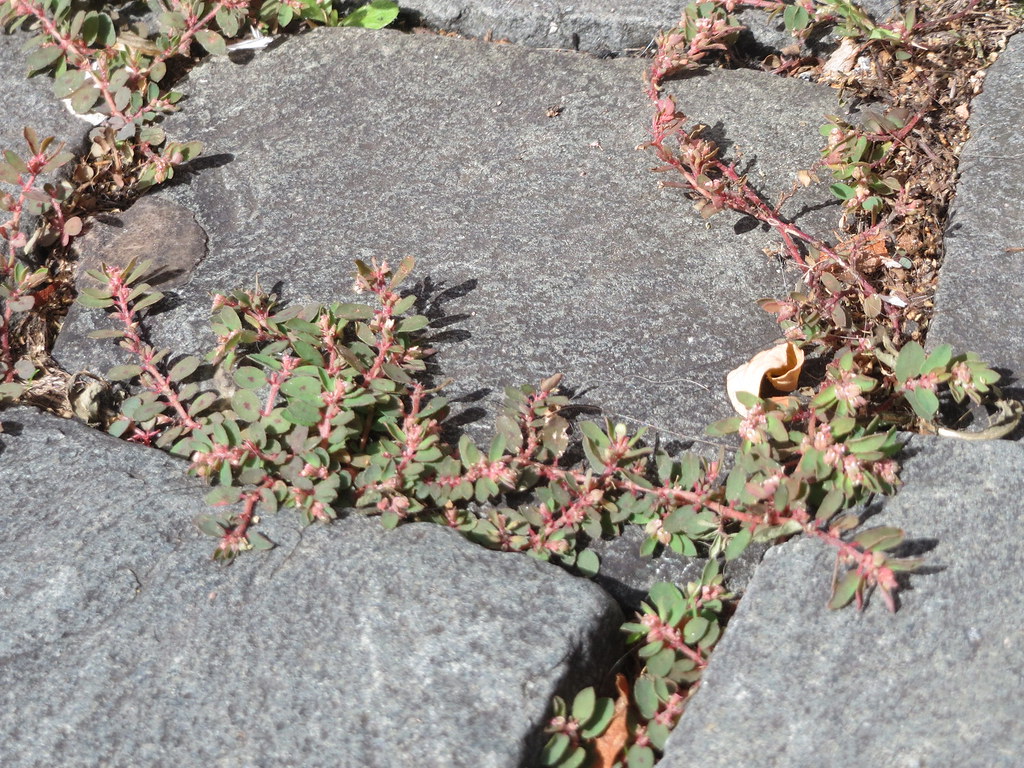
| Spotted spurge (Euphorbia maculata) | Flat mat of tiny paired leaves, often with a red spot; broken stems ooze milky sap | Summer annual | Germinates at 60°F (16°C) and up; sets seed 5 weeks after emerging. Wear gloves, the sap irritates skin |
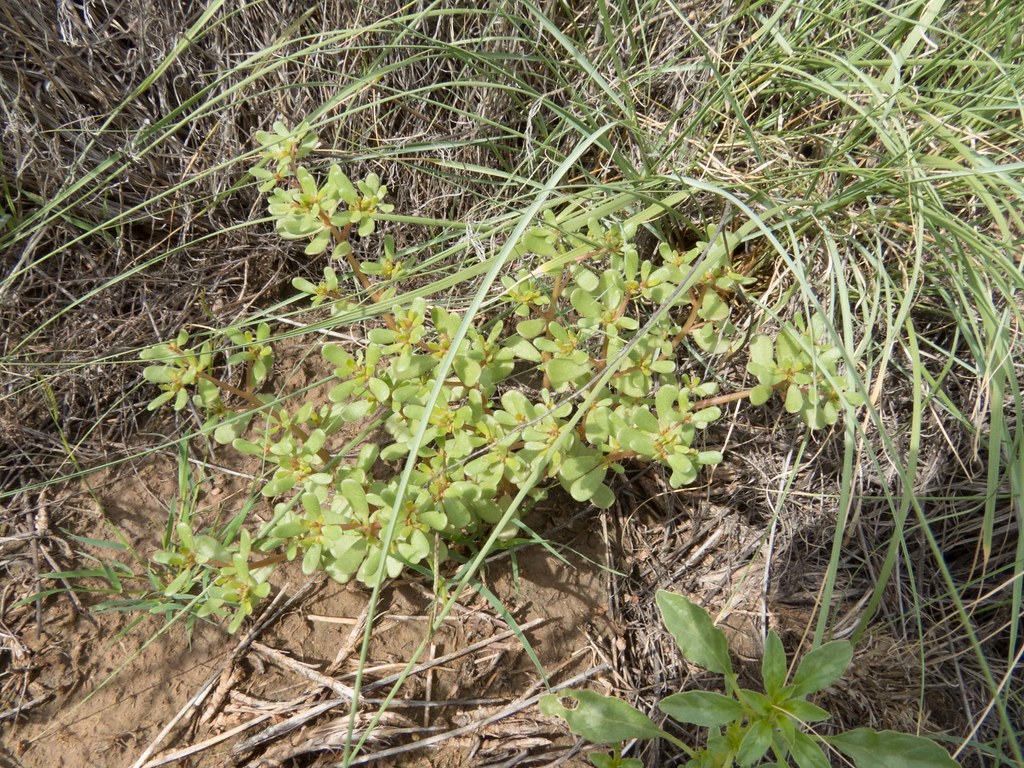
| Common purslane (Portulaca oleracea) | Reddish fleshy stems radiating like wheel spokes, shiny succulent leaves, small yellow flowers | Summer annual | Pulled stems re-root on damp gravel; bag them. One plant can drop 240,000 seeds |
| Crabgrass (Digitaria spp.) | Coarse light green grass spreading from a central crown, rooting at the nodes | Summer annual grass | Prime target for a spring pre-emergent; dithiopyr also kills it just after emergence, before it tillers |
| Creeping woodsorrel (Oxalis corniculata) | Clover-like leaves of three heart-shaped leaflets, often purplish, yellow flowers | Creeping perennial | Pods fire seed several feet; roots and runners must come out or it regrows |
| Field bindweed (Convolvulus arvensis) | Twining vine, arrowhead leaves, white or pink funnel flowers | Deep perennial | Roots run many feet deep; pulling and vinegar only prune it. Needs systemic spot treatment |
| Tree and shrub seedlings | Single upright stem with leaves like the parent tree nearby | Woody perennial | Pull while under 6 in (15 cm) and the gravel is wet |
Spurge and purslane details are from the UC IPM spotted spurge and common purslane pest notes; our crabgrass identification guide covers that one in depth.
Which method to use where
| Method | Best for | Effectiveness | Safety near plants |
|---|---|---|---|
| Hand pulling / weeding knife | Scattered weeds among alpines and perennials | High on annuals; perennials regrow unless the root comes out | Safe |
| Boiling water | Small annuals in paths and edges | Tops die in 1 to 2 days; perennial roots survive | Unsafe within about 12 in (30 cm) of plant roots |
| Flame weeding | Open gravel drives and paths | Good on young broadleaves, weaker on grasses | Unsafe near bark mulch, dry grass, fences, conifers |
| Horticultural vinegar (20% acetic acid) | Annuals in gravel where drift can be controlled | Burns off tops of small annuals; perennials regrow | Damages any leaf it touches; eye and skin hazard |
| Pre-emergent (prodiamine, dithiopyr, trifluralin, isoxaben) | Preventing the next flush of annuals | Very good on crabgrass, spurge, purslane; nothing on established weeds | Safe around ornamentals listed on the label |
| Glyphosate spot spray | Bindweed, established oxalis, woody seedlings | Moves to the roots; the only practical option for deep perennials | Shield plants, avoid green bark, calm day only |
| Salt, bleach, homemade recipes | Nothing in a planted bed | Temporary top-kill | Poisons soil, kills roots of nearby shrubs |
Hand tools for a planted rock garden
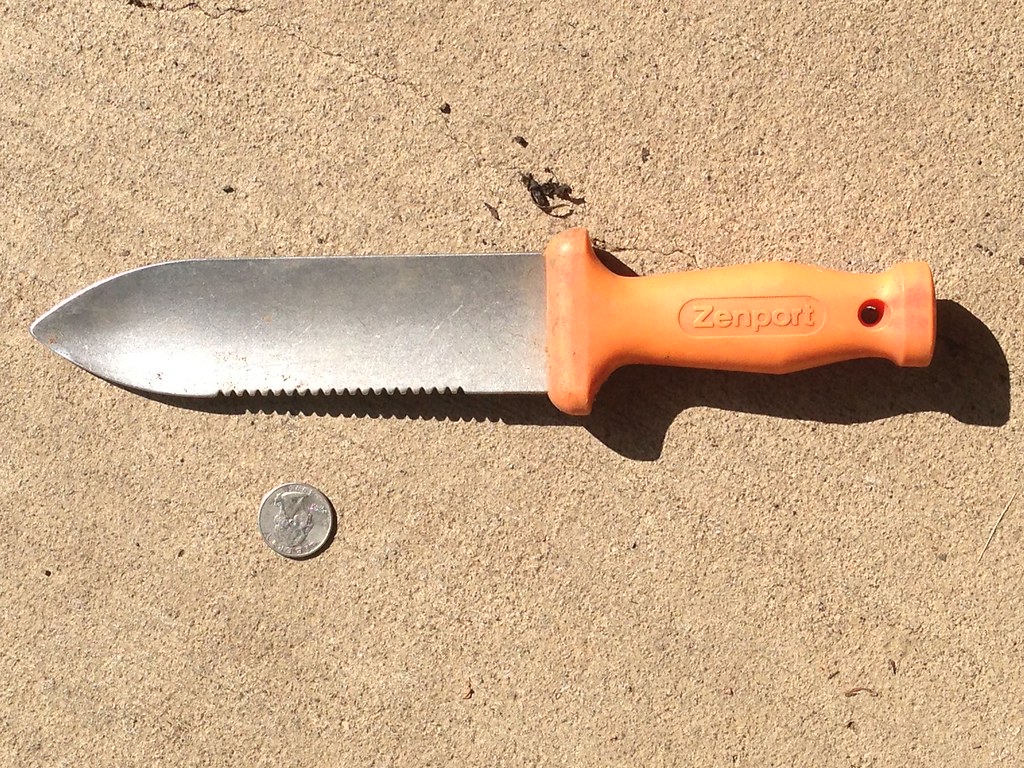
Among alpines and dwarf conifers, nothing beats a knife: water the evening before, push it down beside the crown, lever, and lift. UC IPM recommends a dandelion knife or similar to dig up all roots and underground parts of perennial weeds before they flower and set seed. Bag purslane and spurge; both re-root or drop seed if left on the surface.
Boiling water and flame, for the open parts only
Both are contact methods. Iowa State University Extension notes that boiling water will not kill roots, that tops brown within one to two days, and that established plants need retreatment 7 to 10 days later. Heat spreads through wet stones, so keep it away from root zones you want to protect.
Flame weeding boils the sap inside the cells and the plant collapses. Iowa State’s flame weeding guidance says broadleaf weeds are controlled more completely than grasses, that it suits places without desirable plants nearby such as driveway cracks, and never to use torches on windy days or around dry grass or other materials that could easily ignite. That rules it out where gravel meets bark mulch, a fence, a hedge or dry ornamental grasses. Two to five seconds of heat per plant is enough; flame after rain, keep a hose charged, and check for smouldering litter an hour later.
Horticultural vinegar
The UC IPM landscape herbicide notes class acetic acid products as nonselective contact herbicides that kill small annual weeds but only burn off the exposed parts of perennials. At 20% it is corrosive to eyes and skin, so gloves and goggles are required. It suits annual spurge and purslane in gravel well away from plants. Our post on what horticultural vinegar really does covers the 5% versus 20% trial data and why the salt-and-soap recipes are a bad idea in beds.
Pre-emergents: the step most gravel beds are missing
Once existing weeds are gone, a pre-emergent keeps the bed clean without weekly weeding. Clemson Extension lists prodiamine, dithiopyr, trifluralin, pendimethalin and isoxaben as the common landscape-bed pre-emergents. They stop small-seeded annuals (crabgrass, spurge, purslane, annual bluegrass) but do nothing against large-seeded weeds such as morning glory or against established perennials. Clemson notes that more products are labeled for woody landscape plants and fewer for herbaceous annuals and perennials, so a granule that is fine around junipers and spireas may not be listed for a bed of dianthus and sedum. Check the ornamental list on the label.
- Timing. UC IPM’s rule is late winter to early spring for summer annuals and late summer to early fall for winter annuals. The spring trigger is soil temperature: the UC IPM spurge note says to apply before soil exceeds 55 to 60°F (13 to 16°C).
- Watering in. Clemson advises about 0.25 inch (6 mm) of irrigation soon after application and no later than 5 days, or the product may not work.
- Application. NC State Extension says dithiopyr should go on as a directed application avoiding ornamental foliage, because over-the-top applications can injure leaves and have reduced or delayed flowering in some bedding plants. Shake granules onto the gravel, not over the plants.
- Duration. Expect 6 to 12 weeks of protection, so long-season climates need a second application in early summer. Raking the treated gravel breaks the barrier; level first, then apply.
Glyphosate spot treatment for deep perennials
For bindweed, established oxalis and tree seedlings you need something that moves to the roots. Use a ready-to-use glyphosate product as a spot spray only. UC IPM’s landscape guidance is to apply nonselective liquid herbicides with low pressure and large droplets on a calm day and to use shielded sprayers around ornamentals. A piece of cardboard behind the weed is enough shielding. Keep it off thin green bark and any leaf you want to keep; bindweed will need two or three treatments as it re-sprouts.
Salt and bleach: no
Salt stays in the soil until rain leaches it, sideways as well as down, into the root zones of shrubs that are far more sensitive than the weeds. Bleach breaks down into salts and is not labeled for use as a herbicide. Our article on why bleach is a bad weed killer explains what it does to soil and drains.
When to stop weeding and rebuild the bed
If you scrape back the stones and find a continuous layer of dark, fine material, or torn fabric showing through, weeding is a treadmill. Rebuilding resets the bed for years.
- Lift the stone onto a tarp or into a wheelbarrow, in sections for large beds.
- Screen out the fines. Shake the stone through a half-inch (12 mm) hardware-cloth frame or hose it until the water runs clear. What falls through is the weed seedbank.
- Dig or treat the perennials properly while the stone is off; spot-treat re-growth over two weeks before re-covering.
- Decide on fabric, honestly. Extension advice is split. UC IPM suggests fabric under rock mulch because it keeps stones from sinking into the soil; Kansas State and Illinois counter that it restricts water and air movement, traps sediment and becomes a weed-rooting mat. A workable compromise: use a woven geotextile (never plastic sheeting) only under paths or unplanted expanses of decorative stone, and skip it in planted rock gardens where alpines and shrubs need rain to reach the soil. Either way, fabric stops stone loss, not weeds.
- Replace the stone at the right depth. UC IPM’s guidance is that coarse mulch around 3/4 inch (2 cm) needs 3 to 4 inches (8 to 10 cm) for weed suppression, while pieces over 1.5 inches (4 cm) do not give good control unless applied very thickly, around 6 inches (15 cm). Pea gravel around alpines can be 1 to 2 inches (2.5 to 5 cm), because those plants rot under deep wet mulch. Keep stone 2 to 3 inches (5 to 8 cm) away from stems and trunks.
- Install edging. Steel, aluminium or a concrete strip sunk 3 to 4 inches (8 to 10 cm) stops grass and runners creeping in and clippings blowing onto the gravel.
- Apply a pre-emergent onto the settled stone and water it in, before the first weeds show.
Our guide on stopping weeds growing through mulch covers the same problem in bark beds.
A maintenance calendar that keeps gravel clean
| When | Task | Why |
|---|---|---|
| Late winter / early spring (soil under 55°F / 13°C) | Blow off leaves, level stones, apply pre-emergent, water in 0.25 in (6 mm) | Catches crabgrass, spurge and purslane before they germinate |
| Late spring | Walk the bed weekly; knife out escapes under 2 in (5 cm) | Spurge seeds 5 weeks after emerging |
| Early summer | Second pre-emergent in long-season climates; spot-treat bindweed | Barrier lasts 6 to 12 weeks |
| Late summer / early fall | Fall pre-emergent application | Stops winter annuals such as annual bluegrass, chickweed and bittercress |
| Fall | Blow leaves off before they break down; check edging | Leaf litter is next year’s seedbed |
| Every 3 to 5 years | Scrape back a test patch; if fines are over 1/2 in (1 cm) deep, screen or top up with fresh stone | Resets the seedbed before it becomes a rebuild |
The leaf blower is the most underrated tool on that list. Ten minutes in October removes more future weeds than an afternoon of pulling in June.
Mistakes that keep gravel beds weedy
- Spraying a pre-emergent onto weeds that are already up. It does nothing to them. Clear the bed first.
- Trusting the fabric. It stops stone sinking; it does not stop weeds rooting in the dust on top of it.
- Leaving pulled purslane on the gravel. Its stems stay alive for days and re-root after the next watering.
What to expect and how fast
Pulling and boiling water show results the same day; vinegar and flame within 24 hours, though perennials regrow from the root within days. Glyphosate takes 7 to 14 days and bindweed needs repeat spot treatments through a season. A pre-emergent shows nothing at all, which is the point: the sign it is working is a bed that stays clean through the summer flush when the neighbours’ gravel turns green.
Related guides: How to Get Rid of Spurge in Lawns, Garden Beds and Sidewalk Cracks · Euphorbia hirta (Asthma Plant): Identification, Uses, Safety and Control · Does Boiling Water Kill Weeds? Where It Works and Where It Damages the Garden · How to Kill Weeds in a Gravel Driveway
Sources
- Kansas State University Extension – Rock Mulch, a Solution or a Problem?
- UC Statewide IPM Program – Weed Management in Landscapes
- UC Statewide IPM Program – Weeds in Landscapes: Herbicides
- UC Statewide IPM Program – Pest Notes: Spotted Spurge
- UC Statewide IPM Program – Pest Notes: Common Purslane
- Illinois Extension – The Disadvantages of Landscape Fabric
- Iowa State University Extension – Can I Manage Weeds With Boiling Water?
- Iowa State University Extension – How Can Flame Weeding Be Used to Control Weeds?
- Clemson Cooperative Extension – Weed Control in Landscapes: Herbicides
- NC State Extension – Dimension (dithiopyr)