
Short answer: Rent a sod cutter for anything over about 100 sq ft (9 m²), set the blade to roughly 3/4 to 1 inch (2 to 2.5 cm), cut strips, roll them up and compost or reuse them. Full removal is only worth it when less than half the lawn is grass worth keeping, when thatch is thicker than 1/2 to 1 inch, or when the soil underneath needs regrading or decompacting. After removal, test the soil, work in 1 to 2 inches (2.5 to 5 cm) of compost, apply about 1 lb of nitrogen per 1,000 sq ft (0.5 kg per 100 m²) as a starter, then seed cool-season grass in late summer or warm-season grass in late spring. Sod can go down in either window.
Do you need to remove the old sod at all?
Removal is slow, heavy work that throws away topsoil, and most tired lawns do not need it. According to Penn State Extension, a lawn with 50 percent or more desirable turfgrass, no perennial weed grasses and less than 1/2 inch of thatch can be renovated in place by overseeding. A lawn with less than 50 percent desirable grass, or one infested with perennial weedy grasses such as quackgrass, should be killed and reseeded. Only when thatch exceeds about 1/2 inch does Penn State call for stripping the turf; Colorado State University Extension sets that bar at 1 inch (2.5 cm). Rutgers Cooperative Extension adds the soil reasons: poor drainage, deep compaction, grade faults or a very rough surface, none of which can be fixed through intact turf.
- More than 50 percent good grass, thin thatch: overseed. See our guide on whether to kill weeds before overseeding.
- Less than 50 percent good grass, soil fine: kill the lawn with glyphosate and seed into the dead turf. No sod cutter needed.
- Thick thatch, bumps, compaction, buried rubble, or a level change: remove the sod, fix the soil, then seed or resod.
- Converting lawn to a bed: sheet mulching or solarization is cheaper and keeps the organic matter in place.
Four ways to remove old sod compared
| Method | Best for | Time to bare soil | Typical cost (US) | Pros | Cons |
|---|---|---|---|---|---|
| Sod cutter rental | Areas over 100 sq ft; regrading; laying new sod soon | Same day | About $85–90 per day for a 12–21 in machine at independent rental yards (e.g. $85 per day, $325 per week) | Clean, even surface immediately; strips can be reused or composted | Heavy machine (330–380 lb / 150–170 kg); removes 1–2 in of topsoil; rhizome grasses regrow from fragments |
| Spade or half-moon edger | Under 100 sq ft; edges and corners | 1–2 hours per 100 sq ft | Tools you own | Precise; no rental trip | Slow, hard on the back, uneven depth |
| Glyphosate, then seed (or till) | Large lawns being reseeded with no grade change | 7–14 days for the kill | Low; one or two applications | No hauling; dead turf holds soil and seed in place | Second pass needed on bermudagrass or quackgrass; nothing green can be spared |
| Sheet mulching or solarization | Lawn to beds; small areas; no chemicals | 2–8 weeks under plastic; 6 weeks to several months under cardboard | Cardboard, compost or plastic | Keeps all organic matter; solarization also kills surface weed seed | Slow; unsightly; plastic needs summer heat; not for slopes |
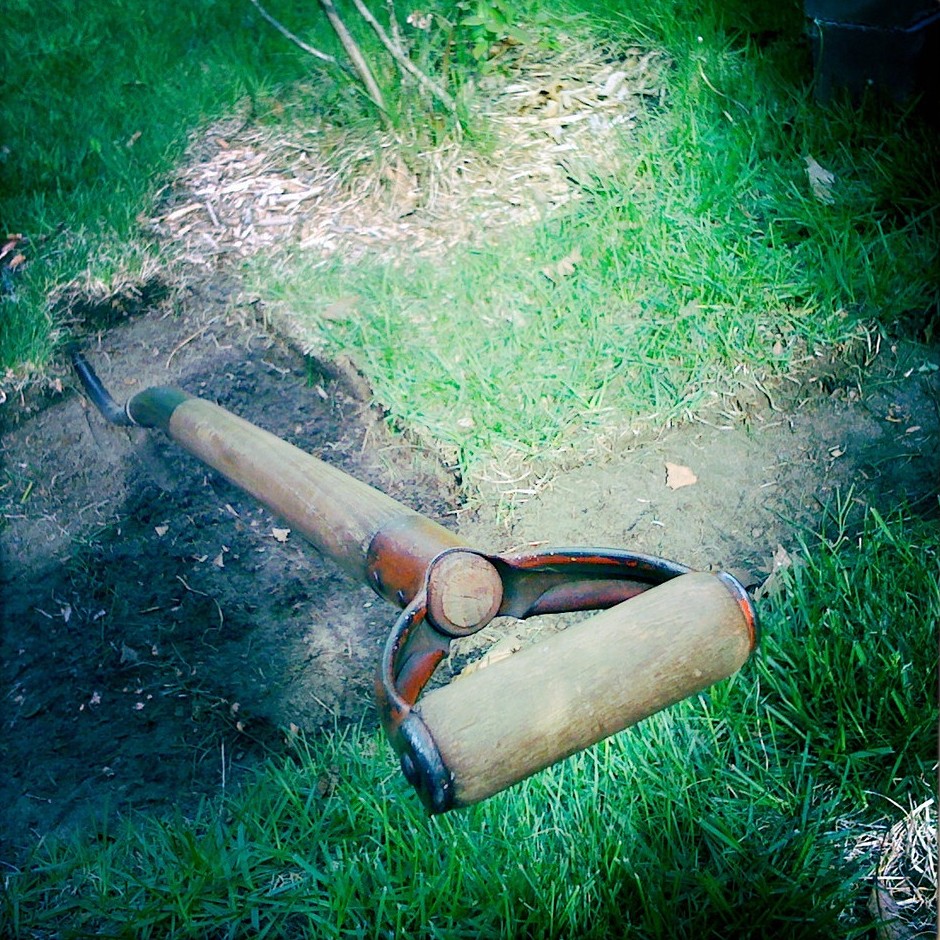
The 100 sq ft line comes from University of Maryland Extension, which limits the spade method (top 1 to 2 inches of sod and soil) to small areas. For sheet mulching, Maryland suggests overlapping unwaxed cardboard under 2 to 4 inches (5 to 10 cm) of compost, started in fall, with 6 to 8 weeks for the grass to die. For solarization, the UC Master Gardener Program (UC ANR) describes sealing black polyethylene over the lawn so the surface soil reaches up to 140°F (60°C), which takes 4 to 8 weeks as spring turns to summer; Oregon State turfgrass specialist Alec Kowalewski told OSU Extension that plastic can suffocate a lawn in two to three weeks of summer heat.
One species caveat overrides the table. If the lawn is bermudagrass, quackgrass or kikuyu, cutting is not enough; UC ANR notes that bermuda roots go down several feet and “it only takes an inch of root to grow it all back.” Kill with glyphosate first, wait 7 to 10 days or longer for the roots to die (Maryland), treat regrowth again, then cut or seed.
How to remove sod with a sod cutter, step by step
Rental sod cutters are typically 12 to 21 inches (30 to 53 cm) wide and cut to a maximum of about 1.4 to 1.75 inches; the professional Ryan Jr. weighs 333 to 377 lb according to its operator’s manual, so book a trailer or a truck with a ramp and a second pair of hands.
- Get utilities marked a few working days ahead (811 in the US, Click Before You Dig in Canada, Dial Before You Dig in Australia). The Ryan manual lists locating underground utilities and clearing rocks, toys and wire as the first safety steps.
- Mow short and water the day before so the top 2 inches are moist. Dry soil makes the blade skip; mud clogs it.
- Set the depth. The manual gives 3/4 inch (2 cm) as a good general starting depth; Kowalewski suggests as little as 1/4 to 1/2 inch (6 to 13 mm) when you only need to lift the crowns and root mat. Most home lawns need about 1 inch (2.5 cm) for the strip to hold together; go to 1.5 inches only for thick thatch. Every extra half inch is topsoil you will haul away and later buy back.
- Cut parallel strips the length of the lawn at a steady walking pace, overlapping each pass slightly. On slopes, cut across the slope.
- Cross-cut and roll. Cut the strips into 3 to 6 ft (1 to 2 m) lengths with a spade and roll them grass-side in. Keep them short enough to lift into a wheelbarrow.
- Hand-cut and rake. Finish around sprinkler heads, roots and paving, then rake up loose crowns; anything left alive will regrow. Return the machine clean; yards charge for caked mud.
What to do with the removed sod
As Maryland Extension puts it, sod contains valuable topsoil and organic matter and should not be thrown out. In order of usefulness:
- Reuse healthy strips to patch bare spots or edge a bed the same day, the way you would when transplanting grass and plugs.
- Stack strips grass-side down, wet them and cover with a tarp; in 6 to 12 months they break down into loam for raised beds. Or chop them into a normal compost heap.
- Dispose of it as green waste if it is full of bermudagrass rhizomes, nutsedge tubers or invasive weeds; see how to dispose of invasive plants safely.
Preparing the soil after the sod is gone
Start with a soil test; Maryland calls it the first step in any lawn conversion, and Rutgers requires one so that lime and phosphorus go on only where results call for them.
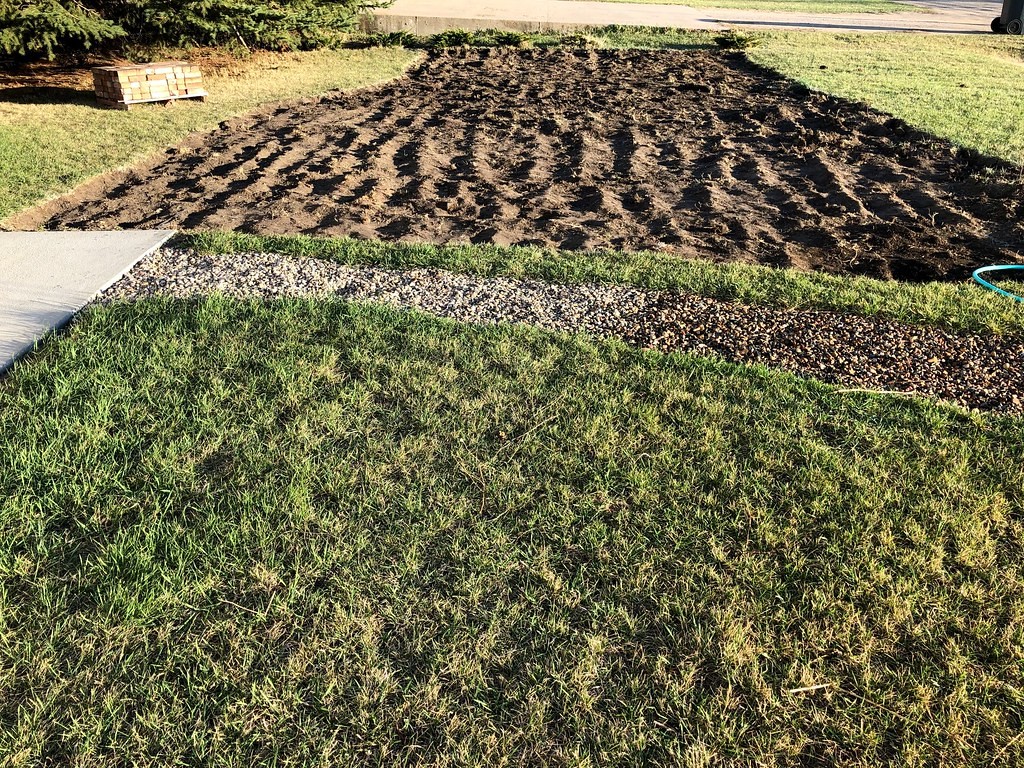
- Fix compaction and drainage now, while the soil is exposed: core aerate or fork-loosen the top 4 to 6 inches (10 to 15 cm). Our guide to preparing compacted soil for grass seed covers when tilling is and is not a good idea.
- Add organic matter. Maryland recommends 1 to 2 inches (2.5 to 5 cm) of compost where the test shows under 3 percent organic matter; Clemson Extension gives about 1 inch tilled in. This replaces what left with the sod.
- Grade and firm. Rake smooth, falling away from buildings, then roll with a water-ballast roller (Clemson) so footprints sink no more than about 1/2 inch.
- Starter fertilizer. Rutgers specifies 1 lb of nitrogen per 1,000 sq ft (0.5 kg per 100 m²) at seeding; Clemson allows 1.5 to 2 lb before planting in the Carolinas. Use a phosphorus-containing starter only if the test shows a need; several US states restrict lawn phosphorus.
- Lime or sulfur exactly per the test. The full grading routine is in how to prepare soil for grass seed.
Reseed or resod? Timing by grass type
Sod gives an instant lawn and can be laid whenever the ground is neither frozen nor baked, but costs many times more than seed. Seed is cheap and lets you match variety to shade and wear, but the window is narrow and the surface must stay moist for two to four weeks.
| Grass | Seed: best window | Seed: second choice | Sod: best window | Seeding rate (lb per 1,000 sq ft) |
|---|---|---|---|---|
| Kentucky bluegrass | Mid-August to mid-September (northern US, Canada) | Early spring; more crabgrass | Spring or early fall | 3–4 |
| Tall fescue | Late summer to early fall; mid to late September in the transition zone | Early spring | Fall or spring | 7 |
| Perennial ryegrass | Late summer to early fall | Spring | Rarely sold as sod alone | 7 |
| Fine fescues (shade) | Late summer to early fall | Spring | Rarely sodded | 5 |
| Bermudagrass, zoysia, centipede | Late spring once soil is warm (Clemson gives May 1–14 for South Carolina) | Early summer | Mid to late spring; fall only if roots can knit before cold | Varies; zoysia and St. Augustine are usually sodded or plugged |
The cool-season rates are Colorado State’s. The late-summer window is shared by Colorado State, Rutgers, UMass Extension (August 15 to September 15) and University of Minnesota Extension; Rutgers explains that spring is second best because crabgrass germinates alongside the new grass. The same logic gives late August to September in the UK and Ireland, and autumn (March to April) for cool-season mixes or late spring for couch, kikuyu and buffalo in southern Australia.
Work backwards from that window: Maryland suggests physical removal in June or July for a fall seeding, or glyphosate in early August. If you lay turf, follow Clemson’s rules: stagger joints like brickwork, roll perpendicular to the strips, and water daily for the first week so the soil stays moist to at least 4 inches (10 cm). Do not lay turf over the old lawn to skip removal; we explain why in can you lay turf over existing grass. After seeding, water lightly every day until germination and do not spread topsoil or sand over the seed (Colorado State).
Mistakes that undo the work
- Cutting too deep. A 2-inch cut removes twice the topsoil of a 1-inch cut, doubles the hauling and leaves the new lawn rooting into subsoil. Start shallow and deepen only if strips fall apart.
- Cutting a rhizome grass and expecting it to stay gone. Bermudagrass, quackgrass and kikuyu regrow from roots below the blade. Kill first, then cut, and spot-treat regrowth in the first season.
- Rototilling the whole area. Tilling brings a fresh layer of dormant weed seed up to the light, leaves a fluffy surface that settles into hollows, and wrecks soil structure; UMass lists excessive tilling among the causes of poor germination. Loosen compacted spots with a fork or aerator and rake compost into the surface instead.
- Seeding into herbicide residue. Glyphosate itself is not the problem: Penn State says seed can safely go in a couple of days after application, and UMass advises 5 to 7 days so the chemical finishes moving into the roots. Selective broadleaf mixtures are different: Penn State gives about four weeks before seeding, and any pre-emergent applied that spring will stop grass seed as surely as crabgrass. Colorado State’s rule is no pre-emergent before or during renovation, and no herbicide on the new lawn until it has been mowed five or six times.
- Working in the wrong season. Seeding cool-season grass into hot midsummer soil, or warm-season grass in autumn, wastes the seed.
What to expect afterwards
Sod laid in season and watered daily knits in two to three weeks. Perennial ryegrass seed shows in 5 to 10 days, tall fescue in 7 to 14, and Kentucky bluegrass in 2 to 3 weeks or longer, which is why bluegrass lawns look thin until the following spring. Expect some regrowth from missed roots and freshly exposed weed seed in the first season; that is normal. If thatch was the reason for stripping, keep it from returning by mowing above 2 inches (5 cm) and not over-fertilizing; see dethatching pros and cons.
Sources
- University of Maryland Extension – Lawn (Turfgrass) Removal Methods
- University of Maryland Extension – Improving a Struggling Lawn and Repairing Damage
- Penn State Extension – Renovation of Lawns
- Colorado State University Extension – Renovating the Home Lawn
- Rutgers NJAES – FS108 Renovating Your Lawn
- UC Master Gardener Program, Sonoma County (UC ANR) – Grass Removal Methods
- Oregon State University Extension – When It’s Time to Say Goodbye to Lawn, Uproot It First
- Clemson Cooperative Extension HGIC – Lawn Establishment
- UMass Extension – Lawn Renovation and Overseeding
- Ryan Turf – Jr. Sod Cutter Operator’s Technical Manual