
Short answer: yes. Common lantana (Lantana camara, which Florida authorities now call Lantana strigocamara) is one of the world’s most widespread invasive shrubs. It is listed or regulated as invasive in Florida, Hawaii, Australia (a Weed of National Significance) and South Africa (Category 1b), is a major forest invader in India, and escapes gardens across the US Gulf Coast. A single plant can produce up to 12,000 bird-dispersed seeds a year, and its leaves and green berries are toxic to livestock and pets. Where frost kills it every winter (the UK, Canada, the northern US) it is a harmless summer annual. Elsewhere, plant only sterile cultivars or native lantanas, pull seedlings, and cut larger plants low and treat the stump at once with triclopyr or imazapyr.
Where lantana is legally or officially a weed
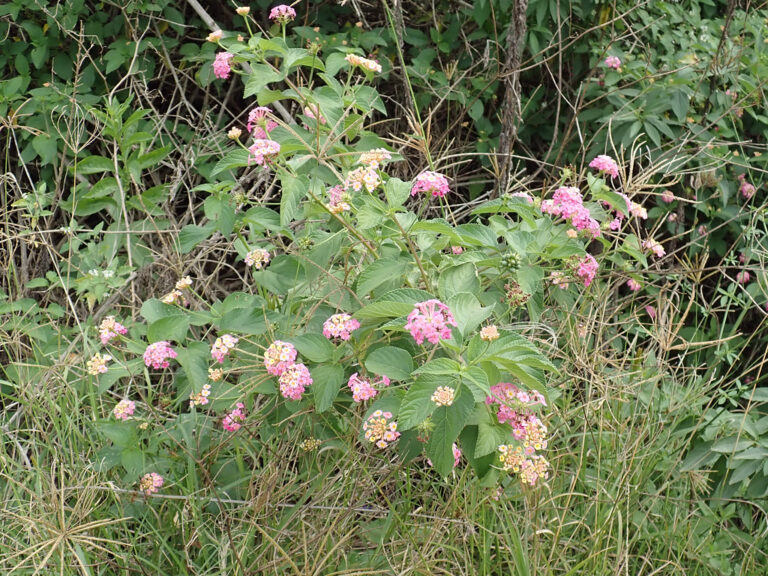
Status depends on climate. Where winters are frost-free, lantana seeds into woodland, pasture and roadsides and forms thickets 6 to 10 ft (2 to 3 m) tall.
| Region | Status | What it means for you |
|---|---|---|
| Florida | Assessed as invasive and not recommended by UF/IFAS in north, central and south Florida | Do not plant fertile lantana. Sterile UF cultivars and the two native species are the alternatives. |
| Texas and the Gulf/Southeast US | Listed by the Texas Invasive Plant and Pest Council; naturalised in AL, AZ, CA, FL, GA, HI, LA, MS, NC, OK, SC and TX | Not illegal to grow, but remove plants that set black berries. Texas has its own native lantana. |
| Hawaii | Infests over 400,000 acres (160,000 ha) on all main islands | A major pasture and forest weed; avoid planting any fertile form. |
| Australia | Weed of National Significance, declared in every state and territory; about 4 million ha infested | Cannot be sold in NSW; landholders have a duty to control it. Check your state and council rules. |
| South Africa | Category 1b invasive under NEM:BA | Landowners must control it; no trade or planting is allowed. |
| India | Invades more than 150,000 km² of surveyed forest; threatens about 44% of the country’s forests | A serious forest and grazing weed; no garden planting of fertile forms. |
| UK, Canada, northern US | Killed by frost; grown as a summer bedding or container plant | No invasive listing. Treat it as an annual and compost it in autumn. |
In Florida the problem goes beyond crowding. According to University of Florida researchers, fertile garden lantana has escaped cultivation and acts as a pollen donor to Lantana depressa, a native South Florida species now listed as endangered, so the garden plant is diluting the native’s gene pool. Weeds Australia lists it as a threat to several World Heritage areas. In South Africa the Agricultural Research Council notes that a dozen biological control insects are established but work at only about 10% of their potential, so the weed keeps spreading. The Indian figures come from a 2020 survey by Mungi, Qureshi and Jhala in Global Ecology and Conservation.
Why lantana spreads so well
- Bird-dispersed berries. Each flower head ripens into a cluster of small berries. Weeds Australia puts output at up to 12,000 seeds per plant per year, and germination improves after the seed passes through a bird’s gut, so new plants appear under fences, trees and power lines where birds perch.
- A persistent seed bank. The NSW Department of Primary Industries reports that about half the seeds stay viable for up to two years in dry conditions, so one season of clearing is never the end of it.
- Layering. Stems that touch the ground root where they lie, so a single plant becomes a spreading thicket.
- Allelopathy. Lantana releases chemicals into the soil that suppress germination of competing plants, which is one reason thickets end up with almost nothing growing beneath them.
- Fire. Dense stands add fuel to bushfires, and plants resprout from the base afterwards. The University of Hawaii CTAHR weed guide warns that burning without follow-up treatment is ineffective and can increase lantana populations.
Is lantana poisonous to pets, livestock and children?
Lantana contains pentacyclic triterpenoids called lantadenes, which damage the liver. How much danger it poses depends on who eats it.
Livestock are at most risk. NSW DPI says red-flowered lantana is the most dangerous form. Cattle, sheep and goats that eat it develop jaundice within one to two days and photosensitisation (peeling, cracked skin in sunlight), and usually die one to four weeks after symptoms appear. Keep stock away from it, especially in dry seasons when other feed runs short.
Dogs, cats and horses: the ASPCA Animal Poison Control Center lists lantana as toxic to all three, with vomiting, diarrhoea, laboured breathing and weakness; liver failure is more common in livestock. Call your vet if a pet has eaten a quantity of leaves or berries.
Children: the green berries are often described as deadly, but the evidence is more reassuring. A review of 641 child ingestions reported to the California Poison Control System from 1997 to 2008, published in Pediatrics (2010), found no significant effects and no deaths. Only 8% were seen at a health facility, and unripe berries caused no more symptoms than ripe ones. Call a poison centre anyway (1-800-222-1222 in the US; 13 11 26 in Australia), but a mouthful of berries is not usually an emergency.
How to tell invasive lantana from sterile and native lantanas
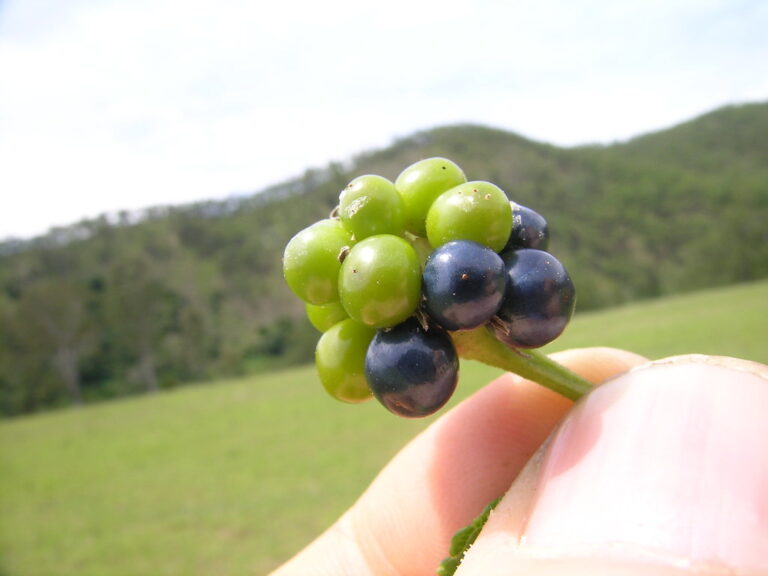
Common lantana has square, hairy young stems with small curved prickles, rough pungent leaves, and flower heads 1 in (2 to 3 cm) across that change colour as they age. The giveaway is fruit: glossy berries 4 to 7 mm across that turn from green to purple-black.
| Plant | Where native | How to recognise it | Invasive? |
|---|---|---|---|
| Common lantana (L. camara / L. strigocamara) | Central and South America, Caribbean | Prickly square stems, multicoloured heads, heavy crops of black berries | Yes |
| Sterile UF cultivars (‘Bloomify Red’, ‘Bloomify Rose’, ‘Luscious Royale Red Zone’) | Bred at UF/IFAS | Look like common lantana but set almost no berries | No (not invasive per UF/IFAS) |
| Pineland lantana (L. depressa) | South Florida | Low, sprawling shrub with yellow flower heads; rare and protected in the wild | No |
| Button sage (L. involucrata) | South Florida, Caribbean | Small white-to-lavender heads, rounded, softly hairy leaves | No |
| Texas lantana (L. urticoides) | Texas, northern Mexico | Orange-red and yellow heads; leaves no longer than about 2.5 in (6 cm) | No |
In UF field trials, the infertile selections cut fruit production by more than 99% compared with the popular ‘Pink Caprice’, reduced viable pollen by at least 85%, and did not produce viable hybrids with L. depressa. According to UF/IFAS Gardening Solutions, Bloomify Red, Bloomify Rose and Luscious Royale Red Zone are the recommended choices in Florida, while fertile common lantana is not recommended anywhere in the state.
For a plant already in your garden, check the spent flower heads in late summer. As the Texas Invasives database puts it, if a lantana produces tiny black seeds, remove it.
Should you plant lantana?
- Frost-free or mild-winter areas: only sterile cultivars or native lantanas; in Australia and South Africa check whether any L. camara is prohibited.
- Areas with regular hard frost (UK, Canada, northern US): any lantana is fine as a summer annual or pot plant.
- Near livestock or horses: avoid it entirely, sterile or not, because the leaves are toxic.
How to get rid of lantana
Match the method to plant size, and wear gloves; the prickles and sap irritate skin.
- Seedlings and small plants (under 3 ft / 1 m): hand-pull or grub out after rain when the soil is soft. NSW DPI advises getting the crown and main roots out and following up within 3 to 6 months.
- Established shrubs, cut-stump method: cut stems 2 to 4 in (5 to 10 cm) above ground and paint the cut surface immediately, before it seals. The University of Hawaii CTAHR reports good results with triclopyr amine at 50% product (equal parts concentrate and water) or imazapyr at 10% product on cut surfaces. NSW DPI lists triclopyr 600 g/L at 1 L per 60 L of diesel for cut stumps on stems over 5 cm. For glyphosate, use the cut-stump rate on your product label.
- Stems under 2 in (5 cm), basal bark: spray the lower 12 in (30 cm) of every stem all the way round with triclopyr ester (CTAHR reports 10% product in oil; NSW DPI uses the same 1 L per 60 L diesel mix). There is no need to cut first.
- Large regrowth or thickets, foliar spray: spray actively growing plants until wet. NSW DPI rates include glyphosate 360 g/L at 1 L per 100 L of water (about 1.3 fl oz per US gallon) and fluroxypyr 200 g/L at 500 to 1,000 mL per 100 L. Note that CTAHR and UF/IFAS pasture trials both found that foliar triclopyr and 2,4-D alone do not control lantana. In the UF trials, fluroxypyr needed two applications (autumn plus spring) to reach 80% control a year later.
- Follow-up: expect seedlings for at least two years. Replant or mulch bare ground at once (see stopping weeds in mulch beds) and pull newcomers while small.
Always read the label: rates and permitted sites differ between countries and products.
Disposing of berries and cuttings
Bag fruiting heads before you cut so berries do not scatter, and keep them out of open compost heaps that birds can reach. Send them to landfill or solarise them in sealed black bags. Our guide on how to dispose of invasive plants safely covers the options by plant type. Berry-free stems can be chipped, but do not leave them lying on moist soil, where they root.
Native replacements by region
- Florida: button sage (L. involucrata), nursery-grown pineland lantana (L. depressa), and firebush (Hamelia patens) for the same butterfly value.
- Texas and the Southwest: Texas lantana (L. urticoides), Gregg’s prairie clover (Dalea greggii), Dakota mock vervain (Glandularia bipinnatifida) and tansyleaf tansyaster (Machaeranthera tanacetifolia), all suggested by Texas Invasives.
- Australia and South Africa: ask your council, Landcare group or local indigenous nursery for a local list. Clear big thickets in stages, since small birds shelter in them, and replant as you go.
Lantana is one of many garden plants that became regional problems; see our overview of introduced invasive weeds.
Related guides: Parthenium Weed (Carrot Grass, Congress Grass): Identification, Health Risks and Control
Sources
- UF/IFAS Gardening Solutions – Lantana
- University of Florida – Infertile Lantana camara Cultivars UF-1011-2 and UF-1013A-2A
- UF/IFAS – Control of Lantana in Pastures (SS-AGR-359)
- University of Hawaii CTAHR – Weeds of Hawaii’s Pastures and Natural Areas: Lantana camara
- Texas Invasive Plant and Pest Council – Lantana camara
- NSW Department of Primary Industries – NSW WeedWise: Lantana
- Weeds Australia – Lantana profile
- Agricultural Research Council (South Africa) – Lantana camara
- Mungi et al. 2020, Global Ecology and Conservation – Expanding niche and degrading forests: Lantana camara in India
- ASPCA Animal Poison Control – Lantana and Pediatrics 2010 – Ingestion of Lantana camara in children (PubMed)