
You spent a Saturday on your knees pulling every yellow head out of the lawn, and it looked great. Three weeks later, with the October mornings turning crisp, fresh rosettes are back in the very same spots. If you’re wondering why dandelions keep coming back no matter what you do, you’re not imagining it, and it isn’t bad luck.
Short answer: dandelions keep coming back because the plant you pull or spray is only the top of the problem. The taproot usually sits 6 to 18 inches deep and a piece as short as 1 inch can grow a new plant, each plant can release up to 20,000 seeds that form without pollination, and those seeds land on every thin spot in the lawn. To get rid of dandelions for good, take out or kill the whole root (early autumn is the best time) and thicken the grass so new seedlings have nowhere to start.
Below, you’ll learn how to confirm you’re dealing with a true dandelion, what the root and seeds are doing out of sight, and which control methods actually reach the root. By the end, you’ll know exactly what to do this autumn, which happens to be the best time of year to act.
For a quick comparison with other yellow-flowered lawn weeds, see our guide to weeds with yellow flowers, and for more lawn weed profiles browse the Lawn Weeds section.
Table of Contents
How to identify a true dandelion
Before you dig or spray anything, make sure it really is a dandelion. A wrong ID sends you chasing the wrong root.
Common dandelion (Taraxacum officinale) is a perennial that grows from a flat rosette of leaves. UC IPM describes leaves 2 to 14 inches long with deep, irregular teeth that usually point back toward the centre of the plant (the name comes from the French dent de lion, “lion’s tooth”). Older plants build a thick crown and a leaf mat 6 to 14 inches across.
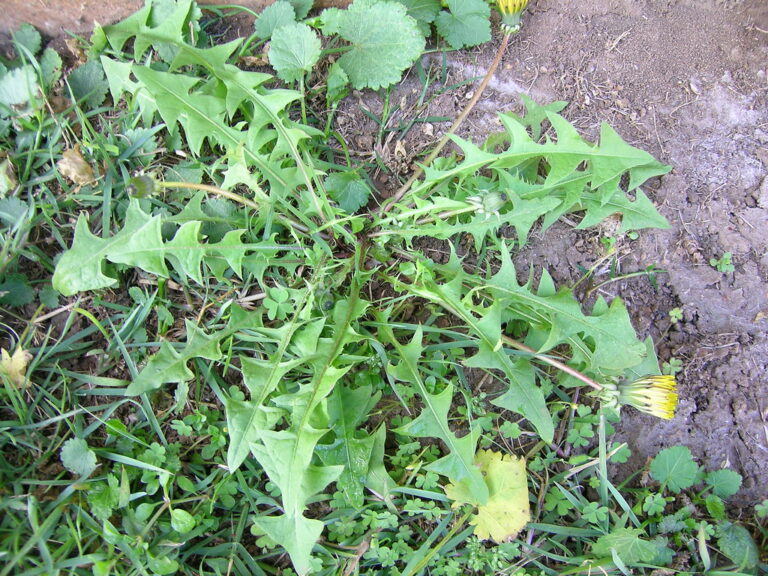
Check these four features and you’ll rule out most lookalikes:
- One flower head per stalk. Each yellow head is made of 100 to 300 small ray flowers and sits alone on top of its stalk.
- A leafless, hollow, unbranched stalk 6 to 24 inches tall that bleeds white, milky sap when snapped.
- Nearly hairless leaves with sharp, backward-pointing teeth.
- A single thick taproot that also oozes milky sap when cut.
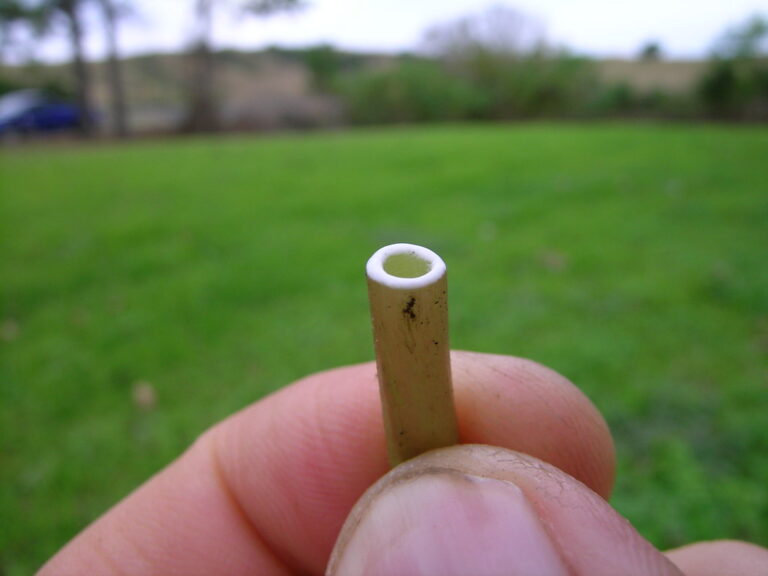
The University of Minnesota Extension lists three plants that are often confused with dandelion: common catsear, chicory and perennial sowthistle. If you find red-seeded dandelion (Taraxacum erythrospermum) in your lawn, relax: Minnesota notes this second species is managed the same way.
Dandelion vs catsear (false dandelion)
Catsear (Hypochaeris radicata) is the lookalike most people get wrong, because its flowers are almost identical. Here’s the quick test. Run a finger over a leaf: catsear leaves are densely hairy with rounded lobes.
Then look at the stalks. NC State Extension describes them as wiry, typically branched and leafless, so one catsear rosette often carries several heads, and it flowers mainly from mid-summer to early autumn. Chicory and sowthistle are easier to rule out, because both grow tall, leafy flowering stems, which a dandelion never does.
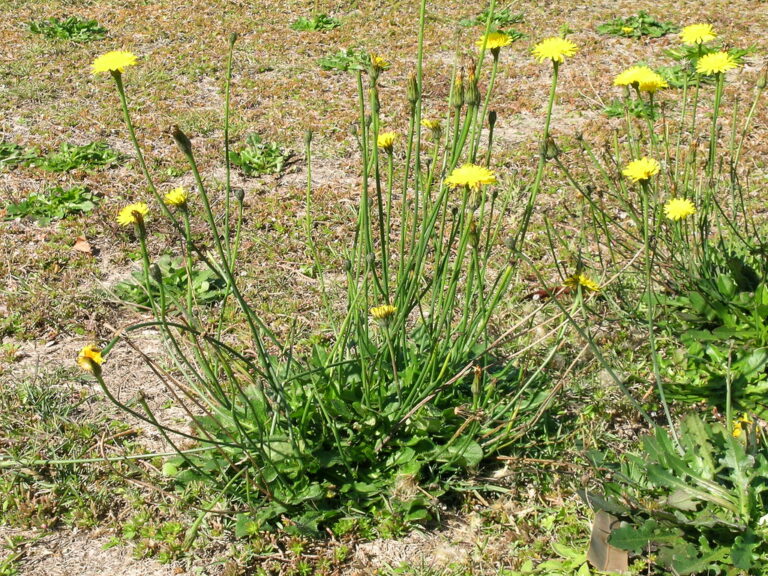
| Feature | Dandelion | Catsear |
|---|---|---|
| Leaves | Nearly smooth, sharp backward teeth | Densely hairy, rounded shallow lobes |
| Flower stalk | Hollow, unbranched, one head | Wiry, usually branched, one to several heads |
| Main flowering | Early spring, then on and off until autumn | Mid-summer into early autumn |
| Control | Same selective broadleaf herbicides; dig the taproot | Same herbicides; dig below the crown |
Why dandelions keep coming back: 5 reasons
If you’ve already pulled or sprayed once and they’re back, one of the five reasons below almost certainly explains it. Often more than one is at work, which is why a single fix rarely sticks.
1. The dandelion root breaks and regrows
Start underground, because that’s where the comeback begins. The University of Wisconsin gives a usual root depth of 6 to 12 inches, and up to 3 feet in loose soil. When you pull a plant by its leaves, the root snaps a few inches down.
And that leftover piece is far from finished. Oregon State University Extension reports that taproot segments as short as 1 inch can regenerate a new plant. Worse, the upper part of the root, the section you most often leave behind, is the most vigorous.
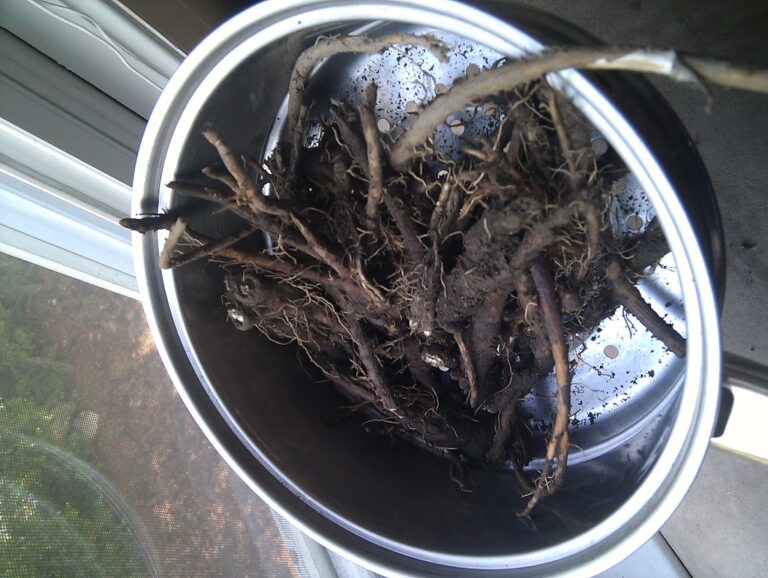
So that’s why a lawn can look spotless for two or three weeks after a weekend of pulling, then fill up again with rosettes in exactly the same places. You didn’t miss them. You trimmed them.
2. Every flower sets seed, even without bees
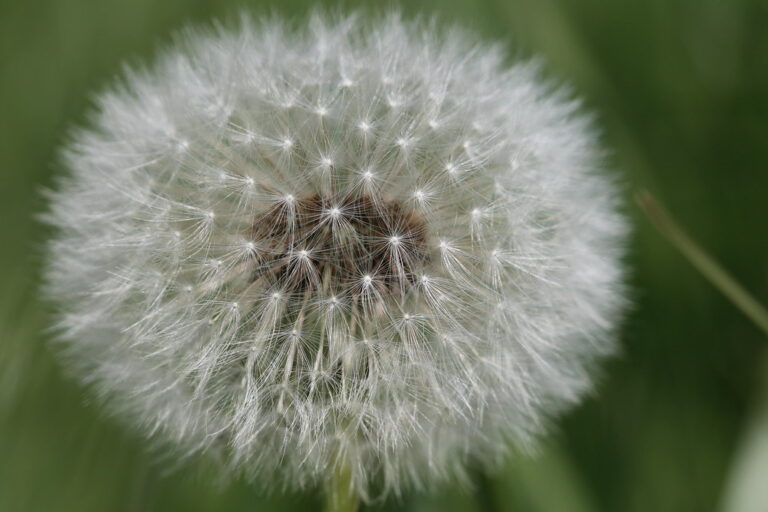
Here’s the part that surprises most people. The common dandelion in most lawns reproduces by apomixis: the seed forms from an unfertilised egg cell, so no pollination is needed and each seed is a genetic copy of its mother. A 2022 study in Nature Genetics identified the PARTHENOGENESIS gene that switches this on.
What does that mean for your lawn? Every flower that opens becomes a seed head, bees or no bees. Wisconsin and Oregon State both put the output at up to 20,000 viable seeds per plant.
3. Seeds fly in from next door
Each dandelion seed hangs under a parachute (pappus) of about 100 bristles. Researchers writing in Nature (Cummins et al., 2018) found that the parachute creates a stable ring of air above it and falls at about 39 cm per second in still air.
Most seeds land within 2 metres. But in warm, dry, windy weather some travel much further, with one estimate of up to 20,000 seeds per hectare moving more than 1 km.
The frustrating upshot: clearing your own lawn does not stop seed arriving from a verge, a vacant lot or a neighbour’s yard.
4. Thin turf gives seedlings a place to start
Rutgers Cooperative Extension puts it plainly: dandelions readily establish from seed in thin lawns. UC IPM notes that seeds germinate once the soil is at least 50°F (10°C) and fastest near 77°F (25°C), so bare patches can produce seedlings from spring through autumn.
Think of every bare spot as an open door. A dense lawn shades the soil surface and leaves little room; a lawn mowed too short, underfed or damaged by drought does the opposite.
5. The method or timing never reached the root
This one stings, because the effort was real but it was aimed at the leaves, not the root:
- Mowing has no effect on established plants, because the rosette sits below the mower blade (UC IPM).
- Vinegar, boiling water and other contact products burn the leaves but do not move into the root. Oregon State’s weed guide rates organic herbicides only “somewhat effective” on dandelion for that reason.
- Late-spring spraying with a selective herbicide, when the plant is pushing its energy up into flowers, gives weaker root kill than an autumn treatment.
Our guide on whether vinegar kills weeds explains the leaf-burn problem in more detail.
How to get rid of dandelions for good
Now the good part. The right method depends on how many plants you have and where they grow, and no single tool does everything. The table sums up what each option does to the root, which is what decides whether it returns.
| Method | Reaches the root? | Best timing | Best for |
|---|---|---|---|
| Hand digging with a long weeder | Partly; repeat on regrowth | Moist soil, young plants | A few plants, organic lawns |
| Selective broadleaf herbicide (spot spray) | Yes, moves to the root | Early autumn; mid-spring second best | Scattered to heavy infestations in lawns |
| Non-selective herbicide (glyphosate) | Yes, but kills grass too | Active growth | Paths, fence lines, beds before planting |
| Vinegar, boiling water, flame | No, leaves only | Any, but regrowth follows | Cracks in paving, short-term cosmetic kill |
| Mulch at least 3 inches deep | Stops seedlings, not deep roots | After weeding a bed | Garden beds |
| Thicker turf (mowing height, feeding, overseeding) | Prevents new plants | Autumn for cool-season lawns | Every lawn, long term |
Dig out the dandelion root the right way
Digging works well for a handful of plants, as long as you remove enough root. Oregon State recommends cutting 4 to 5 inches below the soil surface with a knife or long, narrow weeding tool, and pulling when the soil is slightly moist and the plant is still young and small.
Technique matters more than muscle. Push the tool straight down beside the crown, lever it toward the plant, and lift slowly so the root slides out instead of snapping.
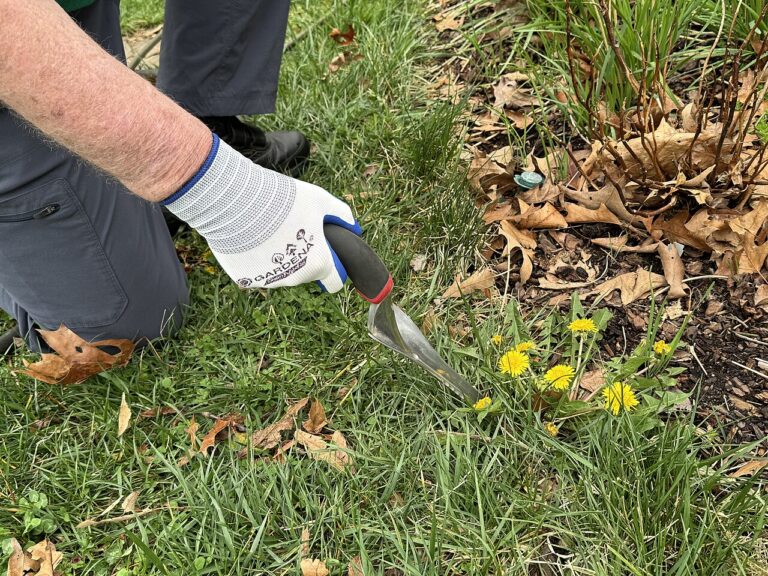
Even with good technique, expect some plants to resprout from root left behind. That’s normal, not failure. Check the same spots after three to four weeks and dig again; each regrowth uses up more of the root’s stored food.
Finally, fill the hole with soil and a pinch of grass seed. Otherwise you’ve just made a tidy seedbed for the next dandelion.
Selective herbicide: use it in early autumn
When you’ve got more dandelions than you can dig, a selective broadleaf herbicide kills the weed without killing the grass. The University of Minnesota lists the common active ingredients as 2,4-D, MCPA, dicamba and triclopyr, usually sold as two- or three-way mixes.
Timing is where most sprays succeed or fail. Late summer to early autumn is the best time, because the plant is moving sugars down into the root for winter and carries the herbicide with them. Purdue Turfgrass Science agrees, with mid-spring flowering as the second window.
Always read and follow the product label first. Beyond that, a few rules from Purdue and Rutgers make the difference between a good kill and a wasted spray:
- Let the spray dry on the leaves for at least 24 hours before rain or irrigation.
- Wait two to three days after spraying before you mow, so the product has time to move into the root.
- Avoid spraying when temperatures above 85°F (29°C) are forecast; most labels warn against it.
- Do not treat newly seeded grass. Wait until it has been mowed at least three times, usually 6 to 8 weeks after seeding (see our guide to killing weeds before overseeding).
- Leave the clippings on the lawn and do not use them as mulch around vegetables or flowers for 6 to 10 weeks, depending on the label. Our clippings guide covers when to bag instead.
If the dandelions are scattered, spot-spray individual rosettes instead of blanket-spraying the whole lawn. It uses far less product, and it spares clover and other plants you may want to keep.
Dandelions in beds, paths and paving
Beds and hard surfaces need a different plan, because there’s no grass to fight back. In garden beds, dig out established plants and then lay mulch at least 3 inches deep, which both UC IPM and Oregon State recommend to stop seedlings. Our guide on stopping weeds growing through mulch covers depth and edging.
On gravel and in paving cracks, a non-selective product such as glyphosate works on the root; keep it off any plant you want to keep, and follow the label. Boiling water or a flame weeder will clear the leaves in cracks, but expect regrowth within weeks.
How to stop dandelions returning
Here’s the part that saves you money year after year: killing the plants you can see is only half the job. Whether dandelions return depends on how thick and healthy the grass is.
The University of Minnesota calls dense, healthy turf the best defence, and Purdue advises homeowners to raise the mowing height and fertilise on a regular programme rather than relying on herbicides alone. That’s how you leave drifting seed nowhere to land.
- Mow higher. Taller grass shades the soil surface and leaves fewer gaps for seedlings.
- Feed the lawn. A thin, pale lawn is an open invitation; follow a fertiliser programme suited to your grass type.
- Overseed thin areas in the right season for your grass, and fill every hole left by digging.
- Remove flowers before they turn to puffballs. Mowing does not kill the plant, but the University of Minnesota notes that mowing before seeds mature reduces spread.
A note from the agronomist’s side
Apomixis changes how you should think about a dandelion patch. Because the seeds are clones of their mother, one plant that seeds into a lawn can found a whole population of genetically identical plants, all with the same tolerance to your soil and mowing.
That makes dandelions a symptom rather than the disease. A clonal, wind-seeded weed is superb at exploiting a gap and far less successful where a dense canopy shades the soil.
Weed scientists see the same pattern in crops: keep killing the weed while leaving the gap in the canopy that let it in, and you’ve signed up for the same fight every year. Lawns behave no differently. So the smart order of operations looks like this:
- Confirm the ID (dandelion, not catsear), so you treat the right plant.
- Kill the existing roots in early autumn, by digging or a spot spray, while the plant is pulling sugars down.
- Close the gaps the same season by overseeding and feeding.
- Keep the mowing height up so the canopy stays shut.
Fix the density first, and the herbicide becomes an occasional tool instead of a yearly ritual.
Where this applies
The timings above (“early autumn”, “mid-spring”, late September to October in New Jersey) are for cool-season lawns in the temperate Northern Hemisphere. In the Southern Hemisphere, shift them by six months.
Warm-season grasses such as St. Augustine, centipede and zoysia differ in herbicide tolerance, so check that the label lists your grass as safe before spraying. Herbicide products and active ingredients are registered country by country, and some regions restrict lawn herbicide use by homeowners; always follow your local label and rules.
For how dandelions behave through the cold months, see do weeds die in winter.
Should you keep some dandelions?
Dandelions flower early, and bees do visit them. Oregon State’s extension team describes them as “a snack, not a full meal” for bees, which do better on a variety of flowers, especially native plants.
So if you want to help pollinators, a mixed flower border does more than a dandelion lawn. Still, leaving a rough corner unsprayed costs little, and spot-treating only the lawn areas you care about keeps herbicide use low. For most yards, that’s a fair compromise.
Frequently asked questions
Is it better to pull or spray dandelions?
For a few plants, dig them with a long weeder and remove 4 to 5 inches of root, then check for regrowth. For a lawn with dozens of plants, a selective broadleaf herbicide in early autumn gives a more complete root kill with far less work on your knees.
Can a dandelion grow back from its root?
Yes. UC IPM and Oregon State both report that a dandelion root section as short as 1 inch can produce a new plant, which is why snapped-off plants return.
Does mowing spread dandelion seeds?
Mowing over ripe puffballs scatters seeds, while mowing before the seed heads form reduces spread. Mowing never kills an established plant, because the rosette sits below the blade.
Related guides: Weeds With Yellow Flowers in Lawns: 8 Common Ones and How to Identify Them · Post-Emergent Herbicides for Lawns: Selective vs Non-Selective
Sources
- UC IPM (University of California), Pest Notes: Dandelions
- University of Minnesota Extension, Dandelions
- University of Wisconsin–Madison Horticulture, Dandelion, Taraxacum officinale
- Oregon State University Extension, Dandelions: Living with, or without, them (EM 9510)
- Oregon State University, Solve Pest Problems: Dandelion
- Purdue University Turfgrass Science, Dandelion Control
- NC State Extension Gardener Plant Toolbox, Hypochaeris radicata (catsear)
- Rutgers NJAES, FS385: Broadleaf Weed Control in Cool Season Lawns
- Cummins C. et al. (2018). A separated vortex ring underlies the flight of the dandelion. Nature 562, 414–418.
- Underwood C.J. et al. (2022). A PARTHENOGENESIS allele from apomictic dandelion can induce egg cell division without fertilization in lettuce. Nature Genetics 54, 84–93.