
Short answer: the weeds with white flowers you are most likely to find in a lawn are white clover, common chickweed, mouse-ear chickweed, hairy bittercress, shepherd’s purse, Virginia buttonweed, wild onion, star-of-Bethlehem, English daisy and yarrow. To tell them apart quickly, count the petals, then look at the leaves. Three of the ten are winter annuals that die on their own by early summer, so they need a different plan from the perennials and bulbs on this list.
White is the most common flower colour among lawn weeds, which is why a patch of white blooms is so hard to name from a distance. Get down to grass level and check three things: how many petals each flower has, whether the leaves are paired, lobed or grass-like, and whether the plant grows from a rosette, a creeping stem or a bulb.
If your weed has coloured flowers instead, see our guides to weeds with yellow flowers, weeds with purple flowers and lawn weeds with blue flowers, or browse the full lawn weeds section.
Table of Contents
Quick identification chart for weeds with white flowers
Use this chart to narrow the list down, then read the section for your weed. The “petals” column is the fastest way to separate look-alikes.
| Weed | Life cycle | Flower | Feature that settles the ID | Best time to treat |
|---|---|---|---|---|
| White clover | Perennial | Round head of 20–40 small florets | Three leaflets with a pale V mark; creeping stems | Fall |
| Common chickweed | Winter annual | 5 deeply split petals | Smooth, light green, pointed leaves in pairs | Pre-emergent in late summer; spray small plants in fall |
| Mouse-ear chickweed | Perennial | 5 deeply split petals | Dark green, densely hairy leaves; stems root at nodes | Fall or spring, repeated |
| Hairy bittercress | Winter annual | 4 petals | Rosette of round leaflets; thin pods that pop open | Pre-emergent in late summer to early fall |
| Shepherd’s purse | Winter annual | 4 petals | Heart-shaped seed pods on the stem | Fall, while plants are small |
| Virginia buttonweed | Perennial | 4 petals in a star | Paired lance-shaped leaves; mats in wet lawns | Spring green-up, repeated for 2 years |
| Wild onion and wild garlic | Perennial (bulb) | 6 tepals in a dome | Grass-like leaves that smell of onion | Fall and early spring, 2 years |
| Star-of-Bethlehem | Perennial (bulb) | 6 petals, green stripe underneath | Narrow leaves with a white midrib; no onion smell | Spring and fall, 2 years |
| English daisy | Perennial | Daisy head, yellow centre | Flat rosette of spoon-shaped leaves | Fall or spring, repeated |
| Yarrow | Perennial | Flat-topped cluster of tiny heads | Feathery, finely divided, aromatic leaves | Fall or spring |
Count the petals: the fastest way to identify white-flowered lawn weeds
Petal number stays the same on a given species however the lawn is mown, so it is a more reliable clue than flower size or stem height. Use a hand lens or your phone camera’s zoom if the flowers are tiny.
- Four petals: hairy bittercress, shepherd’s purse (both mustard family) and Virginia buttonweed.
- Five petals, each split almost to the base: common chickweed and mouse-ear chickweed. At a glance they look like ten petals.
- Six petals (tepals): wild onion, wild garlic and star-of-Bethlehem, which all grow from bulbs.
- Many petals around a yellow centre: English daisy.
- No obvious petals, just a ball or a flat plate of tiny florets: white clover (ball) and yarrow (flat plate).
Clover heads: white clover
1. White clover (Trifolium repens)
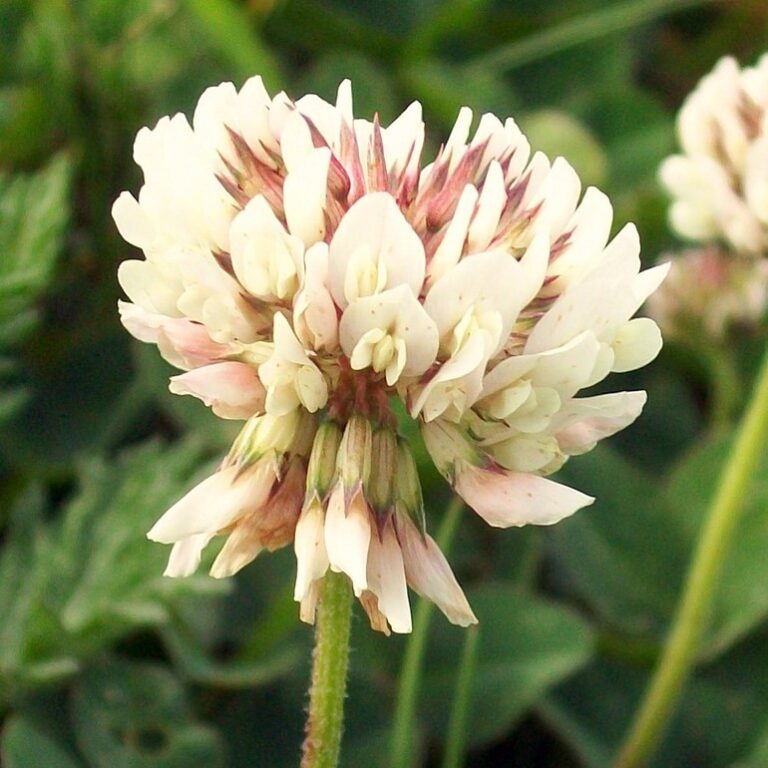
White clover has three oval leaflets, each ¼ to ¾ inch across, usually marked with a white or pale green inverted V. The stems creep along the soil surface and root at the nodes, which is why white clover forms patches instead of single plants. Penn State Extension describes the flower heads as globe-shaped, ½ to ¾ inch across and made up of 20 to 40 small white flowers, peaking in late spring and early summer.
White clover is a legume, so bacteria in its root nodules supply it with nitrogen. That gives it an edge in under-fertilised lawns, where the grass is starved but the clover is not. Penn State recommends nitrogen fertilisation and a denser turf as the first step. For herbicides, it lists dicamba, clopyralid, fluroxypyr and quinclorac, usually in combination products, and notes that fall applications are often the most effective.
Many homeowners now keep some clover on purpose, because its flowers feed bees and it supplies its own nitrogen. If you do spray, mow first to remove the flowers, so bees are not foraging in the treated area. Black medic and hop clover look similar but have yellow flowers; see our yellow-flowered weeds guide to tell them apart.
Five split petals: the chickweeds
Two different chickweeds turn up in lawns. They have almost identical flowers, but one is a short-lived winter annual and the other is a perennial, so it pays to know which one you have.
2. Common chickweed (Stellaria media)
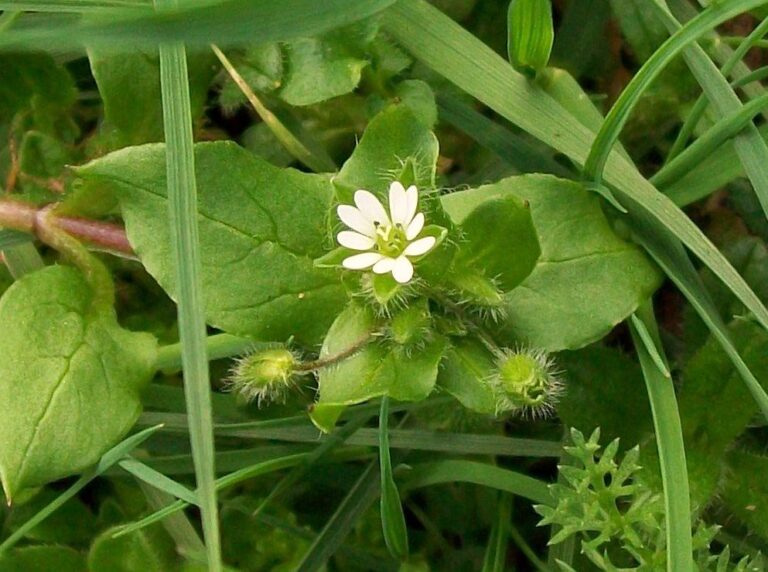
Common chickweed has smooth, light green, oval leaves that come to a point, arranged in pairs along weak, sprawling stems. The small white flowers have five petals, each split so deeply that the flower looks as if it has ten. Purdue University’s turf program classes it as a winter annual that germinates in late summer or early fall and does best in shade and on compacted, moist or poorly drained soil.
For prevention, Purdue lists isoxaben, pendimethalin, prodiamine and dithiopyr, applied before chickweed germinates in autumn. On cool-season lawns, combinations of 2,4-D, dicamba, MCPP or MCPA kill emerged plants. On warm-season lawns, metsulfuron, flazasulfuron and Celsius (thiencarbazone, iodosulfuron and dicamba) are options. Purdue warns that most of these need a second application, especially in spring when the chickweed plants are larger.
3. Mouse-ear chickweed (Cerastium fontanum)
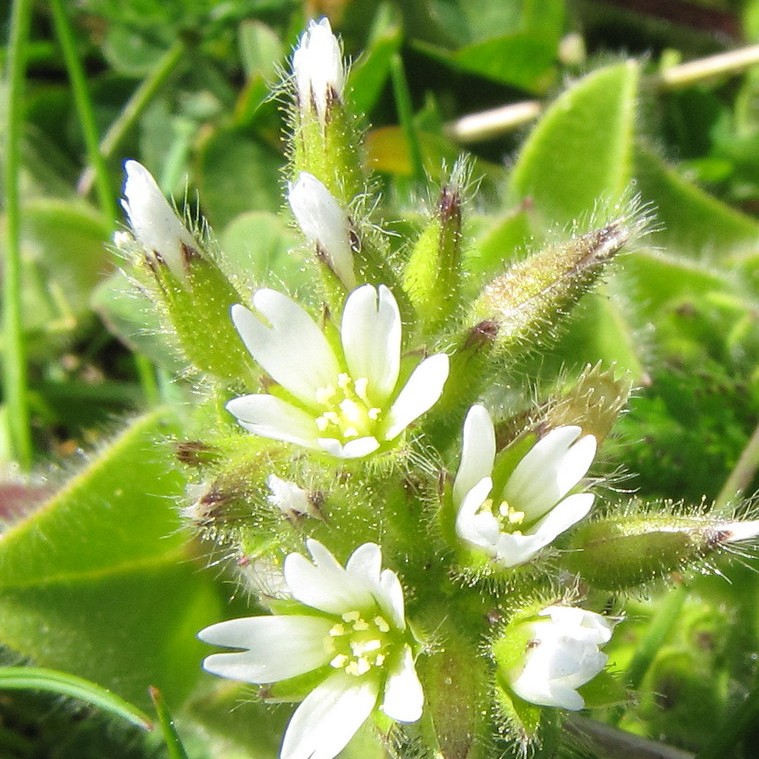
Mouse-ear chickweed has dark green, oblong leaves covered in hairs on the upper surface, which is where the “mouse ear” name comes from. Its flowers have the same five deeply split white petals as common chickweed, with hairy sepals almost as long as the petals. Purdue notes two differences that matter for control: mouse-ear chickweed usually behaves as a perennial, and its stems root wherever the nodes touch soil, so it spreads into dense mats.
Because it is a perennial, pre-emergent herbicides do little against an established patch. Purdue recommends post-emergent two-way or three-way products (2,4-D, dicamba, MCPP or MCPA), repeated as needed.
Four petals: bittercress, shepherd’s purse and Virginia buttonweed
4. Hairy bittercress (Cardamine hirsuta)
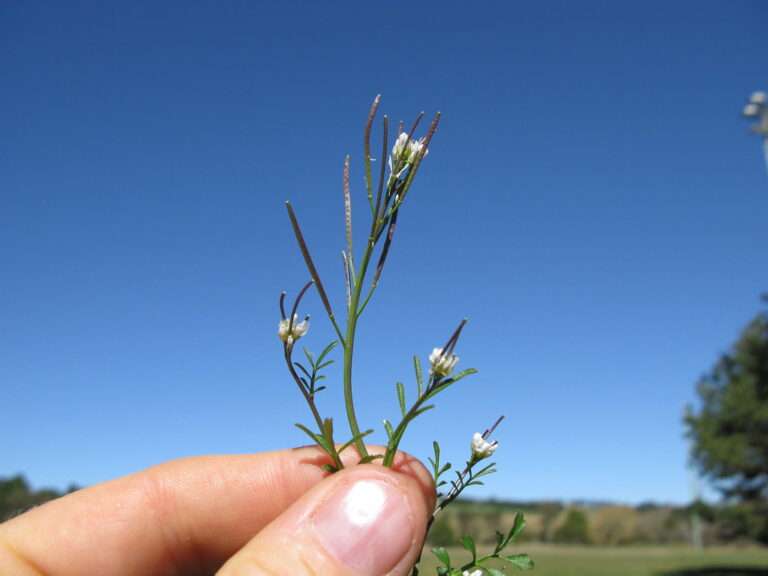
Hairy bittercress starts as a flat rosette of compound leaves with small, rounded leaflets. In early spring it sends up thin stems topped with tiny four-petalled white flowers. The flowers are followed by narrow pods ¾ to 1 inch long. Penn State Extension explains that the ripe pods split open abruptly and launch seeds up to several feet, which is how it spreads so quickly from flower beds into lawns.
Timing is the problem. Bittercress usually flowers and sets seed before most people apply spring weed killers. Penn State’s advice is to apply a pre-emergent in late summer or early fall, before the seedlings appear, and to mow frequently in early spring to remove flower stems. Remember that pre-emergent herbicides also stop grass seed from germinating, so do not use one where you plan to overseed this fall.
5. Shepherd’s purse (Capsella bursa-pastoris)
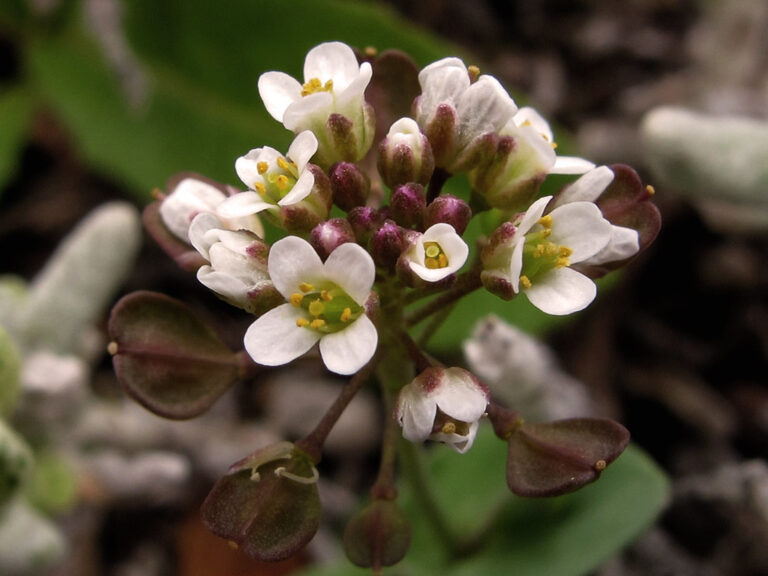
Shepherd’s purse also forms a rosette, but its leaves are usually toothed or lobed, a bit like a small dandelion. Upright stems carry small four-petalled white flowers that open from the bottom up. The identifying feature is the seed pod: Washington State University’s HortSense describes heart-shaped to triangular pods on stalks about ½ inch long, so a single stem shows buds at the top and ripening “purses” further down.
It is an annual or winter annual with a thin taproot, so hand-pulling or hoeing works well on small numbers. In lawns, WSU lists 2,4-D, MCPA, MCPP and triclopyr products. A dense lawn is the best long-term defence, because the seedlings need open soil to establish.
6. Virginia buttonweed (Diodia virginiana)
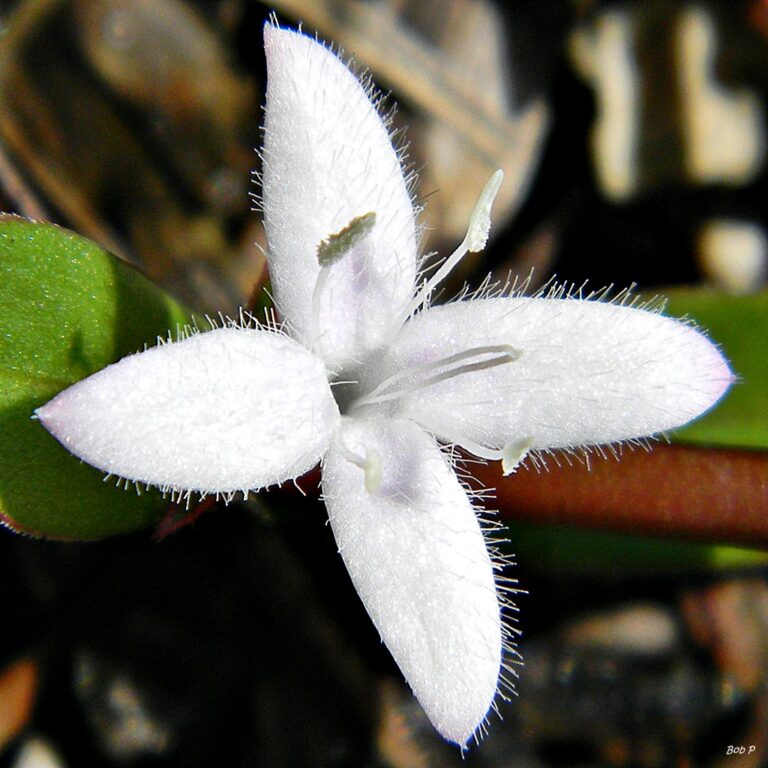
Virginia buttonweed is the toughest weed on this list, mainly in warm-season lawns in the southern United States. It has paired, dark green, lance-shaped leaves with no leaf stalks and white tubular flowers with four petals arranged in a star. Clemson University’s Home & Garden Information Center notes that by late summer the leaves often turn yellow-green because of a virus.
It spreads by underground stems, by seed from flowers both above and below ground, and by stem pieces that mowers and string trimmers scatter and that root in moist soil. Hand-pulling fails because root and stem pieces left behind sprout again. It thrives in poorly drained or overwatered lawns, so watering deeply but infrequently and core aerating are part of the fix.
Clemson suggests metsulfuron or Celsius WG at spring green-up, repeated 4 to 6 weeks later. In bermudagrass and zoysiagrass, three-way herbicides can be used after full green-up, but not when temperatures are above 90°F. Expect to treat for two years.
Six petals from a bulb: wild onion and star-of-Bethlehem
Bulb weeds look like grass for most of the year, so they often go unnoticed until they flower. For more grass-like lawn weeds, see weeds that look like grass.
7. Wild onion and wild garlic (Allium canadense and Allium vineale)
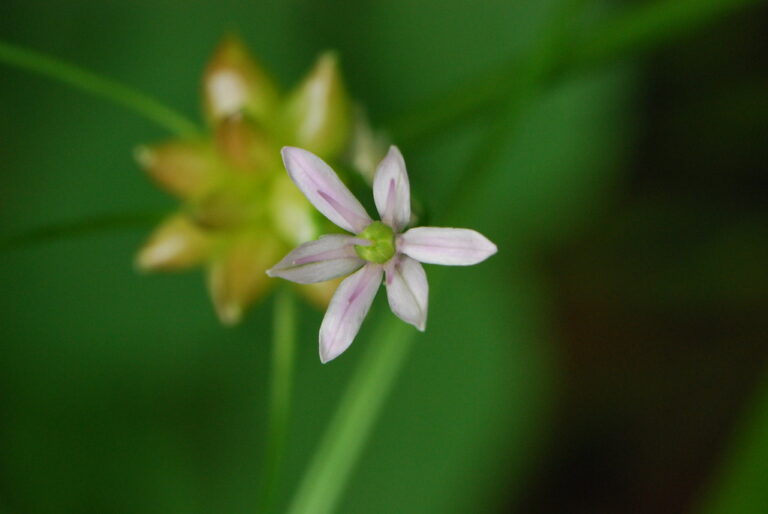
Both plants grow from bulbs, rise above the grass within days of mowing and smell of onion when crushed. Clemson HGIC gives the simplest way to separate them: wild garlic leaves are round and hollow, while wild onion leaves are flat and solid. Wild onion carries dome-shaped clusters of star-shaped white or pink flowers from May to July (Lady Bird Johnson Wildflower Center, University of Texas). Wild garlic flowers are greenish pink to purplish (NC State TurfFiles).
Both emerge in late fall, grow through winter and spring, form small aerial bulbs in late spring and die back in early summer. Their underground bulbs can survive in the soil for several years. Pulling usually snaps the leaves and leaves the bulb behind, so dig clumps out with a thin trowel when the soil is moist.
Clemson recommends spraying in fall after new shoots appear and again in early spring (February to early March) for two years. Iowa State University lists 2,4-D, MCPP and dicamba products, plus metsulfuron, sulfentrazone and sulfosulfuron. It adds that mowing just before spraying helps, because herbicides work better on freshly cut leaves.
8. Star-of-Bethlehem (Ornithogalum umbellatum)
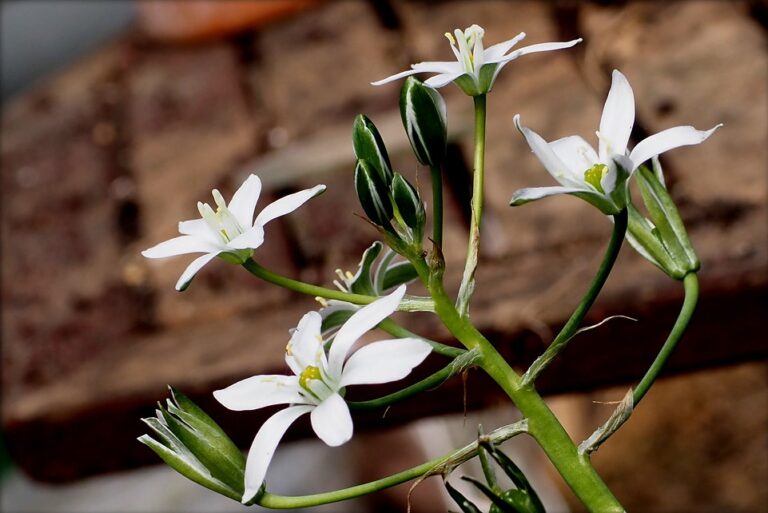
Star-of-Bethlehem looks like wild onion until you crush a leaf: it has no onion smell. The leaves are narrow, smooth and fleshy with a whitish groove down the midrib. From April to June it produces bright white six-petalled flowers with a green stripe on the underside of each petal. University of Illinois Extension warns that all parts of the plant are poisonous if eaten, which matters in lawns used by children and pets.
It is hard to kill. Illinois suggests sulfentrazone, carfentrazone or 2,4-D (ester formulations work better than amines), applied in spring once temperatures reach at least 50°F and again in fall, for at least two years. A field study in dormant bermudagrass found that halosulfuron, imazaquin, metsulfuron, a three-way mix and triclopyr plus clopyralid gave 35% control at most. Bromoxynil, alone or in mixes, gave at least 80% control 35 days after treatment (Main and colleagues, Weed Technology, 2004).
If you dig the bulbs out of a bed, bag them. Do not compost them or till the area, because both spread the bulbs. Our guide to disposing of invasive plants explains safe options.
Daisy-type flowers: English daisy and yarrow
9. English daisy (Bellis perennis)
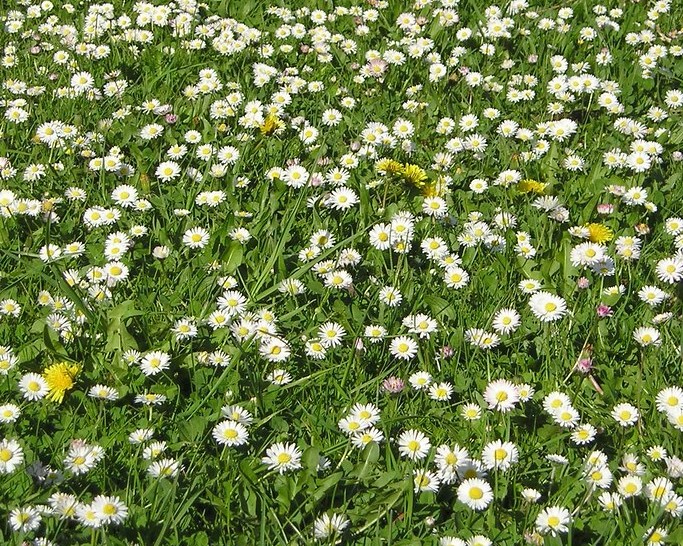
English daisy, also called lawn daisy, is common in cool, moist climates such as the Pacific Northwest and much of Europe. It grows as a flat rosette of spoon-shaped leaves on long stalks, with no leafy upright stem. Each flower stalk carries a single daisy head with white (sometimes pink or red) petals around a yellow centre. WSU HortSense notes that it spreads from the crown into clumps as well as by seed.
Digging works on a few plants, but disturbing the soil can bring buried seeds to the surface. In turf, WSU recommends triclopyr products and warns that several applications are usually needed.
10. Yarrow (Achillea millefolium)
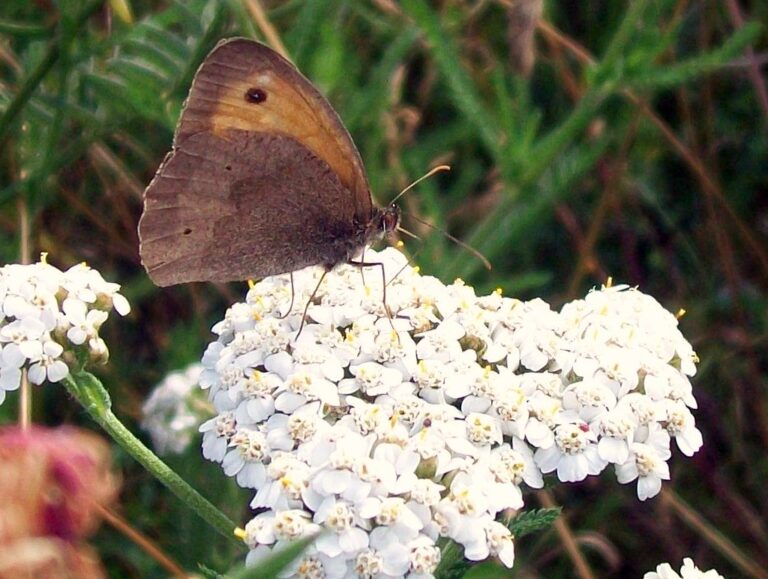
Yarrow is easiest to recognise by its leaves: soft, feathery and finely divided, which smell strongly when crushed. In taller grass it produces flat-topped clusters of tiny white flower heads. In a mown lawn it spreads by underground stems and forms a thick mat. University of Maryland Extension says it is a sign of dry, under-fertilised soil.
Pull or dig small patches early, when the soil is moist. For larger patches, Maryland lists selective broadleaf herbicides containing 2,4-D, MCPP, dicamba or triclopyr. It warns against using dicamba over the root zones of trees and shrubs, because roots can take it up. Researchers have also tested yarrow as a low-input lawn plant for dry Mediterranean climates (Urban Forestry & Urban Greening, 2022), so decide first whether a few patches are really a problem.
When to treat weeds with white flowers
The life cycle matters more than the flower. Group your weeds before choosing a product or a date.
- Winter annuals (common chickweed, hairy bittercress, shepherd’s purse): they germinate in late summer and fall and die by early summer. Apply a pre-emergent in late summer to early fall, or spray small seedlings in autumn. Spraying plants that are already flowering in late spring does little, because they are about to set seed and die anyway. Our article do weeds die in winter? explains the full cycle.
- Creeping perennials (white clover, mouse-ear chickweed, English daisy, yarrow, Virginia buttonweed): fall is usually the best window in cool-season lawns, with a second application a few weeks later. Virginia buttonweed is the exception and is treated from spring green-up in warm-season lawns.
- Bulbs (wild onion, wild garlic, star-of-Bethlehem): spray in fall and again in early spring, and plan on two seasons. Mowing just before you spray helps the herbicide get in.
Always check that the product label lists both your weed and your grass type. Some of the active ingredients named above, such as metsulfuron and flazasulfuron, are listed by Purdue for warm-season turf only and are not meant for most cool-season lawns.
A note from the agronomist’s side
Most weeds with white flowers are telling you something about the soil. Clover and yarrow point to low nitrogen or dry, thin turf. Chickweed and Virginia buttonweed point to shade, compaction or too much water. Bittercress and shepherd’s purse point to bare soil in autumn, when their seeds germinate.
Herbicides treat the symptom. On farms I have worked with, fields stayed cleanest where the crop covered the ground early and completely, and lawns follow the same rule. Fix the fertiliser, watering or mowing height that let the weed in, and the same patch is far less likely to return next year.
Frequently asked questions
What is the weed with tiny white flowers in my lawn?
In early spring, tiny white flowers on a low, sprawling plant are usually common chickweed or mouse-ear chickweed (five split petals) or hairy bittercress (four petals, thin upright pods). Check the leaves: smooth and light green means common chickweed, and hairy and dark green means mouse-ear chickweed.
What weed looks like grass but has white flowers?
Star-of-Bethlehem and wild onion. Crush a leaf: wild onion smells of onion, and star-of-Bethlehem has no smell and a white stripe down the middle of each leaf.
Is white clover bad for a lawn?
Not necessarily. White clover fixes its own nitrogen and its flowers feed bees. It becomes a problem when you want a uniform grass lawn, or when bees in the flowers are a risk for someone allergic to stings. If you want it gone, a fall herbicide application and better fertilisation work best.
Related guides: Clover in Lawn: Should You Keep It or Kill It? · Weeds With Purple Flowers in Lawns: 8 Common Ones and How to Identify Them · Weeds With Yellow Flowers in Lawns: 8 Common Ones and How to Identify Them · Bindweed vs Morning Glory: How to Tell Them Apart
Sources
- Penn State Extension, White Clover and Hairy Bittercress
- Purdue University Turfgrass Science, Common Chickweed and Mouse-ear Chickweed
- Washington State University HortSense, Shepherd’s-purse and English Daisy
- Clemson Home & Garden Information Center, Virginia Buttonweed and Wild Garlic & Wild Onion
- NC State TurfFiles, Wild Garlic
- Iowa State University Extension, How do I control onion grass in my lawn?
- Lady Bird Johnson Wildflower Center, Allium canadense
- University of Illinois Extension, Controlling Star-of-Bethlehem
- Main, C.L., Robinson, D.K., Teuton, T.C. and Mueller, T.C. (2004). Star-of-Bethlehem control with postemergence herbicides in dormant bermudagrass turf. Weed Technology 18(4).
- University of Maryland Extension, Yarrow
- Yarrow (Achillea millefolium) for low-input lawns in the Mediterranean environment. Urban Forestry & Urban Greening (2022).