
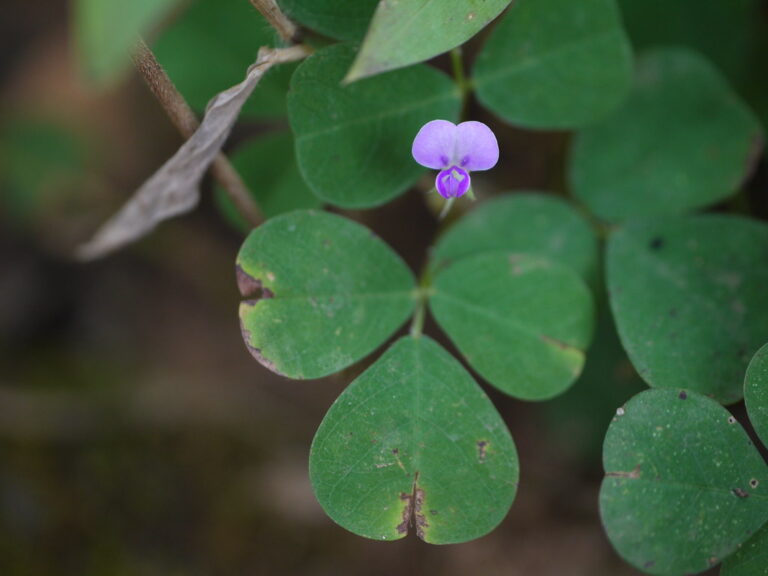
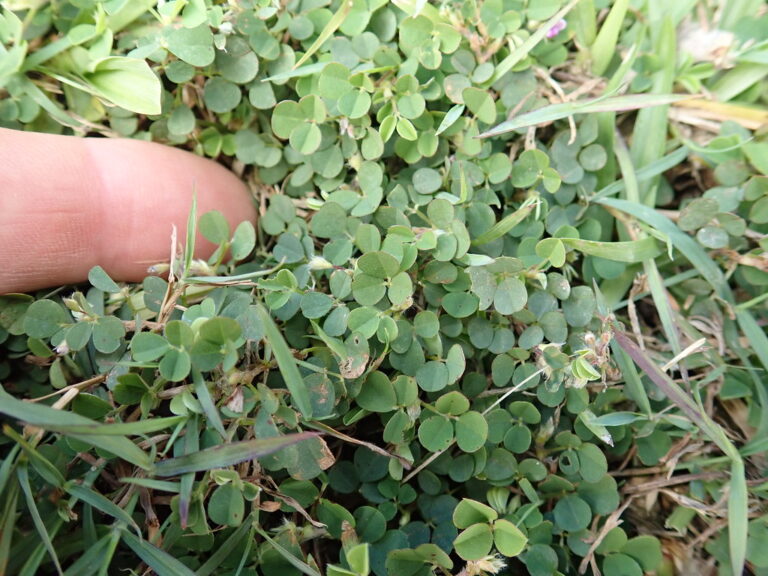
Short answer: Desmodium triflorum, called creeping tick trefoil, three-flower beggarweed or threeflower ticktrefoil, is a tiny mat-forming legume of the tropics and subtropics. Look for trifoliate leaves with rounded to heart-shaped leaflets only 3–10 mm (1/8–3/8 in) long, hairy stems that root at the nodes, and pink to purple pea flowers about 5 mm long, one to three in each leaf axil. It lies 3–5 cm (1–2 in) high, so mowing does not touch it, which is why it turns up as a lawn weed in Florida, Hawaii and other warm regions. It is also a palatable, protein-rich forage and a soil-covering legume, and it has a long history in folk medicine, though the evidence for any medical use is limited to lab and animal studies. If you want it out of a lawn, thicken the turf and use a broadleaf herbicide labelled for your grass; if it is growing on a bank or pasture, it is doing more good than harm.
What Desmodium triflorum is
Desmodium triflorum is a member of the pea family (Fabaceae). Many recent botanical databases, including iNaturalist, now list it as Grona triflora, so you will see both names. According to the Tropical Forages fact sheet, it grows throughout the world’s tropics and subtropics, so widely naturalised that its original range is blurred. The 1944 Hawaii Agricultural Experiment Station survey Legumes of the Hawaiian Ranges describes it as native to the tropics of the eastern hemisphere, and the University of Florida Mid-Florida Research and Education Center (UF/IFAS MREC) calls it a non-native landscape weed indigenous to tropical Asia and Africa.
English names include creeping tick trefoil, three-flower beggarweed and threeflower ticktrefoil; in Chinese it is san dian jin. The “beggarweed” and “tick” names come from the small jointed pods, which break into one-seeded segments that can catch on clothing and fur.
How to identify it
- Habit: a prostrate perennial (sometimes behaving as an annual) that forms flat, dense mats 3–5 cm tall. Slender, much-branched stems spread up to about 50 cm (20 in) and frequently root at the nodes.
- Stems: thin, often reddish, with white or cream hairs.
- Leaves: alternate and trifoliate. The leaflets are obovate to obcordate (broadest at the tip, often with a shallow notch), 0.3–1 cm long, with smooth edges. The middle leaflet sits on a slightly longer stalk than the two side leaflets. Small, pointed stipules sit where each leaf joins the stem.
- Flowers: small pea flowers about 5 mm long, pink to purple or blue-purple, rarely white, borne singly or in twos and threes in the leaf axils. That cluster of up to three is where the name triflorum comes from.
- Pods: flat, jointed pods 5–12 mm long made of 3–5 segments, one seed per segment. Seeds are small, kidney-shaped and light brown.
The measurements are from the Tropical Forages fact sheet and the Hawaii range survey. It is a low creeper, not an upright herb.
Look-alikes and how to tell them apart
Several small legumes share a lawn or roadside with D. triflorum. The quickest checks are leaf shape, flower arrangement and the pod.
| Plant | Leaves | Flowers | Pods / other clues |
|---|---|---|---|
| Desmodium triflorum (three-flower beggarweed) | Trifoliate; leaflets tiny (3–10 mm), rounded or notched at the tip, smooth-edged | 1–3 in each leaf axil, pink to purple | Flat mat 3–5 cm high; jointed pod of 3–5 segments |
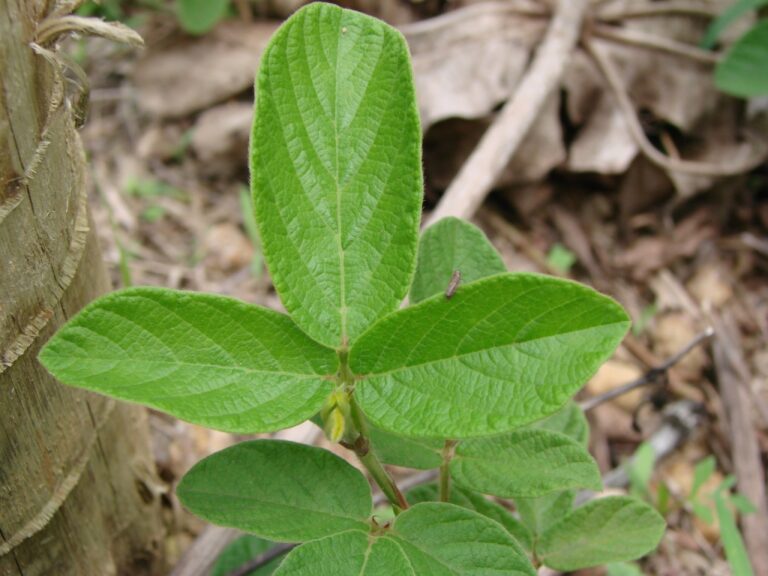
| Desmodium incanum (creeping beggarweed, Spanish clover, kaimi clover) | Trifoliate; leaflets much larger, round at the base and tapering to a point, dark green above and grey-green below | Small, pink to purple | Grows up to 2 ft (60 cm) or more; deep, branched taproot; stems turn woody; sticky pod segments |
| Alysicarpus vaginalis (alyce clover, one-leaved clover) | Single oval leaf, not three leaflets | Reddish-yellow to purplish, 6–15 on a raceme | Cylindrical pod with 3–6 segments |
| Kummerowia striata (common or Japanese lespedeza) | Trifoliate; leaflets oblong, with fine parallel side veins and hairy-fringed margins | Pink or purple, 1–3 in the axils | Pod is a single, oval, pointed segment with netted veins, not a jointed chain |
| White clover (Trifolium repens) | Trifoliate; leaflets with finely toothed edges, often a pale chevron mark | Many tiny flowers packed into a round white head on a long stalk | No jointed pod |
The D. incanum details come from the UF/IFAS Extension publication Biology and Management of Creeping Beggarweed in Warm-Season Turf; the Alysicarpus and lespedeza details are from the Hawaii range survey. If your plant has three leaflets and a pod that breaks into segments, it is a Desmodium; if the leaflets are under a centimetre and the whole plant hugs the ground, it is almost certainly D. triflorum. For clover-like weeds with yellow flowers, see our guide to bird’s-foot trefoil in lawns.
Where it grows
Three-flower beggarweed likes full sun to part shade and moist, well-drained soil, and Tropical Forages describes it as highly shade-tolerant. It needs annual rainfall of more than about 700 mm (28 in). It is common in pastures, roadsides, field edges, paths and lawns, where it often knits into the grass along the edges of walks and on thin, well-trodden turf. The Hawaii survey found it in lowland pastures on the islands, growing best in moist spots but also developing in dry areas during the rainy winter season. The Invasive Plant Atlas of the United States classes it as exotic in the US and notes reports of it as invasive in Haleakalā National Park on Maui.
Is it a lawn weed? Florida and Hawaii
It depends on what you want from the lawn. UF/IFAS MREC lists it among Florida’s landscape weeds, and Tropical Forages notes that it “may be considered a weed in cultivation and in lawns.” The same features that make it a nuisance make it hard to get rid of: it is resistant to heavy grazing and frequent mowing, roots from every node, and sits below the mower blade.
The other view is just as old. The 1944 Hawaii survey observed that it “forms a beautiful turf in association with a short grass such as Bermuda,” is persistent once established, and enriches the soil. On a low-input lawn, a bank or a path edge, a fine-textured green mat that supplies its own nitrogen is not a bad thing. If a uniform grass lawn is the goal, it is a weed; if a low-maintenance ground cover is the goal, it is a helper.
How to control Desmodium triflorum in a lawn
There is no extension trial specifically on D. triflorum in turf. The closest guidance is UF/IFAS’s publication on the related creeping beggarweed (D. incanum), and the same approach applies.
- Thicken the grass. Low-growing legumes move into thin, low-nitrogen turf. UF/IFAS recommends correct irrigation, fertilisation and mowing so the turf can outcompete beggarweed. In Florida, UF/IFAS also notes that creeping beggarweed often arrives in bahiagrass sod cut from weedy pastures, so buy clean sod. Our guide on making bahia grass thicker covers the feeding and mowing side.
- Hand-remove small patches. Lift the mat with a hand fork and pull the rooted runners out; any stem piece left with a rooted node will regrow. UF/IFAS notes that for creeping beggarweed complete root removal is needed, and that mowers can spread stem fragments, so bag the clippings when mowing an infested area.
- Spray young growth with a broadleaf herbicide. For creeping beggarweed in warm-season turf, UF/IFAS reports that repeated applications of Group 4 herbicides are needed; combinations of 2,4-D, dicamba and mecoprop (MCPP), triclopyr plus clopyralid, and products containing metsulfuron-methyl have given control, with a repeat application often needed on older plants. Treat when the plants are young and actively growing.
- Check the label for your grass. UF/IFAS warns that herbicides containing 2,4-D may injure St. Augustine grass under certain conditions. Metsulfuron and triclopyr products also have turf-species restrictions. Only use a product that lists your grass as safe.
- In beds and paths, glyphosate kills established plants because it moves through the whole plant; contact products such as pelargonic acid only burn small plants (4–6 in tall, per UF/IFAS) and will not kill a rooted mat. Our guide on whether vinegar kills weeds explains why contact sprays disappoint on creeping perennials.
Expect to follow up. A mat that has rooted at dozens of nodes needs two or three rounds of spot treatment or weeding over a season, together with better turf density, before it stops coming back.
Nitrogen fixation, forage and soil cover
As a legume, three-flower beggarweed can host nitrogen-fixing bacteria in root nodules, which is why the Hawaii survey noted that it “enriches the soil” in pastures. Its forage value is well documented:
- Protein: Tropical Forages gives 14–18% crude protein; the Feedipedia datasheet (FAO, INRAE, CIRAD and AFZ) gives 11.7% crude protein in fresh aerial parts, with 65% organic matter digestibility in ruminants.
- Palatability: “very palatable” to all classes of livestock, according to Tropical Forages, and it recovers well after grazing. Its low habit limits yield to about 4 tonnes of dry matter per hectare, and the Hawaii survey called it too small to provide much forage on its own.
- Ground cover: it holds a stable cover with creeping grasses under heavy grazing or regular mowing, and Feedipedia notes its use as a cover crop in rubber plantations.
- Live mulch: in a five-year trial at India’s Central Institute for Cotton Research, published in Science of the Total Environment (2021), a desmodium (D. triflorum) live mulch between cotton rows was among the treatments with the highest soil microbial activity.
Tropical Forages reports no toxicity to livestock.
Traditional uses and what studies found
According to Tropical Forages, the plant has been used in traditional medicine in India and China for dysentery, rheumatism, fever, jaundice, stomach ache, skin problems, wounds and ulcers, and UF/IFAS MREC notes that some tribal communities in southern India eat it as a cooked green. Laboratory research so far:
- A 2009 study in mice, published in The American Journal of Chinese Medicine, found that a methanol extract reduced pain responses and paw swelling in standard inflammation tests.
- A 2010 study by the same Taiwanese group, in The American Journal of Chinese Medicine, measured strong antioxidant activity in extracts, linked to their polyphenol and flavonoid content, and found low acute toxicity in mice.
- A 2022 study in Zeitschrift für Naturforschung C isolated flavone glycosides from the plant that had moderate activity against several crop-disease fungi in the lab.
None of these are human trials, and none show that the plant treats any disease. Claims found online that it can cure cancer or tuberculosis have no support in the research.
Safety: do not use Desmodium triflorum or any other wild plant as a medicine without advice from a doctor or qualified pharmacist, particularly if you are pregnant or breastfeeding, giving it to a child, or taking other medicines. Be certain of the identification, since several small trifoliate plants grow together, and do not gather plants from roadsides or lawns that may have been sprayed with herbicide or exposed to traffic pollution. Stop at once and seek medical help if you have any allergic reaction.
Related guides: Bengal Arum (Typhonium trilobatum): Identification, Toxicity and Uses · Acmella uliginosa (Marsh Para Cress): Identification, Uses and Safety · Caesar Weed (Urena lobata): Identification, Control and Uses as Congo Jute
Plant uses are described here as background only. Nothing on this page is medical advice, and no wild plant should be eaten or used as a remedy based on a website. See our disclaimer.
Sources
- Tropical Forages – Desmodium triflorum fact sheet
- UF/IFAS Mid-Florida Research and Education Center – Desmodium triflorum
- UF/IFAS Extension – Biology and Management of Creeping Beggarweed (Desmodium incanum) in Warm-Season Turf
- Hawaii Agricultural Experiment Station – Legumes of the Hawaiian Ranges (Bulletin 93)
- Invasive Plant Atlas of the United States – Threeflower beggarweed
- Feedipedia – Three flower beggarweed (Desmodium triflorum)
- Blaise et al. (2021) – Intercrop mulch affects soil biology and microbial diversity in rainfed Bt cotton
- Lai et al. (2009) – Analgesic and anti-inflammatory activities of Desmodium triflorum in mice
- Lai et al. (2010) – Antioxidant and antiproliferative activities of Desmodium triflorum
- Nguyen-Ngoc et al. (2022) – Chemical constituents of Desmodium triflorum and their antifungal activity