
It’s mid-November. You’re cutting back the spent perennials, and the bare soil between them is already fuzzed with tiny green seedlings: chickweed, bittercress, a little annual bluegrass. You pulled these same weeds in April. And in June. You’re starting to wonder whether a pre-emergent could just stop them before they start, and whether it would hurt your flowers.
Short answer: the best pre emergent for flower beds is one whose label lists the plants you grow. For most mixed beds of annuals and perennials, a trifluralin granule (sold as Preen Garden Weed Preventer and similar) is the safest starting point; isoxaben combinations last longer but injure some common perennials. Apply it to weed-free soil or on top of fresh mulch, water in about half an inch within 24 hours, and never use it where you plan to sow seeds or want self-sown flowers to return.
This guide compares the main active ingredients, shows which flowers each one can damage, and gives you a month-by-month timing plan. By the end you’ll know exactly which product fits your bed, when to put it down, and how to apply it so it actually works.
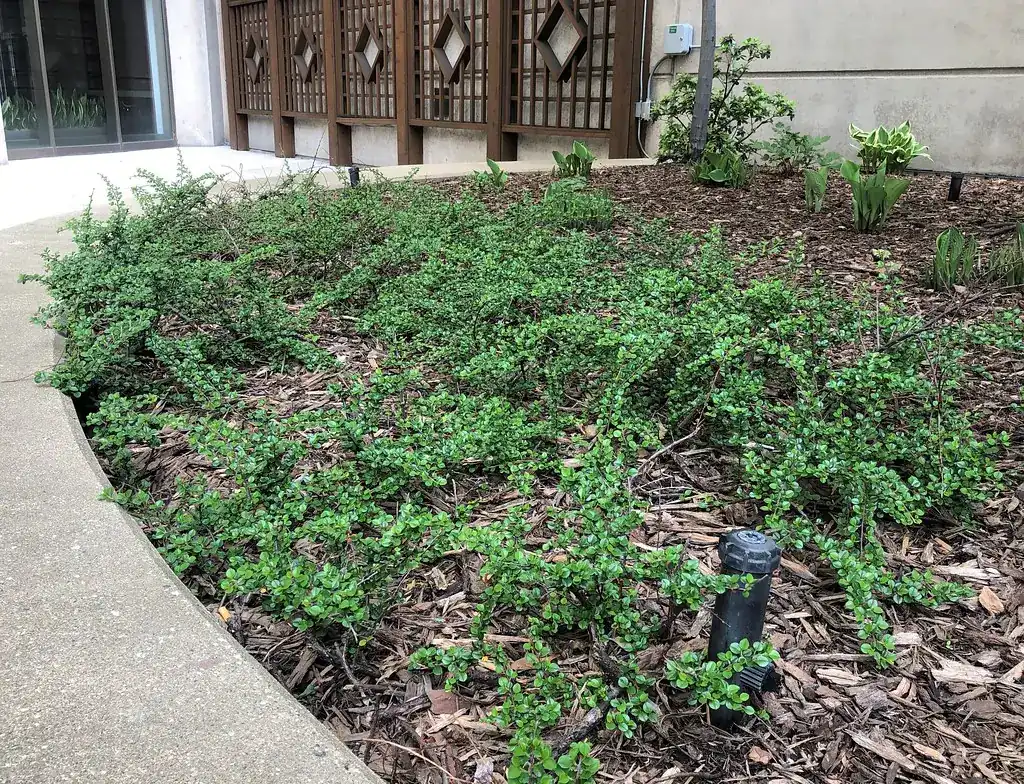
What a pre-emergent does in a flower bed (and what it can’t)
Here’s the catch most product bags don’t spell out: a pre-emergent doesn’t kill seeds. University of Nevada Extension explains that sprouting seeds meet the herbicide in the soil and cell division in the young root stops, so the seedling dies before it ever shows. That’s why timing is everything.
Three consequences follow, and every failure you’ve heard about traces back to one of them:
- It does nothing to weeds that are already up. The Preen label tells you to remove existing weeds first, and Ohio State Extension says the same: clean the bed, then apply.
- It can’t stop perennials. Bindweed, nutsedge and creeping grasses regrow from roots, rhizomes or tubers, not seed. Dig or spot-treat those first; our nutsedge guide covers the toughest one.
- It can’t tell a weed seed from a zinnia seed. UNR warns that these products “affect many germinating seeds, not just those of weeds.” Direct-sown annuals and self-seeders like foxglove or larkspur won’t come back where you’ve applied it.
So think of a pre-emergent as the last layer of a clean bed, not the first fix for a weedy one. It works best stacked on mulch, which is covered in our guide to keeping weeds out of mulch beds.
Pre emergent for flower beds: the active ingredients compared
Brand names change; active ingredients don’t. Flip the bag over and look for one of the names below in the ingredient box. The Pacific Northwest Weed Management Handbook groups most of them into two modes of action: the dinitroanilines (group 3: trifluralin, pendimethalin, prodiamine, oryzalin) and the cellulose-synthesis inhibitors (group 29: isoxaben, dichlobenil, indaziflam).
| Active ingredient | Example products | Best fit in flower beds | Main limits |
|---|---|---|---|
| Trifluralin (1.47% granule) | Preen Garden Weed Preventer, Miracle-Gro Garden Weed Preventer | Mixed beds of annuals, perennials, roses, bulbs and shrubs; Arkansas Extension calls it “one of the safest preemergence herbicides for color beds” | Mainly grasses and small-seeded broadleaves; reapply every 9 to 12 weeks per label; not for lawns |
| Isoxaben + trifluralin | Preen Extended Control, Snapshot 2.5TG | Established perennials, groundcovers and shrub beds where you want 6 months of control | Label excludes coneflower, foxglove, summer phlox, sedum, candytuft, hydrangea and others; Arkansas says not recommended for bedding plants |
| Pendimethalin (granular) | Pendulum 2G | Seasonal color beds; Arkansas says it is labeled for many popular bedding plants | Sprayable pendimethalin is “very damaging to pansies”; granular is relatively safe |
| Prodiamine | Barricade (professional) | Long residual around established perennials and grasses | Mostly sold to professionals; Arkansas notes it is often safer than pendimethalin or oryzalin as an over-the-top spray |
| Oryzalin | Surflan, Weed Impede | Shrub and tree beds | Injured some perennials and all six ornamental grasses in university trials |
| Dichlobenil | Casoron 4G | Established woody shrub borders only, applied in late fall or winter | Not for annuals, perennials, transplant beds or sandy soils; soil must be 55°F or cooler |
| Corn gluten meal | Preen Organic and others | Organic option around established plants | Short window (about 4 to 6 weeks) and fails in wet weather |
If your bed is a typical suburban mix of annuals, perennials and a few shrubs, start with trifluralin. If it’s mostly shrubs and tough established perennials, an isoxaben combination buys you longer coverage. Professionals have more options (indaziflam and flumioxazin among them), but they’re generally not sold for homeowner use in mixed flower beds. You’ll find more product-by-product guides in our Herbicides & Pre-emergents section.
Which flowers can a pre-emergent damage?
This is the section most guides skip, and it matters. A product being “safe for flower beds” on the front of the bag doesn’t mean safe for every flower in your bed.
Look at purple coneflower. The trifluralin-only Preen label lists it as a plant you can treat around. The isoxaben + trifluralin label lists it as a plant you must not treat. Same brand, same aisle, opposite instructions. That single example is why you should match the label to your planting list before you buy.
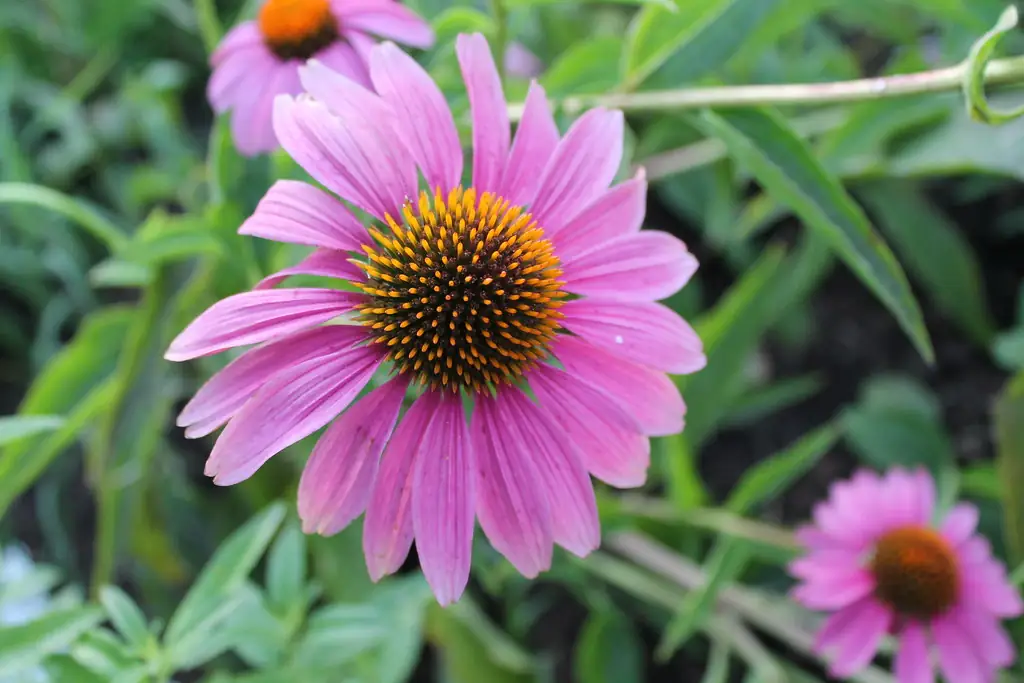
What the labels say
The Preen Extended Control (Snapshot) label lists plants it may injure, including oak leaf acanthus, ajuga, bleeding heart ‘Luxuriant’, foxglove, purple coneflower, euphorbia, hydrangea, candytuft, summer phlox, sedum, wine periwinkle and two rhododendrons. It also says not to treat new transplants until the soil has settled and no cracks remain, and not to treat groundcovers until they’re well rooted. Arkansas Extension adds that isoxaben is known to injure mockorange, euonymus and lilac, and that post-plant applications may kill veronica, digitalis, mints, legumes and mustards.
The trifluralin label is broader. It lists more than a hundred flowers, bulbs, groundcovers and ornamental grasses, from alyssum and begonia to zinnia. Its main cautions: don’t use it on flower seeds, wait until seedlings are 2 to 3 inches tall, and don’t apply to ajuga, myrtle or pachysandra until they’re well established.
What the trials found
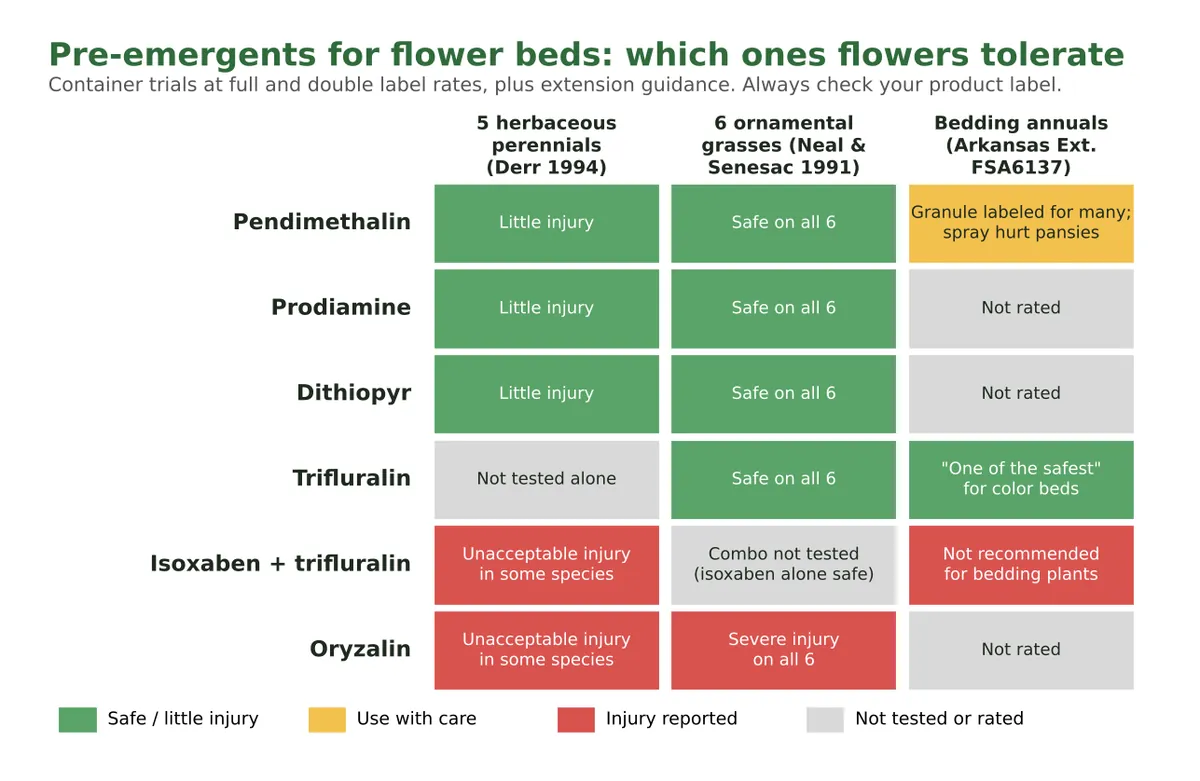
Two university studies tested these chemicals on ornamentals at full and double label rates:
- Herbaceous perennials. Derr (1994, HortScience) treated black-eyed Susan, lanceleaf coreopsis, shasta daisy, purple coneflower and blanket flower. Dithiopyr, pendimethalin and prodiamine gave excellent control of spotted spurge and yellow woodsorrel with little injury. Oryzalin and isoxaben + trifluralin caused unacceptable injury and weight loss in some of the perennials.
- Ornamental grasses. Neal and Senesac (1991, HortScience) tested six species, including blue fescue, fountain grass and tufted hair grass. Pendimethalin, prodiamine, trifluralin, isoxaben and dithiopyr were safe on all six. Oryzalin severely injured all of them.
Both were container trials, so field results can differ, but the pattern lines up with the labels: the dinitroanilines other than oryzalin are the gentlest choices around soft-stemmed perennials and grasses.
When to apply pre-emergent in flower beds
A pre-emergent applied a week late is money spent on nothing. (For lawns, the timing rules differ slightly; see our guide on when to apply pre-emergent.) You’re aiming for the window just before the main flush of weed seeds germinates, and flower beds have two flushes a year.
Spring (summer annuals). Crabgrass begins to germinate when the surface soil reaches 55°F for four or five days in a row, according to UMass Extension, which ties that to forsythia in full bloom. Iowa State uses forsythia petals dropping or redbuds coloring up as the signal. Spurge, oxalis and other summer annuals follow over the next weeks.
Late summer to fall (winter annuals). Chickweed, henbit, hairy bittercress and annual bluegrass sprout as nights cool and fall rains start. UNR recommends a fall application when those rains begin, because a spring application comes too late for weeds that rooted in autumn.
Ohio State Extension suggests this rhythm for Ohio beds: end of March or early April, again in June after mulching, and again at the end of September or early October for winter annuals. Shift it earlier in the South and later in the far North.
| Timing | Main target weeds | What to do | Source of timing |
|---|---|---|---|
| Late winter to early spring, before soil hits 55°F | Crabgrass, spurge, oxalis, other summer annuals | First application on cleaned beds; water in | UMass; Iowa State; Ohio State |
| 9 to 12 weeks after the first (trifluralin) | Late-germinating summer annuals | Repeat trifluralin; skip if using an isoxaben product | Preen label |
| Early summer, after mulching or planting annuals | Seeds blown onto fresh mulch | Apply on top of the new mulch and water in | Preen label; Ohio State |
| Late summer to early fall, as rains start | Chickweed, henbit, bittercress, annual bluegrass | Fall application for winter annuals | UNR; Ohio State |
| End of growing season (isoxaben + trifluralin) | Winter and early spring weeds | One application covers winter into spring; reapply every 6 months, never sooner than 60 days | Snapshot label |
| Late fall to winter, soil 55°F or cooler (dichlobenil) | Annual and some perennial weeds in shrub borders | Woody plants only; apply before the ground freezes | NC State |
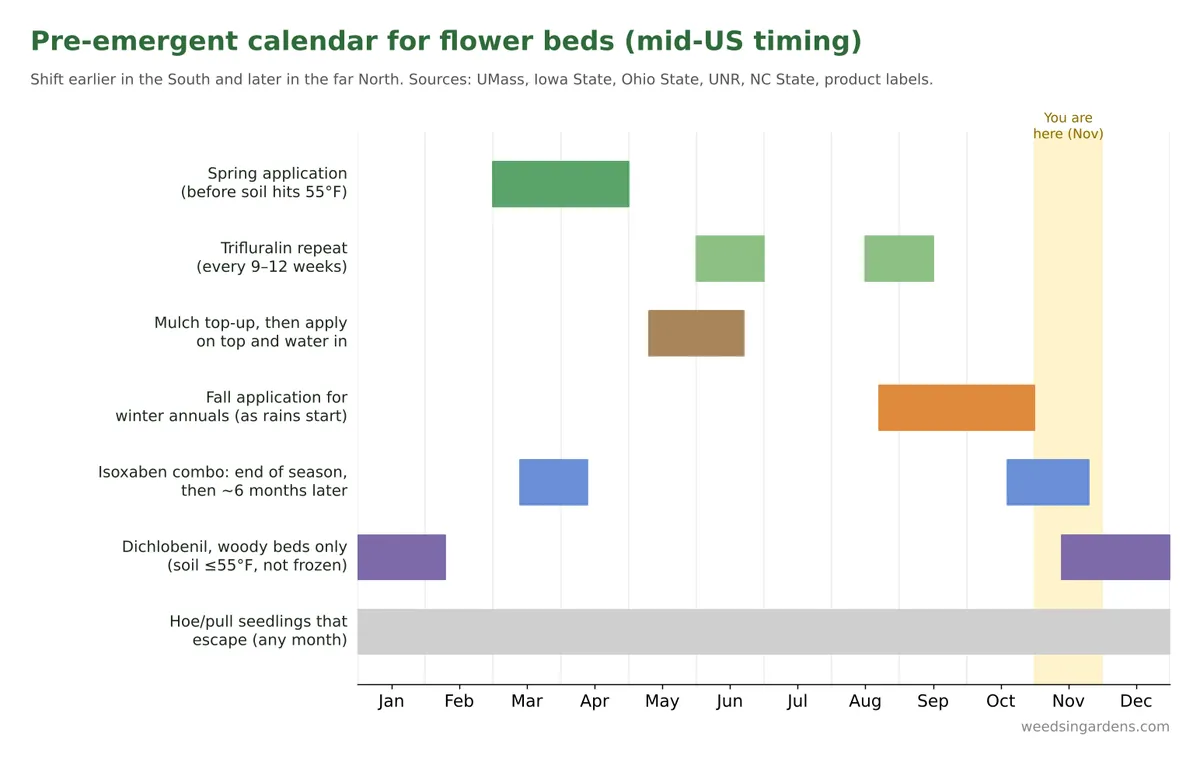
What to do if it’s already November
In most of the country the fall window for winter annuals has closed, and you can probably see the proof in your bed. Hand-pull or hoe those seedlings now while they’re tiny; our guides to chickweed and hairy bittercress explain why it’s worth doing before they flower in early spring. Then mark your calendar for the spring application. If you have an established shrub border, late fall is the label window for dichlobenil, as long as the soil is 55°F or cooler and not frozen.
How to apply pre-emergent in flower beds, step by step
Most “it didn’t work” stories come down to application, not product choice. Here’s the order that gives the barrier its best chance.
- Clear every weed you can see. Pull annuals, dig perennials with their roots, and rake out debris. UNR says clods, prunings and trash must come out before you apply.
- Plant first, then treat. Arkansas Extension advises irrigating a newly planted annual bed to settle the soil before applying. For isoxaben products the label is stricter: no cracks around new transplants.
- Mulch, then apply on top. Both the Preen label and Ohio State say to spread mulch first and sprinkle the granules over it, so the barrier sits where the weed seeds land. The Arkansas fact sheet recommends 3 to 4 inches of coarse bark after settling, or about 2 inches of fine bark.
- Measure the rate. The trifluralin label rate around established plants is 1 ounce per 10 square feet; the isoxaben + trifluralin rate is 0.98 ounce per 10 square feet. Mark out a 10 by 10 foot area, weigh 10 ounces into a cup, and you’ll see how thin the coverage should be.
- Keep granules off wet leaves. Apply when foliage is dry, and brush or wash granules off leaves and out of crowns. The label warns wet foliage can be injured.
- Water it in the same day. The trifluralin and Snapshot labels say the product must be incorporated within 24 hours by at least half an inch of water or light raking. UNR notes an average western Nevada rain (0.26 inch) isn’t enough, so use a sprinkler.
- Then leave the surface alone. Ohio State points out that digging holes or raking after watering breaks the barrier. If you have to plant later, the isoxaben label says to use untreated soil around the roots for 12 months.
- Sweep paths clean. Granules on concrete, stone or vinyl can stain, and the labels ask you to sweep stray granules back into the bed to protect storm drains and streams.
Common mistakes to avoid
- Using a lawn pre-emergent in the beds. Weed-and-feed and crabgrass preventers for turf aren’t labeled for most ornamentals. The garden products, in turn, are labeled “not for use on lawns.”
- Spreading it where you’ll sow seeds. That includes annual poppies, cosmos and sunflowers from seed, plus self-seeders you love. Leave those patches untreated or switch to mulch and hoeing.
- Assuming the bag lasts all season. UNR’s comparison table gives trifluralin an average field half-life of about 45 days, which is why its label says to reapply every 9 to 12 weeks.
- Treating bulbs at the wrong moment. The isoxaben label says not to treat tulips taller than ¾ inch, gladiolus before they emerge or with corms under 1 inch, or any bulb in flower.
- Spraying when granules would do. Arkansas found sprayable pendimethalin damaging to pansies while the granule was relatively safe.
Organic and non-chemical options for flower beds
Not everyone wants a synthetic herbicide in the same bed as the pollinator plants, and that’s a reasonable choice. Here’s what the evidence says about the alternatives.
Corn gluten meal. It’s the active ingredient in “natural” pre-emergents and is exempt from federal registration. UNR summarizes Iowa State’s research: it stops roots forming in sprouting seeds, but only if the soil stays dry for a short period after germination, and labels suggest it’s active for about 4 to 6 weeks. In a wet spring it mostly acts as a fertilizer. It’s a fair choice for dry climates and small beds; in rainy regions, temper your expectations.
Coarse mulch at the right depth. This does most of the work in any bed, chemical or not. Keep coarse bark at 3 to 4 inches and top it up as it breaks down; a crumbly, compost-like surface becomes a seedbed of its own.
Dense planting and a sharp hoe. Arkansas Extension recommends planting so a canopy forms quickly to shade weeds. Ten minutes with a hoe every couple of weeks while seedlings are tiny beats an hour of pulling later.
| Approach | Weeks of control | Works on weeds already up? | Safe where you sow seeds? | Cost and effort |
|---|---|---|---|---|
| Trifluralin granule | 9 to 12 per application (label) | No | No | Low cost; 3 to 4 applications a year |
| Isoxaben + trifluralin | About 26 (label: every 6 months) | No | No | Higher cost; 2 applications a year |
| Corn gluten meal | About 4 to 6 (UNR) | No | No | Moderate cost; unreliable in wet weather |
| Coarse mulch, 3 to 4 in | Until it decomposes | Smothers small seedlings only | Pull it back where you sow | Moderate cost; top up yearly |
| Hoeing and hand-pulling | Ongoing | Yes | Yes | Free; regular time |
A note from the agronomist’s side
When you strip away the marketing, choosing a pre emergent for flower beds comes down to a trade between two things: how long the barrier lasts and how many of your plants it tolerates. The longer-lasting group 29 chemistry in isoxaben products is more aggressive on broadleaf seedlings, which is exactly why it’s harder on broadleaf flowers. Trifluralin is gentler and shorter-lived, so you pay for safety with more frequent applications.
That’s why the label, not the brand, should drive your choice. The coneflower example shows how a single ingredient change flips the advice. My rule of thumb: list the ten plants you’d be most upset to lose, and check every one against the label’s tolerant and “do not apply” lists before you buy. If a plant isn’t on the tolerant list, treat a small patch first.
The second principle is dose and incorporation. The Preen granules contain less than 2% active ingredient, and the labels’ half-inch watering rule exists because the herbicide has to move into the top layer of soil or mulch to form the barrier. Under-watered granules sit on the surface and degrade; over-applied granules raise the risk to tender plants. Measure once, and you’ll calibrate your eye for good.
Finally, keep perspective. Pre-emergents only touch annual weeds from seed. If your bed’s problem is bindweed, nutsedge or grass runners from the lawn, no amount of Preen will fix it. Pair the herbicide with a clean edge, the right mulch depth, and a quick hoe pass every few weeks, and you’ll find you need less of everything.
FAQ
What is the best pre emergent for flower beds?
For most mixed beds, a trifluralin granule such as Preen Garden Weed Preventer is the safest place to start, because its label lists more than a hundred flowers, bulbs and groundcovers. Isoxaben combinations last about six months but injure some perennials, including coneflower and foxglove.
When should I put pre-emergent in my flower beds?
Apply it in early spring before soil reaches 55°F (around forsythia bloom) to stop summer annuals, and again in late summer or early fall as rains start to stop winter annuals. Trifluralin products need reapplying every 9 to 12 weeks.
Can you use Preen on top of mulch?
Yes. The Preen label says best results come from spreading mulch first, sprinkling the granules on top at the surface rate, and watering them into the mulch right away. If you can’t water, lightly rake them into the top layer.
Will pre-emergent hurt my perennials?
It can. Trials found oryzalin and isoxaben + trifluralin injured some perennials, while pendimethalin, prodiamine and dithiopyr caused little injury. Always check that each plant is on the product label and keep granules off wet foliage.
Can I plant flowers after applying pre-emergent?
You can set out transplants, but don’t sow seeds. Trifluralin labels say to wait until flower seedlings are 2 to 3 inches tall. For isoxaben products, use untreated soil around the roots of anything planted within 12 months of treatment.
Do I need to water in pre-emergent?
Yes. The trifluralin and isoxaben + trifluralin labels say to incorporate the product within 24 hours with at least half an inch of water or light raking. Without that, the barrier doesn’t form properly.
Is there an organic pre-emergent for flower beds?
Corn gluten meal is the main option. It only works for about 4 to 6 weeks and needs a short dry spell after weed seeds sprout, so results are unreliable in wet springs. Thick coarse mulch and regular hoeing are the dependable organic alternatives.
Sources
- U.S. EPA – Accepted label, Preen Garden Weed Preventer (trifluralin 1.47%), EPA Reg. No. 961-280 (2022)
- U.S. EPA – Accepted label, Preen Weed Preventer with Snapshot (trifluralin 1.5% + isoxaben 0.375%), EPA Reg. No. 961-421 (2022)
- University of Arkansas Cooperative Extension – Weed Control in Landscape Plantings, FSA6137 (Boyd)
- University of Nevada Cooperative Extension – Using Preemergence Herbicides for Weed Control in the Home Landscape, FS-11-67 (Donaldson and Skelly)
- Ohio State University Extension – Pre-Emergence Weed Control in Landscape Beds (Jagger, 2022)
- NC State Extension – Casoron (dichlobenil) Herbicide Information Factsheet
- UMass Extension – Biology and Management of Crabgrass
- Iowa State University Extension – How to Control Crabgrass
- Pacific Northwest Weed Management Handbook – Landscape Maintenance
- Derr, J.F. (1994). Weed Control in Container-grown Herbaceous Perennials. HortScience 29(2): 95–97
- Neal, J.C. and Senesac, A.F. (1991). Preemergent Herbicide Safety in Container-grown Ornamental Grasses. HortScience 26(2): 157–159