
Short answer: when to apply pre-emergent in spring is set by soil temperature, not the calendar. Put it down when the top 1–2 inches of soil hold about 50–55°F (10–13°C) for several days in a row, which is one to three weeks before crabgrass starts to sprout. In fall, apply it for winter weeds such as annual bluegrass and henbit when the soil cools to about 70°F (21°C). Water it in with ¼–½ inch of water, and plan a second, smaller dose about 8–9 weeks later if you want season-long control.
Knowing when to apply pre-emergent is most of the job; the product choice matters less. The rest of this guide explains where those numbers come from, how to read soil temperature without special gear, the backup signs (forsythia, redbud, degree days), and what to do if you missed the window.
Table of Contents
How pre-emergents work, and why timing decides whether they work
A pre-emergent herbicide does not kill weeds you can see. As Kansas State University’s turf team puts it, the product forms a barrier in the top of the soil that is absorbed by young seedlings, and those seedlings die before they emerge.
That has two consequences. Put the barrier down too late and the weed has already rooted below it, so the product does nothing to it. Put it down too early and the barrier slowly breaks down before the main flush of seedlings arrives. Most products stay active for roughly 6–12 weeks, according to Clemson Cooperative Extension, so a March application can run thin by June.
The goal is simple: have an activated barrier in place a little before germination starts and keep it there through the peak. That is why soil temperature, which drives germination, is a better guide than a date.
Soil temperature: the number that tells you when to apply pre-emergent
Crabgrass, the weed most spring pre-emergents are sold for, starts to germinate when the soil warms. Extension services describe the trigger in slightly different ways, but the numbers agree closely:
- Penn State Extension: germination begins when the upper inch of soil reaches 55–58°F at daybreak for 4 to 5 days.
- NC State TurfFiles: crabgrass germinates when the 24-hour mean soil temperature averages about 53–55°F at a 2–4 inch depth.
- University of Illinois Extension: germination starts when soil stays above 55–60°F for 7–10 consecutive days and continues until the soil reaches 95°F.
- Purdue Turfgrass Science: germination begins at average daily soil temperatures of 57–64°F at one inch, but large numbers of seedlings do not appear until the soil reaches 73°F or more.
The Purdue point matters. The first seedlings appear in the high 50s, but the big flush comes later. A field study of smooth crabgrass by Fidanza, Dernoeden and Zhang (1996) found that major emergence needed mean soil temperatures above 22.8°C (73°F) at 2.5 cm depth. That is why you apply at the 50–55°F mark: the barrier is ready before the first seedlings and still strong at the peak.
How to check soil temperature at home
A cheap probe thermometer is enough. Push it 1–2 inches into bare soil at the edge of the lawn, read it early in the morning (the coldest point of the day), and repeat for four or five days. Readings from a sunny south-facing strip next to a driveway will run warmer than the middle of the lawn, so check the spot where crabgrass usually shows up first. If you’d rather not measure, many state weather networks publish daily soil temperatures.
Other signs: flowering shrubs and degree days
If you don’t want to track soil temperature, three backup signals are widely used.
Forsythia and redbud in bloom
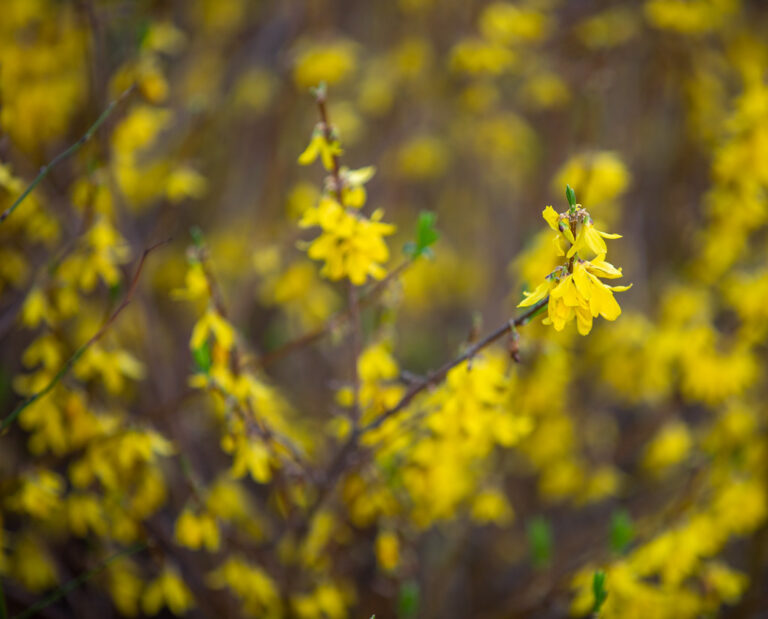
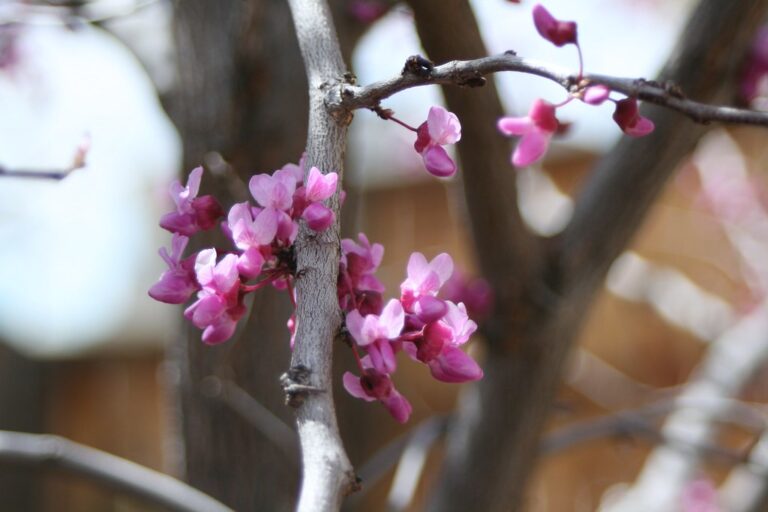
Crabgrass often begins germinating around the time forsythia and redbud trees are in bloom, according to K-State. Research supports the idea: Cardina, Herms and Herms (2011) found that the order of ornamental plants flowering and crabgrass emerging was consistent across years (R² = 0.977). Penn State adds a caution: forsythia bloom is not always a reliable guide. A shrub against a warm wall, for example, can flower well ahead of the lawn soil. Use bloom as a reminder to start checking, and let the soil reading make the call.
Growing degree days
Degree-day models add up daily warmth. The free GDDTracker from Michigan State University uses a crabgrass model that counts from February 15 with a 32°F base and flags a target window of 250–500 degree days. Purdue suggests watching for either 200 degree days with a 50°F base or 4 consecutive days averaging 64°F. The 2011 Cardina study also showed that published degree-day models can miss actual emergence by anything from 0 to more than 60 days, so treat them as a guide, not a rule.
When to apply pre-emergent: timing table by weed and season
Crabgrass is not the only target, and each weed has its own window. This table pulls together the triggers from the extension sources above.
| Target weeds | When to apply pre-emergent | Trigger to watch |
|---|---|---|
| Crabgrass | Early to mid spring | Soil 50–55°F at 1–2 in for several days; forsythia/redbud in bloom |
| Goosegrass | 3–4 weeks after the crabgrass date (Penn State) | Needs warmer soil than crabgrass |
| Spotted spurge | Late spring (emerges early May into June in Kansas) | A second, split application covers it |
| Prostrate knotweed | Late winter (germinates late February–early March in Kansas) | Must go down before the crabgrass product |
| Annual bluegrass, henbit, chickweed | Late summer to fall | Soil cooling to about 70°F; nights 55–60°F for 4 nights |
Regional dates give you a rough starting point for when to apply pre-emergent, but check them against soil temperature each year. Illinois Extension suggests early to mid April in southern Illinois and late April to early May in the north. Penn State gives March 15 to April 15 for southeastern Pennsylvania and April 20 to May 10 for the north and high ground. NC State has advised applying and watering in by about March 1 on the coast and March 15 in the Piedmont, and after seeing crabgrass emerge in late February in 3 of 4 recent years, it advised turf managers to apply at least two weeks earlier than that.
Split applications: two smaller doses beat one big one
The most useful research on timing is about splitting the dose. In trials in Indiana and Nebraska, Proctor and colleagues (2012, HortScience) compared prodiamine, pendimethalin and dithiopyr. Plots that got a first application in mid-April and a second in early June had about 9% crabgrass cover by August. A single full-rate application left about 21% cover. The active ingredient could even be switched between the two applications without losing control.
K-State recommends the second application about 60 days after the first. Clemson says 8 or 9 weeks. Either way, the label sets the maximum yearly rate, so a split means dividing that amount, not doubling it.
Water it in within a few days
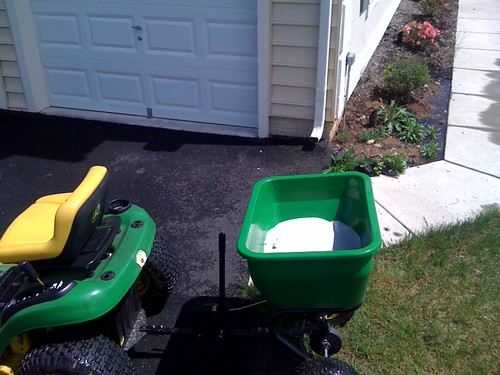
A pre-emergent lying on grass blades or thatch is not a barrier yet. K-State and Texas A&M AgriLife both say granular products need ¼ to ½ inch of water to move into the soil. Penn State advises watering in within 2 to 3 days of application. If rain is forecast, apply just before it. If not, run the sprinkler.
Missed the window? What to do if you are late
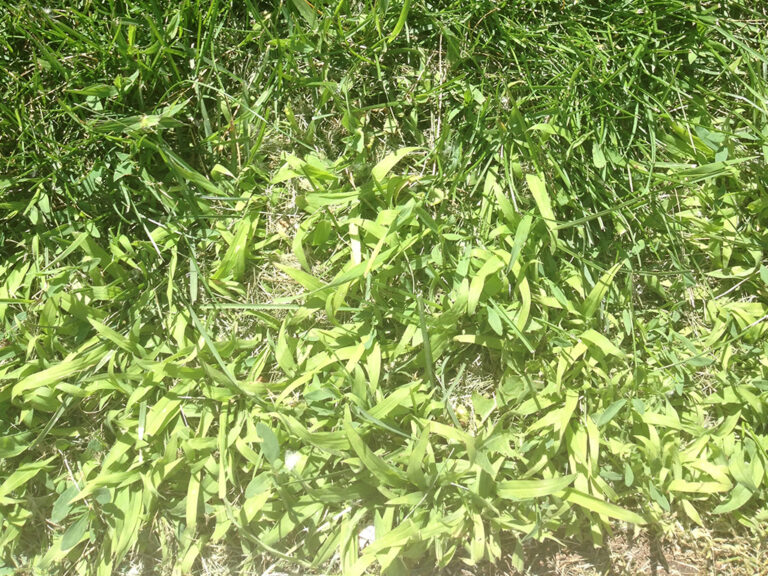
If crabgrass is already up, a standard pre-emergent will not touch it. One exception is dithiopyr, which Purdue describes as the only pre-emergent crabgrass herbicide with some early post-emergent activity. According to Penn State, that activity lasts only until the one-tiller stage, when the seedling has one side shoot. So a late dithiopyr application can still catch very young plants.
Beyond that stage, switch to a post-emergent product labelled for crabgrass in your grass type, and apply it while the weeds are small. It is still worth putting a pre-emergent down late in spring, because germination keeps going through early summer. Illinois notes it continues until soil reaches 95°F. For identification help, see our guides to crabgrass and weeds that look like grass.
When to apply pre-emergent in fall
Winter annual weeds germinate as the soil cools in late summer and autumn, then flower in spring. Texas A&M AgriLife recommends a fall pre-emergent when soil temperature drops to about 70°F. Its target list includes annual bluegrass, henbit, chickweed and Carolina geranium. Clemson’s air-temperature version of the trigger is nighttime lows of 55–60°F for four nights in a row. In South Carolina that falls between about September 1 and October 1, depending on the region.
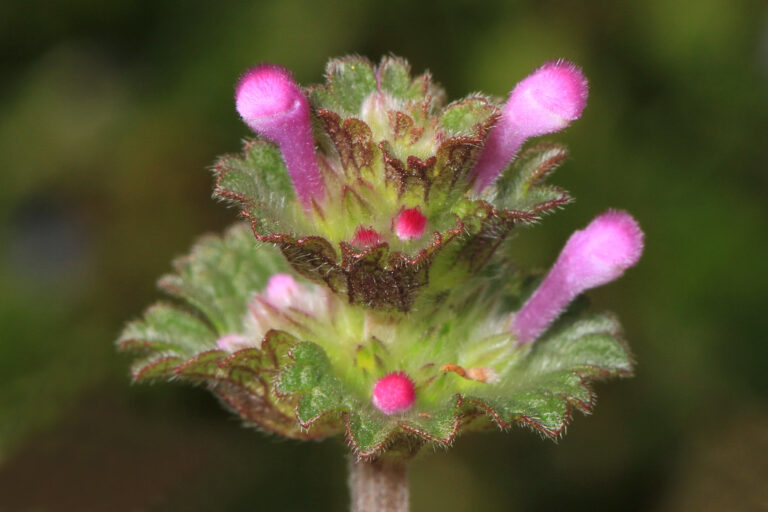
If your spring problem is Poa annua, chickweed or henbit and purple deadnettle, the fall application does more than anything you can spray in April. Our guide on whether weeds die in winter explains why these plants are already established by the time you notice them.
Pre-emergents and grass seed: the timing conflict
Most pre-emergents stop grass seed too. Illinois Extension notes that apart from siduron, pre-emergence grass herbicides will also damage germinating lawn seed. Clemson advises waiting at least nine weeks before seeding into a treated area, and the product label sets the exact interval.
Two actives are the exceptions. Penn State and Rutgers list siduron and mesotrione as safe to apply at seeding. Rutgers adds two cautions. Both are weaker than the standard products under heavy weed pressure, and too much mesotrione can injure new seedlings, especially perennial ryegrass. If you plan to overseed in fall, skip the fall pre-emergent on those areas. Our guide to killing weeds before overseeding sets out the order of work.
6 timing mistakes to avoid
- Copying a date from the bag instead of checking soil temperature. The same week can be two weeks early one year and two weeks late the next. NC State advised going two weeks earlier after crabgrass came up in February in several recent years.
- Going very early with one full dose. A barrier that lasts 8–12 weeks, put down in late winter, can fade before the summer peak. Split it instead.
- Not watering it in. Without ¼–½ inch of water within a few days, the product sits on the surface.
- Seeding into a treated lawn. Unless the product is mesotrione or siduron, the new grass will fail too.
- Forgetting later weeds. Goosegrass and spurge emerge weeks after crabgrass, so a single March application often misses them.
- Relying on pre-emergents in a thin lawn. Bare soil gives weeds light. Thickening the turf reduces the need for pre-emergents over time.
Where this applies
The soil temperatures in this guide hold wherever crabgrass and these winter annuals grow, because they are properties of the weeds. The calendar dates are for the United States, mostly cool-season and transition-zone lawns. Warm-season lawns in the South reach the soil temperature trigger earlier, often February or March. In the Southern Hemisphere the seasons are reversed, so the spring window falls around September to November.
Where soil never cools much, weeds germinate over a longer season and the product label and local advisory service should guide timing. Herbicide registration, product names and allowed rates vary by country, so check what is approved where you live and follow the label.
A note from the agronomist’s side
When someone says their crabgrass preventer “didn’t work”, timing is usually the reason, not the product. In trial plots and on farms I have worked with, the same three errors come up again and again. The product went down on a date copied from last year. It sat unwatered for a week in dry weather. Or a single dose in early spring had run out by the time the heat-loving weeds arrived.
A ten-dollar soil thermometer and a note in your phone to repeat the application eight weeks later fix most of these failures. The other half of the answer is the lawn itself. Pre-emergents buy time, but a dense, well-fed, correctly mown turf is what keeps weed seeds from getting light in the first place.
FAQ
Is it too late to apply pre-emergent in May?
Not always. Crabgrass keeps germinating into summer, so a May application still stops later seedlings. In cooler regions May can even be within the normal window. It will not control plants that are already up, except very young ones reached by dithiopyr.
Should I apply pre-emergent before rain?
Yes, light to moderate rain is ideal because it provides the ¼–½ inch of water needed to activate the product. Avoid applying just before a downpour on a slope or next to drains, where granules can wash away.
Can I put down pre-emergent and grass seed at the same time?
Only with products based on mesotrione or siduron, which are labelled for use at seeding. Other common pre-emergents such as prodiamine, pendimethalin and dithiopyr will also stop grass seed from establishing.
Related guides: Post-Emergent Herbicides for Lawns: Selective vs Non-Selective
Sources
- Landschoot, P. (2024). Control of Summer Annual Grass Weeds in Turfgrasses. Penn State Extension.
- Cooler than average spring temperatures may extend the window for preemergence herbicide applications. Purdue Turfgrass Science.
- Timing of preemergent herbicide applications: apply earlier. NC State TurfFiles.
- Managing Crabgrass in Lawns. University of Illinois Extension.
- Braun, R. (2026). Timing Your Turf: A Guide to Preemergence Herbicides. K-State Turf and Landscape Newsletter.
- Managing Weeds in Warm Season Lawns. Clemson Cooperative Extension, Home & Garden Information Center.
- Segars, C. Apply fall preemergence herbicide to avoid spring weeds. Texas A&M AgriLife Today.
- Elmore, M. (2019). Weed Control in Spring Seedings. Rutgers Center for Turfgrass Science.
- About GDDTracker. Michigan State University.
- Fidanza, M. A., Dernoeden, P. H. and Zhang, M. (1996). Degree-days for predicting smooth crabgrass emergence in cool-season turfgrasses. Crop Science 36(4): 990–996.
- Cardina, J., Herms, C. P. and Herms, D. A. (2011). Phenological indicators for emergence of large and smooth crabgrass. Weed Technology 25(1): 141–150.
- Proctor, C. A., Sousek, M. D., Patton, A. J., Weisenberger, D. V. and Reicher, Z. J. (2012). Combining preemergence herbicides in tank mixtures or sequential applications provides season-long crabgrass control in the upper Midwest. HortScience.