
You spent a weekend pressure-washing the patio, and it looked brand new. Three weeks later, a green line is back in every joint: tiny rosettes, wiry grass, a mat of something reddish creeping across the stones. You pull a few, the tops snap off, and you already know they’ll be back.
Short answer: to get rid of weeds between pavers, kill what’s growing now and then take away what the weeds need: soil and organic debris in the joints. Pull or scrape out young weeds with a paver knife after rain, use heat (flame, boiling water or steam) or a spot-spray for the rest, then clean the joints and refill them with properly compacted polymeric sand. Cornell’s turf and landscape weed team puts it simply: weeds grow in the gaps where soil is allowed to settle, so filling joints and sweeping regularly is the most effective control.
By the end of this guide you’ll be able to name the weeds in your joints, pick the removal method that fits the size of the job, use a weed killer on a patio without harming nearby trees or your drain, and fix the joints so you’re not doing this again every month.
Why weeds keep coming back between pavers
Pavers themselves aren’t the problem. The joints are. A concrete paver patio is a hard surface laid over a compacted base, with sand swept into the gaps. Over time, wind, leaf litter, grass clippings and dust settle in those gaps and break down into a thin layer of soil. Seeds land in it, and a joint that stays damp in the shade behaves like a long, narrow seed tray.
Cornell’s guide to weeds on hard surfaces lists what that costs you over time: weeds make paving uneven and slippery, open and widen cracks, destabilize joints and seals, and shorten the life of the surface. It also points out two sources most people miss:
- The edges. Weeds tend to spread inward from nearby vegetation, so a patio bordered by a weedy lawn or bed gets reseeded constantly.
- Creeping weeds next door. Plants that spread by runners or rhizomes can travel under the pavers and come up through the joints, even when the joints themselves are clean.
That’s why pulling alone feels endless. You’re removing the plant but leaving the soil it grew in, the seeds already in that soil, and the source next to the patio. The fix is to work on all three.
How to identify common weeds between pavers
Knowing what you’re facing tells you which method will work. Annual weeds die from almost anything that kills their leaves. Perennials with deep roots or runners shrug off contact treatments and need either digging or a systemic product. Here are the usual suspects in US paver joints.
| Weed | Key ID features | Life cycle | What works best |
|---|---|---|---|
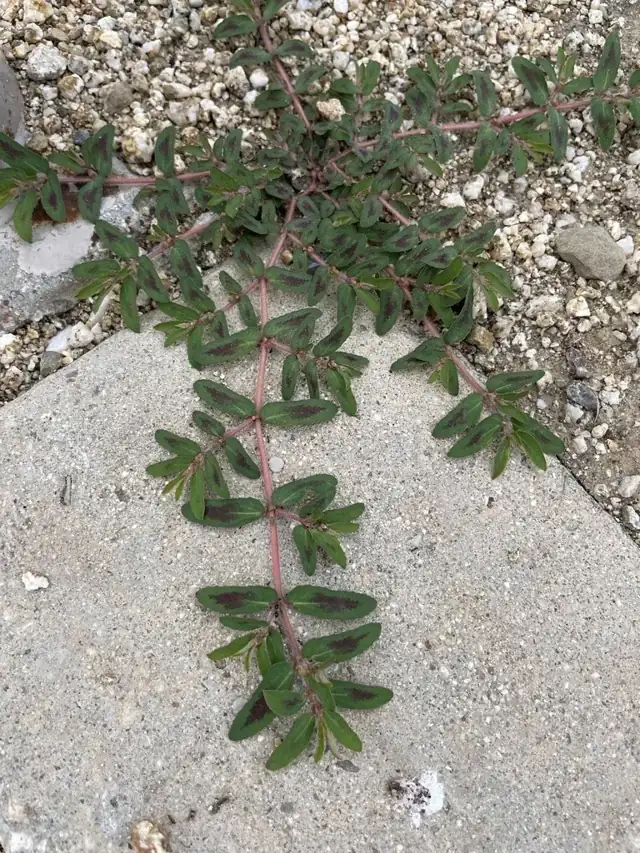
| Spotted (prostrate) spurge | Flat mat of thin reddish stems; small oval leaves, often with a dark blotch; milky sap when broken | Summer annual | Pull or flame while small; stop seed set |
| Common purslane | Fleshy, paddle-shaped leaves; thick reddish stems; small yellow flowers | Summer annual | Pull and bag (stems can re-root); heat |
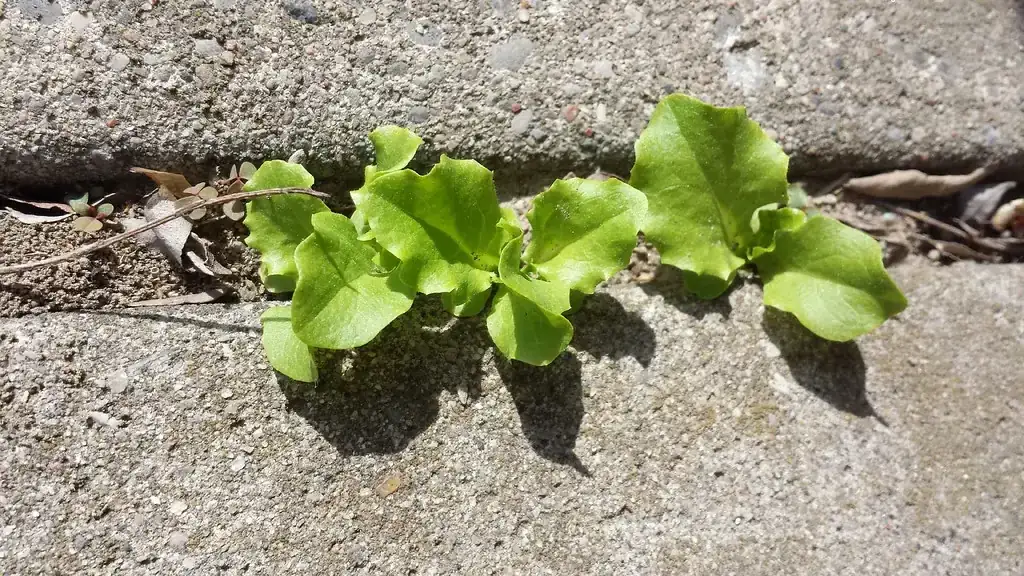
| Hairy bittercress | Small rosette of round leaflets; tiny white flowers; seed pods that pop when touched | Winter annual | Pull before pods form (late winter) |
| Annual bluegrass (Poa annua) | Light green, soft tufts; boat-shaped leaf tips; white-green seed heads even when mowed short | Winter annual | Knife out; heat repeatedly |
| Crabgrass | Coarse, light green blades in a low clump; finger-like seed heads in summer | Summer annual | Knife out young; contact or systemic spray |
| Common chickweed | Small, pointed oval leaves in pairs; tiny white star flowers; sprawling | Winter annual | Pull or brush out; heat |
| Dandelion and other taproot weeds | Toothed leaf rosette; long taproot that snaps | Perennial | Wet the joint, then lever out the root; or systemic spot spray |
| Moss | Green velvet in shaded, damp joints; no roots | Perennial (non-flowering) | Wire paving brush; more sun and better drainage |
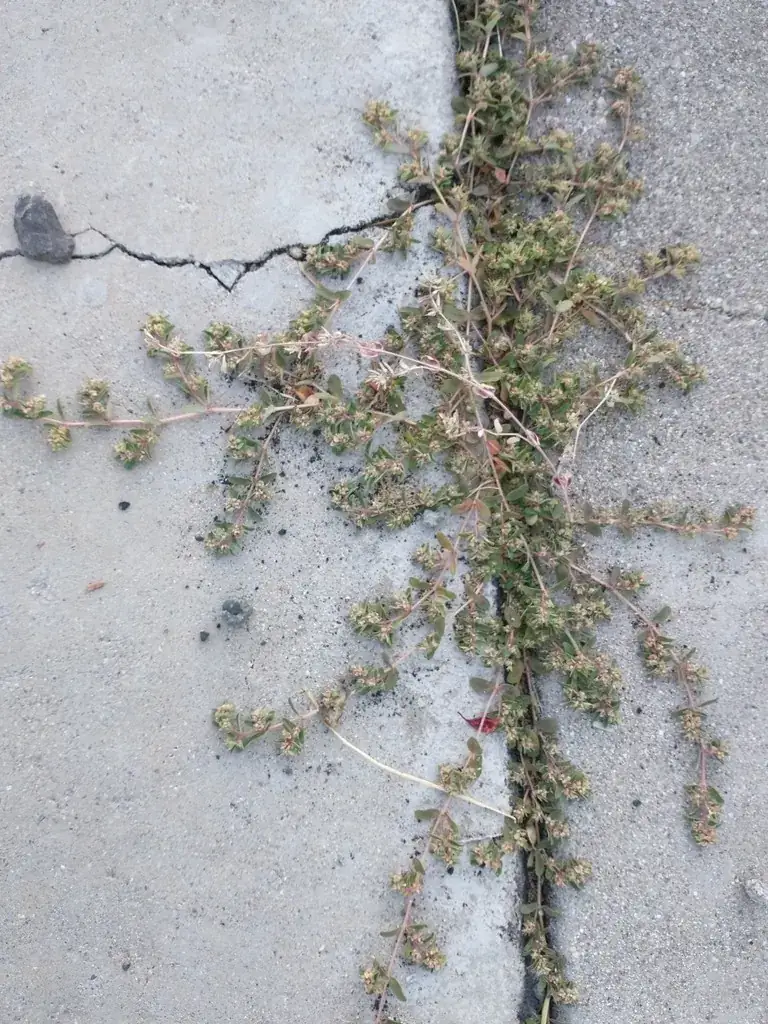
Look at the age of what’s there, too. A joint full of tiny seedlings is a 10-minute job with a brush or a torch. A joint where a dandelion has a taproot down into the base, or where a runner is feeding shoots in from a lawn edge, is a different problem, and that’s where the table above earns its keep.
How to get rid of weeds between pavers: 7 methods compared
No single method is best for every patio. The right choice depends on how big the area is, whether the weeds are annuals or perennials, what’s planted nearby, and how much time you’d rather spend than money. Here’s how the options stack up.
| Method | Best on | Kills roots? | Main drawback |
|---|---|---|---|
| Hand pulling / paver knife | Any weed, small areas | Yes, if the whole root comes out | Slow; tops snap off in dry joints |
| Wire paving brush | Moss and seedlings | No (removes tops and soil) | Can scour soft stone; weak on established weeds |
| Boiling water | Seedlings, small annuals | Rarely | Burn risk; must repeat |
| Flame weeder | Broadleaf seedlings under 3 in | No | Fire hazard; grasses and perennials regrow |
| Horticultural vinegar or other contact sprays | Young annual broadleaf weeds | No | Strong products can burn skin and eyes |
| Glyphosate spot spray | Perennials and established weeds | Yes (systemic) | Drift kills nearby plants; slower to show |
| Residual “total vegetation” sprays | Areas that should stay bare all year | Yes, and prevents new weeds | Can harm tree and shrub roots; never near beds or lawns |
1. Pull or scrape them out (after rain)
For a small patio, hand removal is still the cheapest and most precise method. The trick is moisture. Cornell recommends wetting the soil before weeding, especially for weeds with sizable taproots like dandelion. Wet joints let the root slide out instead of snapping at the surface. A block paving knife (a hooked blade) gets into narrow joints, and a stiff wire paving brush clears moss and tiny seedlings.
How often? NC State Extension suggests hand weeding about every two weeks in landscapes, so weeds come out before they establish a big root system or set seed. On a patio, that’s a five-minute walk with a knife, not an afternoon on your knees.
2. Boiling water
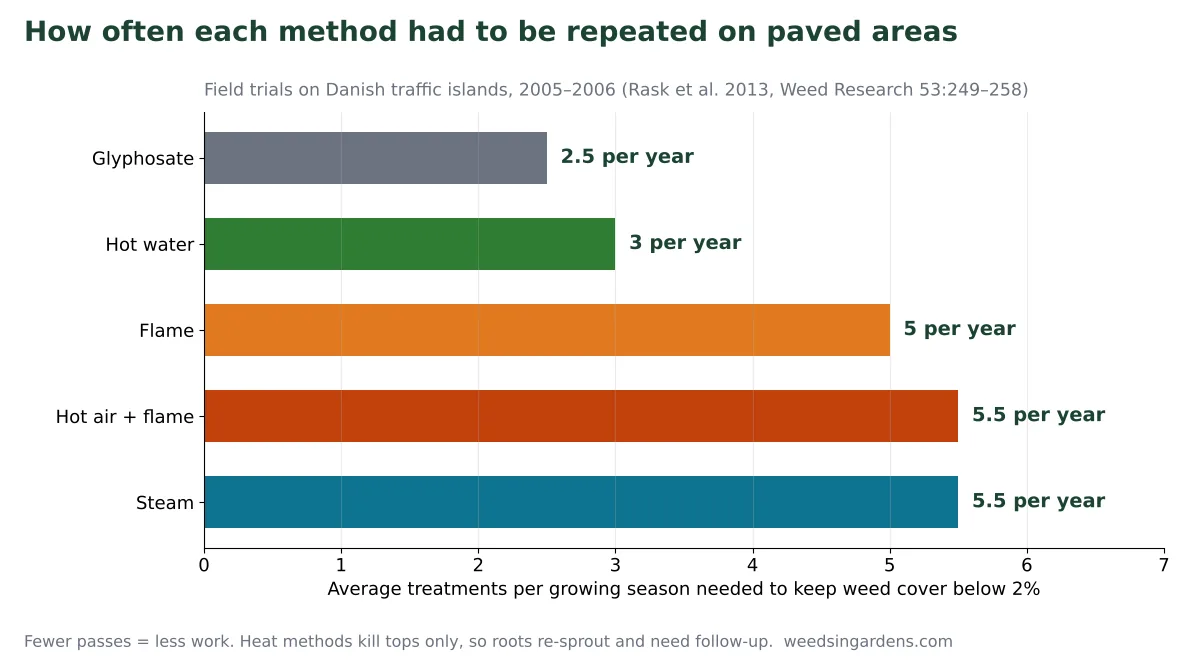
Pouring boiling water into a joint is a cheap way to deal with seedlings, and it’s safe for the pavers. It works on what it touches, so think of it as a heat treatment rather than a root killer. We cover the details and safety steps in our guide to using boiling water on weeds. In Danish field trials on paved traffic islands, hot water was the most effective of five non-chemical methods tested, beating flaming and brushing (Kristoffersen et al. 2008), though those trials used commercial hot-water machines, not a kettle.
3. Flame weeding
A propane flame weeder is the go-to tool for paver joints, and NC State lists cracks in driveways and the gaps between pavers as places where flaming is practical. You don’t need to set anything on fire. A brief pass heats the water inside the leaves until the cells burst. Cornell’s thermal weeding guide gives the numbers:
- Flame when weeds are under 3 inches tall; taller weeds need repeat passes.
- Hold the burner at 22 to 45 degrees to the ground and walk at 1 to 2 mph.
- Do the fingerprint test: once a leaf cools, press it between finger and thumb. If it holds a fingerprint, the pass worked.
- Flaming is more effective on broadleaf weeds than on grasses, and it won’t kill perennials in one pass.
Safety matters here. Check with your local fire department that flaming is allowed, keep water or an extinguisher nearby, stay away from dry mulch, wood and buildings, and never flame poison ivy: Cornell warns that the smoke can cause rashes on the skin, eyes, throat and lungs.
4. Steam and hot foam
Steam and hot-foam machines do the same job as a flame without the fire risk. Cornell notes that most annuals and young perennials die after one steam application, while older perennials need several. These machines are mostly commercial; NC State says they use around 60 gallons of water per hour, and the output can cause severe burns. If a landscaper offers it, it’s a good chemical-free option for a large patio or a pool deck.
5. Vinegar and other “natural” contact sprays
Household vinegar is 5% acetic acid. Horticultural vinegar is 20%, four times stronger, and Oregon State Extension says the best results are on young plants that have just germinated, usually on warm days. It doesn’t move to the roots, so dandelions and other perennials come back, and it does nothing to seeds that germinate afterwards. University of Maine Extension adds that horticultural vinegar is a pesticide by legal definition and calls for rubber gloves and eye protection. Our full test of whether vinegar kills weeds goes deeper.
NC State groups vinegar with the other contact products (pelargonic acid, fatty-acid soaps, plant oils, diquat): each will control seedling annual broadleaf weeds with good coverage, none has soil activity, and “natural” products often carry a higher skin-toxicity rating than synthetic ones. Use them for young weeds, and expect to repeat.
6. Systemic spot spray for perennials
When a weed keeps coming back from its roots, you need something that moves down into them. Glyphosate is systemic: NC State explains that it travels from the leaves to the roots and kills annuals and perennials, and it is quickly bound by clay particles in soil, so it has little soil activity. On a patio, use a ready-to-use spot sprayer on a calm day, wet the leaves of the weed only, and keep spray off lawn edges and bed plants. See our guide to post-emergent herbicides for how systemic and contact products differ.
7. Residual “weed and grass preventer” sprays
These are the products sold for driveways, patios and fence lines that promise a year without weeds. They combine a burn-down herbicide with one that stays in the soil. They work, but they are the easiest way to damage a tree you care about, so they get their own section below.
Herbicides for pavers by active ingredient (read the label first)
If you go the chemical route, choose by active ingredient, not brand name, and follow the label every time. The label is a legal document, and on a patio it also tells you how close to trees and drains you can spray.
| Active ingredient | Type | What it does between pavers | Key limits |
|---|---|---|---|
| Glyphosate | Systemic, non-selective | Kills annual and perennial weeds, roots included | Kills any plant it hits; best in warm, sunny weather |
| Pelargonic acid / ammonium nonanoate | Contact | Burns down seedlings within hours | Weak on perennials; less effective in cold weather |
| Diquat | Contact | Fast burn-down of small weeds, incl. young grasses | Toxic to aquatic invertebrates; keep out of drains |
| Acetic acid (20% vinegar) | Contact | Burns young annual weeds | Eye and skin hazard; repeat applications needed |
| Imazapic (in glyphosate + diquat + imazapic mixes) | Residual (soil-active) | Kills existing weeds and stops new ones for up to 12 months | Not over root zones; groundwater warning; can’t replant for 1 year |
The tree-root rule for year-long patio sprays
Take one popular example: the EPA-accepted master label for Roundup Max Control 365 (EPA Reg. No. 71995-51) lists 1.00% glyphosate, 0.08% imazapic and 0.04% diquat. It’s labeled for driveway and sidewalk cracks, patios and brick or paver paths, and it’s worth reading the restrictions before you buy:
- You must spray the whole area you want kept weed-free, not just the visible weeds.
- Do not use it over the root zones of desirable trees or shrubs. For trees and shrubs, stay back at least twice the distance from the trunk to the drip line.
- Don’t use it where you’ll plant or seed within 1 year, on steep slopes, or along a fence with plants you like on the other side.
- In heavy clay soils, plant growth may be prevented for more than a year; in high-rainfall areas, it may need re-applying every 6 to 8 months.
- Apply in calm weather with no rain forecast for 24 hours, keep it out of storm drains and gutters, and note the label’s groundwater warning for imazapic.
- For best results, the label says to apply in warm, sunny weather above 60°F. People and pets can go back on the area once the spray has dried.
Read that drip-line rule again and picture your patio. A shade tree 10 feet from the patio with branches reaching the patio edge puts much of the paving inside the no-spray zone. Roots run under pavers, especially where the base stays moist. If that’s your patio, skip the residual products and use spot treatments instead.
What to skip: salt and bleach
Salt and bleach show up in every “patio hack” video. They’re not registered as weed killers, they don’t stay where you pour them, and the runoff ends up in the lawn edge or bed next to the patio. Our article on whether bleach kills weeds explains the risks. The legal, labeled options above do the job with fewer surprises.
How to get rid of weeds between pavers permanently: fix the joints
Every method above treats the symptom. This is the cure. If the joints are full, tight and free of organic matter, there’s nowhere for a seed to root. Cornell’s prevention list for hard surfaces is short: seal cracks, fill joints between bricks and pavers (polymeric sand is one option that hardens when activated with water), sweep often so soil doesn’t build up, and pull weeds before they set seed.
Step by step: re-sanding with polymeric sand
Polymeric sand is fine sand blended with a binder that sets when wet, so it resists washout and makes it harder for seeds to root. Every brand has its own instructions and you should follow yours. As one example, the published PolySweep installation instructions set these conditions:
- Kill and remove every weed, then dig the old sand and debris out of the joints. A narrow scraper, pressure washer or joint-cleaning tool all work. Let everything dry completely.
- Pick a window: joints and surface fully dry, no rain for at least 12 hours, and average air temperature above 35°F for 48 hours after installing.
- Sweep the sand into the joints to at least 1.5 inches deep for pavers (1.25 inches for wide-joint formulas).
- Run a vibratory plate compactor over concrete pavers (a rubber mallet and a board for natural stone), then top up so the sand sits about 1/8 inch below the paver surface. Compact again.
- Sweep, then use a leaf blower held almost flat to clear every bit of dust off the paver faces. Leftover dust sets into a haze.
- Mist no more than 500 sq ft at a time, let it soak about 5 minutes, and repeat 3 to 4 times. Check with a screwdriver that the water reached the full 1.5-inch depth.
- Let it cure. Cool, damp, overcast weather slows setting, which can take up to 24 hours.
Wear eye protection and a dust mask while you sweep, as the instructions require. Honestly, most failed polymeric-sand jobs come down to two mistakes: joints that weren’t deep enough, and sand left on the surface before watering.
Other prevention habits that matter
- Sweep or blow the patio weekly in leaf season. Organic debris in the joints is tomorrow’s soil.
- Clean the edges. Edge the lawn hard against the patio and keep beds next to it mulched, so seeds and runners don’t move in.
- Fix drainage and shade where you can. Constantly damp joints grow moss and annual bluegrass; more sun and a slight slope help.
- Seal cracks in concrete edging or steps, and replace cracked pavers.
- Don’t let anything set seed. One mat of spurge can reseed the whole patio. The same rule applies to weeds in gravel driveways and paths; see our other guides to weeds in specific places.
Year-round plan for weeds between pavers
Pavers have two weed seasons. Cool-season (winter) annuals like hairy bittercress, chickweed and annual bluegrass sprout in fall and race to seed in early spring. Summer annuals like spurge, purslane and crabgrass take over once the paving warms up. Time your work to catch each group young.
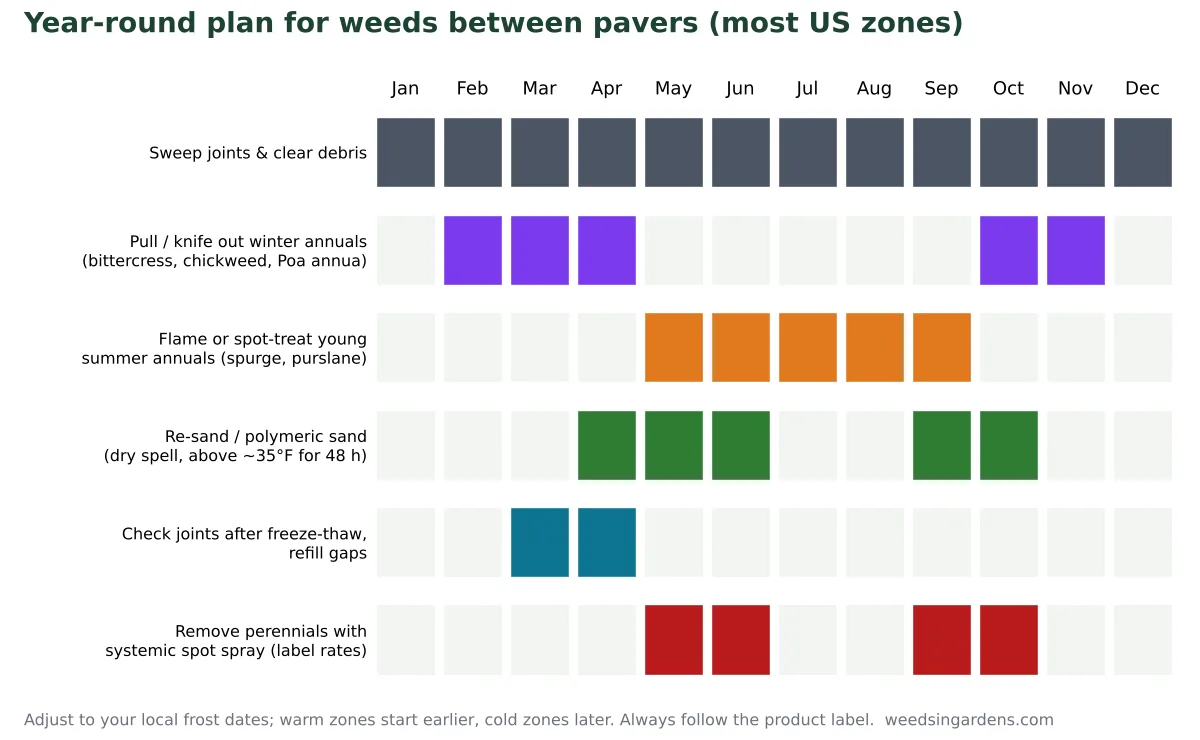
| Season | What’s happening | What to do |
|---|---|---|
| Late fall (now) | Winter annuals are germinating in damp joints; leaves pile up | Sweep and blow leaves off; pull or knife out seedlings; flame small ones on a dry day |
| Winter | Weeds grow slowly; freeze-thaw can loosen joint sand | Keep joints swept; note gaps to refill in spring |
| Early spring | Winter annuals flower and set seed fast | Remove them before seed pods form; check and refill joints after freeze-thaw |
| Late spring | Summer annuals germinate; perennials are actively growing | Best time to clean and re-sand joints; flame or spot-treat seedlings; systemic spot spray on perennials |
| Summer | Spurge, purslane and crabgrass peak | Flame or pull every 2 weeks while weeds are small; don’t let anything seed |
| Early fall | Perennials move sugars to roots | Second window for systemic spot sprays and re-sanding before cold weather |
A note from the agronomist’s side
Think of a paver joint as a soil-making machine. Every leaf, grass clipping and bit of dust that lands in it becomes organic matter, and organic matter holds water and nutrients. Weeds aren’t attacking your patio; they’re colonizing a habitat you’re unintentionally building. That’s why prevention by sweeping and filling joints beats any spray in the long run.
The Danish trials shown in the chart above are a useful reality check. To keep weed cover on paved areas below 2%, researchers needed on average 2.5 glyphosate treatments a year, 3 with hot water, 5 with flame, and 5.5 with steam or hot air (Rask et al. 2013). In practice, chemical-free control isn’t less effective; it just asks for more passes. If you enjoy a quick pass with a torch every few weeks in summer, that’s a perfectly sound plan. If you don’t, put your effort into the joints once and do less after that.
Two rules of thumb hold across all of this. First, match the method to the plant’s life cycle: contact methods (heat, vinegar, soaps) are excellent on seedlings and annuals but only trim perennials. Second, the smaller the weed, the cheaper it is to kill. A two-leaf seedling dies from a single flame pass; a mat of spurge that has already dropped seed has paid for next year’s crop.
Finally, be careful with year-long patio sprays near trees. The label’s drip-line rule exists because tree roots extend well beyond the trunk and often run right under paving. A dead tree costs far more than a summer of weeding.
FAQ
What is the best way to get rid of weeds between pavers permanently?
Kill the existing weeds, clean the old sand and debris out of the joints, and refill them with polymeric sand installed to the manufacturer’s depth and compaction instructions. Then sweep regularly so soil can’t build up. Sprays alone never make it permanent because new seeds keep landing in dirty joints.
How do you get rid of weeds between pavers naturally?
Pull or scrape them out with a paver knife after rain, or use heat: boiling water, a flame weeder or steam. Horticultural vinegar works on young annual weeds but is a 20% acid that needs gloves and eye protection. All of these mainly kill the tops, so repeat as new growth appears.
Does vinegar kill weeds between pavers?
It kills the leaves of young annual weeds it touches, especially on warm days, but it does not move to the roots. Perennial weeds such as dandelions usually grow back, and seeds that germinate later are not affected. Household vinegar (5%) is much weaker than horticultural vinegar (20%).
Is flame weeding safe on pavers?
It is widely used on pavers and in driveway cracks. Keep the flame away from dry mulch, wood, buildings and desirable plants, have water or an extinguisher ready, check that it is allowed locally, and never flame poison ivy because the smoke can cause rashes.
Will polymeric sand stop weeds completely?
It greatly reduces them but not to zero. Seeds can still sprout in dust and debris that collect on top of the sand, and creeping weeds can push through from the edges. Keep the patio swept and remove the occasional seedling while it is tiny.
Can I use a year-long weed preventer on my paver patio near trees?
Only if you can stay outside the tree’s root zone. The label for one popular glyphosate + imazapic + diquat product says not to apply over the root zones of desirable trees or shrubs, and to stay back at least twice the distance from the trunk to the drip line.
When is the best time to re-sand pavers?
In a dry spell in spring or early fall, when joints are completely dry, no rain is expected for at least 12 hours and the average temperature will stay above about 35°F for 48 hours (check your product’s label).
Sources
- Cornell University, Turfgrass and Landscape Weed ID. Hard Surfaces: Monitor, Prevent and Control.
- Cornell University, Turfgrass and Landscape Weed ID. Thermal Weeding: Flame, Steam and Hot Foam.
- NC State Extension. Are There Alternatives to Glyphosate for Weed Control in Landscapes?
- Bubl, C. Oregon State University Extension (2020, reviewed 2024). Does vinegar help with controlling weeds?
- Foster, J. University of Maine Cooperative Extension (2024). Is it safe to use horticultural vinegar on graveled drives?
- U.S. EPA. Master label, EPA Reg. No. 71995-51 (Roundup Ready-To-Use Max Control 365), accepted 5 Nov 2024.
- Rask, A.M., Larsen, S.U., Andreasen, C. & Kristoffersen, P. (2013). Determining treatment frequency for controlling weeds on traffic islands using chemical and non-chemical weed control. Weed Research 53(4): 249–258. doi:10.1111/wre.12019
- Kristoffersen, P., Rask, A.M. & Larsen, S.U. (2008). Non-chemical weed control on traffic islands: a comparison of the efficacy of five weed control techniques. Weed Research 48(2): 124–130. doi:10.1111/j.1365-3180.2007.00612.x
- SEK Surebond / Mutual Materials. PolySweep Polymeric Sand Installation Instructions (manufacturer guidance).