
You kneel down in early spring to pull a few scrappy little weeds from the edge of a flower bed. Something stings your cheek. Then again. Tiny seed pods are bursting in your hand and firing seeds at your face, and when you look up, you notice the same small white-flowered weed tucked along the driveway, in the thin corner of the lawn, and in every nursery pot you bought last year.
Short answer: That weed is almost certainly hairy bittercress (Cardamine hirsuta), a winter annual in the mustard family that sprouts in fall, sits through winter as a flat rosette, then flowers and shoots its seeds several feet in early spring. The fix is timing: pull or spray the rosettes in fall and late winter while they’re small, mow off flower stems before the pods ripen, and use a pre-emergent that is actually rated for bittercress (isoxaben, dithiopyr or dimethenamid, for example) in late summer to early fall.
This guide shows you how to identify hairy bittercress in seconds (and tell it from its look-alikes), why the usual crabgrass preventer often misses it, and a seven-step plan for lawns and beds, with herbicide choices by active ingredient and grass type. October is the right moment to read it, because the seedlings you’ll fight next spring are germinating right now.
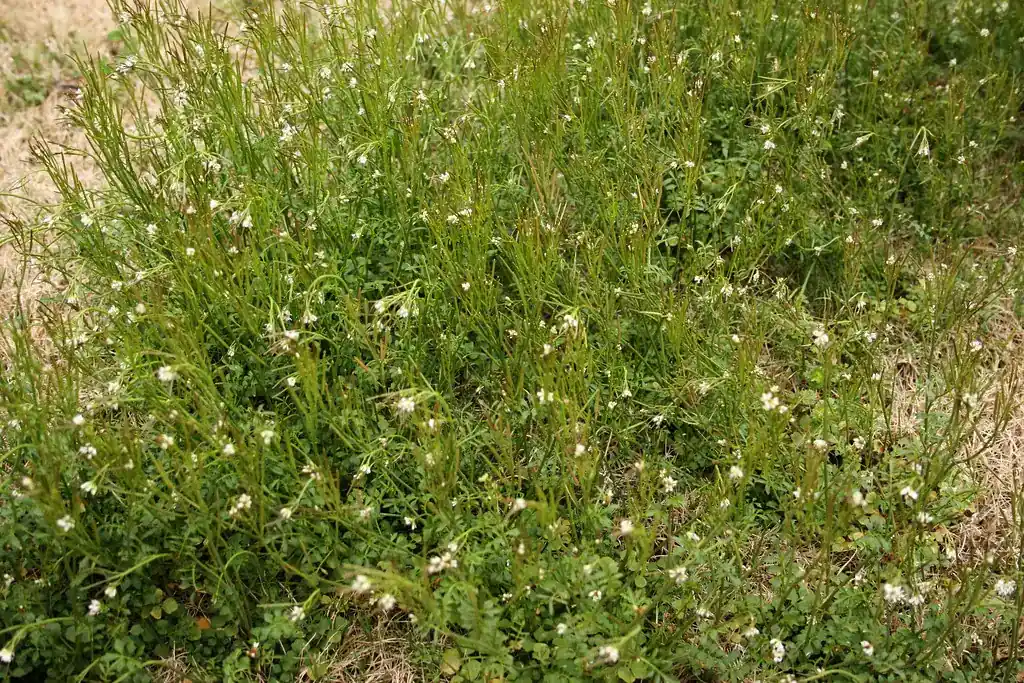
What Is Hairy Bittercress, and Why Does It Appear Overnight?
It’s a small, fast broadleaf weed native to Europe and Asia that is now naturalized across North America (NC State Extension). It belongs to the mustard family (Brassicaceae), which is why its flowers have four petals arranged in a cross. Common names include flickweed, shotweed and popping cress, all of which hint at its party trick.
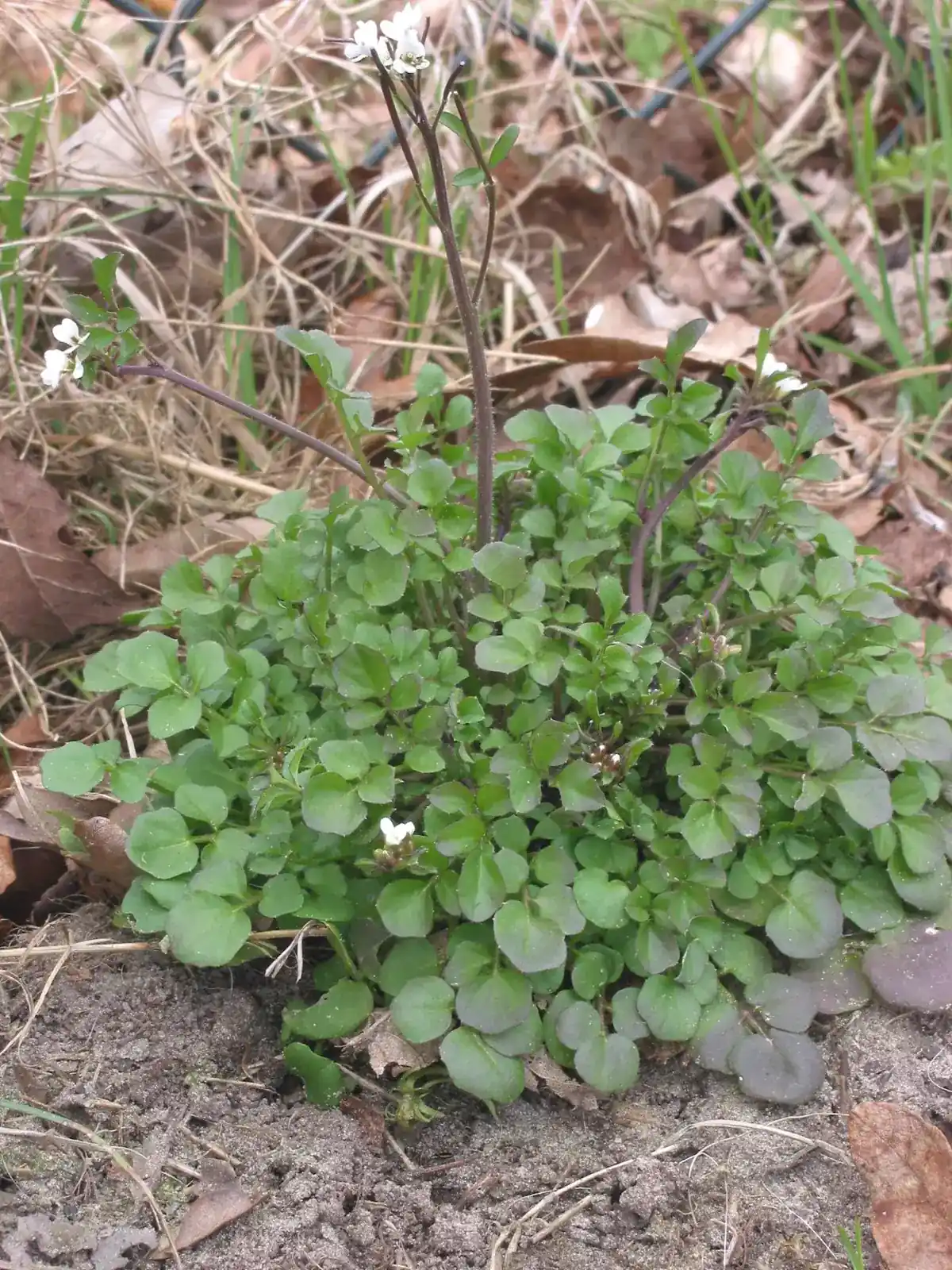
Penn State Extension notes it can behave as a winter annual, a summer annual or a biennial (Penn State Extension). In most US lawns it acts as a winter annual: seeds germinate in fall, the plant spends the winter as a low rosette, and it flowers and sets seed in early spring. That’s why it seems to appear overnight in March. It was there all winter; you just didn’t notice a flat green rosette until it sent up white flowers.
It loves cool, damp, recently disturbed soil, which makes it common in both turf and landscape beds (University of Tennessee Extension). It thrives in moist shade as well as full sun, near ornamental beds, vegetable gardens and paved areas. If you’ve already met its cousins in our guides to henbit and chickweed, you know the pattern: these cool-season weeds take advantage of the weeks when your grass is slowing down.
How to Identify Hairy Bittercress
Getting the ID right matters because the control timing for a winter annual is completely different from a perennial like creeping Charlie. Here’s what to look for at each stage.
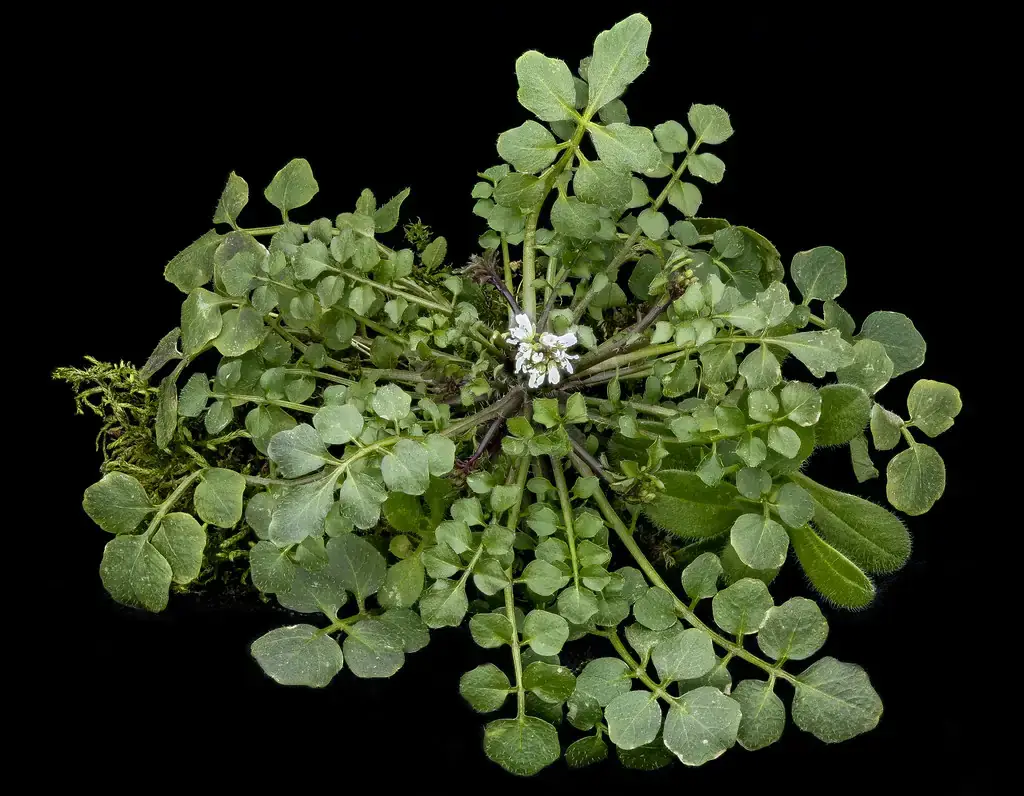
The rosette (fall through late winter)
Look for a flat rosette of leaves at ground level, each leaf made of several small, rounded leaflets lined up along a central stalk (pinnately compound). The Northern Virginia Master Gardeners describe 5 to 7 alternately arranged, rounded leaflets per basal leaf (MGNV). The end leaflet is usually the largest. Leaves often carry a few small hairs, especially near the base, which gives the plant its name (UT Extension).
Flowers and stems (late winter to spring)
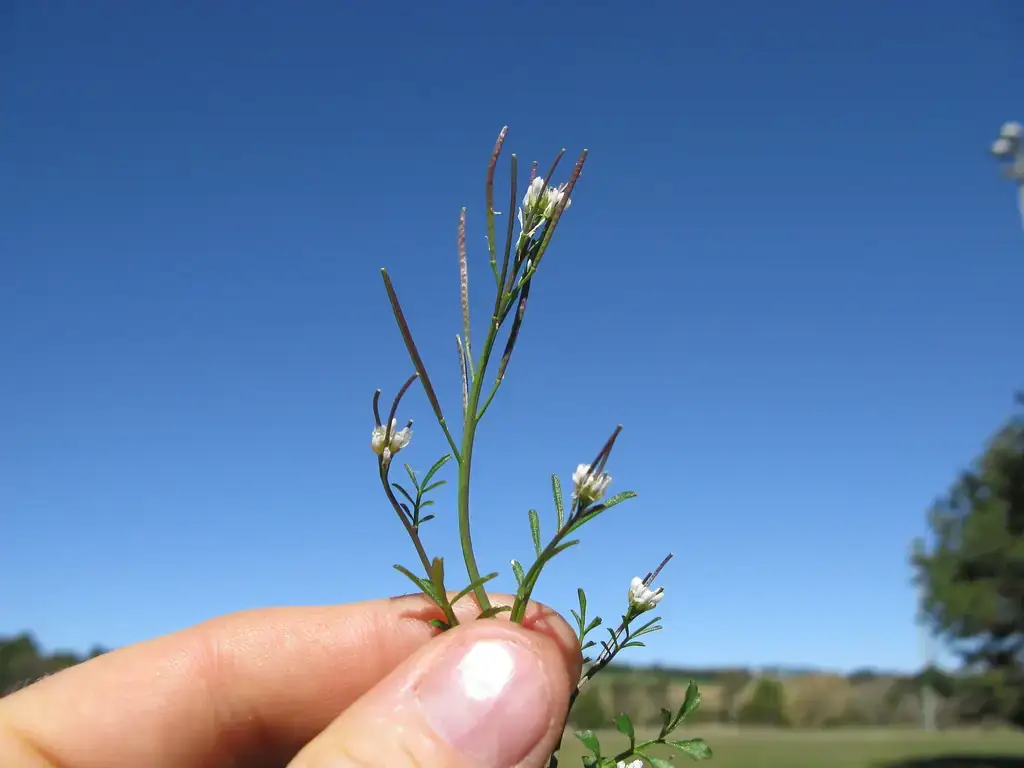
Stems are erect and branching, usually 3 to 10 inches tall, with small white flowers (about ¼ to ½ inch) clustered at the tips. Each flower has four petals and, typically, four stamens (Penn State Extension). Stem leaves are narrower and more elongated than the round leaflets of the rosette.
Seed pods (spring)
After the petals drop, narrow upright pods about ¾ to 1 inch long form below the flowers and stick up past them. When ripe, they split abruptly and launch seeds (Penn State Extension). If a plant pops when you brush it, you have your answer.
Hairy bittercress look-alikes
Several plants share the white flowers and rosette. For a broader lineup, see our guide to weeds with white flowers. The table covers the ones most often confused with it.
| Plant | Key difference | Does control change? |
|---|---|---|
| Hairy bittercress (Cardamine hirsuta) | Persistent basal rosette at flowering; 4 stamens; pods stand upright above flowers | — |
| Wavy bittercress (C. flexuosa) | Taller (to about 20 in in damp spots); stems zig-zag side to side; can live longer (RHS) | No, same methods work (RHS) |
| Pennsylvania bittercress (C. pensylvanica) | Native; few or no basal leaves while in bloom (MGNV) | Native; tolerate it in wild areas |
| Common chickweed (Stellaria media) | Simple, opposite, pointed-oval leaves (not leaflets); 5 deeply split petals | Similar timing, different herbicide ratings |
| Shepherd’s purse (Capsella bursa-pastoris) | Lobed, dandelion-like rosette; heart-shaped (not long, thin) pods | Similar timing |
Why Hairy Bittercress Spreads So Fast: The Exploding Seed Pod
Most weeds need wind, birds or your shoes to travel. This one launches itself. Understanding how it does this explains every step of the control plan below.
Researchers at the Max Planck Institute for Plant Breeding Research found that the pod wall stores elastic energy as it grows and then releases it in a fraction of a second. The seeds accelerate from zero to about 10 meters per second in roughly half a millisecond, and, surprisingly, the pods explode while still green and hydrated, not after drying out (Max Planck Society, summarizing Hofhuis et al., 2016, Cell). In practice, that means seeds can scatter before the plant looks “finished.”
| Trait | Figure | Source |
|---|---|---|
| Seeds per pod | About 20 | Garden Organic |
| Seeds per plant | 600 on average; several thousand on a large plant | Garden Organic; NC State (600–1,000) |
| Launch distance | About 3 ft (RHS, Garden Organic); 3–6 ft (NC State); up to 16 ft reported (MGNV) | Various |
| Seed launch speed | 0 to ~10 m/s in ~0.5 milliseconds | Hofhuis et al., 2016 |
| Fastest life cycle | 5–6 weeks (longer in rich soils) | Garden Organic |
| Seed bank | Relatively persistent; seeds viable for several years | Garden Organic; MGNV |
| Hitchhiking | Seeds turn sticky when wet and travel on tools and clothing | Garden Organic |
There’s one more route that catches gardeners off guard: nursery pots. NC State calls bittercresses the most common cool-season weeds in container nurseries, and it advises inspecting all new plants for them (NC State Container Weeds). Many backyard infestations start with a single potted shrub.
When to Control Hairy Bittercress: Timing Is Everything
Here’s the core problem, as Penn State puts it: the weed flowers and sets seed before most homeowners apply their spring broadleaf herbicide. By the time you spray in April, next year’s seeds are already in the soil. So the winning windows are fall and late winter, not spring.
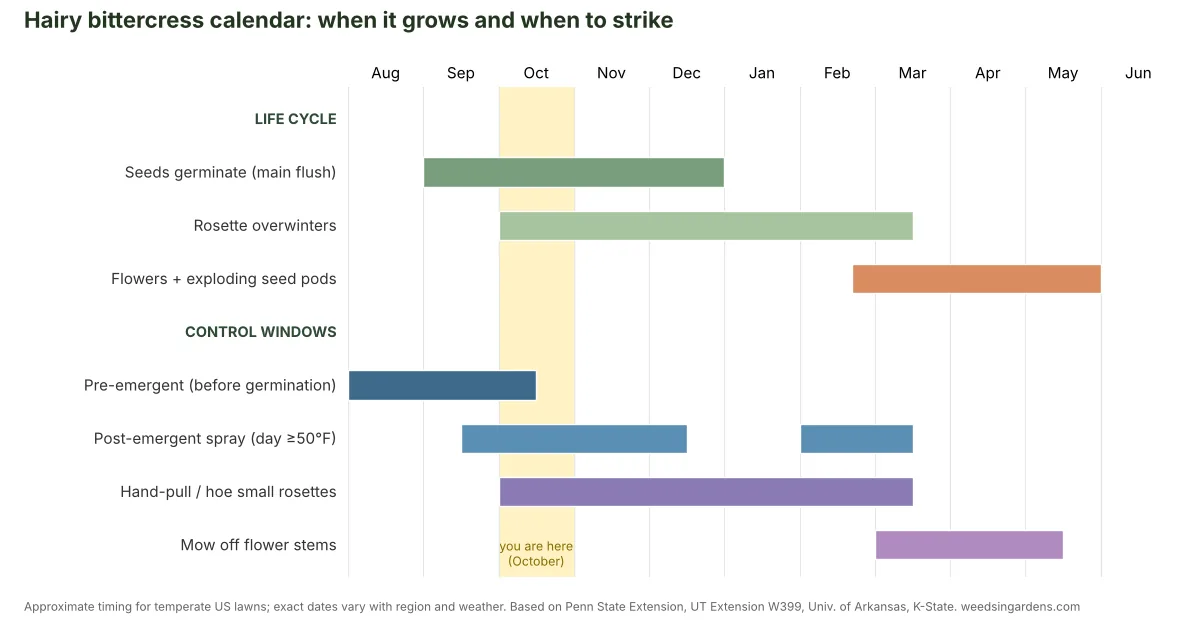
| Season | What the weed is doing | What you should do |
|---|---|---|
| Late summer – early fall (Aug–Sep) | Seeds about to germinate | Apply a pre-emergent rated for bittercress if you’re not seeding (Penn State) |
| Fall (Oct–Nov) | Seedlings and young rosettes | Hand-pull or hoe; spot-spray a broadleaf herbicide on days at least 50°F (K-State); thicken turf |
| Winter (Dec–Feb) | Rosettes sit low and green | In mild spells, pull rosettes from soft, moist soil; University of Arkansas advises spraying warm-season turf between December and March 1 while weeds are small |
| Early spring (Feb–Apr) | Flowering and seed pods forming | Pull before pods ripen; mow often to remove flower stems (Penn State); bag, don’t compost flowering plants |
| Late spring – summer | Plants die back in heat | Mulch beds; fix thin, damp, disturbed spots before fall |
If you’d like the bigger picture for all winter weeds, our guide to winter annual weeds explains why fall is the leverage point for the whole group.
How to Get Rid of Hairy Bittercress in Lawns and Beds: 7 Proven Steps
You don’t need to do all seven. Small patch in a flower bed? Steps 1, 2 and 6 will do it. A lawn speckled with white flowers every March? Work through steps 3 to 5 as well.
1. Pull it while the soil is moist
Bittercress has a shallow, fibrous root system and slides out of moist ground easily (MGNV). Pull after rain, and pull before pods ripen. If plants are already flowering, cup the top with your hand or slip a bag over it first. Garden Organic notes that stem fragments can re-root in moist conditions, so lift the whole plant rather than snapping it.
2. Hoe seedlings early and often
In vegetable gardens and open beds, regular shallow hoeing kills seedlings before they flower (Garden Organic). Because the life cycle can be as short as 5 to 6 weeks, a hoe every couple of weeks in fall and early spring beats one big weeding session. The RHS considers non-chemical methods easy and effective for bittercress (RHS).
3. Mow off the flower stems in spring
In lawns, frequent mowing in early spring removes flower stems and reduces seed set (Penn State Extension). It won’t kill the rosette, which hugs the ground, but it buys time until warm weather finishes the plant off. Honestly, for a light infestation in turf, consistent mowing plus a thicker lawn may be all you need.
4. Use the right pre-emergent (and skip it where you’re seeding)
This is the step most people get wrong. The University of Arkansas turfgrass database states that dinitroaniline herbicides such as prodiamine and pendimethalin do not provide effective preemergence control of this weed (University of Arkansas). Those are the active ingredients in many crabgrass preventers. NC State’s container trials agree, rating prodiamine only fair and trifluralin poor, while isoxaben and oxadiazon rate good.
Penn State lists dimethenamid, dithiopyr, isoxaben, and sulfentrazone + prodiamine among products labeled for bittercress, applied in late summer or early fall. Remember that most pre-emergents also stop grass seed from germinating, so don’t use them where you’re overseeding this fall. For timing basics, see our guide on when to apply pre-emergent.
5. Spot-spray a selective broadleaf herbicide in fall or late winter
Young rosettes are easy to kill with common three-way lawn herbicides. Spray when the weeds are actively growing and the daytime temperature is at least 50°F (K-State), and target them before they flower. The table summarizes extension-listed options. Product names are professional examples from the extension tables; homeowner products with the same active ingredients are widely sold. Always follow the label for rate, grass tolerance and temperature limits.
| Active ingredient(s) | Type | Turf listed as tolerant (UT W399) | Notes |
|---|---|---|---|
| Isoxaben | Pre-emergent | Bermuda, centipede, fine fescue, Kentucky bluegrass, tall fescue, zoysia | Rated good on bittercress (NC State); fall timing |
| Dithiopyr | Pre-emergent | Bermuda, centipede, fine fescue, KBG, perennial rye, tall fescue, zoysia | Labeled for bittercress (Penn State) |
| Prodiamine or pendimethalin alone | Pre-emergent | Most turf | Not effective on bittercress (Univ. of Arkansas) |
| 2,4-D + MCPP/MCPA + dicamba (three-way) | Post-emergent | Bermuda, centipede, fine fescue, KBG, perennial rye, tall fescue, zoysia | Standard homeowner option; spray small rosettes |
| 2,4-D + MCPP + dicamba + carfentrazone | Post-emergent | Same as above | Faster burndown in cool weather |
| Sulfentrazone | Post-emergent | Bermuda, centipede, fine fescue, KBG, perennial rye, tall fescue, zoysia | Labeled for bittercress (Penn State, UT) |
| Metsulfuron | Post-emergent | Bermuda, centipede, fine fescue, KBG, zoysia | Not listed for tall fescue or ryegrass |
| Clopyralid mixes | Post-emergent | Several | Penn State: not for residential lawns |
Two cautions. St. Augustinegrass isn’t on UT’s tolerance lists for these products, so read your label carefully before spraying a St. Augustine lawn. And in warm-season turf, Arkansas recommends tank-mixing a post-emergent with simazine or atrazine for best results, applied between December and March 1. Our post-emergent herbicide guide covers spray technique and drift in more detail.
6. Mulch beds and inspect nursery pots
Bare, damp soil is an open invitation. Keep a continuous layer of mulch in beds (see how to stop weeds in mulch beds) and check every new potted plant. If you see rosettes on the soil surface, scrape off the top inch of potting mix before planting. That one habit, recommended in spirit by NC State’s advice to inspect new plant material, can keep the weed out of your garden altogether.
7. Fix the conditions that favor it
Bittercress favors cool, damp, disturbed soil and thin turf. Penn State recommends increasing turf density through proper fertilization and choosing grasses that suit your site. Garden Organic adds that improved drainage may discourage this moisture-loving weed. Fill bare patches, correct soggy spots, and avoid leaving soil exposed after fall projects.
A Note from the Agronomist’s Side
Think of bittercress as a race: it’s a weed that wins by being early. It germinates in the cool weeks after your attention has drifted from the lawn, it survives severe frost as a seedling (Garden Organic), and it finishes its cycle before most spring routines begin. Every effective program I can build from the extension literature comes down to one rule: act before the first pod ripens. Kill one rosette in November and you’ve prevented hundreds of seeds; kill the same plant in late April and you’ve mostly prevented nothing.
The second lesson is about the label on the bag. Gardeners often tell themselves they “already put down pre-emergent,” but a prodiamine crabgrass product applied in spring is the wrong chemistry at the wrong time for this weed. Match the active ingredient to the target and apply it before fall germination, or rely on cultural control and spot treatment instead.
Finally, keep perspective. Bittercress is small and shallow-rooted, it fades in summer heat, and it offers early nectar to bees when little else is blooming (NC State). The RHS even treats it as a useful wildlife plant in the right place. In a lawn edge or wild corner, a few plants are not a crisis. In a vegetable bed, a nursery bench or a lawn you’ve just overseeded, zero tolerance before seed set makes sense.
FAQ
What kills hairy bittercress?
Hand-pulling and hoeing kill it easily because the roots are shallow. In lawns, selective broadleaf herbicides such as 2,4-D + MCPP + dicamba, sulfentrazone or metsulfuron (on tolerant grasses) control young rosettes. Spray in fall or late winter on days at least 50°F, and follow the label.
Is hairy bittercress edible?
Yes. The leaves and flowers are edible and have a mild, peppery taste despite the name (NC State Extension). Only eat plants you have identified with certainty, from areas that have not been sprayed or heavily trafficked, and rinse them well.
Will vinegar kill hairy bittercress?
Household vinegar can burn back small seedlings, but it is non-selective and can damage grass and garden plants it touches. For a few plants, pulling is faster and more reliable. See our vinegar guide for the trade-offs.
Does pre-emergent stop hairy bittercress?
Only the right one. The University of Arkansas says prodiamine and pendimethalin are not effective on it. Isoxaben, dithiopyr and dimethenamid are labeled for it (Penn State Extension). Apply in late summer or early fall, before seeds germinate.
How far can hairy bittercress shoot its seeds?
Usually about 3 feet according to the RHS and Garden Organic, and 3 to 6 feet according to NC State. Some sources report distances up to 16 feet. Seeds leave the pod at about 10 meters per second.
Should I compost hairy bittercress?
Compost young plants that have no flowers or pods. Bag plants that are flowering or setting seed, because pods can ripen and release seeds after pulling (Northern Virginia Master Gardeners).
Is hairy bittercress native to the US?
No. It is native to Europe and Asia and was introduced to North America (NC State Extension). The similar Pennsylvania bittercress is a US native and has few or no basal leaves when it blooms.
Want more cool-season weed help? Browse all our garden weed guides or read does vinegar kill weeds?
Sources
- Abbey, T., Landschoot, P., & Delvalle, T. (updated 2025). Lawn and Turfgrass Weeds: Hairy Bittercress. Penn State Extension.
- Breeden, G. K., & Brosnan, J. T. W399: Hairy Bittercress (Cardamine hirsuta). University of Tennessee Extension.
- Bittercress (Cardamine spp.): Container Weeds. NC State University.
- Cardamine hirsuta. North Carolina Extension Gardener Plant Toolbox, NC State Extension.
- Hairy Bittercress: Turfgrass Weed Control Database. University of Arkansas System Division of Agriculture.
- Hairy bittercress weed datasheet. Garden Organic (UK).
- RHS Advice Team. Bittercress: removal tips. Royal Horticultural Society.
- Free, M. (2021). Weed Watch: What are those clusters of tiny white flowers blooming in my spring lawn? Master Gardeners of Northern Virginia.
- Hofhuis, H., Moulton, D., Lessinnes, T., et al. (2016). Morphomechanical innovation drives explosive seed dispersal. Cell, 166(1), 222–233. Summary: Exploding seed pods, Max Planck Society.
- Honig, R. (2021). Fall is the best time to control dandelions and perennial weeds. K-State Research and Extension.