
It’s October, the summer crops are out, and the bed you cleared two weeks ago already has a fine green fuzz across it. Look closer: tiny paired leaves on soft, trailing stems. In a month it will be a mat right where your spinach and peas should go. If you want to get rid of chickweed before it owns the cool-season garden, this is exactly the moment to start.
Short answer: chickweed is a cool-season annual that can go from seedling to seed in about six weeks, so the way to get rid of chickweed in a vegetable garden is to stop every flush before it flowers. Hoe or pull it while it is small and the soil is dry, cover bare soil with 2–3 inches of mulch, let a flush sprout and kill it before you sow (a “stale seedbed”), and water crops with drip lines instead of wetting the whole bed. Do that for two or three seasons and the seed bank shrinks fast.
Here’s the thing about common chickweed (Stellaria media): on its own, it rarely ruins a harvest. The trouble is timing. It fills beds in fall, winter and early spring, exactly when you want to sow peas, spinach, lettuce and onions, and it quietly carries virus and insect pests into those crops.
By the end of this guide you’ll be able to confirm you have it, understand why it keeps coming back, and run a plan that works without spraying your food beds.
Table of Contents
How to identify chickweed
First, make sure it really is chickweed, because two cousins share the name and one of them behaves quite differently. Common chickweed grows as a low, sprawling mat of soft, bright green stems. In lawns it rarely gets taller than about 2 inches, but in shaded garden beds it can reach 4 to 6 inches, according to UC IPM Pest Notes 74129. Look for these features together:
- Leaves: opposite, smooth, egg-shaped with a pointed tip, about 1/2 to 1 inch long, often with a glossy sheen (Rutgers Cooperative Extension).
- Stems: the best single clue is a line of fine hairs running along the stem, usually on one side only, while the rest of the stem is smooth. Stems root at the nodes where they touch moist soil.
- Flowers: about 1/4 inch across, with five white petals so deeply split that they look like ten (NC State Extension Plant Toolbox).
- Seedlings: pairs of small, smooth oval leaves, often coming up in dense patches after cool, wet weather.


Chickweed lookalikes: mouse-ear and sticky chickweed
So what about those cousins? Mouse-ear chickweed (Cerastium fontanum ssp. vulgare) is a perennial with hairy, oblong leaves and hairy stems; its petals are only slightly notched (Washington State University HortSense). It is mostly a lawn weed.
Sticky chickweed (Cerastium glomeratum) grows more upright, and its hairy leaves and stems give it a grey look and a tacky feel. In vegetable beds, though, the common species is almost always the one you’re fighting.
| Feature | Common chickweed | Mouse-ear chickweed | Sticky chickweed |
|---|---|---|---|
| Life cycle | Annual, mostly cool season | Perennial | Annual |
| Leaf surface | Smooth, glossy | Densely hairy | Hairy, slightly sticky |
| Stem hairs | One line down one side | Hairy | Hairy, sticky |
| Petals | Split almost to the base | Slightly notched | Notched |
| Where it causes trouble | Vegetable beds, borders, thin lawns | Lawns, turf edges | Beds and lawns |
| Best control | Remove before flowering, mulch | Thicker turf, spot treatment | Remove before flowering |
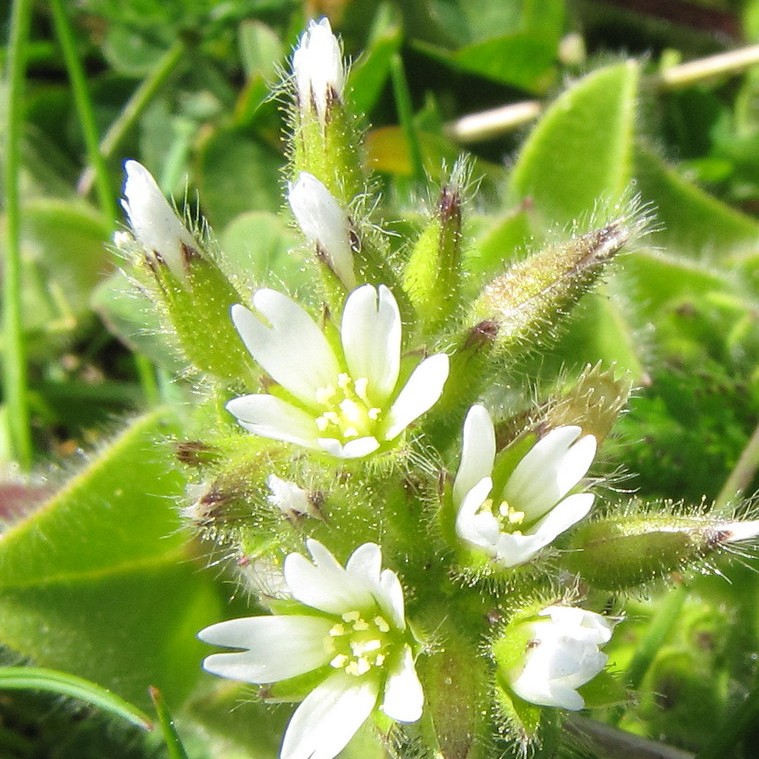
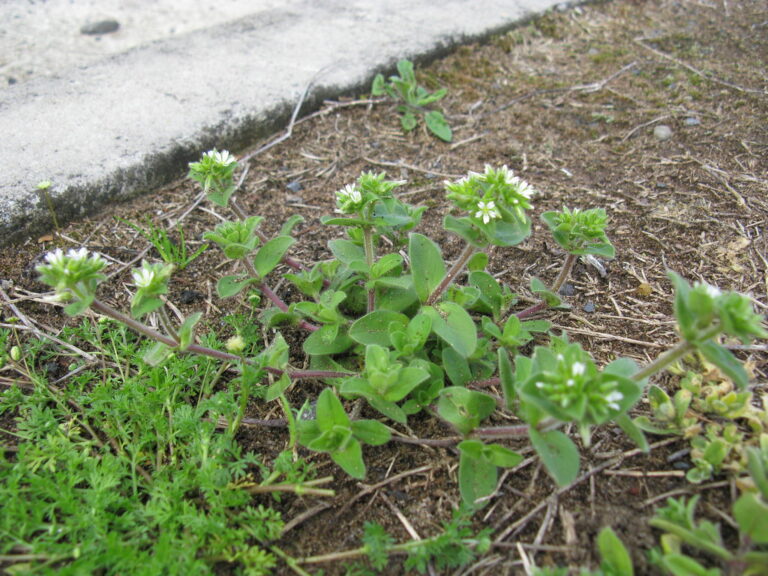
If a white-flowered weed does not match any of these, compare it with the other species in our guide to weeds with white flowers.
Why chickweed keeps coming back
If you’ve weeded a bed clean and found it green again a month later, you’re not doing anything wrong. This weed is hard to get ahead of because its whole life is short and its seed bank is long. The research numbers explain why.
- Fast cycle: plants usually flower within six weeks of emerging and set seed about two weeks later, so three or four generations a year are possible (SARE, Manage Weeds on Your Farm). UF/IFAS has recorded first flowers 4 to 5 weeks after germination.
- Lots of seed: a typical plant makes 500 to 3,000 seeds; a large, uncrowded plant can make 13,000 to 15,000.
- Cool, moist germination: seeds sprout best at 54–68°F and will not germinate above 86°F. That is why it flushes in fall and spring and fades in hot summers.
- Shallow emergence: seeds germinate best from 1/4 to 1/2 inch deep, and very few emerge from below 1 inch (UF/IFAS EP577).
- Cold hardiness: plants survive down to about 7°F with some damage, so in mild winters it keeps growing when little else does.
- Persistence: UC IPM reports the soil seed bank is about 95% depleted after 7 to 8 years with no new seed, although UF/IFAS notes that a few seeds can stay viable for decades in some soils.
One more detail catches a lot of raised-bed gardeners out. Clemson HGIC warns that uprooted plants left lying on moist soil can keep ripening seed and even re-root. In other words, weeds pulled and dropped on the path are not dead weeds yet.
Why it matters beyond competition
This is the part many guides skip. Chickweed is a reservoir for cucumber mosaic virus and tomato spotted wilt virus, and a host for lygus bugs and thrips (Rutgers).
University of Maryland Extension lists chickweeds among the key weed hosts of cucumber mosaic virus and notes that infected weeds often show no symptoms. Aphids then carry the virus from the weed to spinach, cucurbits and peppers, so a “harmless” mat can cost more than space.
How to get rid of chickweed in a vegetable garden: 6 methods
Honestly, no single method clears chickweed for good. What works is stacking a few methods that hit its weak points: shallow roots, shallow seeds and a need for cool, wet soil at the surface.
1. Pull or hoe it before it flowers
Start with the good news: the plant has a shallow root system, so it comes out easily. Hand weed or hoe when the soil surface is dry and the plants are small, as UC IPM recommends. Why dry? Severed seedlings shrivel on dry soil instead of re-rooting.
A sharp stirrup or collinear hoe run just under the surface is enough. UF/IFAS suggests weeding every two to three weeks, which fits neatly inside its four- to six-week cycle.

Bag or compost pulled plants only if they have not flowered. Plants carrying seed pods go in the trash or a hot compost pile, not on the bed edge.
2. Mulch bare soil 2–3 inches deep
Mulch may be the best value on this list. Because the seeds need light and sit near the surface, a blanket on top takes away what they need to start. UC IPM says a layer at least 2 inches deep reduces germination, UF/IFAS recommends 2 to 3 inches in the landscape, and Clemson suggests about 3 inches of coarse mulch in beds.
In vegetable beds, straw, shredded leaves or a layer of newspaper topped with compost are practical choices. Mulch between rows as soon as the crop is big enough, and see our guide to stopping weeds that grow through mulch if seedlings appear on top of it.

3. Use a stale seedbed before sowing
This one feels backwards, because you grow weeds on purpose. A stale seedbed empties the top layer of seed before the crop goes in. Prepare the bed, water it, let the weeds emerge, then kill them with minimal soil disturbance and sow straight away.
The secret is not digging. University of Maryland Extension notes that most weeds emerge from the top inch of soil and that any cultivation should stay shallower than 2.5 inches, so you do not bring up new seed. In UMD’s cucumber example the bed was prepared 20 to 30 days before planting.
4. Water the crop, not the whole bed
This is the step most gardeners overlook. The seed is sensitive to surface moisture: in a 2026 study in Agronomy, germination fell by about half at a water potential of −0.13 MPa, which is only a mild level of soil drying.
So put the water where the crop is. Drip tape or soaker hoses under mulch keep the crop row moist and leave the paths and the gaps between plants too dry for many seeds to sprout. Overhead sprinklers do the opposite, wetting every inch of surface, which is just what chickweed wants.
5. Keep winter beds covered
Empty beds from fall to spring are where the seed bank quietly builds up, so try not to leave them bare. Rutgers recommends a vigorous fall cover crop sown at a higher seeding rate, so it forms a dense stand that shades the soil.
Cultivating the late-summer flush of seedlings just before sowing the cover crop helps it win. No cover crop? A thick mulch over the winter does a similar job.
6. Solarize or flame weed bare beds
For a badly infested bed, it’s worth bringing out heavier tools. UC IPM lists soil solarization under clear plastic, which heats the top layer of soil enough to kill seeds; it needs the hottest, sunniest weeks of the year. Flame weeding kills small seedlings on a stale seedbed without turning the soil.
Both share one big advantage: they leave the soil undisturbed, so no new seed is brought to the surface. Here’s how all six compare.
| Method | Best timing | What it does | Limits |
|---|---|---|---|
| Hoeing / hand pulling | Every 2–3 weeks, dry soil, before flowers | Kills plants before seed set | Pulled plants with pods can still drop seed |
| Mulch 2–3 in | After sowing, once the crop is up | Blocks light, stops germination | Thin mulch lets seedlings through |
| Stale seedbed | About 3–4 weeks before sowing | Empties the top inch of seed | Needs moisture to trigger a flush |
| Drip irrigation | All season | Keeps inter-row soil too dry | Less effect in rainy spells |
| Cover crop | Late summer to fall | Shades out winter flushes | Must be sown thickly |
| Solarization / flaming | Hot season / small seedlings | Kills seed or seedlings without tillage | Needs sun (solarizing) and care with fire |
What about herbicides?
In a vegetable garden, herbicides are a last resort, and for good reason. UC IPM lists pre-emergent products such as trifluralin, oryzalin, pendimethalin, prodiamine, benefin and dithiopyr for chickweed, and non-selective post-emergent products such as glyphosate, glufosinate and diquat.
Only some of these are labelled for use near specific food crops, and each label sets which vegetables are allowed and how long to wait before harvest. Always read and follow the label.
Pre-emergents come with a catch: they also stop vegetable seeds you sow directly, so they only suit beds of transplants. Non-selective sprays should be limited to killing a flush before planting.
What about kitchen-cupboard options? Vinegar and other burn-down products scorch leaves but miss roots; our look at whether vinegar kills weeds explains when that is enough. Herbicide registration varies by country, so check what is approved where you live.
A simple season plan for chickweed
Put the methods together and the year takes on a rhythm. Fall matters most, because the flush you deal with now decides how much seed is waiting for you in spring.
- Late summer: water empty beds, let the first flush appear, and hoe it off on a dry day.
- Early fall: sow a dense cover crop, or plant fall crops and mulch them 2–3 inches deep.
- Winter (mild climates): check beds every 2–3 weeks and pull any plant with flower buds.
- Late winter: run a stale seedbed about 3–4 weeks before sowing peas, spinach and lettuce.
- Spring: hoe shallowly, mulch as soon as crops are up, and switch to drip watering.
Where this applies: the seasons above are for temperate climates in the Northern Hemisphere, where chickweed behaves as a winter annual. Henbit runs on the same winter annual calendar and often shares the same beds; our guide to getting rid of henbit covers it in detail.
In cool, cloudy regions it can germinate almost year-round; in hot lowland tropics it appears mainly in the cool season or at higher elevations. In the Southern Hemisphere, shift the months by six. Herbicide registrations differ between countries and states.
Chickweed in lawns
Finding it in the grass instead? In turf, it thrives where grass is thin, mowed short and kept wet, so change those conditions rather than chasing the weed. Clemson recommends raising the mowing height in fall and cutting back irrigation, and Rutgers recommends improving turf density with fertilizer and lime based on a soil test.
Mouse-ear chickweed is mainly a lawn weed. For identification help, see weeds with white flowers in lawns, and read do weeds die in winter? for why chickweed stays green when the grass goes dormant.
Can you eat chickweed?
Yes. The NC State Extension Plant Toolbox lists the leaves, stems, flowers and seeds as edible raw or lightly cooked, with a mild taste like spinach or corn silk. It also notes that the leaves contain saponins, which are poorly absorbed and are broken down by thorough cooking.
Only eat plants you have identified with certainty, never from beds treated with herbicides, and wash them well. Eating the weeds you pull is a nice way to get value from a flush, but it does not replace removing plants before they seed.
A note from the agronomist’s side
Chickweed is the weed that punishes a missed fortnight, and its biology tells you why. With first flowers four to six weeks after it sprouts and seed about two weeks after that, a bed that looks clean in the first cool weeks can be a green carpet a month later, with the oldest plants already dropping seed.
That’s why the fix that works is boring: shallow hoeing on a dry afternoon every two to three weeks, plus mulch as soon as the crop can take it. Regularity beats intensity.
The other big lever is water, and it’s the one people underestimate. If a mild drop in surface moisture can cut germination roughly in half, a bed sprinkled every evening is close to an open invitation, while a bed on drip under mulch gives the same seed bank far fewer chances.
Finally, think in seasons, not weekends. Most of the seed bank is gone after 7 to 8 years without new seed, and it falls faster where the surface is stirred, so every plant you stop before it flowers is an investment in an easier spring.
FAQ
Does chickweed die in summer?
It usually fades. Its seeds do not germinate above 86°F (SARE), so few new plants appear in hot weather, but in shade and in cool climates chickweed can keep growing through summer.
Is chickweed bad for a vegetable garden?
A few plants do little harm, but dense mats compete with young cool-season crops and can harbor cucumber mosaic virus, tomato spotted wilt virus, thrips and lygus bugs. Control it before it flowers.
How long do chickweed seeds last in soil?
UC IPM reports about 95% of the seed bank is gone after 7 to 8 years without new seed. Stirring the top layer speeds this up: SARE cites a 72% yearly decline where soil was stirred four times a year.
More on bed weeds: how to get rid of oxalis, how to dispose of weeds safely, and the full garden and bed weeds section.
Related guides: Purslane: Weed or Vegetable? How to Identify, Control and Eat It Safely
Sources
- UC Statewide IPM Program. Chickweeds, Pest Notes 74129.
- SARE. Common chickweed, Manage Weeds on Your Farm.
- Khamare, Y., Marble, S.C., Boyd, N.S., Steed, S. UF/IFAS. Biology and Management of Common Chickweed in Ornamental Crop Production, EP577.
- Clemson Cooperative Extension HGIC. Common Chickweed (Stellaria media).
- Washington State University HortSense. Chickweed, common and mouseear.
- Rutgers Cooperative Extension. Common Chickweed.
- University of Maryland Extension. Spinach crops found with cucumber mosaic virus.
- Chen, G., Hooks, C.R.R. University of Maryland Extension. The Stale Seedbed Technique.
- NC State Extension Gardener Plant Toolbox. Stellaria media.
- Valdez-Herrera, J., Clark, N., Waselkov, K., Shrestha, A. (2026). Germination responses of common chickweed to water potential, salinity, and pH. Agronomy 16(15): 1411.