
It happens slowly, then all at once. One wet November you step onto the back patio with a coffee, your heel slides, and you realise moss on pavers isn’t just a cosmetic thing: every joint has turned into a neat green stripe. The shady corner by the downspout looks like velvet. And the path to the shed? Slick enough to make you walk like you’re on ice.
Short answer: to get rid of moss on pavers, scrape or brush it out of the joints, kill what’s left with a potassium-salt (soap-based) moss killer or a diluted bleach solution used exactly as the label says, then brush away the dead moss and refill the joints with fresh sand. Moss on pavers always comes back unless you also fix the shade, standing water and debris that let it grow, so the long-term cure is more sun, better drainage and regular sweeping.
In this guide you’ll learn how to tell moss from algae and lichen (they need different treatment), a five-step removal method that won’t wreck your joint sand, which moss killers stain concrete or corrode metal, and a simple year-round plan that keeps paths and patios safe to walk on.
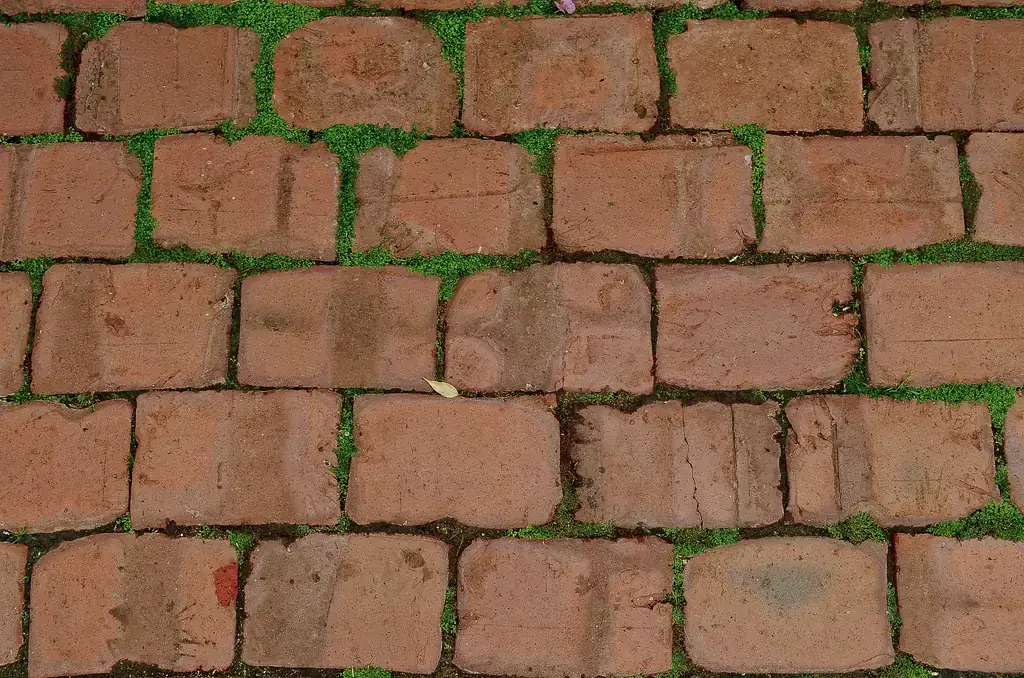
Why moss grows on pavers (and how to tell it from algae or lichen)
Moss isn’t attacking your patio. It’s taking advantage of it. Mosses are primitive, flowerless plants with no true roots, and the ones on hard surfaces are the same cushion-forming types you see on walls and roofs. Oregon State University lists Dicranoweisia cirrata and Bryum capillare among the common species on structures (OSU Extension).
What they need is simple: moisture that hangs around and not too much sun. The joints between pavers give them both. Sand and fine dirt hold water long after the paver faces dry, and the narrow gap shelters spores from wind and foot traffic. The Royal Horticultural Society notes that mosses “often grow in the spaces between paving,” favour damp, shady spots, and that build-ups tend to follow wet winters.
Here’s the part most guides skip: the site matters more than the stone. In a study of concrete specimens exposed outdoors, Spanish and Belgian researchers found that the local environment had a bigger effect on early colonisation than the concrete’s own properties (Manso et al., 2015). In plain terms, swapping to a “moss-proof” paver won’t help much if the patio stays shaded and wet.
How to identify what’s growing on your patio
Before you buy anything, check what you actually have. Moss, algae, lichen and liverworts all turn up on paving, but they don’t all need removing, and they don’t respond the same way to cleaning.
| Growth | What it looks like | Slip risk | What to do |
|---|---|---|---|
| Moss | Green or yellow-green cushions, carpets or tufts; tiny leafy stems; often thick in joints and shady corners | High when wet | Scrape, treat, remove dead material, fix the site |
| Algae | Thin green film or powdery green-black coating on the paver face; no visible leaves | Very high when wet | Scrub or pressure-wash; prevention is the same as for moss |
| Lichen | Flat, crusty grey, white, yellow or orange patches; some look like old chewing gum | Low | Usually leave alone; slow-growing and harmless |
| Liverwort | Flat, green, plate-like lobes, sometimes with tiny umbrella-shaped structures | Moderate | Usually leave alone unless on a walkway |
Oregon State’s Solve Pest Problems guide says lichens and liverworts “rarely require any management” and can usually be left alone, while algae on walkways is best pressure-washed. That’s why this guide focuses on moss: it’s the one that builds thick, slippery mats in high-traffic spots.
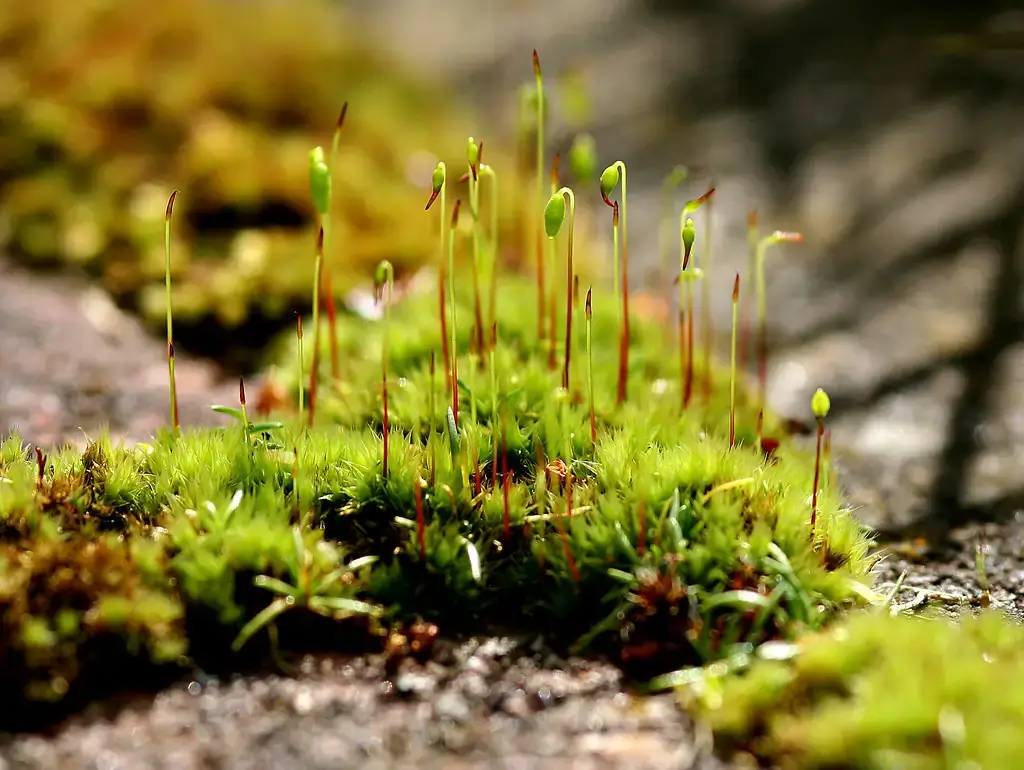
How to get rid of moss on pavers in 5 steps
Is moss actually hurting your pavers? Not much. The RHS says moss, algae and lichens “do not damage the surfaces they grow on.” The real problem is safety: a wet, mossy path is a fall waiting to happen. So the goal is a clean, grippy surface that stays that way, not a scorched-earth spray program.
Step 1: Pick a dry day with no rain coming
Start when the forecast is dry for at least 24 hours. Every product label and extension source agrees on this. Rain washes moss killer off the target and into storm drains, where it can harm aquatic life (OSU). Dry moss also scrapes out more cleanly.
Step 2: Scrape and brush out the bulk
Physical removal is the method Oregon State actually recommends first. Run a paver knife, an old kitchen knife or a putty knife down each joint, then go over the surface with a stiff-bristle broom or wire brush. The RHS specifically suggests a pointed weeding tool or old knife for moss in the cracks between paving.
Honestly, for a small patio this step alone does most of the job. Sweep the scrapings into a bag rather than into the lawn or beds, because moss fragments can re-root.
Step 3: Treat the regrowth with a labeled moss killer
Whatever moss is left after scraping, especially the fine green film deep in the joints, is where a moss killer earns its place. The gentlest effective option is a potassium-salt-of-fatty-acids product (a moss soap). One EPA-registered concentrate (EPA Reg. No. 67702-12) directs you to dilute 1 part product with 9 to 19 parts water for hard surfaces and apply 8 to 12 gallons of mix per 1,000 sq ft, rising to 25 gallons per 1,000 sq ft for moss thicker than an inch. If the moss is dry, wet it with plain water first.
Moss treated this way turns brown within a few days. Cold weather slows the reaction, so a November application may take longer to show. That’s normal and not a reason to spray again.
Step 4: Remove the dead moss
This is the step people skip, and it’s why the moss seems to “come back” in weeks. Oregon State is blunt about it: moss killers kill moss, but “you must still remove the dead material.” Dead moss and the organic crumbs under it are a perfect seedbed for the next round of moss, and for weeds too. Brush it out once it’s brown and crisp.
Step 5: Rinse gently and re-sand the joints
If you rinse or pressure-wash, keep the spray wide and low. The concrete masonry industry’s paver cleaning guidance (CMHA Tech Note PAV-TEC-005-22) notes that a wide nozzle held at a low angle reduces the risk of dislodging joint sand. Then sweep fresh joint sand back in. Full, tight joints leave less space for moisture, dirt and spores to collect.
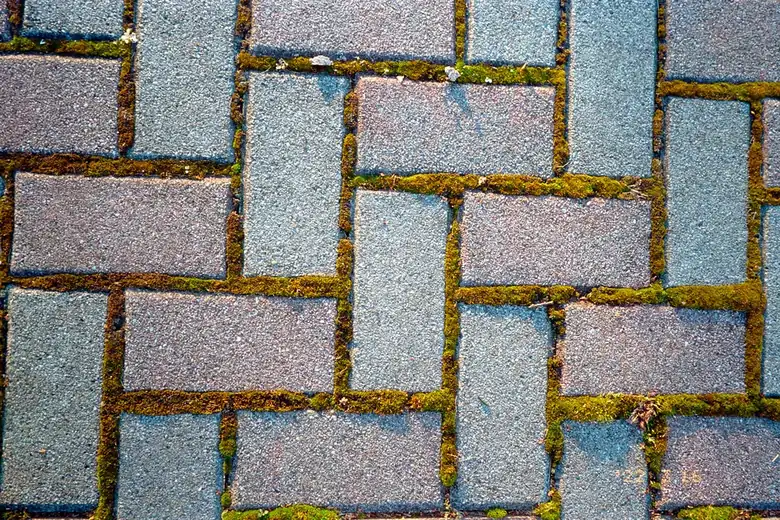
Moss killers for pavers and concrete, compared
Walk down the garden aisle and you’ll find soaps, zinc products, iron products and patio cleaners all promising the same thing. They are not interchangeable on hard surfaces. The big differences are whether the product stains, whether it corrodes metal, and what it does to plants and water nearby.
| Active ingredient | Typical use on hardscape | Main advantages | Main risks | Verdict for pavers |
|---|---|---|---|---|
| Potassium (or ammonium) salts of fatty acids | Label example: 1:9 to 1:19 dilution, 8 to 12 gal/1,000 sq ft | Biodegradable, non-corrosive; OSU calls it non-staining on most surfaces | Eye irritant (label requires goggles); hazardous to aquatic invertebrates; can burn plants if oversprayed | Best first choice |
| Sodium hypochlorite (chlorine bleach) | OSU bryophyte guidance: 1 part bleach to 1 part water | Cheap; OSU notes it won’t stain or corrode at proper strength | Toxic to plants if left on more than 10 minutes; fumes; never mix with other cleaners | OK for small, plant-free areas |
| Zinc sulfate | OSU: 3 lb in 9 gal water covers 600 to 1,000 sq ft (roof rate) | Longer-lasting on roofs | Corrodes copper; toxic to fish; OSU warns metal-based products may stain concrete | Avoid on patios |
| Ferrous (iron) sulfate | Lawn moss product; 4 to 8 lb/1,000 sq ft of lawn | Works on lawn moss | Label warns it stains concrete sidewalks; sweep spills off immediately | Never on pavers |
| Household vinegar | No registered moss-killer rate | Easy to find | It’s an acid; industry guidance warns strong acid cleaners can change paver colour | Not recommended |
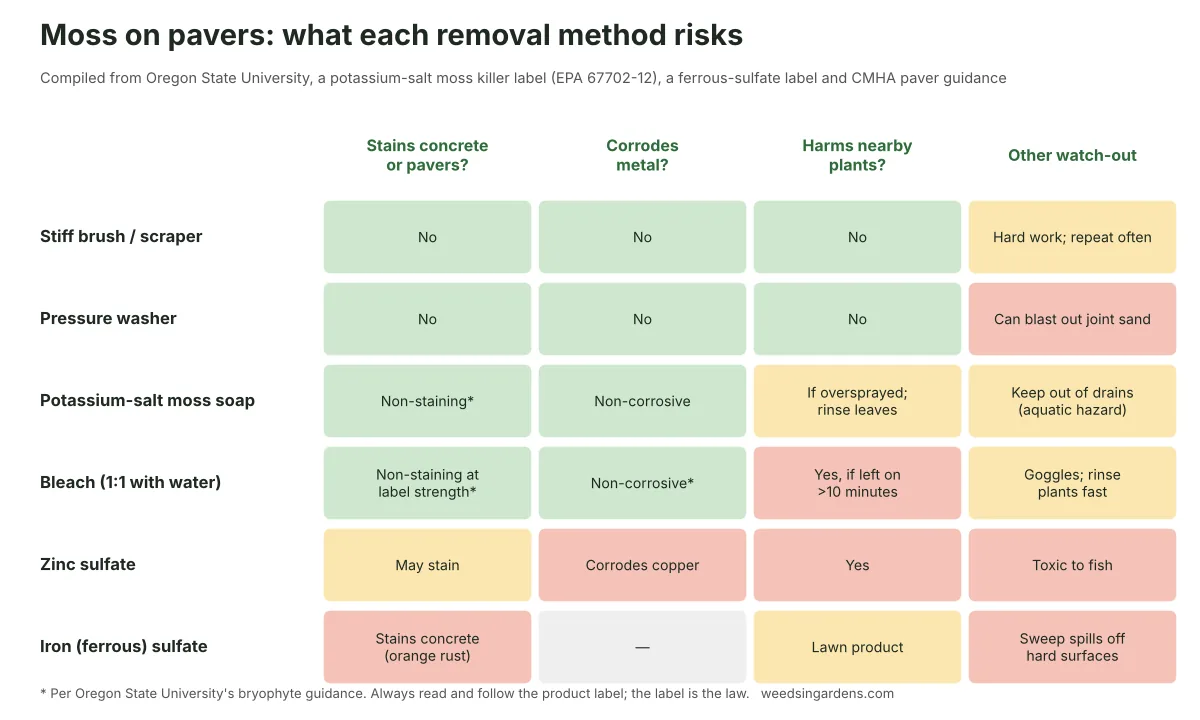
Potassium-salt moss killers: the safest bet
Oregon State’s homeowner guide says moss-killing soaps containing ammonium and potassium salts “are effective for killing moss” and are “biodegradable and non-corrosive.” They work by damaging moss cell membranes, which is why they act within days. The trade-off is that they don’t persist. Oregon State warns that mossicides wash off patios with rainfall and “don’t provide long-term moss growth control,” so plan on an annual treatment at most, as the label suggests.
Bleach: useful, but handle it carefully
Oregon State’s bryophyte group describes a 1:1 bleach-and-water mix that you keep wet on the surface briefly, then rinse. Their key warning: bleach at that strength is toxic to plants if left on for more than ten minutes. If your pavers are bordered by lawn or beds, soak those plants with water first and rinse them right after. For more on how bleach behaves in soil, see our guide on whether bleach kills weeds.
Why iron and zinc products don’t belong on patios
Iron sulfate is a classic lawn moss killer, which is exactly how it ends up on patios: it bounces off the spreader onto the path. One ferrous sulfate label states plainly that the product “will stain paint, concrete sidewalks and cart paths.” Those orange-brown rust stains are notoriously hard to remove. Zinc products have a different problem. OSU Extension says zinc corrodes copper, and Oregon State’s pest guide adds that zinc and copper products are toxic to aquatic animals and may stain concrete. If you’re treating moss in the lawn too, follow our moss in lawn guide and sweep any granules off the hardscape the same day.
What about vinegar and baking soda?
They’re popular in online hacks, but neither is a registered moss killer, and we couldn’t find extension data giving a tested rate for moss on paving. Vinegar is an acid, and paver-cleaning guidance warns that strong acid cleaners can change paver colour slightly. Our vinegar weed killer article explains why vinegar works on tiny leaves but struggles on anything with reserves. A labeled moss soap is cheaper than a stained patio.
Moss on concrete patios, driveways and steps
Moss on concrete behaves a little differently from moss on pavers. On a poured slab there are fewer joints, so moss usually starts along control cuts, cracks, the shady edge next to a fence, or the low spot where water sits. On steps it loves the back of each tread, where water drains slowly.
| Surface | Where moss starts | Best removal approach | Watch out for |
|---|---|---|---|
| Concrete pavers | Joints, edges, shady corners | Scrape joints, moss soap, re-sand | Washing out joint sand |
| Brick pavers | Joints and porous brick faces | Stiff brush, moss soap | Zinc-copper mixes may react with red brick (OSU) |
| Poured concrete patio or path | Cracks, control joints, low spots | Brush, moss soap or bleach, rinse | Iron sulfate rust stains |
| Concrete driveway | Shaded strips, edges near lawn | Brush or wide-spray rinse, spot-treat | Runoff to street drains |
| Concrete steps | Back of treads, sides | Scrape, treat, keep debris off | Slipping while you work |
| Natural stone | Joints and textured faces | Brush and moss soap; test first | Acids on limestone-type stone |
Whatever the surface, test any product on a small hidden spot first. The potassium-salt label above even says to test-spray a small area before treating, and that’s good practice for older, weathered or sealed surfaces.
Steps and sloping paths deserve extra care because they’re where falls happen. Treat them on a dry day, work from the top down so you aren’t standing on wet product, and keep kids and pets off until the surface is dry, as the label instructs.
How to keep moss off pavers for good
Here’s the honest truth: if you only spray, you’ll be spraying forever. As Oregon State plant pathologist Jay Pscheidt put it when talking about roof moss, “You can clean all you want but to keep moss at bay, the environment needs to change.” The same logic applies to your patio.
Let in sun and air
Shade and still air keep paving damp. The RHS recommends pruning overhanging plants so the drying effects of sun and wind reach the surface. Even thinning a single low branch can shorten the time the joints stay wet after rain.
Get rid of standing water
The RHS suggests making sure hard surfaces slope slightly so water doesn’t pool, digging shallow channels along the edges of paths and patios and filling them with coarse gravel to catch run-off, and keeping drains clear of leaves. If one corner of your patio always puddles, that’s where moss will win every year. For loose-surface areas, our gravel driveway weeds guide covers raking and edging.
Keep the surface clean
Leaves, needles and soil break down into the organic layer moss needs. Sweep regularly, especially in fall. If you’re deciding what to do with all those leaves, our guide to leaves on the lawn over winter has options that keep them off the patio.
Seal the joints
Full joints are harder for moss to colonise than half-empty ones. The CMHA tech note says both joint stabilizers and sealers “reduce the potential for weeds and insects in the joints,” and that pavers should stay dry for at least 24 hours before sealing. Polymeric or stabilized sand also resists washing out. Our article on weeds between pavers walks through re-sanding step by step.
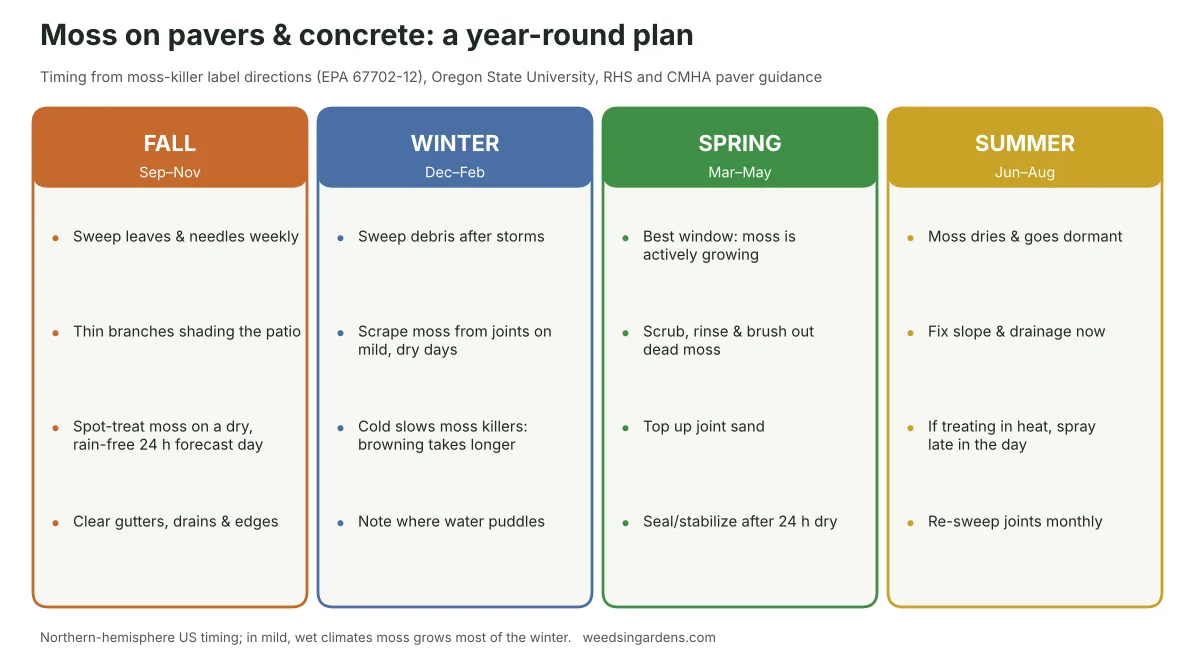
| Season | Main jobs | Why |
|---|---|---|
| Fall (Sep to Nov) | Sweep leaves, thin shading branches, spot-treat on a dry day | Moss is actively growing; label lists spring and fall for best results |
| Winter (Dec to Feb) | Sweep after storms; scrape joints on mild days | Cold delays moss-killer browning; good time to see where water pools |
| Spring (Mar to May) | Main clean-up: scrub, remove dead moss, top up sand, seal after 24 h dry | Second best treatment window; dry weather for sealing |
| Summer (Jun to Aug) | Fix slope and drainage; treat late in the day if you must | Label advises late-day application in warm weather |
Mistakes that make moss come back faster
- Blasting the joints with a narrow pressure-washer tip. You remove the moss and the sand in one go, leaving deep, damp gaps that recolonise quickly. Use a wide fan at a low angle and re-sand afterwards (CMHA).
- Spraying and walking away. Dead moss left in place is next year’s growing bed. Brush it out.
- Using lawn moss granules near the patio. Iron sulfate stains concrete. Sweep spills off before they get wet.
- Treating before rain. The product washes into storm drains, and you’ll need to repeat the job.
- Ignoring the downspout. A gutter that empties onto the patio keeps one corner permanently wet. Extend or redirect it.
- Mixing cleaners. Never combine bleach with other products, including acids or ammonia-based cleaners.
- Expecting a once-and-done fix. Even the RHS notes most patio products are non-persistent, so growth returns if conditions stay the same.
If you also deal with weeds in the same cracks, the heat-based options in our boiling water for weeds guide are worth a look for small areas, though they’re slower on dense moss mats than a brush.
A note from the agronomist’s side
Think of moss on pavers as a moisture meter you didn’t ask for. Where it’s thick, the surface stays wet longest. That’s useful information, and it’s why I’d always look at the pattern before reaching for a sprayer. A green band along one edge points to run-off or a blocked channel. A green patch in one corner points to shade or a downspout. Joints that are green everywhere usually mean the joint sand has dropped and filled with organic dirt.
The research supports this site-first view. The Manso study found environmental conditions outweighed the material itself during early colonisation of concrete. Extension advice from Oregon State and the RHS says the same thing in practical language: treatments are temporary, and growth returns if the conditions remain.
On products, my rule of thumb is to match the chemistry to the risk. Potassium-salt soaps are the right tool on paving because they act fast, don’t stain, and break down. Bleach has a place on a small, isolated slab where no plants can be splashed. Metal-based products solve a roof problem, not a patio problem, and they bring staining, corrosion and water-quality baggage with them. Whichever you use, read the label first; it’s the legal instruction for that product and it changes between brands.
Finally, don’t chase perfection. The RHS points out that these growths support a surprising amount of small wildlife. A mossy, little-used corner or a stone wall can stay green. Clear the routes people actually walk on and let the rest be.
FAQ
What kills moss on pavers permanently?
Nothing applied once is permanent. A potassium-salt moss killer or diluted bleach kills existing moss, but Oregon State notes these products wash off with rain and don’t prevent regrowth. Lasting control comes from removing dead moss, refilling joints with sand, sealing, and reducing shade and standing water.
How do you get rid of moss on pavers naturally?
Scrape the joints with a paver knife, scrub with a stiff broom, and brush out the debris. Then change the conditions: prune overhanging branches, fix puddles and keep leaves swept off. The RHS says these non-chemical methods are effective, so moss killers are optional.
Can I use vinegar to kill moss on pavers?
It isn’t recommended. Vinegar isn’t a registered moss killer and there’s no tested rate for paving. It’s also an acid, and paver-cleaning guidance warns that strong acid cleaners can change paver colour. A labeled potassium-salt moss soap is a safer choice.
Will bleach kill moss on concrete?
Yes. Oregon State’s bryophyte guidance describes a 1:1 bleach and water mix that kills moss on hard surfaces. Rinse nearby plants quickly, because bleach at that strength is toxic to plants if left on more than ten minutes, and never mix it with other cleaners.
Does pressure washing remove moss from pavers?
It removes moss quickly, but it can also wash out joint sand and the moss returns if the area stays damp. Use a wide spray at a low angle, then refill the joints with sand. The RHS notes it uses a lot of water for a temporary result.
Is moss on pavers bad?
It doesn’t damage the pavers themselves, according to the RHS, but it makes paths and steps slippery when wet. Remove it from walkways and patios people use; it can stay on walls or unused corners.
When is the best time to remove moss from a patio?
Spring and fall, when moss is actively growing, give the best results from moss killers, according to product labels. Choose a dry day with no rain forecast for 24 hours. Scraping and sweeping can be done any time the surface is dry.
Sources
- Royal Horticultural Society. Algae, lichens, liverworts and mosses on hard surfaces.
- Miller, W., Mann, J.J. and Buhl, K. Moss on Roofs & Walkways. Solve Pest Problems, Oregon State University Extension Service (updated May 2026).
- Pokorny, K. (source: J. Pscheidt). How to control roof moss and prevent long-term damage. Oregon State University Extension Service (2023, reviewed 2025).
- Oregon State University, Department of Botany and Plant Pathology. Chemical Moss Control for Roofs, Decks, and Sidewalks.
- U.S. EPA. Accepted label, H02 Moss Killer Concentrate (potassium salts of fatty acids 22.11%), EPA Reg. No. 67702-12 (May 2025).
- Jonathan Green. Lawn Moss Control product label (ferrous sulfate monohydrate 25.8%), EPA Reg. No. 9240-8-50931.
- Concrete Masonry & Hardscapes Association. Tech Note PAV-TEC-005-22: Cleaning, Sealing and Joint Stabilization of Interlocking Concrete Pavement (2022).
- Manso, S., Calvo-Torras, M.A., De Belie, N., Segura, I. and Aguado, A. (2015). Evaluation of natural colonisation of cementitious materials: effect of bioreceptivity and environmental conditions. Science of the Total Environment 512–513: 444–453.
More guides in this section: Weeds in Specific Places.