
Short answer: in the bindweed vs morning glory question, the root is the real difference. Field bindweed is a perennial with roots that can reach 20 feet down, small arrowhead-shaped leaves and white-to-pink flowers about 1 inch across. Annual morning glories grow from seed each year, have larger heart-shaped or three-lobed leaves and bigger flowers, often blue or purple. Pulling works on morning glory; field bindweed needs a patient, multi-year plan.
The two vines belong to the same plant family (Convolvulaceae) and both twine, climb fences and smother shrubs, which is why they are mixed up so often. The sections below show how to tell them apart in under a minute, why field bindweed keeps coming back, and which control methods actually work for each one.
Table of Contents
Bindweed vs morning glory at a glance
Three plants cause most of the confusion in gardens: field bindweed (Convolvulus arvensis), hedge bindweed (Calystegia sepium) and the weedy annual morning glories (Ipomoea species such as tall and ivyleaf morning glory). The table sums up the features that separate them, drawn from UC IPM Pest Notes 7462, Cornell weed science and Penn State Extension.
| Feature | Field bindweed | Hedge bindweed | Annual morning glory |
|---|---|---|---|
| Life cycle | Perennial | Perennial | Summer annual (from seed) |
| Roots | Deep vertical roots, 20 ft or more; lateral roots and rhizomes | Shallow rhizomes, mostly in the top 2 ft | Ordinary branched root, no creeping roots |
| Leaf shape | Arrowhead, rounded tip, 1/2–2 in long | Triangular, sharp tip, squared lobes at the base, up to 5 in | Heart-shaped or deeply three-lobed, usually 2 in or more |
| Flower | White to pink, about 1–1 1/2 in wide | White (sometimes pink), mostly over 2 in | Often purple, blue, pink or white, usually 2 in or wider |
| Bracts | Two tiny bracts about 1 in below the flower | Two large leafy bracts hiding the flower base | No bindweed-type bracts |
| Comes back from | Roots, root pieces and seed | Rhizome pieces and seed | Seed only |
How to identify field bindweed
Field bindweed is the one that matters most, because it is the hardest to get rid of. The stems are thin, up to about 6 feet long, and either sprawl flat across the soil or twine up anything nearby. The leaves are alternate and shaped like an arrowhead with a blunt, rounded tip. UC IPM gives the leaf length as 1/2 to 2 inches, depending on growing conditions.
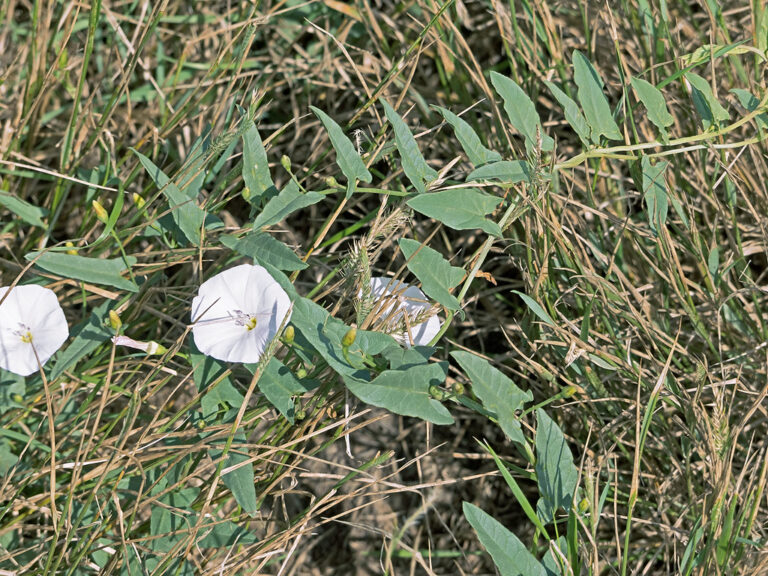
The flowers are trumpet-shaped, white to pink, and 1 to 1 1/2 inches wide. Look on the flower stalk: about 1 inch below the flower there are two tiny, narrow bracts. That detail is described by Cornell’s bindweed identification guide and is one of the fastest checks in the field.
Seedlings are easy to miss. Their seed leaves (cotyledons) are nearly square with a shallow notch at the tip, and the first true leaves already show the arrowhead shape. Each capsule holds one to four dark, wedge-shaped seeds.
Hedge bindweed: the big-flowered lookalike
Hedge bindweed has many local names, “wild morning glory” among them. It is also a perennial and also a bindweed, but it looks halfway between the two groups. The leaves are larger, up to 5 inches, triangular with a sharp point and squared-off lobes at the base. The white or pale pink flowers are 1 1/2 to 3 inches long.
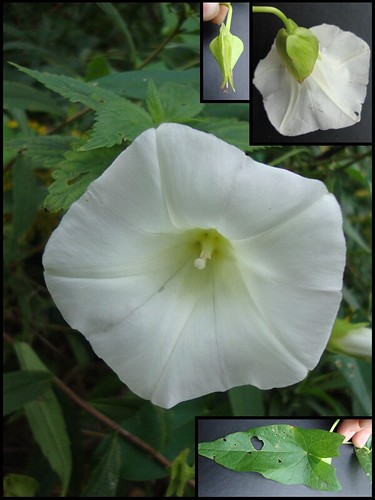
The giveaway is at the base of the flower. Washington State University’s HortSense points to the two large, leaf-like bracts that enclose the base of each flower. Field bindweed never has these. Hedge bindweed spreads by rhizomes that stay mostly in the top 2 feet of soil, so it is easier to dig out than field bindweed, but every rhizome piece left behind can sprout.
How to identify annual morning glory
The weedy morning glories in gardens and field edges are summer annuals in the genus Ipomoea. The three common ones in North America are tall morning glory (I. purpurea), ivyleaf morning glory (I. hederacea) and pitted morning glory (I. lacunosa). Tall morning glory is also the old-fashioned ornamental that reseeds itself from one year to the next.
Tall morning glory
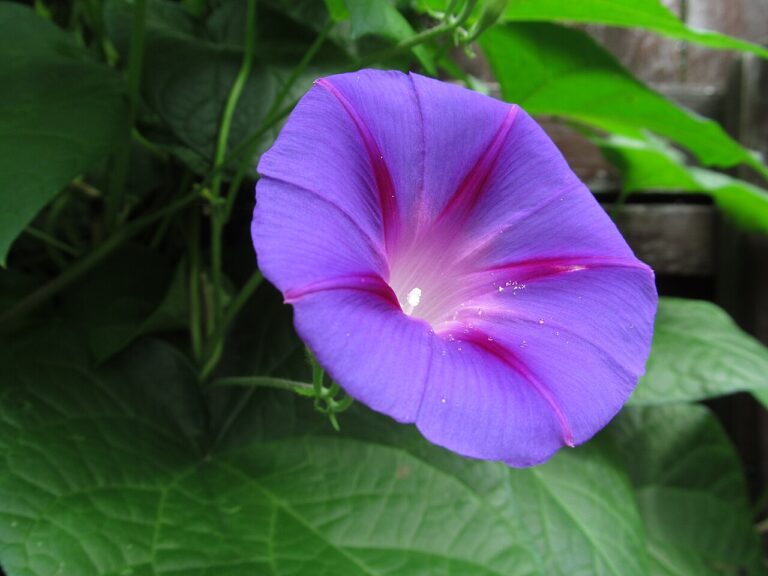
Tall morning glory has broad, heart-shaped leaves with a pointed tip and a rounded base, and the flowers are funnel-shaped in shades of purple, pink or white. Oregon State University Extension puts morning glory flowers at 2 to 6 inches, against about 1 inch for bindweed, and notes that their seeds “can survive in the soil for several decades”.
Ivyleaf morning glory
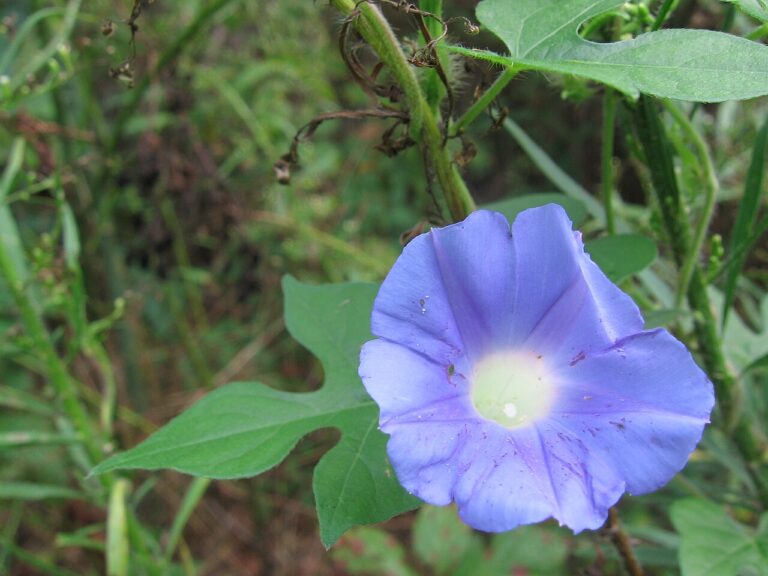
Ivyleaf morning glory has deeply three-lobed leaves covered in upright hairs, and hairy stems. Its flowers are funnel-shaped like those of tall morning glory. Seedlings of all three species have large, deeply notched, butterfly-shaped cotyledons, according to SARE’s Manage Weeds on Your Farm. Those look nothing like the small square seed leaves of field bindweed.
If the vine has a large, deeply lobed leaf shaped like a tiger’s foot and grows in a warm climate, it may be a tropical relative. See our guide to tiger foot morning glory for that species.
7 ways to tell bindweed and morning glory apart
Use these checks in order; the first three settle most cases.
- Dig down 6 inches. Field bindweed has roots running deeper than you can dig, often with side roots that send up new shoots. Morning glory has an ordinary branched root that comes up with the plant.
- Measure the flower. Around 1 inch wide and white or pink points to field bindweed. A flower of 2 inches or more, especially in blue or purple, is almost always morning glory.
- Look behind the flower. Two large bracts hiding the flower base mean hedge bindweed. Two tiny bracts well down the stalk mean field bindweed.
- Check the leaf shape. Small arrowhead with a blunt tip: field bindweed. Triangle with square lobes: hedge bindweed. Broad heart or three lobes: morning glory.
- Feel the stem. Hairy stems and leaves suggest ivyleaf or tall morning glory. Field bindweed ranges from hairless to slightly hairy, so this check only helps in one direction.
- Look at the seedlings in spring. Butterfly-shaped seed leaves belong to morning glory; small square seed leaves with a notch belong to field bindweed.
- Watch where it returns. Morning glory returns only where seed fell. Field bindweed comes back in the same spot every year, and a patch widens outward from its roots.
Why field bindweed is so hard to kill
Field bindweed survives almost anything a gardener throws at the top growth, because most of the plant is underground. A review in Weed Technology by Sosnoskie, Hanson and Steckel (2020) reports vertical roots reaching 6 to 9 meters, with 50 to 70% of the underground biomass in the top 60 cm of soil.
- Root reserves. UC IPM puts the root and rhizome mass at 2 1/2 to 5 tons per acre in an established stand, and a patch can spread more than 10 feet across in one season.
- Root pieces. Fragments as short as 2 inches can form new plants (UC IPM), which is why rototilling a patch usually multiplies it.
- A short window. Seedlings are easy to kill for only 3 to 4 weeks after they germinate. After that, they form perennial buds on the roots.
- Long-lived seed. One plant can produce about 550 seeds, and seed 60 years old has been found viable.
The UC Agriculture and Natural Resources weed science blog adds two useful numbers: bindweed seed germinates anywhere from 41°F to 104°F, and most seedlings come up from the top 2 inches of soil. That is why a layer of mulch helps against new seedlings, even though it will not stop established roots.
How to get rid of field bindweed
No single treatment kills an established field bindweed patch. What works is starving the roots, again and again, until their reserves run out. eOrganic (Oregon State University) puts that at 3 to 5 years of every-other-week cultivation in farm fields.
1. Cut or pull every 2–3 weeks, without a break
Remove every shoot at or just below the soil line every 2 to 3 weeks through the growing season. Each new shoot draws on the root reserves, and removing it before it can feed the roots again slowly runs them down. UC IPM and the UC weed science blog both give 2 to 3 weeks as the working interval. Penn State Extension is blunt about it: the effort has to be consistent, “without a break, and usually for more than one season”. Do not rototill the patch.
2. Smother it in beds and paths
In shrub beds and paths, landscape fabric covered with bark or rock can keep field bindweed from emerging. UC IPM warns it may take more than 3 years of total light exclusion before the roots die, and shoots will find every gap and planting hole, so overlap seams and check the edges. Our guide to stopping weeds growing through mulch covers how to lay it so it lasts.
3. Use a systemic herbicide at the right time
Contact products such as vinegar only burn the leaves (see does vinegar kill weeds?). Systemic products that move into the roots are needed, and timing matters more than the product:
- In lawns: UC IPM reports that products containing 2,4-D and/or dicamba control field bindweed without injuring the turf, but more than one application is needed during the summer. The University of Illinois also lists carfentrazone, quinclorac and triclopyr for turf.
- In beds and around shrubs: a 2 percent glyphosate solution is effective when bindweed is actively growing with no moisture stress (UC IPM). Apply it as a spot treatment only; it kills any plant it touches. Painting or dabbing it onto leaves, or training vines up a stake away from garden plants before spraying, protects nearby plants.
- Timing: apply when plants are flowering in late spring and early summer, or in early fall, when sugars are moving down into the roots. Spring and fall treatments are often both needed.
Read and follow the label for your site. The products registered for lawns, vegetable gardens and ornamental beds differ, and registration varies by country and state.
4. Consider the bindweed gall mite (dry western areas)
The bindweed gall mite (Aceria malherbae) is a microscopic biocontrol agent that forms galls on the new growth, stunts the stems and reduces flowering. The Colorado Department of Agriculture sells releases through its Request-a-Bug program for $35 per release.
The department reports that bindweed under drought stress can be controlled in the first year, but it often takes two or three years for plants to die. Demand is high: Colorado says orders placed after May 1, 2026 will likely be filled in 2027. Outside Colorado, ask your state or county weed program whether the mite is released in your area.
5. Bin the roots, don’t compost them
Root pieces as short as 2 inches can regrow, so bag bindweed roots and seed-bearing vines or dry them out completely before disposal rather than adding them to a home compost pile. Our guide on disposing of invasive plants safely explains the options.
Control options compared
| Method | Field bindweed | Annual morning glory |
|---|---|---|
| Hand pulling | Weakens it only if repeated every 2–3 weeks for seasons | Works well; pull before flowering |
| Hoeing seedlings | Works only in the first 3–4 weeks | Works well when seedlings are small |
| Rototilling | Spreads root pieces; avoid | Buries seed that may sprout for years |
| Straw or wood-chip mulch | Stops seedlings, not established roots | Seedlings can push through 6 in of straw |
| Landscape fabric + mulch | Can work, but may take 3+ years | Vines grow through planting holes |
| Vinegar / contact products | Tops die, roots regrow | Can burn down small seedlings |
| Systemic herbicide (label use) | Most effective when flowering or in fall; repeat | Rarely needed in gardens |
| Bindweed gall mite | Useful in dry areas over 2–3 years | Not applicable |
How to control annual morning glory
Morning glory is far easier, because it has no perennial roots. The goal is simply to stop seed. SARE reports that the weedy species flower 4 to 8 weeks after emerging and ripen seed about 4 weeks later. A single plant usually makes around 300 seeds, but can make more than 15,000 in good conditions.
The hard seed coat is what keeps the problem going. Ivyleaf morning glory seed has survived up to 17 years buried, and 31% of pitted morning glory seed was still alive after 39 years deep in the soil. Seedlings emerge best from 1 to 2 inches deep but can come up from 6 inches.
- Hoe or pull seedlings while they are small, before they start to twine into other plants.
- Cut vines off fences and shrubs before the first flowers turn into seed pods.
- If you grow ornamental morning glory, remove spent flowers before the pods dry, or expect seedlings every spring.
- Do not rely on straw or plastic mulch alone; seedlings push through thick straw and vines come up through planting holes.
Keep checking for a few years after the last plant sets seed, as buried seed keeps sprouting. The same “stale seedbed” idea used for chickweed in vegetable beds works for morning glory too.
Where this applies
The timings above are written for temperate climates in the Northern Hemisphere, where bindweed grows from spring to the first frost. In the Southern Hemisphere, shift the months by six. In warm climates without frost the growing season is longer, so cutting and spot treatments continue for more of the year. Herbicide products and their registered uses differ between countries and states, so check your local label and extension service before using any product named here.
A note from the agronomist’s side
The most common mistake I see with field bindweed is treating it once and calling it done. A single spray in midsummer, on dusty, drought-stressed leaves, makes the vines yellow for a few weeks and the patch looks beaten. Then it comes back from roots the spray never reached.
On farms I have worked with, the patches that were finally cleared were the ones where someone walked the same ground every two weeks for three seasons, cutting every shoot and spot-treating only when the plants were growing well. Bindweed rewards patience more than product choice. Morning glory is the opposite: a few afternoons of pulling before seed set, repeated for a couple of years, usually ends it.
FAQ
Is bindweed a type of morning glory?
They are in the same family, Convolvulaceae, which is why hedge bindweed is sometimes called “wild morning glory”. But they are different genera: bindweeds are Convolvulus and Calystegia, while the annual morning glories are Ipomoea.
Will morning glory come back every year?
Not from its roots. It dies at frost but comes back from seed dropped the previous year, and that seed can last in the soil for many years.
What other lawn weeds have white trumpet flowers?
Field bindweed is the most common one in lawns. For other white-flowered lawn weeds, see our guide to weeds with white flowers, and browse all garden and bed weeds.
Sources
- Wright, S.D., Elmore, C.L. and Cudney, D.W. Pest Notes: Field Bindweed, UC ANR Publication 7462, University of California Statewide IPM Program.
- Cornell University College of Agriculture and Life Sciences. Bindweed identification.
- Marquesen, S. The noxious, persistent, invasive and perennial bindweeds, Penn State Extension, 2025.
- Washington State University HortSense. Weeds: Hedge bindweed.
- Wiesbrook, M. Bindweed: the vines that bind (to turf and ornamentals), University of Illinois Home, Yard and Garden Pest Newsletter, 2018.
- Mohler, C.L., Teasdale, J.R. and DiTommaso, A. Morningglories, in Manage Weeds on Your Farm, SARE, 2021.
- Edmunds, B. Growing annual morning glory, Oregon State University Extension, EM 9880, 2023.
- Sosnoskie, L.M., Hanson, B.D. and Steckel, L.E. (2020). Field bindweed (Convolvulus arvensis): “all tied up”. Weed Technology 34(6): 916–921.
- Sosnoskie, L.M. The biology of field bindweed, UC ANR blog, 2018.
- Green, J. Field bindweed: why it’s so hard to manage, eOrganic, 2021.
- Colorado Department of Agriculture. Field bindweed biocontrol.