
It’s a still, clear morning in late November. The lawn is silver-white, the trash cans need to go to the curb, and the dog is already tugging toward the grass. You step off the path and hear that faint crunch underfoot. Then you wonder: is walking on frozen grass actually doing any harm?
Short answer: Walking on frozen grass while frost or ice crystals coat the blades can crush and puncture leaf cells, and the footprints often turn brown within 48–72 hours. The crowns and roots usually survive, so a few stray prints on a healthy lawn grow out once growth resumes. The real damage comes from walking the same path every day, and from walking when the surface has thawed over still-frozen soil, which can tear roots and compact the ground.
This guide explains what happens inside a frozen grass blade, which winter conditions are risky and which are mostly harmless, and how cool-season and warm-season lawns differ. You’ll also get a simple frost-morning routine and a spring repair plan, so you can tell exactly when to stay off the lawn and how to fix any tracks you’ve already left.
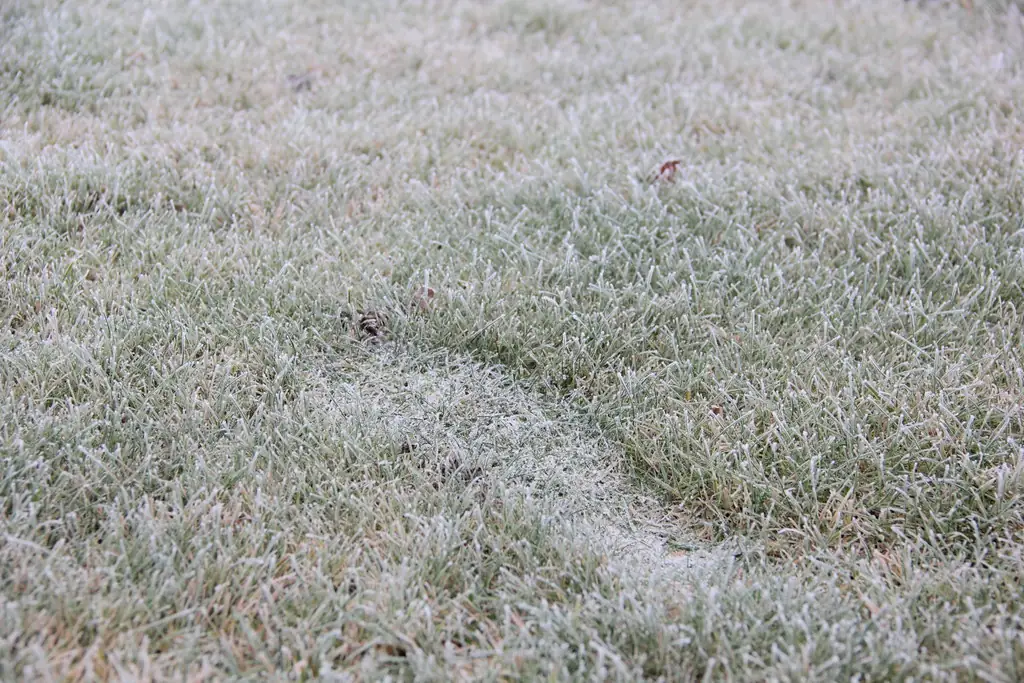
What Happens to Grass When You Walk on It While It’s Frozen
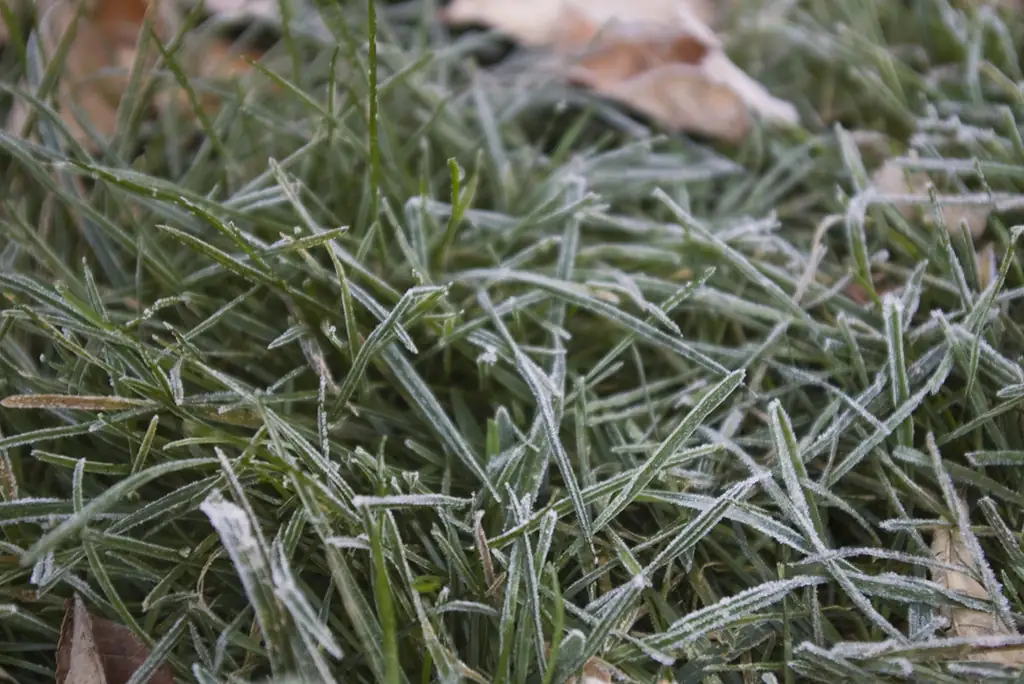
Frost is simply frozen dew. On a cold, humid night, the leaf surface cools below freezing and water vapour forms ice crystals on the blades. Kansas State University turf specialist Jack Fry notes that the leaves of cool-season grasses tolerate frost on the leaf just fine (K-State, 2024). Left alone, a frosty lawn thaws out and carries on.
The trouble starts when weight is added. K-State’s Jared Hoyle describes the ice crystals as acting “like knives”: pressure from a foot or a tyre drives them into the leaf and pokes holes in the cells (K-State, 2015). A frozen leaf is also stiff and brittle rather than flexible. A 1996 GCSAA bulletin compared it to cracking an egg: once the cell membranes break, the plant can’t put them back together.
Why the damage shows up days later
You won’t see anything at first. As the frost melts, the lawn looks normal. Then, over the next two to three days, the crushed leaf tissue dies, and a trail of brown or grey-tan footprints appears where you walked. The GCSAA bulletin puts that delay at 48 to 72 hours, which is why many people never link the brown prints to that one frosty morning.
Why your grass usually survives
Here’s the reassuring part. A Virginia Tech extension article by John Shoulders noted that traffic on frosted turf kills the grass blades in the footprints but usually does little or no damage to the crown or roots (Shoulders, 1977). The crown is the growing point at the base of the plant. As long as it’s alive, the plant can push out new leaves once the weather warms.
That’s very different from true freezing injury inside the crown. Fry explains that ice forming inside crown cells (intracellular freezing, or crown hydration injury) kills the plant outright. It’s mostly a late-winter problem in low, wet spots, and it’s driven by weather, not by your feet.
Why frost appears even when the forecast says 36°F
Many homeowners are surprised to find a frosted lawn after a forecast low in the upper 30s. The National Weather Service in La Crosse, Wisconsin, explains that on clear, calm nights the air at the grass surface can be up to 10°F colder than at the height where official temperatures are measured. An official 36°F can mean 30°F or colder at the blades (NWS La Crosse). NWS Louisville adds that the difference between 0.5 m and 2 m above ground is often 3–5°F at night (NWS Louisville).
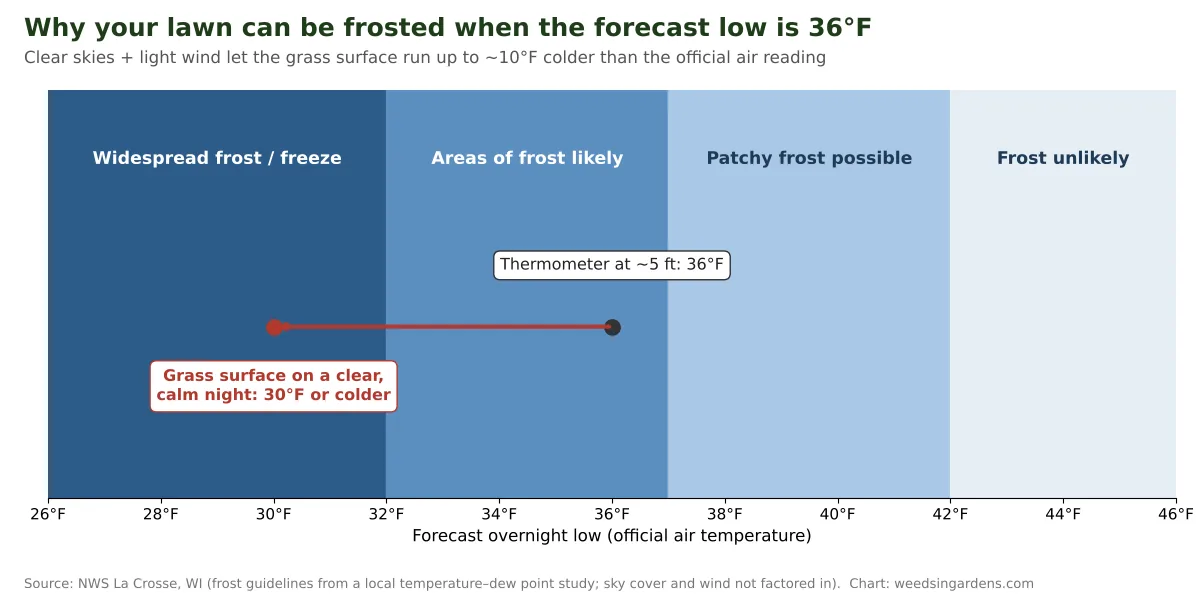
So don’t judge the lawn by the thermometer on your porch. Look at the grass itself. If the blades look white, sparkly or crunchy, treat them as frozen.
Is Walking on Frozen Grass Always Harmful? Frost vs Frozen vs Thawing Soil
“Frozen grass” covers several different situations, and they’re not equally risky. Extension turf specialists separate frost on the leaves, soil that is freezing, soil that is frozen solid, and soil that is thawing on top but still frozen below. Knowing which one you’re looking at tells you whether to stay off or go ahead.
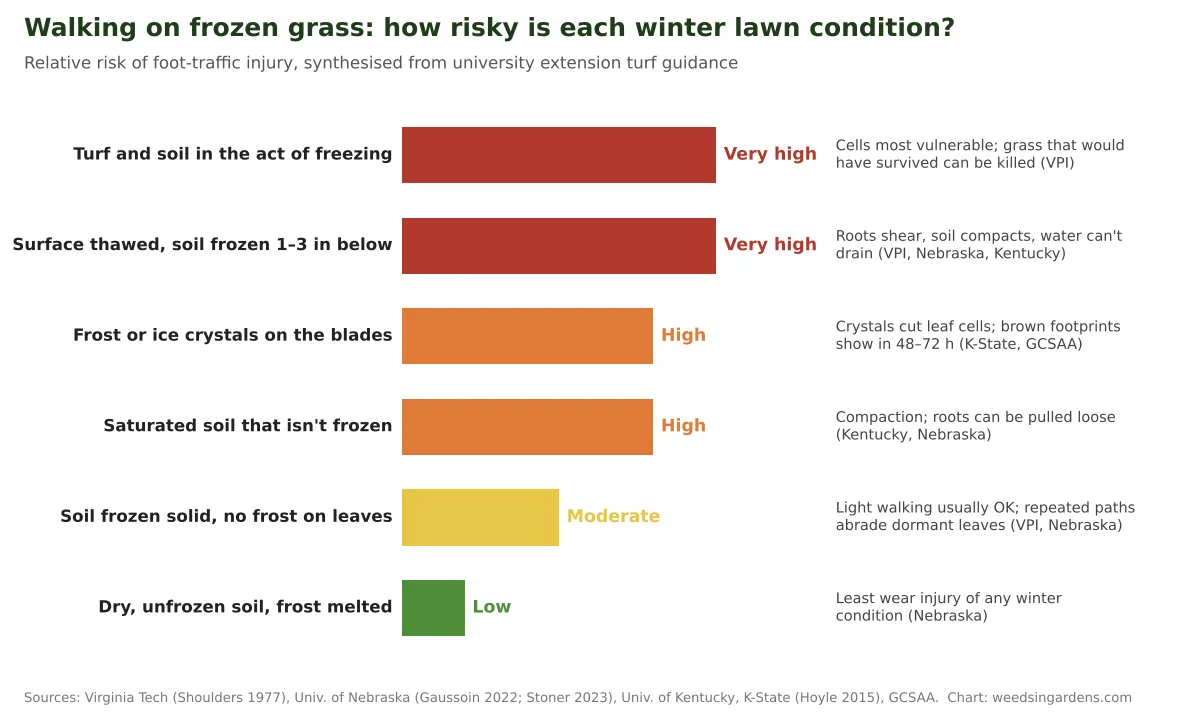
| Lawn condition | What’s happening | Risk from foot traffic | What to do |
|---|---|---|---|
| Frost on the blades | Ice crystals coat brittle leaves | High for leaves; crowns usually OK | Wait until the frost has melted |
| Soil and turf in the act of freezing | Cells are freezing; tissue most fragile | Very high | Stay off completely |
| Soil frozen solid, no frost on leaves | Firm surface, dormant leaves | Moderate; light walking usually OK | Walk lightly; vary your route; no vehicles |
| Surface thawed, soil frozen 1–3 in below | Wet, soft top layer over an ice layer | Very high: roots tear, soil compacts | Stay off until it has thawed and firmed up |
| Saturated soil that isn’t frozen | Pores full of water | High: compaction and root damage | Wait for the soil to drain |
| Dry, unfrozen soil, frost gone | Normal winter dormancy | Low | Fine for normal use |
Shoulders’ Virginia Tech article is clear that the most severe damage happens during the freezing and thawing processes, not when the ground is frozen hard. Once the turf has frozen solid and the frost has left the blades, “little damage occurs” from people walking, although heavy traffic can grind the leaves against the frozen surface (Shoulders, 1977).
Roch Gaussoin at the University of Nebraska–Lincoln agrees. Traffic on dry soil that isn’t frozen is the least likely to cause wear injury. Frozen soil raises the chance of wear but causes little compaction. The most problematic condition is a thawing, wet surface with frozen soil underneath, because both wear and compaction can happen (UNL Turf, 2022).
The footprint test for thawing lawns
Shoulders offered a simple rule of thumb that still works: if your foot sinks into the soft upper layer, or you leave footprints, the lawn needs more time to thaw and dry. Wait until the surface is firm enough to carry your weight without leaving prints. In his article, the danger zone lasted until the soil had thawed to a depth of about 2 to 3 inches.
How to Identify Frost and Winter Traffic Damage (and Rule Out Look-Alikes)
Brown patches in a winter or early-spring lawn have several possible causes. Damage from walking on frozen grass has a few tell-tale features that set it apart.
- Shape: distinct foot-sized prints or a narrow, worn strip that follows a route (door to driveway, gate to shed, the dog’s favourite loop).
- Timing: prints appear 2–3 days after a frosty morning, or the strip slowly thins over winter.
- Texture: leaves are brown and dry but rooted; tug gently and the plant stays put because the crown and roots are intact.
- No fungal growth or runways: no grey or pink matting and no surface tunnels (see the table below).
- Spring check: UNL Extension notes that footprints often show up as brown tracks when the rest of the lawn starts to green in spring.
| Symptom you see | Most likely cause | Key clue | Learn more |
|---|---|---|---|
| Brown footprints in a line | Traffic on frost | Matches where someone walked 2–3 days earlier | This guide |
| Thin, worn strip along a route | Repeated winter traffic and compaction | Follows a daily path; soil feels hard | Fixing compacted soil |
| Matted, crusty circles with grey or pink edges after snowmelt | Snow mold | Worst where snow piled up or drifted | Snow mold guide |
| Winding 1–2 in surface trails of chewed grass | Voles | Runways and small holes, often revealed at snowmelt | Vole damage guide |
| Dead strip along a driveway or sidewalk | De-icing salt | Next to paved edges where melt or salt was thrown | Ice melt safe for grass |
Snow piles are worth a special mention. Illinois Extension notes that areas receiving drifting snow or piles of shovelled snow are more prone to snow mold (Illinois Extension). If you pile snow in the same spot every storm, and also walk that spot to reach the bins, you may be dealing with two problems at once.
Cool-Season vs Warm-Season Lawns: Who’s More at Risk?
Grass type changes how much harm walking on frozen grass does, and how quickly the lawn bounces back.
Cool-season lawns (Kentucky bluegrass, tall fescue, perennial ryegrass, fine fescue)
These grasses stay partly green through early winter and handle frost on their leaves well. Their risk comes from frosty traffic on green leaves in fall and spring, and from thaw-over-frozen-soil traffic in late winter. Because cool-season grasses start growing again early in spring, scattered footprints usually grow out quickly. A heavily worn path may still need reseeding.
Warm-season lawns (bermudagrass, zoysiagrass, St. Augustine, centipede)
Mississippi State’s Wayne Wells explains that after a couple of hard “killing” frosts, the leaves and many above-ground stolons of warm-season lawns die and slowly break down over winter. Walking on them while they’re frosted fractures the ice crystals and can sever the blades, speeding up that breakdown (Mississippi State, 2011).
That brown layer matters. The University of Kentucky notes that dormant bermudagrass needs to keep enough foliage to insulate its stolons. Heavy traffic makes dead leaves and stolons brittle so they break off and blow away. If most of that layer is worn out, the best you can expect is recovery from rhizomes in about the following July (Univ. of Kentucky). Kentucky also found that bermuda kept shorter than about 1.25 inches going into fall wears out much faster, and that traffic on saturated soil can dislodge part of the root system and lead to winterkill.
| Cool-season lawn | Warm-season lawn | |
|---|---|---|
| Frost on leaves alone | Tolerated well | Triggers dormancy after the first hard frost |
| Main winter traffic risk | Frosty green leaves; thaw over frozen soil | Wearing away the insulating dead canopy; wet soil |
| Typical recovery from footprints | Early to mid-spring as growth resumes | Late spring to early summer after green-up |
| Worst case | Bare, compacted path needing reseeding | Winterkill in high-traffic, wet or shaded spots |
How to Protect Your Lawn on Frosty and Frozen Mornings
You don’t need to ban walking on frozen grass for the whole winter. A few habits prevent almost all of the damage.
- Wait for the frost to melt. This is the golf-course rule: tee times are delayed until the frost is off, even on healthy cool-season turf. On a sunny morning it often lifts by mid-morning; shaded areas take longer.
- Choose the afternoon when you can. In Oregon State University trials, morning traffic during freezing conditions reduced turf health more than afternoon traffic (WinterTurf / OSU, 2025).
- Don’t wear a single path. If you must cross the lawn, UNL Extension suggests taking a different route each time instead of the same line to the mailbox or dog area (UNL, 2023).
- Give daily routes a hard surface. For a path you use every day, stepping stones, pavers or a gravel strip are a permanent fix. That’s more practical than asking the household to avoid the lawn.
- Keep vehicles and heavy loads off. In the same OSU research, even one pass of a golf cart during frost visibly damaged a creeping bentgrass fairway. Wheelbarrows, trailers and cars concentrate weight far more than feet.
- Don’t mow, fertilize or spread anything on frost. K-State’s Hoyle specifically warns against mowing, rolling or driving on turf while frost is present (K-State, 2015).
- Use the footprint test after a thaw. If your shoes sink in or leave prints, stay off until the surface is firm.
- Spread out snow piles and choose de-icers carefully. Rotate where you pile snow, and keep salt off the lawn edge. Our guide to ice melt that is safe for grass compares the options.
A healthy lawn going into winter also resists traffic better. Mowing at the right height at the last mow of the season and keeping enough soil moisture through dry spells (see watering grass in winter) both help the canopy cope.
Spring Repair Plan: Fixing Footprints and Worn Paths
If you’ve been walking on frozen grass all winter, don’t worry. Most damage is cosmetic, and the fix depends on how bad it is.
| When | What to check | What to do |
|---|---|---|
| Winter (Dec–Feb) | Frosty mornings; thaw cycles | Stay off frost and thawing soil; reroute daily traffic; avoid piling snow on worn paths |
| Late winter (Feb–Mar) | Soft, soggy areas after thaw | Use the footprint test; keep off until firm and drained |
| Early spring green-up | Brown prints vs worn, bare strips | Lightly rake dead leaves out of prints; wait 2–3 weeks to see if they green up |
| Mid-to-late spring (cool-season) | Strips still thin or bare | Core aerate compacted paths; overseed (UNL suggests mid-to-late April in Nebraska) |
| Late spring to early summer (warm-season) | Bermuda or zoysia slow to fill | Allow green-up; patch with sod or plugs if bare areas remain |
Light damage: scattered footprints
Scattered prints on a healthy lawn usually need nothing more than time. The crowns are alive, so new leaves replace the dead tissue once growth resumes. A gentle raking helps light reach the new shoots.
Heavy damage: a worn, compacted path
A path walked every day for months is different. UNL Extension’s Nicole Stoner notes that repeated winter traffic can kill turf in commonly walked areas and require overseeding in spring. Traffic on wet or frozen soil also squeezes out air pockets, and that compaction takes time, aeration and organic matter to fix (UNL, 2023). Before reseeding, loosen the soil (our guide to preparing compacted soil for grass seed covers this step by step).
Weed control around reseeded paths: herbicide choices by active ingredient
This is where many spring repairs fail. A bare, worn path is an open invitation for crabgrass and other summer annuals, but the usual crabgrass preventers also stop grass seed from germinating.
| Active ingredient | Use on reseeded paths? | Notes |
|---|---|---|
| Prodiamine | No | Common pre-emergent; UNL advises against it where you plan to overseed |
| Pendimethalin | No | Same problem: blocks new grass seedlings as well as weeds |
| Mesotrione | Yes, per label | UNL lists it as an option when overseeding; now sold to homeowners |
| Topramezone | Yes, per label | UNL lists it as the other overseeding-compatible option |
Always follow the label. It sets the rate, the turfgrass species it can be used on, any temperature limits, and the waiting period before or after seeding, and these differ between products. Ask at the garden centre and read the active-ingredient list carefully, as UNL recommends (UNL, 2023). For general timing, see our guide on when to apply pre-emergent.
Prefer a non-chemical route? Seed the path thickly at the right time, keep it evenly moist while seedlings establish, and pull or hoe the first weeds by hand. A dense stand of new grass is the best long-term weed control.
A Note from the Agronomist’s Side
It’s worth being honest about what the research shows, because the internet tends to overstate this. Most “never walk on frosty grass” advice comes from golf putting greens: grass mown at an eighth of an inch, walked by hundreds of feet a day, where every brown print matters. When Oregon State researchers tested the idea directly for the USGA, foot traffic equivalent to 16 golfers on a putting green, applied during eight frost events, produced no visible damage on annual bluegrass. Carts and rollers were another story, and morning traffic was worse than afternoon. The authors concluded that winter traffic does reduce turf health, but that the risk of actually killing turf is likely lower than current guidance suggests (WinterTurf / OSU, 2025).
For a home lawn mown at 2.5–3.5 inches, that’s good news: a single bout of walking on frozen grass is unlikely to cause lasting harm. What does cause problems is repetition and timing. The same path walked every morning stacks injury on a plant that can’t regrow until spring. And walking on a thawing surface over frozen soil damages roots and soil structure, not just leaves. Damage to roots and soil is much slower to fix than damage to leaf tips.
There’s also a weed angle. Thin, compacted strips are where crabgrass, knotweed and annual bluegrass get their foothold, because those weeds tolerate compaction better than lawn grasses. Protecting the canopy in winter is cheap weed prevention for summer. A practical rule of thumb: if the grass is white, wait; if the soil is squishy over hard ground, wait; and if you cross the same spot every day, give it a path instead.
FAQ
Does walking on frozen grass kill it?
Usually not. Walking on frosted grass kills the crushed leaf tissue, which shows as brown footprints after 2–3 days, but the crowns and roots generally survive and regrow when growth resumes. Repeated traffic on the same path, or walking on a thawing surface over frozen soil, can kill turf and may require overseeding in spring.
How long after frost can I walk on my lawn?
Wait until the frost has completely melted from the blades. On a sunny morning that’s often by mid-morning; shaded areas take longer. After a thaw, also check that the surface is firm enough that your shoes don’t sink in or leave footprints.
Can I mow grass with frost on it?
No. Mowers, like feet, drive ice crystals into frozen leaves and crush brittle tissue, so K-State turf specialists advise waiting until the frost is gone before mowing, rolling or driving on the lawn.
Does walking on frozen grass cause soil compaction?
Soil that is frozen solid compacts very little. Compaction mainly happens when the soil is wet or thawing, especially when the surface has thawed but the soil below is still frozen and water can’t drain.
Will brown footprints in my lawn grow back?
Most will. Scattered footprints on a healthy lawn usually fill in once cool-season grasses start growing in spring, or after warm-season grasses green up. Worn, bare paths may need aeration and overseeding.
Is frost bad for grass if nobody walks on it?
Cool-season grasses tolerate frost on their leaves well. Warm-season grasses such as bermuda and zoysia usually go dormant and turn brown after the first hard frost, which is normal and not a sign of death.
Sources
- Fry, J. (2024). Ice, Ice Baby. Kansas State University Turf and Landscape Newsletter.
- Hoyle, J. (2015). FROST… Already?. Kansas State University Turfgrass Research and Extension.
- Stoner, N. (2023). Avoid Traffic on Frozen Turf. University of Nebraska–Lincoln Extension (UNL Water).
- Gaussoin, R. (2022). Winter Traffic and Play on Turfgrass. University of Nebraska–Lincoln Turfgrass Science.
- Kowalewski, A., Schmid, C., McDonald, B. & Starchvick, R. (2025). Effects of equipment traffic on turfgrass during frost conditions. Oregon State University, via WinterTurf (University of Minnesota).
- University of Kentucky Turfgrass Science (2026). Effects of Traffic on Dormant Bermuda.
- Wells, W. (2009). Don’t tread on your frozen lawn; and (2011) Reducing Wear of Winter Dormant Turf. Mississippi State University Extension Turf Tips.
- Shoulders, J. F. (1977). Preventing Injury to Frosted or Frozen Turf. Virginia Polytechnic Institute, Tech Turf Topics (MSU Turfgrass Information Center archive).
- GCSAA (1996). GreenTips: Frost Delays. Golf Course Superintendents Association of America (MSU Turfgrass Information Center archive).
- National Weather Service La Crosse, WI. What Causes Frost?; and NWS Louisville, KY. Why Frost Forms at Temperatures Above Freezing.
- University of Illinois Extension. Preventing Winter Damage to Lawns.