
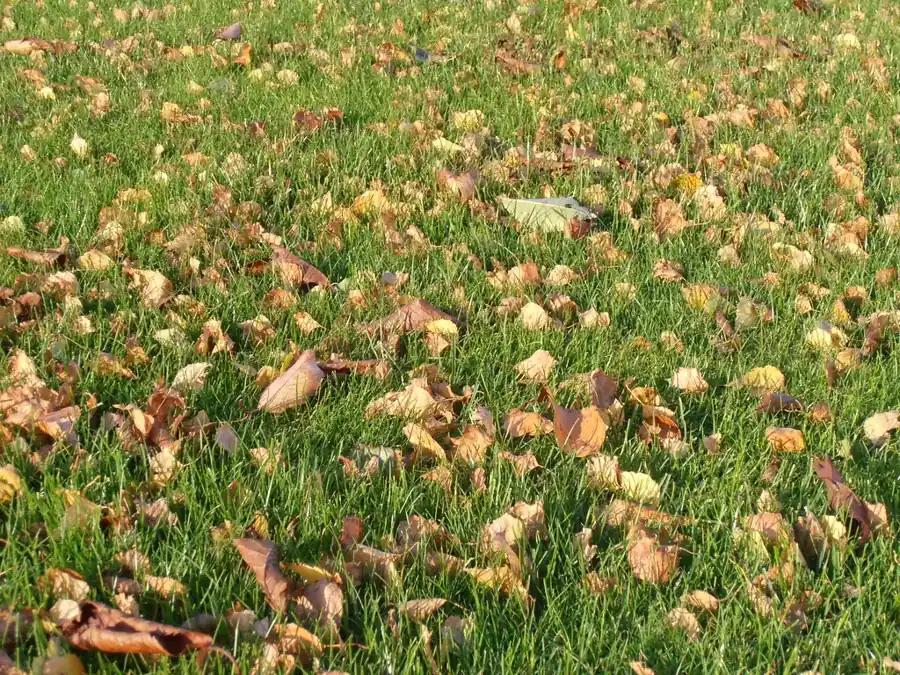
It’s a cold Saturday in late October. The grass barely grew this week, the maple has dropped half its leaves on the lawn, and the mower is sitting in the garage with a quarter tank of gas. You’re wondering whether this should be the last mow of the season. If you do, should it be short to “put the lawn to bed”, or left long to protect it? And should you bag it or let the clippings fall?
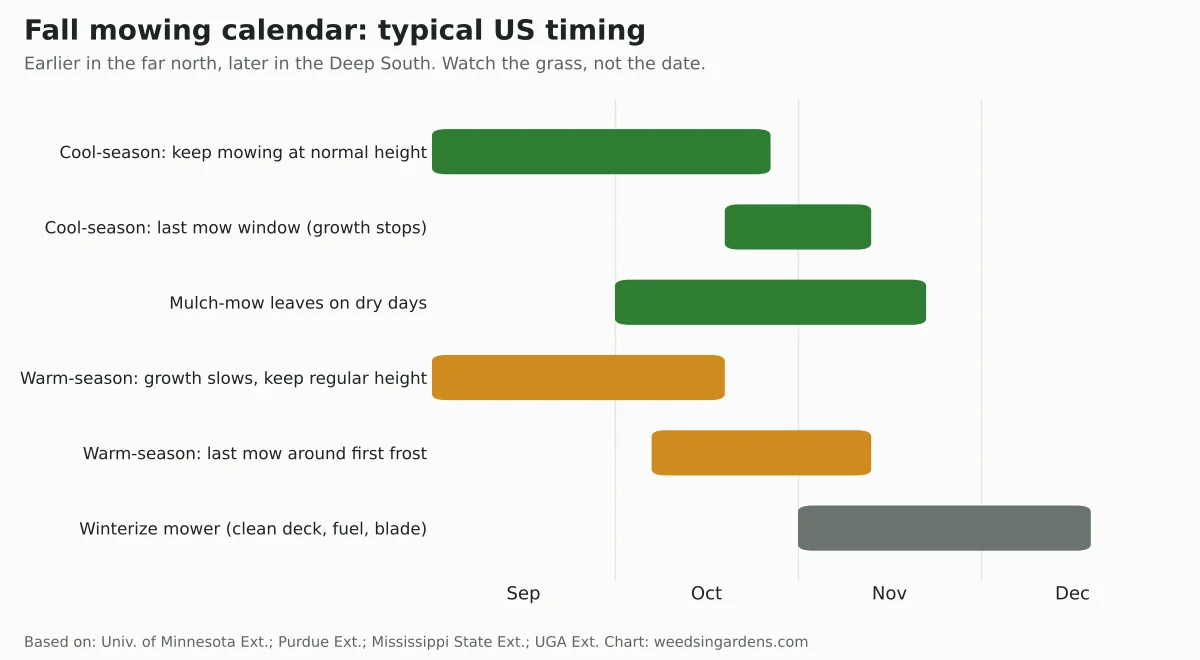
Short answer: Make the last mow of the season when the grass has actually stopped growing, which is usually late October to early November for cool-season lawns and around the first frost for warm-season lawns. Cut at the normal height for your grass type, or at the low end of its range. Never scalp it, and never leave it 5 or 6 inches tall going into winter. Mulch the clippings and any light leaf cover back into the turf, and bag only what the mower can’t shred.
This guide pulls the advice from several university extension services into one plan. By the end you’ll know how to spot the right day, where to set the deck for your grass, what to do with clippings and leaves, how the final cut affects next spring’s weeds, and how to put the mower away so it starts in April.
When Is the Last Mow of the Season?
The calendar is a poor guide here. The grass tells you when the season is over. The University of Minnesota Extension says to keep mowing “until the grass stops growing in the fall, generally around the end of October” (UMN Extension). Purdue’s former turf specialist Zac Reicher puts it at “normally into late October or early November” for Indiana lawns (Purdue Extension, 2022).
Warm-season lawns in the South follow a different signal. Mississippi State University Extension notes that bermudagrass, zoysiagrass and St. Augustinegrass keep growing slowly through fall “until the first frost marks the beginning of dormancy” (MSU Extension). Once the lawn has turned tan and stopped growing, the mower has nothing left to do.
Signs your lawn has stopped growing
- You mowed a week ago and the lawn still looks freshly cut.
- Daytime highs sit in the 40s °F most of the week and nights bring regular frost.
- Warm-season grass has turned straw-colored after the first frost.
- The only thing collecting on the lawn is leaves, not new growth.
Here’s a practical test. Stop on the first week the grass doesn’t need cutting under the one-third rule (more on that below). That’s your season finale. If a warm spell restarts growth in November, it’s fine to mow again. Reicher said it’s OK to mow even in November or December if the lawn is too tall (Purdue, 1996).
Should the Last Mow of the Season Be Short or Long?
This is the question that starts arguments over garden fences. One camp scalps the lawn to 1.5 inches “so it doesn’t mat.” The other leaves it at 4 inches “so it’s insulated.” The research-backed answer sits in between, and it’s less dramatic than either camp.
Why not scalp it
Grass still photosynthesizes in fall, storing carbohydrates in its crowns and roots to survive winter and green up in spring. Reicher warns against setting the mower low to scalp the lawn because the grass needs that leaf area for photosynthesis (Purdue Extension, 2022). He called scalping “really bad for the turf,” even if it might reduce snow mold (Purdue, 1996). A scalped lawn also opens bare soil to winter annual weeds, which we’ll come back to.
Why not leave it long
Tall grass going into winter has its own problems. Grass left at 6 or 7 inches “will flop over and allow the fungus to develop” (snow mold) (Purdue, 1996). UMN Extension adds that grass kept too long over winter invites disease and may encourage voles, which tunnel under matted grass and snow (UMN Extension).
The sweet spot
Keep the final cut inside your grass type’s normal range, and if you lower it at all, lower it to the bottom of that range, not below it. For most Midwest cool-season lawns, that means about 3 inches. Reicher’s advice was simply that “it’s best to leave your turfgrass at three inches through the winter” (Purdue, 1996). Clemson’s chart shows tall fescue’s winter range (2–3 inches) sitting only slightly below its summer range (3–3.5 inches) (Clemson HGIC 1205). That’s a modest step down, not a buzz cut.
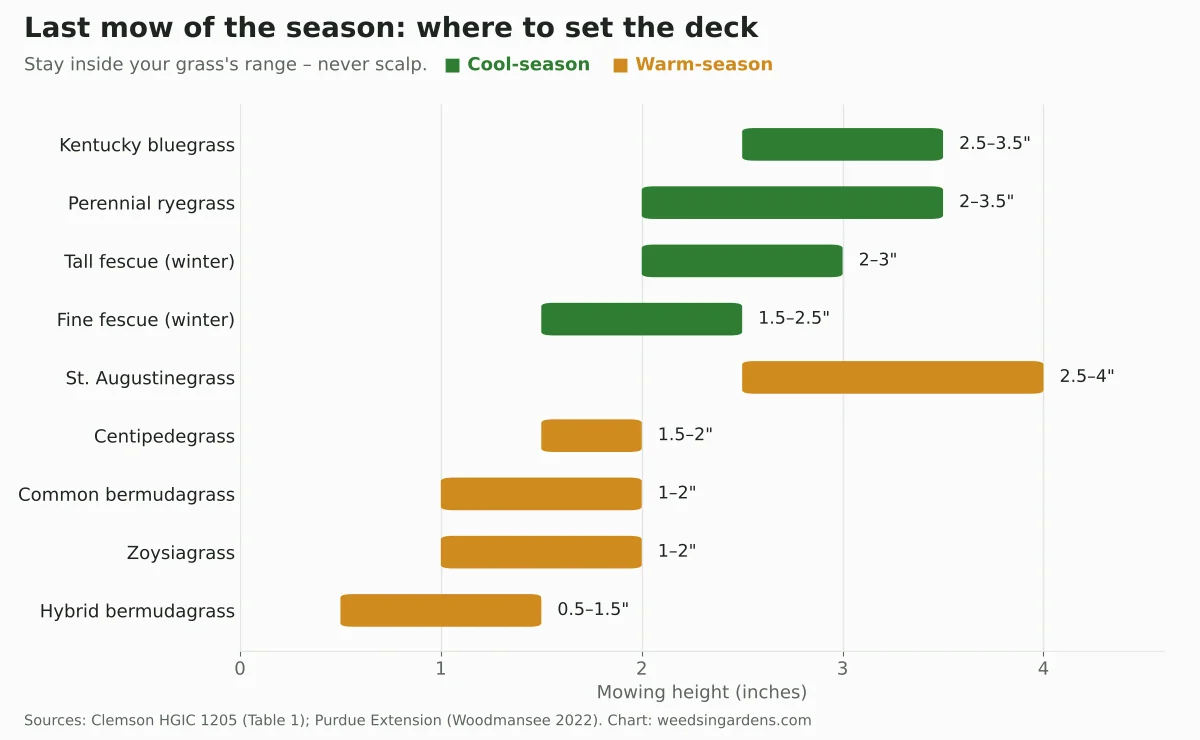
| Grass type | Last-mow height (inches) | Note |
|---|---|---|
| Kentucky bluegrass | 2.5–3.5 | Purdue’s “normal” range; 3 in. is a safe default |
| Perennial ryegrass | 2–3.5 | Same range as bluegrass in Purdue guidance |
| Tall fescue | 2–3 (winter) | Clemson lists 3–3.5 for summer |
| Fine fescue | 1.5–2.5 (winter) | Clemson lists 2.5–3 for summer |
| St. Augustinegrass | 2.5–4 | MSU: raise to 3 in. for winter hardiness |
| Centipedegrass | 1.5–2 | Low-input grass; don’t scalp before dormancy |
| Common bermudagrass | 1–2 | Keep regular height until frost |
| Zoysiagrass | 1–2 | Keep regular height until frost |
| Hybrid bermudagrass | 0.5–1.5 | Usually reel-mown; keep normal height |
Not sure which grass you have? Our guide to the different grass types in a lawn walks through the ID features.
Use the One-Third Rule, Even on the Final Cut
The most common last-mow mistake is lowering the deck two notches in one go. Both UMN and Purdue tell homeowners to remove no more than one-third of the leaf blade at a single mowing (UMN Extension). For a lawn kept at 3 inches, that means mowing when it reaches 4.5 inches and taking off no more than 1.5 inches (Purdue Extension, 2022).
So if you want to finish the season at the low end of your range, get there in steps over the last two or three mows. Clemson gives the same advice in reverse: if grass gets too tall between cuts, raise the mower, then bring it down gradually (Clemson HGIC 1205).
| If your lawn is… | Do this on the last mow |
|---|---|
| At normal height and barely growing | Mow once at normal height or one notch lower. Done. |
| 5–6 in. tall after a wet fall | Cut to about 4 in. now, then to your target a few days later. |
| Already short (under 2.5 in. cool-season) | Skip the mow. Don’t take more off going into winter. |
| Covered with a light leaf scatter | Mulch-mow at normal height; leaves and clippings stay. |
| Buried under a thick leaf layer | Rake or bag the surplus first, then mow (see below). |
| Frosty or frozen in the morning | Wait until the frost melts and the blades are dry. |
Avoid mowing frost-covered or frozen turf, which Purdue specifically warns against (Purdue, 2021). Frozen blades shatter, and you’ll see brown footprints and wheel tracks for weeks.
Bag or Mulch the Last Mow of the Season?
For most lawns, mulch. Grass clippings are a free fertilizer. Clemson puts them at roughly 4% nitrogen, 0.5–1% phosphorus and 2–3% potassium (Clemson HGIC 1205). UMN Extension estimates that returning clippings over a year adds the equivalent of one fertilizer application (UMN Extension). Late-season clippings are short and dry quickly, so they rarely mat.
Leaves are where the bag earns its keep. Purdue’s John Orick explains that a heavy layer of leaf debris left over winter blocks light, reduces photosynthesis, thins the turf and makes the lawn more prone to snow mold (Purdue, 2021). Mowing right up to dormancy mulches late-fallen leaves and may help prevent snow mold.
How much can you mulch? University of Illinois Extension cites Michigan State University research showing a six-inch layer of maple and oak leaves was mulched into established turf with no apparent harm. The decomposing leaves were linked to quicker spring green-up and fewer weed seeds germinating (Illinois Extension, 2022). If leaves are deep, mow a second pass at 90° to the first.
- Mulch when the leaves are dry and you can still see grass between them after one pass.
- Bag or rake when the layer is wet and matted, or when the lawn is still mostly covered after two passes. UMN advises raking up excessive debris after the last mow of the season (UMN Extension).
- Reuse what you bag: shredded leaves make good mulch for beds and vegetable gardens (Illinois Extension, 2022).
We cover the leaf question in depth in leaves on lawn over winter: rake, mulch or leave them. For the clipping trade-offs, see mulching grass clippings: pros and cons.
How Your Final Cut Shapes Next Spring’s Weeds
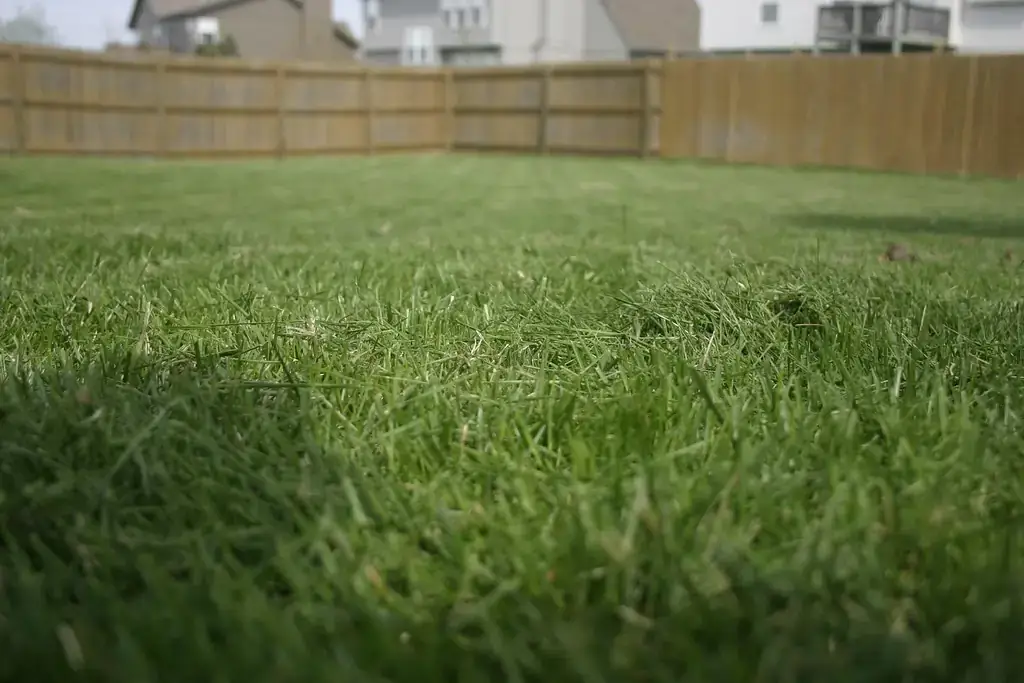
This is the part most last-mow guides skip, and it matters on a weed site. Winter annuals such as henbit, chickweed and annual bluegrass germinate in fall and sit as small rosettes all winter. Then they explode in March. A dense, properly mown lawn shades the soil and leaves them less room. A scalped lawn hands them a seedbed.
Mowing height has a striking effect on weeds. In NC State field trials in tall fescue, crabgrass cover by mid-September was 95% at a 1-inch mowing height, 48% at 2 inches, 13% at 3 inches and 0% at 4 inches (NC State TurfFiles). That’s a summer weed, but the lesson carries over: turf that keeps its leaf area competes better. The extension write-up does not report replication or statistics, so read it as a strong trend rather than a guarantee.
| Mowing height (tall fescue) | Crabgrass cover by mid-Sept |
|---|---|
| 1 inch | 95% |
| 2 inches | 48% |
| 3 inches | 13% |
| 4 inches | 0% |
Timing fall weed control around the last mow
Fall is the best time to spray perennial broadleaf weeds such as dandelion, clover and creeping Charlie, because they move sugars, and herbicide with them, down to the roots. Iowa State’s guidance for fall broadleaf herbicide applications (Iowa State Extension):
- Active ingredients: look for products combining two or three of 2,4-D, MCPP, MCPA, dicamba and triclopyr. No single compound controls every broadleaf weed.
- Mowing: don’t mow for 2–3 days before spraying (the weeds need leaf surface to absorb it) or for 3–4 days after (so it moves to the roots).
- Weather: no rain forecast for 24 hours, wind under 5 mph, and don’t water for 24 hours afterward.
- Temperature: Purdue notes many broadleaf herbicides need about 50°F to work, and they shouldn’t go on dormant turf (Purdue Extension, 2022).
In practice: spray in early to mid fall, wait the 3–4 days, then make your final cuts. Always follow the label for your product, especially the turf species listed. Some products restrict use on St. Augustinegrass and centipedegrass. For more on product choice, read our post-emergent herbicide guide. If you want to know what’s actually alive out there in January, see do weeds die in winter?.
Non-chemical options still count. Hand-pull rosettes of henbit and chickweed while the soil is soft, and leave the mower high enough to keep the canopy closed. On warm-season lawns in the South, UGA suggests applying pre-emergent in September, before night temperatures drop below 60°F (UGA Extension).
Warm-Season Lawns: A Different Finish
If you’re mowing bermudagrass, zoysiagrass, centipedegrass or St. Augustinegrass, the rules shift slightly:
- Keep your regular height until frost. MSU Extension says to continue regular mowing at the recommended heights for bermudagrass, zoysiagrass and carpetgrass (MSU Extension).
- Raise St. Augustinegrass. MSU recommends raising it to 3 inches to promote winter hardiness.
- Don’t push growth late. UGA Extension advises making the last nitrogen application in August, because fertilizing in September can delay dormancy long enough for cold injury (UGA Extension). A late fertilizer flush also means more mowing you don’t need. (Cool-season lawns are different; see when to apply winterizer.)
- Once it’s brown and dormant, you’re done. There’s no growth to cut. Any later pass is just to tidy up leaves or a stray winter weed.
Southern lawn owners who overseed with perennial ryegrass for winter color are the exception. Those lawns keep growing and keep needing mowing through winter.
After the Last Mow: Put the Mower to Bed
The final cut is also the best moment to service the mower, so spring starts with a clean cut instead of a pull-cord fight. A dull blade matters more than most people think. Clemson notes that dull blades tear the grass, give the lawn a brownish cast and weaken it against weeds, disease and insects (Clemson HGIC 1205).
- Fuel: check your manual to see whether gas should be drained or stabilized (UGA Extension, 2023). If you use stabilizer, add it as directed and run the engine so it reaches the carburetor. Purdue’s Orick suggests running the tank empty in fall if possible, since fresh fuel in spring is best (Purdue Extension, 2022).
- Deck: scrape off packed clippings and leaf mush, which hold moisture and rust the deck.
- Blade: sharpen or replace it now, not in April.
- Oil: change it so acidic used oil doesn’t sit in the engine all winter.
- Battery (riding or cordless mowers): disconnect it, clean the terminals and store it somewhere cool and dry (UGA Extension, 2023).
A Note From the Agronomist’s Side
Most of the confusion around the last mow comes from treating it as a special event. Physiologically, it isn’t. The grass doesn’t know it’s the last cut. It only knows how much leaf it has left to feed its crowns through winter. Every piece of good advice above comes from that one idea: keep enough leaf to photosynthesize, but not so much that it lies down wet under snow.
That’s why the extension advice clusters around “normal height, maybe a notch lower.” Scalping trades one risk (snow mold) for several bigger ones: depleted carbohydrate reserves, thinner turf, and open soil for winter annual weeds. Leaving it long simply moves the risk the other way. The middle path is boring, and boring is what you want from turf management.
Two rules of thumb are worth keeping. First, judge by growth, not by date: a mild November can easily earn one more cut. Second, treat leaves as the real variable. A lawn mown at a perfect 3 inches can still come out of winter patchy if it spent February under a wet mat of oak leaves. If you only do one thing in late fall, keep the grass blades in the light.
Finally, if your lawn has had snow mold before, don’t rely on height alone. Address the other factors the extensions name, such as avoiding heavy fall fertilizing and spreading big snow piles (Utah State Extension). Mowing height is one lever among several. If moss is the bigger problem in shady corners, our moss in lawn guide covers the fixes.
FAQ
When should the last mow of the season be?
When the grass stops growing. For cool-season lawns that is usually late October to early November in the Midwest and North; for warm-season lawns it is around the first frost, when the grass goes dormant. If a warm spell restarts growth, mow again.
Should the last mow of the season be short?
Slightly shorter at most. Keep the cut within your grass type’s normal range, ideally at the low end (about 3 inches for most cool-season lawns), and never scalp. Scalping removes leaf area the grass needs, and grass left 6–7 inches tall can flop over and encourage snow mold.
Should you bag the last mow of the season?
Usually no. Mulch clippings and light leaf cover back into the lawn, as they return nutrients. Bag or rake only when leaves are so thick or wet that the grass is still mostly covered after mulching.
How short should I cut grass before winter?
For Kentucky bluegrass, perennial ryegrass and tall fescue, about 2.5–3 inches. For bermudagrass and zoysiagrass, 1–2 inches. For St. Augustinegrass, about 3 inches. Lower in small steps using the one-third rule.
Can I mow my lawn in November or December?
Yes, if it is still growing and getting too tall, as long as the grass isn’t frosty or frozen. Wait until frost melts and the blades are dry.
Is it bad to leave grass long over winter?
Moderately long (around 3 inches) is ideal. Very long grass (6 inches or more) tends to mat under snow, which favors snow mold and gives voles cover.
Should I fertilize after the last mow?
Cool-season lawns can take a late-fall feeding while still green. Avoid fertilizing dormant turf, and on warm-season lawns stop nitrogen in August so dormancy isn’t delayed.
Sources
- University of Minnesota Extension. Mowing practices for healthy lawns.
- Woodmansee, J. E. (2022). Ending lawn activities and looking toward spring. Purdue University Extension, 11 Nov 2022.
- Orick, J. (2021). Mowing and leaf removal. Purdue University Plant & Pest Diagnostic Lab, Picture of the Week, 6 Dec 2021.
- Purdue News Service (1996). Snow mold prevention advice from turfgrass specialist Zac Reicher. Purdue University, 25 Oct 1996.
- Polomski, R. F. & Shaughnessy, D. Mowing lawns (HGIC 1205). Clemson Cooperative Extension Home & Garden Information Center.
- Mississippi State University Extension. Fall lawn guide. Extension for Real Life blog.
- Kolich, H. N. Fall care for warm-season lawns. UGA Cooperative Extension, Forsyth County.
- NC State University TurfFiles (2015). Mowing height impacts weed populations.
- Cleveland, T. (2022). Home, Yard & Garden Pest Newsletter, Issue 12, 8 Oct 2022. University of Illinois Extension.
- Jauron, R. (2013). Control of broadleaf weeds in the lawn. Iowa State University Extension Yard and Garden, 27 Sep 2013.
- Utah State University Extension. Common turf diseases in Utah (IPM).
- Prichard, P. (2023). How to care for and winterize your garden tools. UGA Cooperative Extension, Paulding County, 18 Dec 2023.